What Lisa and Evelyn Watched Last Night #76: Romeo Killer: The Chris Porco Story (dir by Norma Bailey)


Last night, my BFF Evelyn and I watched the Lifetime original movie, Romeo Killer: The Chris Porco Story.

Romeo Killer

Why Were We Watching It?

First off, it was on Lifetime.  Secondly, both me and Evelyn love the true crime genre.  And finally, the film starred the very hot and very Texan Matt Barr.  Seriously, how couldn’t we watch?

There was one other reason that I wanted to see Romeo Killer.  Chris Porco, the subject of the film and a convicted murderer, actually obtained a court order to prevent the film from being shown.  The New York Court of Appeals overturned the order just two days before Romeo Killer was scheduled to premiere.  After all the drama about whether or not I would even be allowed to see it, how could I not watch when I got the chance to do so?

What Was It About?

Chris Porco (Matt Barr) is handsome, charming, and possibly a sociopath.  After his parents (Lochlyn Munro and Lolita Davidovitch) are attacked by an axe-wielding assailant, Porco is the number one suspect.  While the lead detective (Eric McCormack) tries to send Porco to jail, Porco’s mother insists that her son is innocent.  Meanwhile, Porco is attempting to seduce McCormack’s insecure daughter (Sarah Desjardins…)

What Worked?

Romeo Killer is the epitome of a Lifetime true crime film, in that it featured a truly disturbing crime, a charming villain, a driven cop, and a lot of melodrama.  Though the film made an attempt at ambiguity (for instance, we never actually see Chris Porco attacking his parents and the film ends with a quote from his mother in which she says that she still thinks that her son is innocent), it was also pretty obvious that the filmmakers believed Chris Porco to be guilty.  In the end, Romeo Killer made a compelling argument for Porco’s guilt (which is probably why he tried to keep the film from airing).

As portrayed in the movie, Porco comes across as being a pretty obvious, 1-dimensional psychopath but Matt Barr still does a pretty good job playing him.  Barr captures both the empty interior and charming exterior of the character.  (Of course, it should also be noted that Barr is about a thousand times better looking than the real Chris Porco.)  Among the supporting characters, Eric McCormack, Sarah Desjardins, and Lolita Davidovich all give strong performances.

Porco’s father is played by Lochlyn Munro.  Munro is a Canadian actor who has played small roles in a countless number of Lifetime films.  I don’t know much about him beyond the fact that I’m always happy to see him because, seriously, it’s just not a Lifetime film without Lochlyn Munro.  That said, Munro gave a sympathetic performance here.  The scenes where he staggers around the house after being attacked were difficult to watch.

What Did Not Work?

If I was the type to needlessly nitpick, I would point out what the film itself acknowledges with a disclaimer that appears immediately after the end credits.  While the movie is based on a true story and it does follow the broad outline of the actual case, it is also a fictionalization in which certain characters and events were created for dramatic purposes.  As such, some viewers would be justified in wondering which parts of the film are based on reality and which parts were created to tell a better story.

That said, as far as I’m concerned, Romeo Killer was the epitome of a Lifetime true crime film and, as a result, it all worked.

“Oh my God!  Just like Us!” Moments

Evelyn and I both found ourselves relating to the women in this film, all of whom were charmed by Chris Porco.  Because seriously, Matt Barr made for one seriously hot sociopath…

Lessons Learned

Some bad boys really are bad.

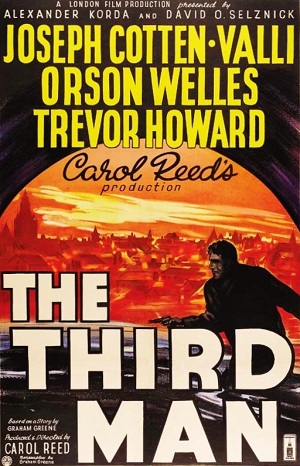
Scenes That I Love: The Cuckoo Clock Speech From The Third Man


ThirdManUSPoster

Some movies are merely good.  Some movies are undeniably great.  And then, a handful movies are so amazingly brilliant that, every time you watch, you’re reminded why you fell in love with cinema in the first place.

The Third Man is one of those brilliant films.

Directed by Carol Reed and scripted by novelist Graham Greene, The Third Man takes place in the years immediately following the end of World War II.  Pulp novelist Holly Martins (Joseph Cotten) comes to Vienna to search for his old friend Harry Lime (Orson Welles).  Upon arriving, Holly is shocked to learn that Harry makes his living selling diluted penicillin on the black market.

In the classic scene below, Harry and Holly have a clandestine meeting in a Ferris wheel and Harry justifies both his actions and the lives that have been lost as a result of them.

While Orson Welles’ performance is (rightfully) celebrated, I’ve always felt that Joseph Cotten’s work was even more important to the film’s success.  While Welles made Harry Lime into a charismatic and compelling villain, it was  Cotten who provided the film with a heart.

Quickie Review: Olympus Has Fallen (dir. by Antoine Fuqua)


OlympusHasFallen

“The most protected building on Earth has fallen.”

Die Hard has become it’s very own subgenre of action films since it was first released in 1988. It was a simple enough story that combined the “one against many” type of story with the “siege tale”. It was a perfect combination that has since been copied, imitated, but truly never duplicated to the highest level of success the original film had upon release. There’s been a few films that added their own unique take on this action film template. There was “Die Hard on a boat” with the underappreciated Under Siege. Then we have Air Force One which was “Die Hard on a plane”. The latest action film to try and put a new spin on the Willias-McTiernan classic is Antoine Fuqua’s latest film, Olympus Has Fallen.

The film pretty much takes what worked with the three films before it that’s been mentioned above and combines them to make a film. We have a lone, highly skilled operative in the form of Secret Service Agent Mike Banning in the role that made Bruce Willis famous and, for a time, resuscitated Steven Seagal’s career. Then we have the Presidential angle but instead of Air Force One it’s the White House this time around. The plot of the film is simple enough that even a person not well-versed in film could follow it. A group of dedicated and highly-trained North Korean terrorists do a surprise attack on the White House as the President of the United States and his South Korean counterpart try to find a way to defuse a situation that’s been growing in the DMZ between the two Koreas. It’s now up to Agent Banning, on his own, to try and stop whatever plans the terrorists have brewing with the President as hostage while also dealing with an inept group of higher-ups trying to deal with it far from the action.

Olympus Has Fallen doesn’t break new ground with the way it’s story unfolds and it’s characters develop. The film was pretty much beat-for-beat and scene for scene lifted from the three other films mentioned above. The characters may be different and the circumstances they find themselves in somewhat different, but the screenwriters played everything safe except the action sequences part of the film. It’s these action scenes which brings Olympus Has Fallen to a new level of violent artistry that the previously mentioned films never reached.

To say that this film was violent would be an understatement. Where other films of this type a certain cartoonish tone to it’s violence this time around Fuqua goes for a much more serious and, at times, disturbingly difficult to watch level of violence to make the film stand out from the rest of it’s kind. The assault on the White House itself and the surrounding area has less a look of a fun action film and more of a war film. People die in droves and it doesn’t matter whether they’re Secret Service, police, terrorists or innocent civilians. All were fair game in this film.

Even the action once we get to Banning playing the Willis role looked more brutal than what Willis and even Seagal ever got to do. Gerard Butler may not have had the charisma and wit of Willis in the same role, but he convincingly played his role as more Jack Bauer than Officer McClane. Butler as Banning was all business and efficiency while Willis as McClane was more the witty, smartass who just keeps finding himself in the wrong place at the wrong time.

Olympus Has Fallen won’t be hailed as one of the best films of 2013. It won’t even be talked about as one of the top action films this year, but despite the story being a derivative of every Die Hard and it’s clones before it the film does succeed in being a very enjoyable piece of popcorn flick. It was full of tension and big action setpieces (though the CG effects looked very cheap at times) that Fuqua has gradually become known for. The characters in the film were just a step above being one-dimensional and the story itself becomes less eye-rolling and more worrisome considering the real tensions coming out of the Korean Peninsula at this very moment.

One thing I’m sure of is that of the two “Die Hard-in-the-White-House” films this year (there’s the bigger-budgeted White House Down later this summer from Roland Emmerich) I have a feeling that Olympus Has Fallen might be the more fun. It’s probably going to be the more violent of the two and that’s an assumption I’m willing to make without even seeing how Emmerich’s film turns out.

What Lisa and the Snarkalecs Watched Tonight #75: Chupacabra Vs. The Alamo (dir. by Terry Ingram)


Earlier tonight, the Snarkalecs and I watched the latest SyFy original film — Chupacabra Vs. The Alamo.

Why Were We Watching It?

It’s a little known fact but several of the Snarkalecs — including me — are either from or live in the great state of Texas.  So, seriously — how could we not watch a SyFy film that takes place in San Antonio?

As well, Chupacabra Vs. The Alamo is just a brilliant title!  Of course, with a great title comes great responsibility…

What Was It About?

It’s Cinco De Mayo in San Antonio and you know what the means!  That’s right — thousands of chupacabras are coming across the border and killing all that they see.  Can DEA agent Carlos (played by Erik Estrada) save both his children and the city of San Antonio?  Carlos and a private army made up of bored DEA agents and gangbangers (who, we’re told, are “down for the hood”) end up locking themselves in the Alamo and making a last stand against the forces of goat sucking evil.

What Worked?

Like the best original SyFy films, Chupacabra Vs. The Alamo is the epitome of the type of film that’s fun to watch with a group of friends.  The acting is over-the-top, the chupacabras are cute, and even the scenes were Estrada is obviously just sitting on a motorcycle in front of a green screen have an odd charm to them.  The film had a definite telenovela feel to it and that’s always a good thing.

Even though the majority of the film was obviously shot somewhere other than San Antonio (I’m guessing Canada), I still enjoyed seeing stock footage of the Riverwalk.

(Seriously, I love the Riverwalk!  While I’ve never lived in San Antonio, I’ve visited enough times that I have a lot of very good and very romantic memories of walking along the river.)

Finally, on a personal note, I have to say that the Snarkalecs were on fire tonight!  Within fifteen minutes of the film starting, we had made it a trending topic on twitter.  Some of the funniest tweets I have ever read were the result of us watching Chupacabra Vs. The Alamo.

What Did Not Work?

If any film called for Danny Trejo cameo, it was this one.  Unfortunately, Trejo was nowhere to be seen.  Maybe he’ll show up for the sequel…

 It took about 90 minutes for Estrada and his private army to reach the Alamo and when they did, it turned out to be a totally fake Alamo.  In all fairness, I can not imagine any circumstances that would have led to the Daughters of the Texas Republic agreeing to allow this film to be shot within the Alamo but, speaking as a Texan, I was disappointed at just how poorly this faux Alamo compared to the real thing.

(Also, unlike the rather flamboyant tour guide featured in this film, an actual Alamo tour guide would never wear a gigantic coonskin cap.)

On a related note, as much as I appreciated the fact that the film featured the Riverwalk, it was still hard not to feel that the filmmakers essentially shot about 5 minutes of footage in San Antonio before then going up to Canada to finish the rest of the film.  As a result, the film featured a lot of people saying, “Remember the Alamo!” and random things in Spanish but ultimately, it did not feel like a Texas film at all.

“Oh my God!  Just like me!” Moments

Like the characters in this film, I’m down for my hood.

Lessons Learned

I need to revisit San Antonio sometime soon.

Chupacabra vs. The Alamo - 2013

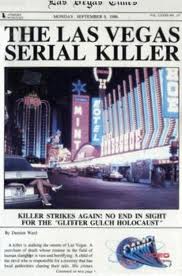
“The Las Vegas Serial Killer” Goes Back To A Dry Well


lv

As we painstakingly established around these parts a few days back, The Hollywood Strangler Meets The Skid Row Slasher was not exactly Ray Dennis Steckler’s finer hour (okay, hour and ten minutes). It’s a definite head-scratcher of a movie, to be sure, but as mind-bogglingly weird as Steckler’s idea to shoot a silent slasher flick on a budget of $1,000 in 1979 was, that decision seems positively logical in comparison to his decision to actually make a sequel to said silent $1,000 slasher flick seven years later!

Still, in 1986, for reasons known only to the the pseudonymous “Cash Flagg” himself, that’s exactly what he did. Sort of. I think.

vegasserial2

The setup here is, as you might expect, something of a puzzler in spite of its simplicity. Pierre Agostino is back as our strangler, but he’s called “Johnathan Glick” rather than “Johnathan Click,” and his stomping grounds have changed from Tinseltown to Sin City. He’s let out of the joynt  on the flimsiest technicality you can possibly imagine — they never found any bodies, so his convictions for a series of murders are all overturned — and he hits the streets again and starts killing.

Now, that might seem to make sense apart from the inexplicable swapping of the C in the character’s last name for a G, but that’s really just the tip of the iceberg. What’s he doing in prison in Nevada when his kill-spree took place in California, for instance? And, oh yeah — what he even doing alive, since he was murdered by the Skid Row Slasher at the end of the last one?

You begin to see the problem here. But “problems” are a relative concept, I suppose, and the logical gaps in the story’s basic premise are absolutely nothing compared to the problems in this film’s pacing and execution.

4080196602_815a9d0305

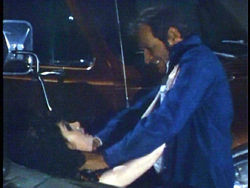
Steckler, here operating once again under his “Wolfgang Schmidt” nom de plume, has opted, no surprise at this point, to shoot the proceedings without sound — but instead of just telling the whole story via voice-over narration, he’s dubbed in actual, honest-to-goodness dialgoue in this one, and it’s never synched up even close to properly. Not that it really matters, because no one’s saying anything interesting — and nothing interesting is happening, either, with Click/Glick/whatever cruising downtown Vegas, the Strip, and neighborhood streets for ladies to choke with his bare hands. It’s, as you’ve no doubt come to expect, a pretty drawn out and tedious affair, and the killings themselves, when they do finally happen after interminable set-up periods, are all uniformly blase and aggressively nondescript.

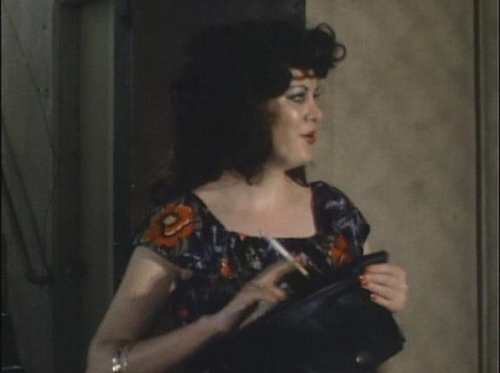
Then we’ve got the subplot about two low-rent hoodlums who stand around making cat-calls at women, snatching their purses, and taking long lunch breaks. They always seem to show up in roughly the same locales as G(C)lick, and at roughly the same times, but their importance —  and I use that term very loosely, trust me — to the goings-on isn’t fully explained until very nearly the end, at which point you’ll have long since stopped giving a shit, and this little “revelatory twist” is so underwhelming that it would almost be insulting if you weren’t so begrudingly impressed at Steckler’s bravado for thinking he could get away with an “explanation” so lame.

MV5BMTc1MTk5NjMwNl5BMl5BanBnXkFtZTcwMjg5NzkyMQ@@._V1_SY317_CR4,0,214,317_

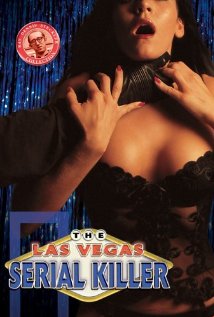
Unleashed  on a by-and-large uncaring populace via the straight-to-VHS route, The Las Vegas Serial Killer is, naturally, available on DVD these days (it’s presented full-frame with mono sound, both of which are, I guess, adequate enough all things considered), and while Media Blasters, under their Guilty Pleasures sublabel, have given us a nice (-r than this flick deserves) set of extras, including an on-camera interview with the director and a full-length commentary track where he opines at length on the making of the production, at the end of the day it still makes no sense, simply because all the explanation in the world  couldn’t begin to shine any light on why this was made and who Steckler thought his audience was.

Shit, I’ve seen this thing a few times now, and I’m still none the wiser. Is it a sequel to The Hollywood Strangler Meets The Skid Row Slasher? Is Agostino playing the exact same guy? How did he manage to survive when it sure as shit looked like he was dead? Why was he doing his time in a state other than that in which his (first) crimes were committed?

Fortunately, all of these questions have the exact same, simple answer — it doesn’t matter.

Grindhouse Classics : “The Hollywood Strangler Meets The Skid Row Slasher”


l_79300_4d2680e6

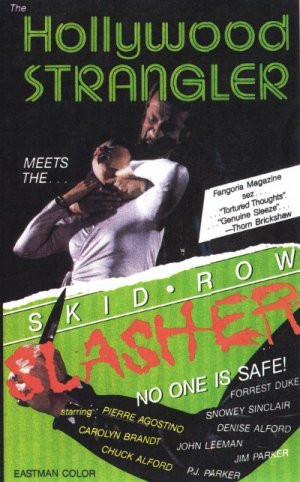
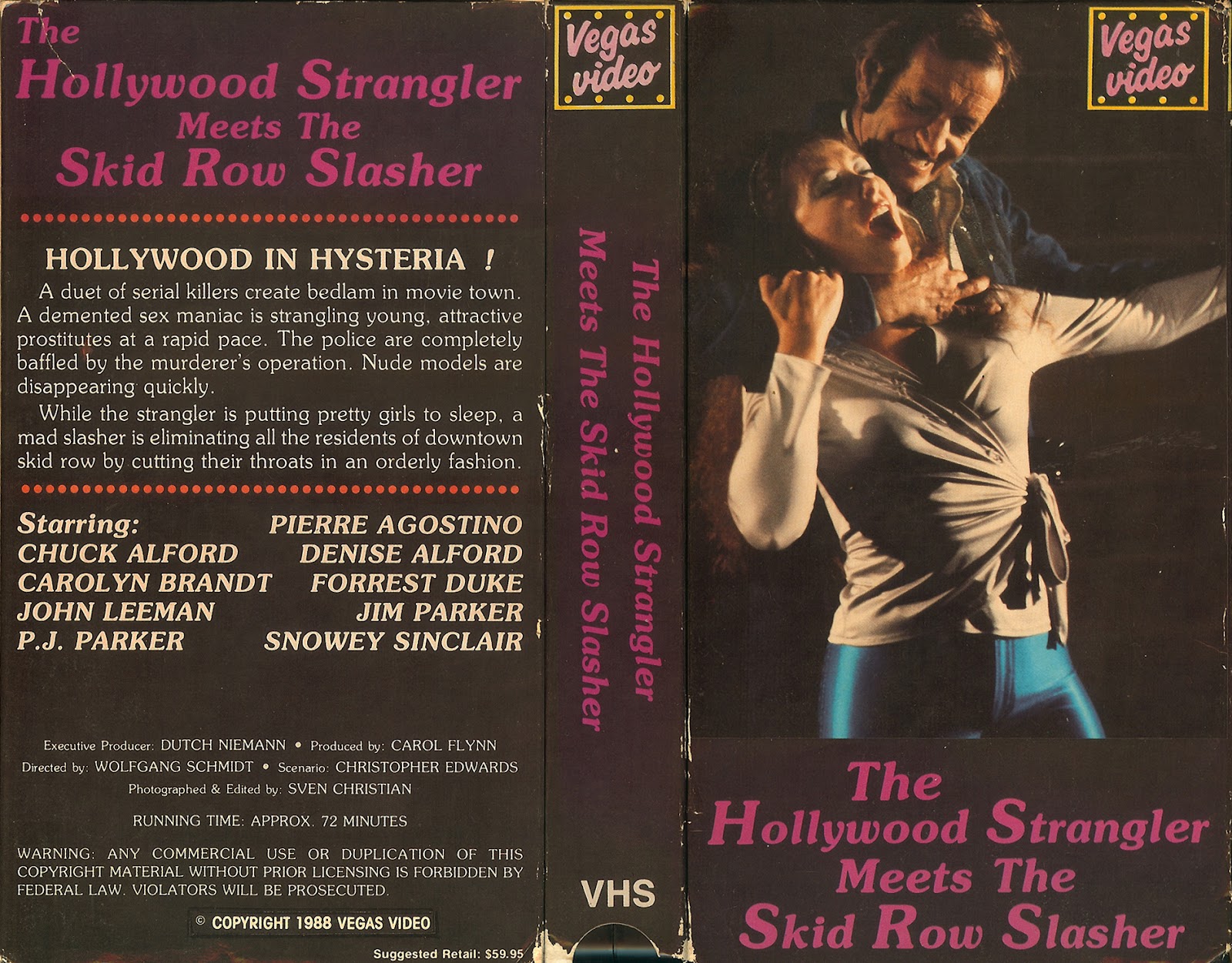
Sometimes, it’s almost impossible to know where to begin. Watching cult auteur Ray Dennis Steckler’s less-than-no-budget/dual-slasher mash-up The Hollywood Strangler Meets The Skid Row Slasher feels like a step back in time to the late 50s/early 60s, when ultra-cheap productions like The Creeping Terror and The Beast Of Yucca Flats were shot not only without sound, but with what sound was dubbed in later in post-production coming primarily in the form of voice-over narration, since the producers were too stingy and/or lazy to match up dialogue with actors’ moving mouths and only wanted to have to hire one person to tell their “story” anyway.

There’s just one wrinkle — Steckler (under his often-used “Wolfgang Schmidt” pseudonym) made this thing in 1979, hoping for a quick cash-in on the success of John Carpenter’s Halloween and the fly-by-night slasher genre that was then burgeoning in its wake! Honestly, by this point even Doris Wishman wasn’t cooking up her home-baked celluloid casseroles in a manner this frugal.
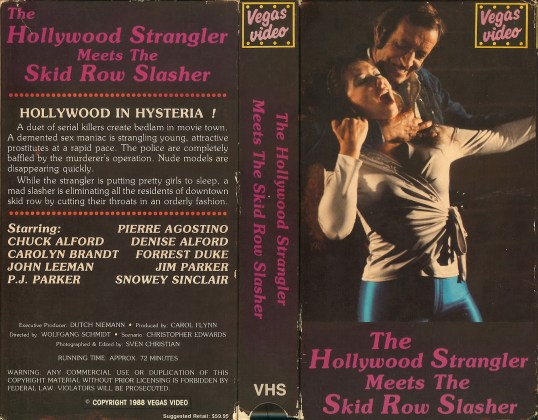
hwood vhs

Still, you’ve gotta give RDS at least some credit here — his dialogue-free, ultra-minimalist approach results in a style that can only be described as uber-naturalist, simply because when you spend this little on a production (the film’s total budget is reputed to be somewhere in the range of $1,000 — yes, you read that right) it literally can’t come out any other way. Honestly, his more “well-known” 1960s efforts such as The Thrill Killers, The Adventures Of Rat Pfink And Boo Boo, The Lemon Grove Kids Meet The Monsters and, of course, The Incredibly Strange Creatures Who Stopped Living And Became Mixed-Up Zombies feel like big-money blockbusters in comparison with this effort, which is more akin in terms of its production “values” and “standards” to one of those old 8mm (although this was shot on 16) “educational” films they used to show you in school (if you’re old enough to have been around for them) on subjects ranging from photosynthesis to slaughterhouse operations and everything in between.

Purely as a side note,  I have to say that I have no idea what teachers do when they’re feeling lazy these days — I guess give a power-point presentation or something, but I do know what Ray Dennis Steckler does when he’s feeling like mailing it in — he makes a movie like this one.
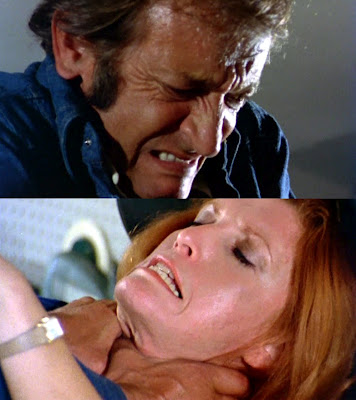
Hollywood Strangler Meets Skidrow Slasher 271 - 273

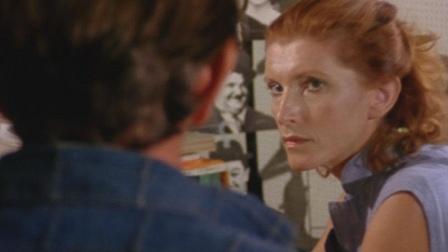
This was made at the apex of our guy Ray’s so-called “dark period” — when he got divorced from actress Carolyn Brandt (although she continued to star in his features, including this one), split LA broken-hearted, set up shop in Vegas, and generally spent his time seething with bitterness toward the Hollywood system that had rejected his admittedly unique — if not good by any standard definition of the word — brand of film-making. Returning to the streets of Hollywood Boulevard for the first time in many years for this one, there is, in fact, a palpable sense of rage that oozes from the frames of The Hollywood Strangler Meets The Skid Row Slasher, and if you do a little game in your head while you’re watching it whereby you replace the young, female victims of the strangler and the derelict, destitute victims of the slasher in your mind with the various exploitation producers and distributors that ripped Steckler off over the years, the flick becomes a lot more interesting.

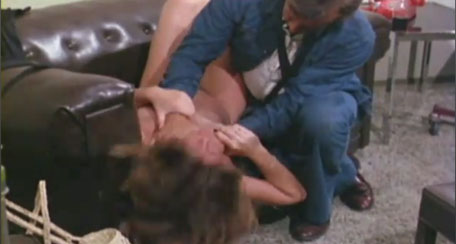
Truth be told, though, that’s about the only way you can draw any sort of “entertainment” from this 71-minute snooze-fest because Ray doesn’t really do anything on his part to keep you involved in the proceedings — it falls entirely on your shoulders as a viewer to invent a reason to keep watching. The “plot” alone’s certainly not gonna do it — our psycho narrator, one “Johnathan Click” (Pierre Agostino) poses as a nudie photographer in order to lure women whose phone numbers he’s obtained via the various hooker newspapers littering the boulevard over to his pad, where he dutifully proceeds to strangle them after they’ve disencumbered themselves of most or all of their clothing, while just a few block over an unnamed used bookstore clerk played by the aforementioned ex-Mrs. Steckler gets so sick of the bums and winos coming into her shop drunk off their asses that she starts slitting their throats (sometimes, curiously enough, with a knife that’s already got blood on it before she even sticks ’em ). As they both go about their business slicing,dicing, and choking their way through tinseltown, their paths are bound to cross — especially once Click rumbles his fellow traveler’s identity — but when they do, will they become uneasy allies in their mutual quest to, as they see it, clean up the streets, or will they have to duke it out to the death, figuring the town’s not big enough for the both of them?
the-hollywood-strangler-meets-the-skid-row-slasher

Don’t worry — by the time their confrontation finally does take place, you won’t give a shit about the outcome. Hell, if you’re a normal human being, you won’t even be awake anymore. Even as a morbid curiosity piece centered around the less-than-burning question of “how can Ray Dennis Steckler  make a movie with absolutely no money?,” this one runs out of gas pretty fast, and once the end credits (such as they are) roll, it feels more like a relief than anything else.

Perhaps the weirdest of all weird things in relation to this production, though, is that Steckler somehow, for some reason, must have felt that it worked (or at the very leaast turned a profit), because seven years later — long after what very few people who would have cared stopped doing so — he decided to make a sequel, this time featuring only “Mr. Click,” called The Las Vegas Serial Killer. I think he spent even less on that one since he didn’t have to  leave town to make it, and most of Hollywood Strangler‘s micro-micro-micro budget was, I’m guessing,  probably consumed by the director’s own travel and lodging expenses, given that the on-screen product looks like it didn’t cost  so much as one thin dime.

All that being said, Steckler performs something of an entirely accidental occult ritual here, by managing to warp our perceptions of the passing of time itself. At barely over an hour, this feels more like seven. You’ll swear that you can sit through the entire Godfather trilogy plus Lawrence Of Arabia  in the time it takes to watch The Hollywood Strangler Meets The Skid Row Slasher. At some point along the way, this passes the point of being merely dull and obtains the power to warp the laws of the universe merely through the force of its lethargy. This is a movie that works hard to be as boring as it is, goddamnit, and as a result it manages to completely take over our minds even if it can’t sustain our attention.

Don’t ask me how that works. I have no idea. Nor does Steckler. This kind of thing just comes naturally to a master of the craft such as himself.
Untitled-2

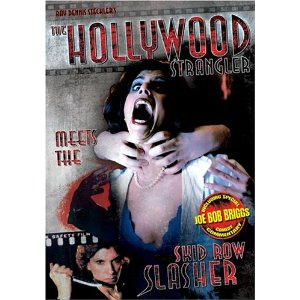
Fortunately, if you spring for either the purchase or rental of The Hollywood Strangler Meets The Skid Row Slasher on DVD, Media Blasters (under the auspices of their “Guilty Pleasure” sublabel) has done some things to make sure this can, indeed, sustain your interest. The widescreen transfers looks, well, as good as it can, the mono sound is bearable enough (not that it really matters that much), there are on-camera interviews with Brandt and Steckler, and we get two commentary tracks — one from Steckler which is pretty good, and one from the inimitable and legendary Joe Bob Briggs, which is, as you would expect, packed full of awesome from start to finish. A better overall package than this movie deserves, to be sure, but you’ll be grateful for it nevertheless.
51KK023JF3L__SL500_AA300_

All of which leads this review to one of those schizo conclusions that only seem possible with bottom-of-the-barrel exploitation cinema — the film sucks, but the DVD is great. At this point in his career, Steckler’s admitted one over-riding goal was to spend as little on his productions as possible, and here it really shows. He also prided himself on his intense hatred for actors and refused to hire any real ones, but that doesn’t matter much in this instance, since even the most talented performers in the world couldn’t save this thing. This is still, however,  a film worth sitting through, if not actively or actually watching — and not just as an endurance test (even though those can be fun sometimes). I know a statement like that positively demands an explanation, so try this — pop this disc into your player and keep one eye on your watch. Hell, keep both eyes on your watch since it’ll be more interesting than the movie. I guarantee you, at some point, the hands will stop moving, and they won’t start up again until “The End” comes up on the screen. That, my friends, is some real movie magic.

What Lisa And The Snarkalecs Watched Last Night #73: Flying Monkeys (dir by Robert Grasmere)


Last night, the Snarkalecs and I watched a SyFy original movie called Flying Monkeys.

Flying Monkeys

Why Were We Watching It?

Because that’s what we do!  Every Saturday night, the Snarkalecs get on twitter and watch a SyFy movie together.  Add to that, the minute that we saw that the film was called Flying Monkeys, we knew we had to watch it and try to come up with as many bad monkey pun as possible.

What Was It About?

It all takes place in the little town of Gale, Kansas.  (Named, I assume, after Dorothy Gale from The Wizard of Oz.)  Joan (Maika Monroe) is upset because her dad is late to her high school graduation.  So, Dad says sorry by buying her a pet monkey.  He’s a cute little monkey and Joan names him Skippy.

What Joan and her Dad don’t realize is that Skippy is a demon monkey and, whenever the sun goes down, he sprouts wings, flies around the town, and kills people.  Even worse, it turns out that every time somebody shoots Skippy, this causes Skippy to reproduce and multiply.  Since everyone in the town of Gale shoots Skippy at least once or twice, there are soon hundreds of killer flying monkeys all over the place.

Luckily, two demon hunters from China manage to get to Kansas in record time but then … well, let’s just say that, as far as demon hunting is concerned, they were both definitely overrated.

What Worked?

As far as I’m concerned, almost the entire film worked.  Seriously, how can you not enjoy something this ludicrous?  The makers of Flying Monkeys knew exactly what they were doing and it looks like they had a good time doing it.

Plus, Skippy was so cute!

Seriously, how can you not love a film featuring a killer named Skippy?

What Did Not Work?

The film spent a lot of time building up these two demon hunters from China but, once they showed up, they both turned out to be pretty useless.  I understand that was probably the point but still, it felt like the only reason they existed was to pad out the film’s running time.

“OH MY GOD!  Just like me!” Moments

Towards the end of the film, Skippy attempts to attack Sonya (Electa Avellan, best known for being one of the Babysitter Twins in Grindhouse) in the shower and Sonya reacts by literally running all the way to the other side of town while clad only in a towel.  At the time, we all pointed out how gratuitous this whole scene was.

After the movie ended, I took a nice, long, relaxing shower.  It was only after I had stepped out of the shower and turned off the water that I realized 1)  just how hard it was raining outside and 2) that I couldn’t remember if my car windows were open.

The idea of my car getting flooded so panicked me that, despite being clad in only a towel, I ran outside to make sure my windows were up.  Long story short, my windows were closed, I got even more wet, and I learned that, sometimes, you just have to go outside wearing a towel.

Lessons Learned

Don’t mess with Skippy.

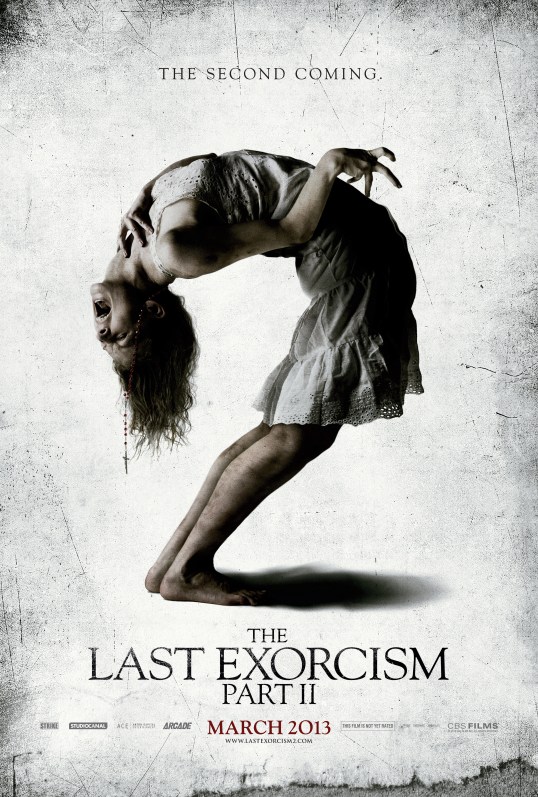
Film Review: The Last Exorcism Part II (dir. by Ed Gass-Donnelly)


Though it was dismissed by a lot of critics and remains underrated to this day, The Last Exorcism is one of the best horror films of the past four years.  Featuring an excellent lead performance from Patrick Fabian and an intelligent, thought-provoking plot, The Last Exorcism was both a very creepy horror movie and a surprisingly effective character study.  It even managed to be effective despite being an example of a “found footage” horror movie.

The Last Exorcism‘s sequel — the unimaginatively titled The Last Exorcism Part II — was released this weekend.  Like a lot of people, I have to admit that I wasn’t expecting much from the sequel.  The first film’s success was such a surprise that I doubted that the sequel could come close to matching it.

To a certain extent, I was right.  The sequel is nowhere near as good as the first film.  However, that said, The Last Exorcism Part II is still an above average horror film.

Ashley Bell

Wisely abandoning the whole found footage format, The Last Exorcism Part II begins with Nell (played, again, by Ashley Bell) as the only survivor from the previous film.  After escaping the cult that previously attempted to sacrifice her, Nell finds herself put into group home in New Orleans.  The group home is run by Frank Merle (Muse Watson), a friendly (if vaguely threatening) man who encourages Nell to try to move on from her traumatic past.  With Frank’s help, Nell starts to recover.  She gets a job working as a motel maid, makes friends with some of the other girls at the home, and she even starts to flirt with shy Chris (Spencer Treat Clark).

Everything seems to going so well for Nell.

Or is it?

Despite her claim that she no longer believes that she was ever possessed, Nell still finds herself being watched by menacing, masked figures who pop up on random street corners.  She still receives mysterious phone calls.  She’s still haunted by visions of her dead father walking through the dark hallways of the group home.  Nell is still having nightmares where she’s seduced by an unseen creature and her roommate and new best friend Gwen (Julia Garner) still seems to be oddly amused by any type of human suffering.

And that’s not even taking into consideration the voodoo priestess who follows Nell up and down the streets of New Orleans…

As opposed to the first film, The Last Exorcism Part II is a pretty conventional horror film.  Whereas the first film kept you constantly wondering whether Nell was actually possessed and made some surprisingly intelligent observations regarding the battle between faith and reason, The Last Exorcism Part II never gives you any reason to doubt that both the demon and the possession are real.  Whereas The Last Exorcism was a horror film that could be appreciated even by people who hated horror films, The Last Exorcism Part II is pretty much a film for horror fans only.

Fortunately, I happen to be a horror fan and I was pleasantly surprised by The Last Exorcism Part II.  While director Ed Gass-Donnelly shows little interest in rewriting the rules of the horror, he also shows that he can effectively work within the conventions of the genre.  He even uses the PG-13 rating to the film’s advantage, making up for the lack of gore by emphasizing the otherworldly atmosphere of New Orleans.

It also helps that Ashley Bell returns in the role of Nell.  As is typical of other possession movies (like the Exorcist, to cite an obvious example), the demon inside Nell can just as easily be taken as a metaphor for Nell’s emerging sexuality.  Ashley Bell gives a performance that walks a perfect line between innocence and carnality.  Much as Patrick Fabian’s performance elevated the first film, Bell’s performance elevates the second.

That said, The Last Exorcism Part II is ultimately the type of film where people tend to spend a lot of time wandering around dark hallways in the middle of the night without ever bothering to turn on a light.  It’s up to each individual  member of the audience to decide whether they’re going to demand to know why nobody turns on the lights or whether they’re simply going to enjoy waiting for the inevitable “jump” scene that we all know is coming.  If the audience is willing to set aside logic and enjoy a movie for what it is, then they are the ideal audience for a film like this one.

Perhaps not surprisingly, The Last Exorcism Part II has not received a lot of critical praise.  The film was not screened for critic prior to release and now that it has been released, it has a 15% overall rating over at Rotten Tomatoes.  However, you could have guessed that without me even telling you.  Everyone knew that the professional critics were going to hate The Last Exorcism Part II.  This is the type of film that most critics feel almost duty-bound to condemn.  This is also the type of film that reminds us of just how little the critical consensus really matters.  When judged on its own (admittedly limited) terms,The Last Exorcism Part II is an effective and creepy film.  It’s the epitome of a fun and occasionally stupid horror film, the type of movie you want to see with a group of friends who enjoy jumping at things that go bump in the night.

the-last-exorcism-part-2-poster

A Blast From The Past: Duck and Cover


Let’s face facts.  We live in a scary world and it’s not getting any safer.  However, before we all give up on the future, maybe we should take a look at the past.  With that in mind, it’s my pleasure to share the 1951 educational short film Duck and Cover.  

Seriously, if Bert the Turtle can survive then I think there might be hope for us all…

This is the epitome of one of those things that simply has to be seen to be believed.  That said, if I was a child in the 50s, I think Duck and Cover would have provided me with some comfort.  After all, Bert is just so cute and the Duck and Cover song is kinda catchy.

The SPM Trilogy Revisited : “Slumber Party Massacre III”


SLUMBER-PARTY-MASSACRE-III-DVD

What the heck, let’s wrap this up, shall we?

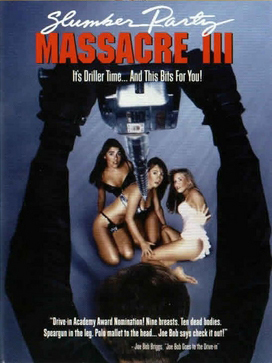
While the appearance of Slumber Party II may have surprised some being that it came five years after the original, it’s safe to say that when Roger Corman unleashed Slumber Party Massacre III  on the direct-to-video market in 1990, nobody was shocked in the least.

Shot primarily at one beach location and one residential home for exteriors, and with all the interiors being filmed at Corman’s Venice, California studio, the third installment in the SPM series cost a grand total of $350,000 and took somewhere in the neighborhood of one week to get “in the can,” as the saying goes, so yeah — it’s cheap , quick stuff we’re talking about here.

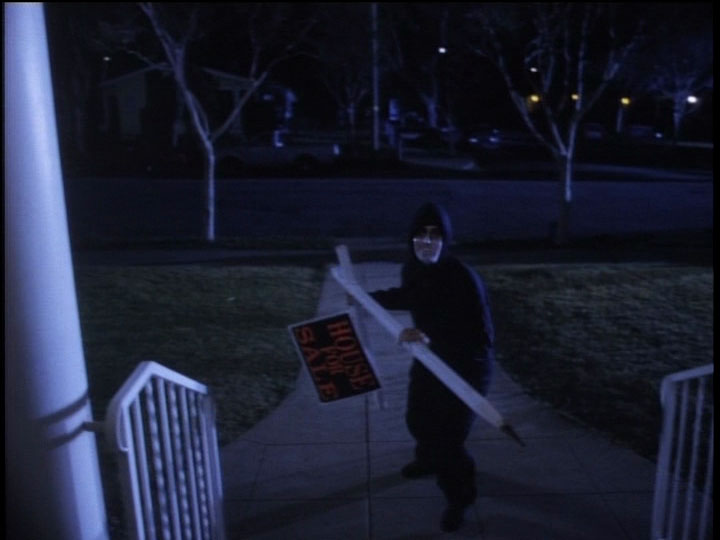
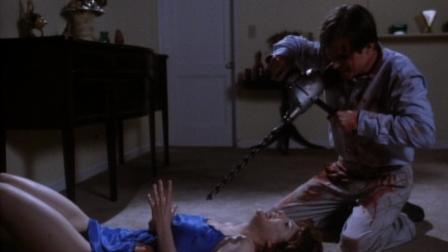
That being said, that certainly doesn’t mean it’s bad. What starts as a pretty bog-standard tale of stereotypical SoCal bimbo Diane (Brandi Burkett) and her friends ( a crew that features a few  young-at-the-time ladies, such as Hope Marie Carlton, Maria Ford, and Keely Christian, whose faces — and other parts — you may recognize from similar early-90s “slasher”/sexploitation fare) playing volleyball at the beach and then returning to Diane’s parents’ place for a weekend slumber party, where they are set upon, in turn, by their prankster-ish boyfriends, a voyeuristic “nosy neighbor” type, a mute Albino creepy dude, and finally a pyscho killer with a power drill, actually morphs somewhere along the way into a flick with a pretty wickedly sadistic, even black-hearted, sense of humor — with a pretty heavy dose of the misogyny you’ve come to expect from these things thrown in, of course.

As a brief case in point, instead of the standard bathtub-electrocution with either a hair dryer or toaster, in SPM III one of the nubile young co-eds is dispatched in the tub by means of a vibrator gone haywire! Nasty stuff, to be sure, but clearly not something that takes itself too terribly seriously while it’s dishing out its feminist-unfriendly — hell, female-unfriendly — goods.

slumberpartymassacre3girls

As with the previous two entries in this series, Corman again opted for an all-female writing and directing team here in order, one would assume, to help deflect any criticism this one might bet from the usual quarters (not that very many people were paying attention by this point), with those duties falling to Catherine Cyran (one of his regular screenwriters at the time) and Sally Mattison (a semi-veteran of Hollywood’s low-budget fringes best known for her work as a producer), respectively, and while it’s fair to say that this film is the most “seems-like-it-coulda-been-directed-by-a-man-ish” of the bunch, given that it ups the ante a bit in terms of its misogyny and plays it much “straighter,” if you will, than its predecessors in terms of sticking to the standard and much-maligned slasher formula, at the end of the day it’s still a pretty tongue-in-cheek affair  that’s just a bit more self-indulgent and gratuitous in terms of the T&A and overall mean-spiritedness.

To their absolute, credit, though, Mattison and Cyran, while carrying over the blatant phallo-centrism of the whole power drill thing, at least decide to throw in a bit of “whodunit?”-style mystery into the proceedings vis a vis their killer’s identity. Yes, folks, for the first time in a Slumber Party Massacre movie, the psycho might actually have some motivation for his murder spree here!

Or, ya know, he might turn out to be just some random stranger after all. I guess I won’t “spoil” anything in case you haven’t actually seen it. I will say, however,  that the mystery angle isn’t a particularly involving one — but hell, at least it’s there. We’ve already firmly established that “take what you can get” is the order of business with these things, haven’t we? The same — ahem! — “philosophy” applies here.

spmpt32

All in all,  though, you do get the sense that everyone involved here is giving it their best go on what they’ve got — which admittedly isn’t much in terms of time, talent, and money — but I’d rather watch so-called “D-listers” actually try than “A-listers” sleepwalking through yet another mega-budget production any day of the week. Slumber Party Massacre III may not be particularly ambitious stuff by any stretch, but it’s put together and performed by people who gave an honest day’s effort at the office. That’s worth a little something right there,  and after the absolute clusterfuck of wanna-be “trippy-ness” in the second flick, the “return to roots” sensibility in this one is very welcome indeed.

slumber-party-massacre-iii

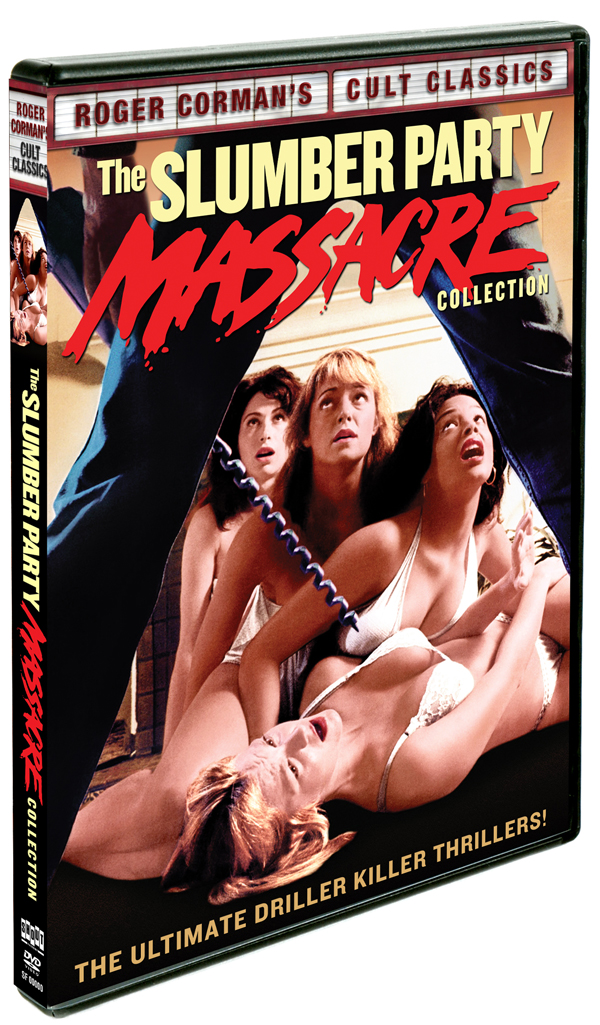
As always, the third and final outing (to date) in the SPM “oeuvre” is available on DVD from Shout! Factory packed together with its older celluloid sisters in a two-disc set under the heading “The Slumber Party Massacre Collection,” part of the “Roger Corman’s Cult Classics” series. It’s presented full-frame with 2.0 stereo sound — and while if there’s been any remastering done with either it’s certainly minimal, the whole thing looks and sounds generally decent enough. Extras include a good little “making-of” featurette, a feature-length commentary with director Mattison, the original trailer, a few trailers for other titles in the Corman series, a poster and still gallery, and a liner notes booklet by Slumber Party Massacre fanatic/filmmaker Jason Paul Collum. A very comprehensive package well worth your time.

slumber082710

Look, who are we kidding? This isn’t a movie out to set the world on fire — hell, it’s not even out to set the DTV slasher world on fire. It’s there to give two distinct parties their money’s worth — Roger Corman and you, the viewer. It manages to deliver on both fronts, even if just barely. That doesn’t mean it’s necessarily worthy of a ton of respect, but it’s not worthy of any sort of scorn, either. Don’t expect too damn much, and you’ll walk away satisfied.

Not, I suppose, that anyone who might be inclined to “expect much” as far as their entertainment choices go  is even watching this in the first place.