Embracing the Melodrama #1: Where Are My Children? (dir by Phillips Smalley and Lois Weber)


Where Are My Children

I love melodrama, don’t you?

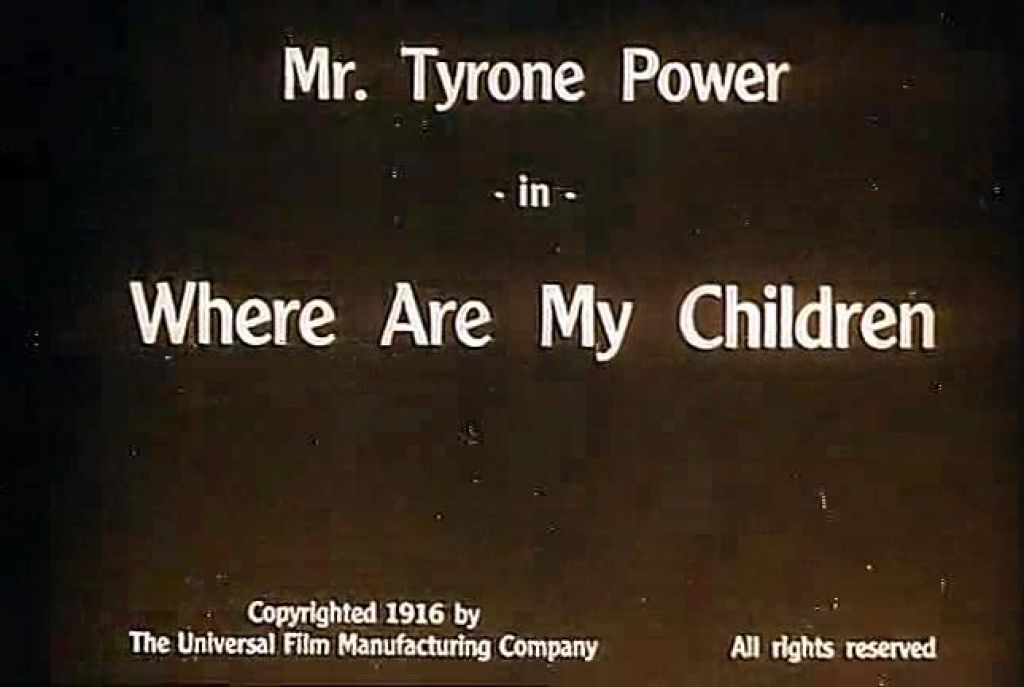
Well, I hope you do because, for the next 10 days, I’m going to be taking a chronological look at fifty of the best (and worst) film melodramas of all time!  I’m going to start with a silent film that’s nearly 100 years old.  Written and directed by Lois Weber, one of the first female filmmakers, Where Are My Children? is a melodramatic look at an issue that is just as controversial today as it was when this film was first released in 1916.

Where Are My Children? tells the story of John Walton (played by Tyrone Power, Sr.), a upright district attorney who feels that all crime could be prevented if only there was a way to stop irresponsible and morally lax people from reproducing.  Walton’s only regret in life is that he and his wife have never had any children of their own.  While Walton is busy dealing with the prosecution of a medical practitioner who has been arrested for distributing pro-birth control literature, his wife is hiding a secret from him.  Because they would rather have social lives than families, she and her friends have been secretly getting abortions…

One of the great secrets of American film history is just how weird much of silent cinema truly was.  I think we tend to assume that because silent movies are old, they also have to be primitive, corny, silly, slow, and out-of-touch.  And, often times, they are!  But, if you’re a serious student of film, you owe it to yourself to watch as many silent movies as you can.  It’s important to know the history of what you love and a film like Where Are My Children? is quite definitely a part of that history.  Add to that, for every five silent films that have been rendered almost unwatchable by the passage of time, there’s going to be one — like Where Are My Children? — that has held up fairly well.  There’s an undeniable pleasure to discovering a silent film that still — despite all the odds — remains interesting.  And, finally, there’s the fact that silent films are often odd in ways that you’d never expect.

Let’s take Where Are My Children? for instance.  This is one of those films that literally opens in Heaven, with a lengthy explanation of how there are three different levels of babies — the “chance” children, the “unwanted” (who, we are told, are constantly sent back to Heaven and have been marked with the “sign of the serpent,”), and then finally there’s the select few children who have been blessed ahead of time “by the almighty.”  Creepy, no?  As the film progresses, it becomes obvious that Where Are My Children? is a pro-eugenics film.  Eugenics, of course, is the horrific idea that only certain, elite people should be allowed to have children, because of course undesirable adults will just have undesirable children who will eventually grow up to undesirable things.

Needless to say, a lot of very evil people have used eugenics to justify doing a lot of very evil things but what is often forgotten (or not even acknowledged) is that during the early 20th century, eugenics was considered to be a very progressive concept.  For all the good work that Margaret Sanger did towards promoting birth control and sex education, she was also a supporter of eugenics.  It was her 1916 arrest and trial for distributing contraception that inspired Phillips Smalley and Louis Weber to make Where Are My Children?

Ironically enough, this film — which, with its pro-sex education message, would probably be considered quite liberal by the cultural standards of 1916 — is probably now best known for being strongly anti-abortion, with Weber and Smalley going as far as to use double exposure (which was quite an advanced technique back in 1916) to show us the children that will never be born to the film’s characters.  It’s the sort of thing that would never happen in a mainstream movie today.  It’s also the sort of thing that a lot of modern progressive audiences will undoubtedly find to be incredibly offensive.  But, speaking as someone who strongly believes in my right to make my own decisions about what I do with my body, I find films like Where Are My Children? to be fascinating.  It has nothing to do with politics and everything to do history.  Where Are My Children? is a valuable time capsule.

Watch it below!
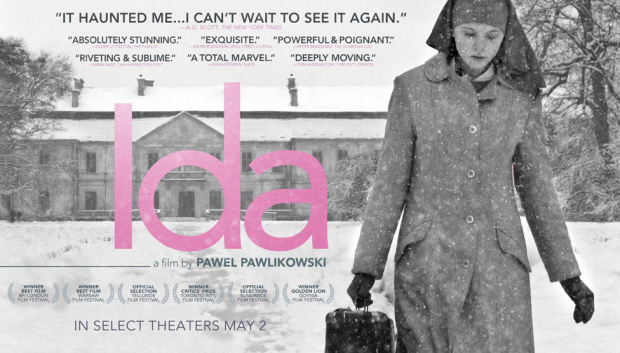
Quick Reviews: ‘Ida’ (dir. Pawel Pawlikowski) & ‘We Are The Best!’ (dir. Lukas Moodysson)


ida_poster-620x353

“Ida”, the best looking film so far this year, is the bittersweet story of a young woman named Anna living in a convent in Poland, waiting for the day when she will take her vows. Before that can happen, a Nun asks her to visit her aunt, the only known relative she has. During that visit she learns that her parents were Jewish and died during the events of WWII. Anna wants to know where they are buried, and so goes on a road trip with her aunt to their old family home to find answers. The journey opens her eyes to the joys and also sorrows of the world as she struggles with coming to terms with the past, present and her future. She now must decide whether she should stick with her devotion to god and err on the side of tranquility and solitude; or to live the life her mother couldn’t, risking pain and loss but possibly finding love and freedom.

It is an already beautiful story made more so through gorgeous cinematography and imagery. The sort that says more in each frame than its dialogue could ever hope to say. It is also the sort of Bergman-esque, quiet and contemplative, European film that I can only imagine will be more rewarding on multiple viewings. The performances are also wonderfully reserved, especially Agata Trzebuchowska who played Anna and has possibly the most mesmerizing eyes I have ever seen. It all adds up to an incredibly rewarding experience. Go see it if you get the chance.

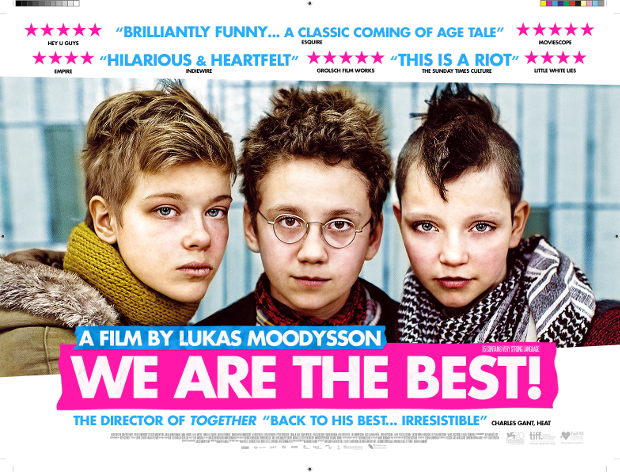
watb

“We Are The Best!”, one of the best films I have seen so far this year, is a wonderful story of youth, rebellion and friendship that perfectly captures the ups and downs of adolescences.

The film revolves around three young girls in Sweden during 1982. They are fans of punk, though all their classmates make a habit of telling them it is dead. One winter, after playing around in their youth club’s rehearsal space, they decide to make their own punk band to spread their own message…mainly how much they hate sports.

Their conflicts throughout this process are rather inconsequential. One of their parents is divorced and focuses more on men than her daughter; another’s is overly religious and restrictive. They are also often picked on in school, question their looks, and have the usual boy trouble one would expect from a film about a group of thirteen-year-olds. What sets this apart from those other films is that these conflicts, as I mentioned, are shown as just minor bumps in the road for these three; it is their love of music and each other, love that could see them through anything, that shines through. Plus, it is all just a whole lot of fun.

It is that wonderful and relatable portrayal of friendship and youth that fills “We Are The Best!” to the brim with warmth and heart. Honestly, if you don’t walk out of the theater with a smile on your face then I can only hope your cold icy heart sees you through the hot summer ahead!!

————————————————-

So, with that said, now that June is almost over here is my list of favorite films so far in 2014 (with trailers!):

1)      Boyhood

2)      We Are The Best!

3)      Under The Skin

4)      Edge of Tomorrow

5)      Ida

6)      The Trip to Italy

7)      The Grand Budapest Hotel

8)      Enemy

Lisa’s Homestate Reviews: Louisiana and Sister, Sister


Sister,_Sister

My sixth and (to date, anyway) final home state is Louisiana, where my family called Shreveport home from December of 1996 to May of 1998.  Louisiana was the last state I lived in before moving back to Texas, where I’ve remained ever since.

Whenever people find out that I used to live in Louisiana, they always seem to automatically assume that means that I either lived in New Orleans or next door to the family from Duck Dynasty.  They always seem to be somewhat disappointed to learn that I lived in Shreveport, which has a lot more in common with East Texas than with the things that most people visualize when they think about Louisiana.  However, I will always have good memories of Shreveport and let me tell you why.  For most of my childhood, I had a really bad stutter and, as a result, I was extremely shy.  However, shortly after my 12th birthday, my stutter went away.  Whether it was the result of spending hours with speech therapists or if it’s just something that I outgrew, Shreveport will always be the city where I stopped stuttering.  (And, it should be noted, Shreveport may not be New Orleans but it still celebrates Mardi Gras.  It’s just that the celebrations in Shreveport are a bit more …. sedate.)  So, seriously — don’t say a word against Shreveport.

Besides, Shreveport has a wonderful atmosphere all of its own.  In fact, the same thing can be said about all of Louisiana.  With its long history and unique culture, Louisiana is perhaps the most atmospheric state in the union and that atmosphere is perfectly displayed in Sister, Sister, an effective little thriller from 1987.

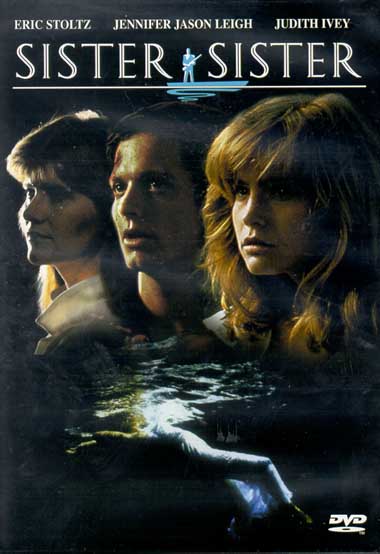
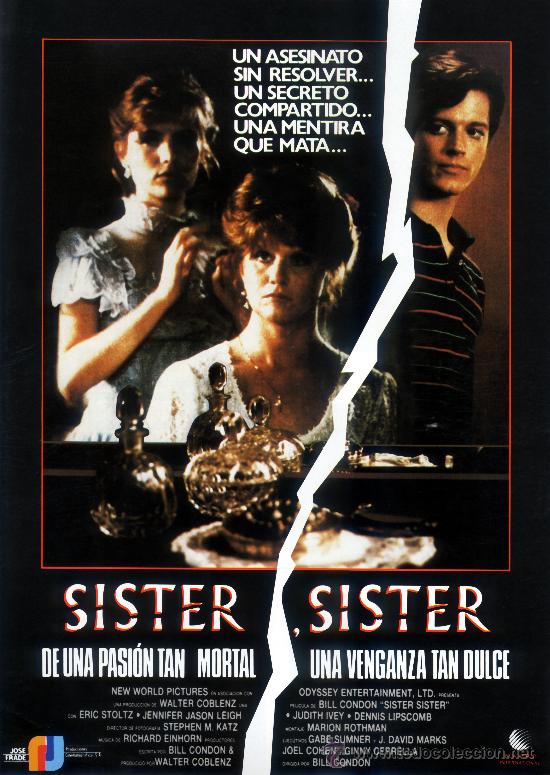
Sister, Sister tells the story of two sisters living in a dilapidated mansion on the bayous.  The older sister, Charlotte (Judith Ivey) is in love with Sheriff Cleve Doucet (Dennis Lipscomb) but she knows she can never marry him because she has to watch and protect her younger sister, Lucy (Jennifer Jason Leigh).  Lucy is mentally unstable and claims that she can communicate with the ghosts that live in the bayous.

Charlotte and Lucy have turned their mansion into the boarding house and they rent a room to Matt (Eric Stoltz), a congressional aide who is taking his vacation in the bayous.  Matt takes an interest in Lucy, which raises the suspicions of Etienne (Bejamin Mouton), a sinister handyman who appears to be obsessed with Lucy himself.  As you can probably guess, nobody in this film is quite who he or she appears to be and it all leads to the uncovering of dark secrets from the past.

So, let’s just start with the obvious.  The plot of Sister, Sister doesn’t make much sense.  If you think about it, you’ll find a lot of improbabilities.  So, my suggestion is that you just don’t think about it.  Instead, watch the film for the performances of Judith Ivey and Jennifer Jason and the atmosphere of the bayous.  Making his directorial debut here, future Twilight director Bill Condon captures a lot of haunting images of the bayou and his direction emphasizes mood over cheap thrills.  The end result is a horror film that might not be scary but it certainly is creepy and stays with you after it’s over.

If nothing else, Sister, Sister is an effective B-movie.  It’s also a nice showcase for my former home state of Louisiana.

Sister, Sister

Lisa’s Homestate Reviews: Colorado and Over the Edge


From August of 1994 to July of 96, my family lived in Longmont, Colorado.  Whenever I think back to living in Colorado or the times that I’ve visited it since, there’s always two things that I remember.  First off, Colorado had the cleanest air that I’ve ever breathed and, for someone like me who grew up with severe asthma, that’s a big deal.  Secondly, Longmont had some great dance teachers.  I may have taken my first dance classes in Texas but I’ve always liked to think that Colorado is where I first truly fell in love with dancing.

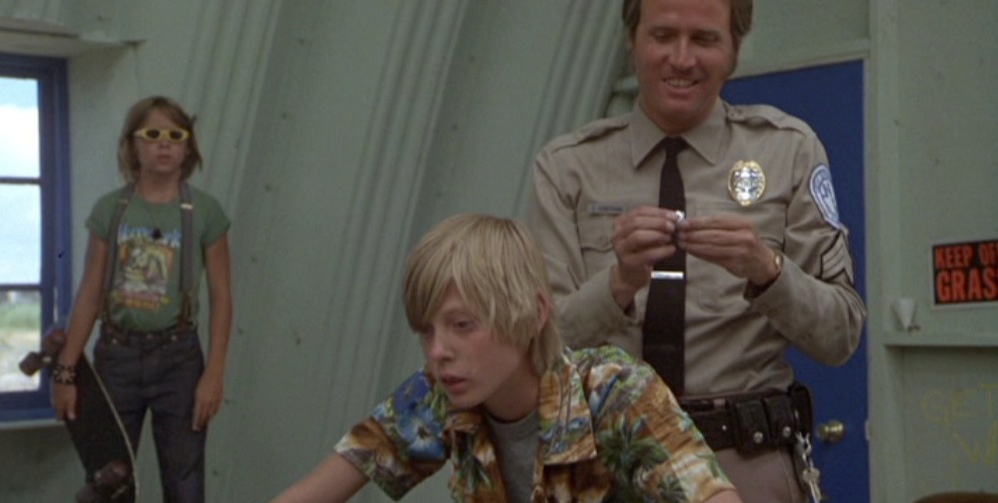
Fortuantely, my family and I lived in Longmont and not New Granada, the setting of the Colorado-shot 1979 film Over the Edge.  New Granada is a planned community, a collection of identical houses and sterile buildings that sit out in the middle of the desert.  The majority of town’s adult population views New Granada as less a home and more of a business opportunity.  When their children misbehave, they worry less about why and more about how that’s going to effect the effort to get a visiting businessman to invest in their town.  The streets of New Granada are patrolled by a fearsome cop with the very appropriate name of Doberman (Harry Northup).  Doberman may claim to be maintaining the peace but, as quickly becomes apparent, he’s just a bully with a uniform.

Is it any wonder then that the teenagers of New Granada are out-of-control?  Between living in a town where there is literally nothing to do other than skip school, smoke weed, and hang out at a dilapidated rec center and having to deal with parents who don’t really seem to want them around, the youth of New Granada are angry and Over the Edge suggests that they have every right to be.

When Mark (Vincent Spano) uses his BB gun to shoot a hole in Doberman’s windshield, Doberman reacts by blaming and harassing Carl (Michael Kramer) and his friend Richie (a very young Matt Dillon).  When Doberman demands that Richie tell him who shot the BB gun, Richie replies, “I only got one law.  Any kid who tells on another kid is a dead kid.”

Things escalate.  When a Texas businessman visits the town, the rec center is closed in an attempt to keep any of the kids from being seen.  Doberman arrests Claude (Tom Fergus) for possessing a gram of hash, which leads to Richie realizing that one of the kids has turned into a snitch.  Doberman’s obsession with finding out who shot the BB gun leads to the death of one of New Granada’s teens. Eventually, the adults of New Granada attend an emergency PTA meeting down at the high school, just to find themselves locked into the building by their children, the majority of whom proceed to riot and destroy the town outside.

Directed by Jonathan Kaplan and based on a true story, Over the Edge is one of the best youth-in-revolt films ever made.  Not only is it well-acted (with Matt Dillion in particular showing a lot of rebellious charisma as Richie) but it’s also unique in that it is totally on the side of the young people.  While Over the Edge does not necessarily endorse the violence that dominates the film’s finale, it also suggests that acting out was perhaps the only option left to the teenagers of New Granada.  That Over the Edge was made in the 70s is obvious as soon as you hear the soundtrack and see the clothes and hairstyles.  However, with its portrayal of both youthful alienation and out-of-control authority, it’s still very relevant today.

It’s a great film with an absolutely hear-breaking ending and it’s one that you should see if you haven’t yet.

The Face of Fascism In Over The Edge

The Face of Fascism In Over The Edge


Lisa’s Homestate Reviews: Oklahoma and Terror at Tenkiller


A typically enthralling scene from Terror at Tenkiller

A typically enthralling scene from Terror at Tenkiller

When I was growing up, I lived twice in Oklahoma.  In July of 1992, my family moved from Carlsbad, New Mexico to Ardmore, Oklahoma.  We lived in Ardmore until January and then we moved to Texarkana.  3 years later, we would return to Oklahoma when we moved from Longmont, Colorado to Tulsa.  We called Tulsa home for five months before my Dad got a new job working in Shreveport, Louisiana and we moved yet again.

Now that I live in Texas, I’m almost legally obligated to give Oklahoma a hard time but actually, it’s a pretty nice state.  There’s a lot pretty scenery and, even more importantly, Oklahoma is home to some of the nicest people you could ever hope to meet.  Add to that, I often feel that I owe my fascinating with the horror genre to Oklahoma.  When we were living in Ardmore, there was an abandoned barn near our house and a group of mean older sisters and cousins of mine told me that there were monsters living inside of that barn.  That inspired the very first nightmare that I ever had and, all these years later, I’m still scared of barns.

When I sat down to write a review of a film that was made in my former homestate, I ran into a problem that I really hadn’t planned for.  There just aren’t that many movies that were filmed entirely on location in Oklahoma.  At first, I thought I might go with either The Outsiders or Rumble Fish, since both of those films were shot in and around Tulsa but I really can’t say that I was enthusiastic about the prospect of sitting through and reviewing either one of those.  Fortunately, I had the bright idea to check with Wikipedia and that’s when I first came across Terror at Tenkiller, an independent slasher film from 1987.

“Ah!” I thought, “a horror film, which will tie in nicely with my memories of that scary barn!”

Even better, I quickly discovered that some generous soul had previously downloaded the film to YouTube.

“Yay!”  I thought, as I sat down to watch Terror at Tenkiller, “This may be bad but at least I won’t have to sit through The Outsiders!”

Anyway, Terror at Tenkiller is really, really bad.  The acting is terrible, the film reveals the identity of the killer within the first few minutes and then actually has the nerve to brag about the fact that the killer is basically motiveless, all of the dialogue was rather clumsily dubbed into the film, and the film is so ineptly lit that you often can’t even tell what’s happening on screen.  Yes, it’s a pretty bad film alright but I still have to admit that I enjoyed watching it.

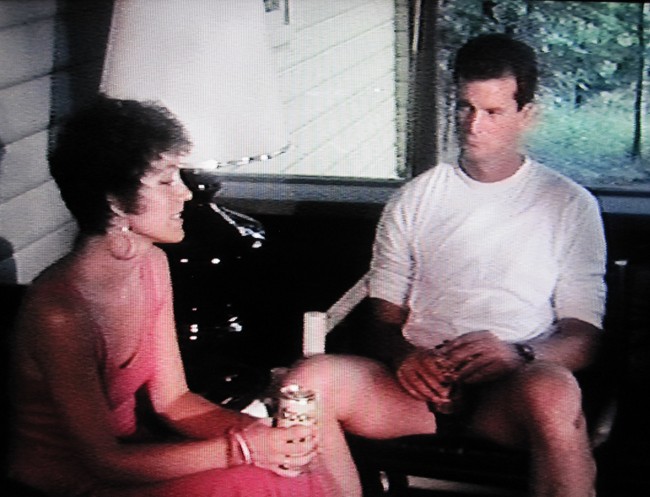
What can I say?  When it comes to my movies, much like my men, it’s impossible for me not to find something to enjoy about them.  Even more importantly, I have a weakness for low-budget regional horror films.  First off, the film takes place at Lake Tenkiller, which is absolutely gorgeous and, whether he was simply trying to pad out a thin story or not, director Ken Meyer wisely includes a lot of footage of the surrounding countryside.  Secondly, the film is full of people who were obviously locals.  What they lacked in acting talent, they made up for authenticity.  I’ve had to sit through a lot of bad films that have featured a lot of professional actors trying their best to sound like they’re from my part of the world but, in the end, simply sounding like they’ve never even seen the Mason-Dixon Line, let along traveled below it.  If I’m going to watch a bad movie, I’d rather watch a bad movie that gets the accents right as opposed to one where everyone sounds like they just failed their dialect midterm at the Actors Studio.

Finally, I think the argument can be made that the low-budget and the stiff acting and the random volume level of the dubbing actually works to this film’s advantage.  If nothing else, these so-called flaws gives Terror at Tenkiller an undeniably dream-like feel.  The surrealism of Terror at Tenkiller may be unintentional but does that make it any less effective?

Anyway, you can make up your own mind by watching below.  The film itself is only 87 minutes long but the upload on YouTube has been divided into 6 different parts, each one of which lasts about 14 minutes.  In the interest of space, I’m only embedding part one but, at the end of the video, you should be able to find links for the other five parts.  If you’re at work, be warned.  This film does contain some very brief nudity and you probably shouldn’t be watching movies at work anyway.

Lisa’s Homestate Reviews: New Mexico and A Million Ways To Die In The West


million-ways-fix

My family lived in Carlsbad, New Mexico from January of 1991 to July of 1992.  I was only 5 years old when we arrived and 6 when we left so I really can’t say that I remember that much about Carlsbad, beyond the fact that my mom was always worried about rattlesnakes, I was excited about going to kindergarten and that, when my Dad announced that we were moving to Oklahoma, I cried and cried because, even at that age, I knew that meant I’d never get to see my friends again.

So yeah, some of my memories of New Mexico are a little traumatic.  But are they as traumatic as watching Seth McFarlane’s A Million Ways To Die In The West, a film that was shot in New Mexico and which is an early front-runner for claiming the title of worst of 2014?

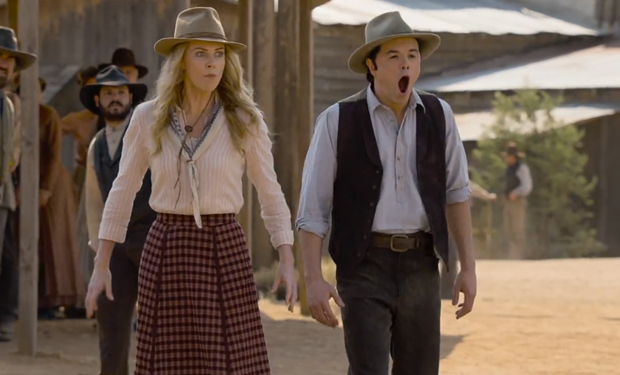
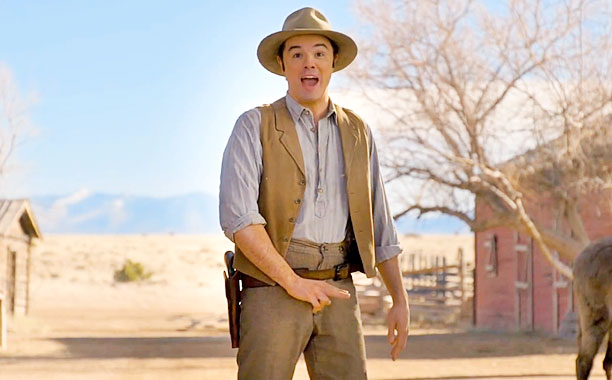
Written by, produced by, directed by, and starring Seth McFarlane, A Million Ways To Die In The West tells the story of a sheep farmer named Albert (played by Seth McFarlane) who basically spends the entire movie whining about how much he hates living in the old west.  His girlfriend leaves him for … well, look, the plot is stupid.  You knew the plot was going to be stupid when you first saw the trailer earlier this year.  You probably even knew the film wasn’t going to be that good.  However, as bad as you might think the film is, it’s nothing compared to how bad the movie actually is.  And the blame pretty much rests with Seth McFarlane.

Seth McFarlane has got cold, dead eyes and a curiously unlined face that, when taken along with his ever-present smirk, tends to make him look like one of those horror movie mannequins that comes to life once the store closes and murders horny teenagers.  I understand that it’s always been a part of McFarlane’s act to present himself as being an asshole with a heart of gold but, for the most part, that works best when you only have to deal with his voice.  The minute that you see his smug face, which is as immobile as his voice is expressive, the heart of gold part disappears.  All your left with is an asshole who insists on telling the same joke over and over again.  As both a comedic writer and director, McFarlane’s technique is to basically beat the audience into submission, dragging jokes out to such an interminable length that you eventually laugh because you simply cannot believe that you’re wasting so much time watching this crap.  Some people have mistaken that technique for genius.  Those people should be forced to watch A Million Ways To Die In The West in much the same way that Malcolm McDowell was forced to watch violent movies in A Clockwork Orange.

(And I write all of that as perhaps the only woman in the world who was not offended by Seth McFarlane singing The Boob Song at the Academy Awards, if just because the joke was clearly meant to be at the expense of McFarlane and the overage frat boys who seem to make up his fan base.)

A Million Ways to Die In The West is full of familiar faces.  Liam Neeson goes totally overboard as the film’s villain.  Neil Patrick Harris, as usual, is fun to watch, or at least he is until he’s forced to take part in one of McFarlane’s trademark endless musical numbers.  Eventually, Harris’s character gets slipped a laxative and it’s just as disgusting as it sounds.  Giovanni Ribisi plays McFarlane’s best friend and his joke is that he’s a Christian (yes, Seth takes on Christianity — what a rebel!) and that his girlfriend (Sarah Silverman, who deserves better) is a prostitute who is willing to have sex with everyone but him.  Amanda Seyfried has the thankless task of playing McFarlane’s girlfriend while Charlize Theron plays the enigmatic woman who teaches Seth how to shoot a gun.  (Theron gives a far better performance than this movie deserves and it was hard not to wish that the entire film had just been about her character.)  There are also several celebrity cameos — Ryan Reynolds, Christopher Lloyd, and even Jamie Foxx show up.

But, ultimately, the entire film is about Seth McFarlane.  He wrote it, he directed it, and he stars in it.  Seth McFarlane dominates this film and that’s the problem.  What might be slightly amusing in a 22-minute cartoon is not going to be funny enough to sustain a nearly two-hour film.  For a rambling and often aimless film like A Million Way To Die In The West to succeed, it needs a star who is both skilled at comedy and likable enough that he’ll be able to anchor the mayhem.  (Seth Rogen, for instance.)  Instead, we’re given a smirking Seth McFarlane and the end result is a film that somehow manages to be both forgettable and a disaster.

Now, you may be wondering how I ended up watching this film.  Well, originally I wasn’t planning on ever seeing it but then I started to read reviews about how terrible it was and I was like, “This is a film that I definitely need to see for myself, so that I can see if the film is actually a misunderstood masterpiece or if it’s a film that I’m going to have to keep in mind when I’m compiling my annual list of the year’s worst films.”  (Plus, when I arrived at the theater, The Fault In Our Stars was sold out.)  But anyway, I sat through it and I forced my sister Erin to watch it with me and I think Erin may be on the verge of finally forgiving me.

Finally, what was more traumatic?  Leaving behind my friends or watching this movie?

Too close to call.

A-MILLION-WAYS-TO-DIE-WEST

Lisa’s Homestate Reviews: Arkansas and Mud


Mud

When it comes to Arkansas, people seem to automatically think of two things.  Arkansas is the former home of Bill and Hillary Clinton and it’s also the state that accused three teenage boys of committing horrific acts of murder, largely on the basis of the fact that one of the boys used to dress in black and listen to heavy metal music.  Between the state’s largely rural image and repeat showings of Paradise Lost on HBO, Arkansas does not exactly have the best reputation.

Myself, I have a lot of childhood memories of Arkansas.  Some of them are good and some of them aren’t so good. My grandmother lived in Fort Smith so, even when my family was living in another state, we would still always find the time to come visit her every summer.  As well, I had (and still have) cousins spread out all over the state.  Almost every road trip that I’ve ever taken has involved at least a few stops in Arkansas.  When I think about Arkansas, I don’t think about the Clintons or Damien Echols.  Instead, to me, Arkansas is where I used to get excited whenever I saw we were approaching grandma’s house and where my mom once grabbed me right before I stepped on a snake that was hidden in the high grass that surrounded my cousin’s farm.

As often as I visited Arkansas while I was growing up, I also actually lived there twice.  I don’t remember the first time, because I was only two years old at the time, but my family spent 3 months living in Ft. Smith before going back to Texas.  Then five years later, we returned to Arkansas and, over the course of 19 months, we lived in Texarkana, Fouke, Van Buren, North Little Rock, and, finally, Ft. Smith once again.

Originally, for Arkansas, I was planning on reviewing The Legend of Boggy Creek, a 1974 psuedo-documentary that deals with a bigfoot-like creature that was said to live near the town of Fouke.  It made perfect sense as not only was The Legend of Boggy Creek filmed in Arkansas but it was produced by an Arkansan as well.  It remains one of the most financially successful independent films of all time and, because it’s presented as being a documentary, it features authentic Arkansans in the cast.  Even more importantly, my family actually lived in Fouke from August of ’93 to May of ’94.  I’ve been down to Boggy Creek!  (Though, to the best of my memory, the monster never made an appearance while we were living in Fouke.)

But then I thought about it and something occurred to me.  The Legend of Boggy Creek is not that good of a movie.  I watched it a few weeks ago and, once I got passed the fact that it was filmed in a town that I have vague memories of living in back when I was seven years old, I found the film itself to be almost unbearably dull.

So, instead of unleashing my snark on a 40 year-old exploitation film, I’m going to use this opportunity to recommend another film that was shot in Arkansas.  This film, however, was one of the best films of 2013.  It’s a film that, if you haven’t watched it yet, you owe it to yourself to see.

It’s a film called Mud.

Directed by Jeff Nichols (who previously gave us the excellent Take Shelter), Mud takes place in the town of DeWitt, Arkansas.  Two teenage boys, Ellis (Tye Sheridan) and Neckbone (Jacob Lofland) spend their days going up and down the Arkansas River.  Ellis, the more introspective of the two, dreams of escaping his homelife with an abusive father (Ray McKinnon) and a compliant mother (Sarah Paulson).  Quietly watching over the two boys is Tom (Sam Shepard), an enigmatic older man who lives across the river from Ellis’s family.

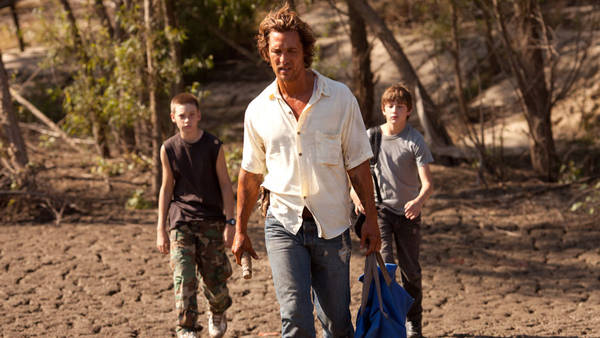
One day, Ellis and Neckbone come across a mysterious man living on a small island.  The man’s name is Mud (Matthew McConaughey) and he tells them that he’s waiting for his girlfriend, Juniper (Reese Whitherspoon).  Mud explains that he killed a man who once pushed her down a flight of stairs while she was pregnant.  Ellis and Neckbone agree to help Mud, secretly supplying him with food and delivering notes from him to Juniper.

However, the father (Joe Don Baker) of the man who Mud killed has arrived in town as well.  He’s brought an army of mercenaries with him and, each morning, he gathers them together for a quick prayer and then sends them out to track down and kill Mud…

Mud is a wonderful film, one that is full of visually striking images and excellent performances.  (If Dallas Buyers Club hadn’t come out later that same year, Matthew McConaughey could have just as easily been nominated for his charismatic and sympathetic performance here.)  Even more importantly, the film is full of authentic local culture and color.  If, decades from now, someone asked me what Arkansas was like in the early 21st Century, Mud is the film that I would show them.

Much as how Richard Linklater can capture Texas in a way that a non-Texan never could, Mud is fortunate to have been directed by a native of Arkansas.  Watching Mud, it quickly becomes obvious that Jeff Nichols knows and understands Arkansas and, as such, he presents an honest portrait of the state.

Every state should hope to inspire a film as well-made and entertaining as Mud.

Lisa’s Homestate Reviews: Texas and Bernie


I recently realized something while I was working on my autobiography.  By the time I turned 12, I had really been around!

When I was growing up, my family moved around a lot.  By the time that my mom, my sisters, and I moved back to Texas for the final time, I had lived in a total of 6 states: Texas, Arkansas, New Mexico, Oklahoma, Colorado, and Louisiana.  Whenever I’m asked which one of those six states was my favorite, I always say — without a moment of hesitation — Texas.  Don’t get me wrong — those other five states are all wonderful but I’m a Texas girl.  It’s where I was born, it’s where the majority of my family lives, and it’s where I attended and graduated from college.  I love traveling and I love seeing the world but, in my heart, I know that I’ll always return to Texas.

Unfortunately, the rest of America rarely seems to love my homestate as much as I do.  It never ceases to amaze me how many people — who have obviously never even been here! — consider themselves to be an expert on Texas.  They talk about George W. Bush.  They talk about the Kennedy assassination.  They talk about Rick Perry and Ted Cruz.  They talk about oil.  They talk about guns.  They talk about these things as if a state as huge and populous as Texas can be defined by only a few issues or citizens.  That may be true of a tiny state like Vermont but there’s a lot more variety to Texas than any outsider will ever be able to understand.

Movies rarely get Texas right.  I’ve lost count of the number of films that have tried to portray north Texas as being a desert or having mountains.  And don’t even get me started on how terrible most actors sound when they try to imitate our accent!  Fortunately, Texas has its own set of native filmmakers, true artists who are capable of making movies that both criticize and celebrate Texas without descending to the level of elitist caricature.  One of the best of them is Richard Linklater and 2012’s Bernie is one of his best films.

Bernie tells the true story of Bernie Tiede.  In 1996, Bernie (played, quite well, by Jack Black) was perhaps the most popular citizen of Carthage, Texas.  Along with being the leader of the church choir (which is always an important position in small town Texas), Bernie was also an assistant funeral director who was known for always saying exactly the right thing to a grieving family.  As a 38 year-old bachelor, Bernie was also the center of a lot of small town gossip, especially after he became the constant companion of the town’s richest (and, some would say, meanest) woman, 81 year-old Marge Nugent (played, in the film, by Shirley MacClaine).

When Bernie announces that Marge has had a stroke and is currently away in a hospital, the people of Carthage have no reason to doubt him.  Since Marge was usually such an unpleasant person to be around, most are just fine with not having to deal with her personally.  They’re even happier when Bernie suddenly starts to donate large sums of money to his neighbors, local businesses, and the church.

However, Marge’s accountant has his doubts about Bernie’s claims.  With the help of Marge’s previously estranged family, he convinces the local police to search Marge’s house.  That’s where they discover Marge’s body in a freezer, dead as a result of being shot four times in the back with an armadillo gun.  A tearful Bernie confesses to the murder, saying that Marge was just so mean to him that he eventually snapped.

District Attorney Danny Buck Davidson (played by a hilariously slick Matthew McConaughey) charges Bernie with first degree murder but soon discovers that — despite the fact that Bernie has confessed — it might not be so easy to get a conviction.  The people of Carthage may have hated Marge but, even more importantly, they absolutely loved Bernie.  Danny Buck is forced to file a motion to move the trial to nearby San Augustine County (which is, as the film correctly points out, the squirrel-hunting capitol of the world) and the citizens of Carthage wait to see if their most beloved citizen is convicted of murder.

Bernie was one of my favorite films of 2012 but I have to admit that, when it came to write this review, I was a little worried about rewatching it.  If there’s anything that often suffers upon repeat viewing, it’s quirkiness and Bernie is nothing if not quirky.  However, I’m happy to say that Bernie was just as effective on a second viewing as it was on the first.  Jack Black’s performance remains the best of his career and, in the role of Marge, Shirley MacClaine deftly brought to life a type that should be familiar to anyone who has ever lived in a small town.  When I first saw the film, it seemed like Matthew McConaughey occasionally went a bit overboard in the role of Danny Buck Davidson but, on a second viewing, it was obvious that, as flamboyantly as McConaughey played the role, he never allowed Danny Buck to become a caricature.  The film’s unique structure — which is made up of a combination of scenes with actors and interviews with the actual citizens of Carthage — also held up surprisingly well.  Those interviews are the key to the film’s success because, otherwise, it’s doubtful that anyone would believe that this story actually happened.

But ultimately, I think the reason that Bernie worked the first time I saw it and why it continued to work when I watched it again is because Richard Linklater is from Texas.  Can you imagine if an outsider had come down here and tried to make a movie out of the story of Bernie Tiede?  It probably would have ended up being one of the most condescending movies ever made, full of actors from up north trying to sound Texan.  And that would have been a shame because Bernie is a uniquely Texan story and, as such, it’s a story that could only be properly told by someone who knows the state.

Don’t get me wrong.  There’s definitely some pointed humor to be found in Bernie‘s portrayal of life in small town Texas.  The sequence where various citizens of Carthage are asked whether or not Bernie was gay (“That dog don’t hunt,” one woman says after explaining that Bernie couldn’t be gay because he led the church choir) is just one example.  But the difference between Linklater’s approach and the approach that one might expect from a non-Texan is that Linklater allows the citizens of Carthage to have their dignity even as he pokes some gentle fun at them.  As a native Texan, Linklater portrays our state — flaws and all — honestly, without any of the elitist posturing that we’ve come to expect from northern filmmakers.

And, as a result, Bernie is one of the best films ever made about both Texas and small town life.

As for the real life Bernie Tiede, he was released from prison in May of this year, under the condition that he live with Richard Linklater in Austin.

Bernie

Bernie and friends

Film Review: Cold In July (dir by Jim Mickle)


Cold in July

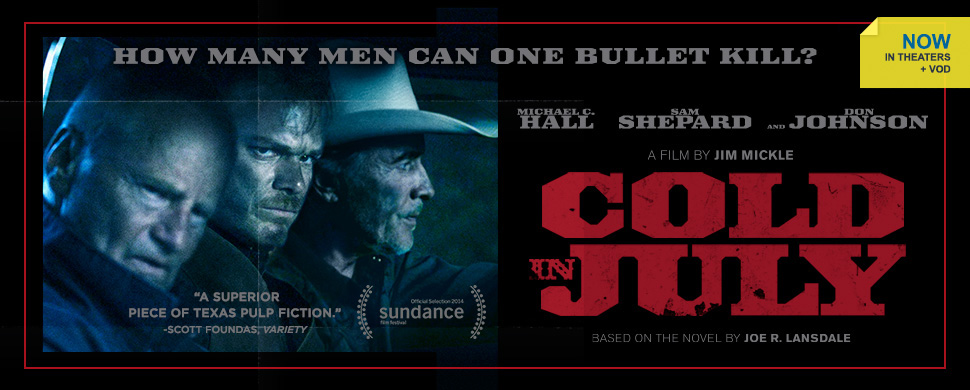
Cold in July, which is currently available OnDemand and also playing in select theaters, is a great film.

To a large extent, you’re simply going to have to take my word about that because to give too much away about this twisty and emotionally resonant thriller would be a crime.  Quite frankly, I’d rather write a vague review than rob you of the pleasure of discovering this film’s secrets for yourself.

Here’s what I can tell you.

Cold In July takes place in east Texas and, speaking as a Texan, it manages to perfectly capture the odd mix of southern gothic and western stoicism that distinguishes that section of Texas from the rest of the state.  Cold in July is one of the best Texas-set films that I’ve ever seen, one that is uniquely Texan and yet still accessible for those viewers who live elsewhere (except maybe for Vermont).  Director Jim Mickle and cinematographer Ryan Samul fill Cold In July with hauntingly beautiful images of the landscape, capturing that unique Texas stillness that can be both tranquil and threatening at the same time.

Michael C. Hall plays Richard Dane, an ordinary guy who, at the start of the film, confronts and kills a burglar who has broken into his house.  While nearly everyone else in town is impressed by Richard’s actions, Richard is haunted by them.  While everyone else tells Richard that he should be proud for standing up against crime, Richard is obsessed with the bloodstains that now decorate his living room wall.  Richard grows even more uneasy when the town’s police chief informs him that the burglar’s father has recently been paroled from Huntsville Prison.

When Richard goes to the burglar’s funeral, he meets the quietly menacing Ben Russell (Sam Shepard).  Ben reveals that Richard killed his son and then goes on to suggest that maybe, in order to even the score, Ben should now go after Richard’s son.  Even after the police agree to protect Richard and his family, it quickly turns out that Ben is a lot more clever than anyone realized…

And that’s all I can tell you about this film’s plot without spoiling the many twists and turns.  I can, however, assure you that anything you may be assuming about this film or the relationship between Richard and Ben is probably incorrect.  This is a film that starts out like an effective but standard thriller and then, about 30 minutes into the action, the story suddenly goes off in an entirely different direction.  The fact that the film manages to pull off such a sudden shift in tone and plot is due to both Mickle’s confident direction and the excellent performances of Hall and Shepard.

I can also tell you that this film features a great and award-worthy supporting performance from Don Johnson.  Johnson plays Jim Bob Luke, a flamboyant private detective who also owns a pig farm and drives a red Cadillac with vanity plates that read “RED BTCH.”  Johnson brings a jolt of life to the film right when it most needs it.  Jim Bob starts out as comic relief but, as the film progresses, Johnson brings a surprising amount of gravitas to the role until finally, Jim Bob is as much the moral center of the story as Tommy Lee Jones was in the thematically similar No Country For Old Men.

Finally, I can tell you that Cold In July is a violent film but it’s not the empty, consequence-free mayhem that you might expect to see in a thriller like this.  It’s hard to explain without giving away too much of the plot but I would have to describe it as almost being “violence with heart.”  Cold In July may be violent but it’s never mindless and that makes all the difference.

As I said, it’s difficult to review Cold In July because to go into too much detail would run the risk of ruining the film’s many surprises.  So, instead, I’ll just say that Cold In July is one of the best films of the year so far.

It’s a film that you, as a lover of cinema, owe it to yourself to see.

Quick Review: How to Train Your Dragon 2 (dir. by Dean Dublois)


how-to-train-your-dragon-2-poster1-690x1024Ah, Berk. That fictional far away land where Dragons once plagued humans, until a young boy made friends with a Night Fury and changed everything.

How I’ve missed this place.

Fox & Dreamworks’ How to Train Your Dragon 2 brings us back to its dragon riding fun, taking place 5 years after the events of the first film. While the story doesn’t have the same level of depth as say, Kung Fu Panda 2, it still manages to be an enjoyable thrill ride when the dragons are taking flight.

Since this is an animated feature, let’s do visuals first. The animation is roughly the same as the original, with a bit of aging here and there for the main characters, but both the colors and the depth of field are a major standout. Cinematographer Roger Deakins (Skyfall) was brought back on board as  a consultant for the lighting, focus and color tones and it definitely shows. If at all possible, this film should be seen in its 3D format. The flight sequences are a joy to behold and when they’re not flying, you shouldn’t find yourself squinting and pinching your nose too much. Chris Sanders wasn’t on hand this time for the writing and directing, although you can still see his designs all over the film.

Additionally, there were a number of technical changes that improved the process. Just as Pixar did with Renderman, Dreamworks ended up creating their own software, Apollo. Apollo uses two tools – Premo, which allowed the animators better control of characters through the use of Wacom tablets. Even more magical is Torch, a lighting system developed with Deakins’ assistance that allowed for more natural setups in animation. One of the best uses of this is when Hiccup is surrounded in a dark room and needs to use his sword to illuminate the area. It’ll be interesting to see how it’s used in other Dreamworks projects.

All of the familiar characters are back – Jay Baruchel’s Hiccup is a little older, and much wiser than in the original, with he and Toothless mapping the lands around Berk during their flights. Hiccup’s flair for gadgetry hasn’t left him, as in this film, the character is introduced almost as a medieval Batman. Between he, his father Stoic (Gerald Butler) and his girlfriend / Dragon Racing Champion Astrid (America Ferrera), they get the bulk of the screen time. His friends, played by Jonah Hill, Christopher Mintz-Plasse,  and Kristen Wiig, felt more like cameos than anything else here. Then again, they really didn’t have that great a part in the first film. Toothless, the Unholy Offspring of fire and darkness itself, is still as cuddly and emotive as ever, despite not being able to actually speak. Through the film, both Toothless and Hiccup find themselves growing up in different ways and their relationship is at the heart of everything here. Hiccup and Stoic still have family issues, this time centering around Hiccup preparation for becoming Chief of the town after Stoic steps down.

When Astrid and Hiccup discover dragon hunters (Lead by Game of Thrones’ Kit Harrington, whose character here still knows nothing), they find a new evil on the horizon in the form of Drago (Guardians of the Galaxy and Blood Diamond’s Djimon Hounsou), who is building a dragon army to do some harm.

Where the movie may stumble is in its last act. It felt abbreviated to me, but as this is meant for children, I suppose it’s not meant to be that long of a film. Clocking in at 102 minutes, it moves fast. For a kid’s film, Dragon 2 rises to some interesting heights that even adults would appreciate. The film doesn’t assume you need to be retold everything you may have missed in the first film, though it does reference some elements of it. The themes of the story are coexistence (between humans & dragons), leadership, friendship and family, and they’re done well.