“All these traditions, jack-o’-lanterns, putting on costumes, handing out treats, they were started to protect us, but nowadays… no one really cares.” — Principal Steven Wilkins
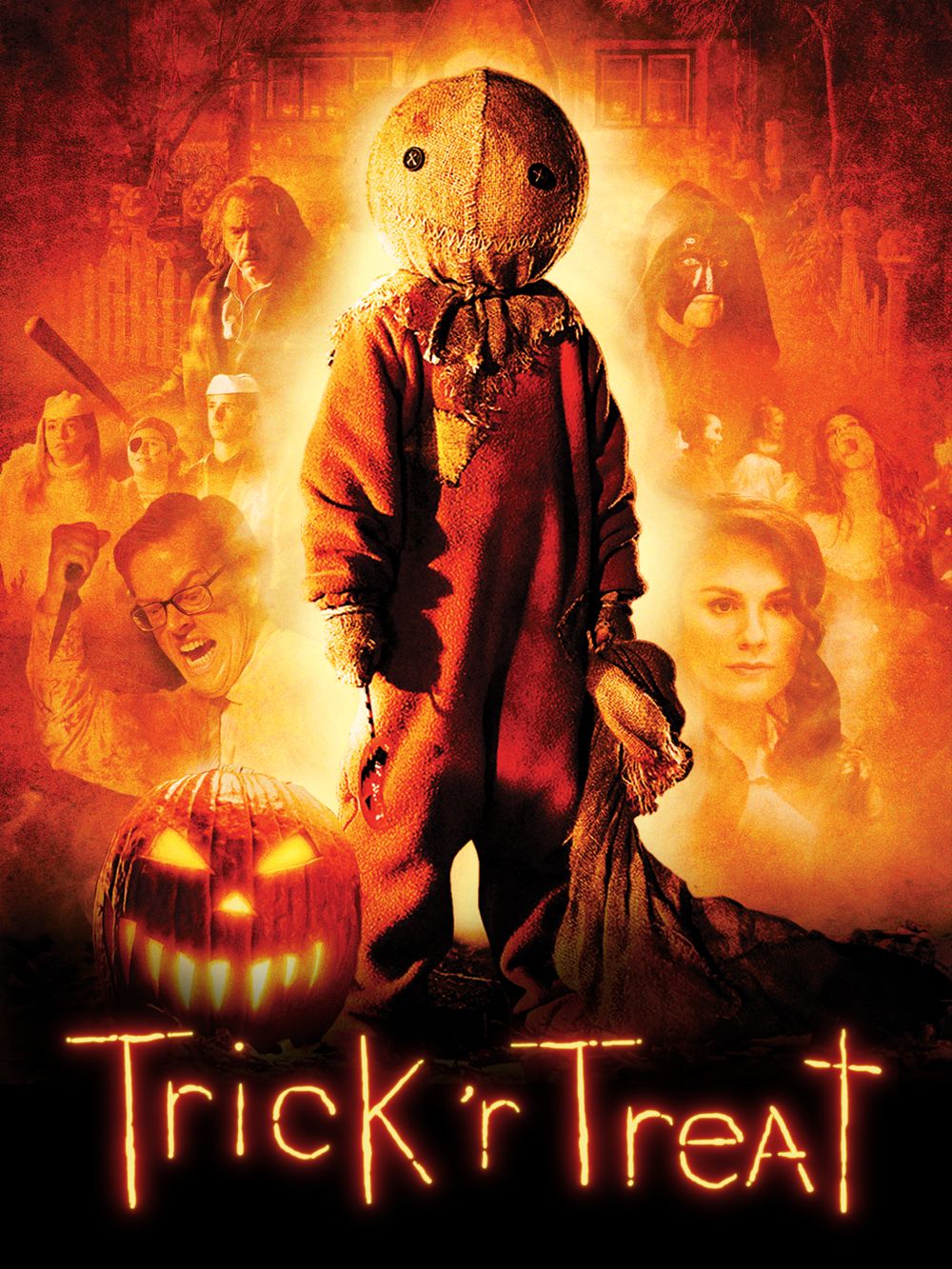
What better and more fun way is there to celebrate the full month of scares and horror that October has become than with Michael Dougherty’s 2007 film Trick ’r Treat? It is the kind of Halloween movie that feels less like it was merely set on the holiday and more like it was built out of everything people love about it. Trick ’r Treat has jack-o’-lanterns glowing on porches, costumes ranging from charming to grotesque, chilly nighttime streets, old local legends, candy bowls, haunted-school-bus stories, werewolves, serial killers, and that ever-present feeling that something is watching from behind a tree. It is funny, nasty, creepy, and strangely cozy at the same time. More than almost any modern horror film, it understands Halloween as a whole atmosphere rather than a collection of familiar props.
At first glance, the movie looks like an anthology film. It is divided into several distinct stories with their own central characters, premises, and horror styles. One segment involves a principal with a murderous secret, another follows a group of kids investigating a grim local legend, another centers on young women looking for dates at a costume party, and another focuses on a bitter old man dealing with a small but persistent visitor. Each story could almost function as its own short horror movie. Dougherty clearly enjoys shifting tones, moving from slasher material to ghost-story melancholy, then into monster-movie lunacy and dark comedy. But the key difference is that Trick ’r Treat is not simply an anthology stitched together by a host or a framing device. Every story told in the film ties into an overarching story unfolding across one night of Halloween.
That structure is one of the movie’s smartest features. Characters drift in and out of one another’s narratives, sometimes briefly and sometimes in ways that completely change the audience’s understanding of what they have already seen. A person who seems like a background extra in one sequence becomes the focus of another. A strange sound, a distant scream, a passing school bus, or a visual detail in one story can gain much more meaning when it reappears elsewhere. The movie plays with chronology too, allowing events to overlap and occasionally revealing that scenes which seemed straightforward were occurring at a different point in the night than viewers assumed. It rewards attention without becoming confusing for the sake of being clever.
Dougherty handles those connections smoothly because the film never stops feeling like one continuous Halloween night. The transitions are playful rather than showy. The camera may follow a character down a street, past a decorated yard, into another group’s story, and suddenly the audience has entered a different kind of nightmare. That makes the town itself feel like a character. It is not a generic horror-movie setting where bad things happen because the script requires them to. It feels like a community with traditions, buried crimes, local myths, annual rituals, and plenty of people who are either hiding something or about to discover something unpleasant.
The town’s Halloween obsession is also what gives the film its personality. Trick ’r Treat treats Halloween rules almost like ancient laws: wear a costume, hand out candy, never blow out a jack-o’-lantern before midnight, and always respect the dead. Breaking those rules does not guarantee immediate punishment in a simple moralistic way, but it certainly puts people at risk. The film’s central icon, Sam, embodies that idea. Wearing orange pajamas, a burlap sack mask, and carrying a lollipop that can become a weapon, Sam is one of the great modern horror mascots because he is both adorable and deeply unsettling. He is not presented as a typical slasher villain with a detailed backstory or a conventional motivation. He feels more like the living spirit of Halloween itself: mischievous, ceremonial, cruel when necessary, and completely devoted to the holiday’s traditions.
Sam’s presence gives the movie a connective thread beyond plot mechanics. He appears in the background, watches over events, and eventually takes center stage in a way that is both amusing and genuinely tense. There is something almost storybook-like about him. He resembles a child going door to door for candy, but his behavior suggests an old supernatural force enforcing rules everyone else has forgotten. The movie wisely never overexplains him. Horror icons often become less interesting once every mystery is reduced to lore, family trees, and exposition. Sam works because Dougherty lets him remain partly unknowable.
The cast is another reason the film holds together so well. Dylan Baker is excellent as Steven Wilkins, the seemingly mild suburban principal whose cheerful politeness becomes much more disturbing once the movie reveals what he is doing after dark. Baker has a talent for making every smile look just slightly too controlled. His storyline is especially effective because it mixes grotesque humor with an unsettling domestic quality. He is not stalking victims through a foggy forest or living in an abandoned asylum. He is cleaning up a mess in his backyard while trying to maintain a normal family routine. That contrast makes his scenes nastier and funnier.
Brian Cox brings real weight to Mr. Kreeg, the grumpy old man at the center of the film’s most memorable Sam-focused material. Cox could have played him as a broad caricature, but he gives the character enough fear, frustration, and hidden sadness to make the confrontation feel more substantial than a simple old-man-versus-monster sequence. The movie’s final act uses his house almost like a haunted maze, with the warm, cluttered interior gradually becoming a battlefield. The tone remains playful, yet there is a real sense of danger whenever Sam drops the cute disguise and shows what he can do.
Anna Paquin also stands out in the segment involving Laurie and her friends. At first, it seems like the film is setting up a familiar vulnerability narrative: young women in costumes, a dark forest, strange men, and the possibility of a predatory attacker. Then Trick ’r Treat gleefully twists expectations. The reveal is not subtle, but it is staged with enough energy and confidence that it lands as a crowd-pleasing monster-movie moment. Dougherty knows that horror does not always need to be grim to be effective. Sometimes the best reaction is an audience laughing in surprise right before a scene turns bloodier than expected.
The school-bus story is probably the film’s creepiest material. The idea of children killed by adults and returning as drowned, decayed figures could have been handled in a cheap or overly cruel way, but the movie gives it a sad, mythic edge. The ghosts are frightening, but the story is also about guilt, buried history, and a town that has allowed its ugliest secret to become a campfire legend. The children may be supernatural monsters by the time they reappear, but the adults who wronged them are even more horrifying. That is a recurring theme throughout Trick ’r Treat: Halloween monsters are dangerous, but human selfishness, cowardice, and cruelty tend to create the worst consequences.
Visually, the film has aged remarkably well because it does not chase a slick, overly polished look. It has a rich autumnal color palette full of oranges, blacks, deep reds, and warm porch-light yellows. The night scenes are dark enough to feel threatening but clear enough that viewers can appreciate the costumes, decorations, and production design. Every street seems covered in leaves, every house has candles or carved pumpkins, and every shadow seems capable of hiding a creature. It feels like a heightened version of childhood Halloween memories, except those memories have been invaded by murderers, werewolves, demons, and ghosts.
The practical effects and creature work add a lot to that charm. The movie uses CGI when needed, but it does not depend on weightless digital spectacle. Sam’s physicality, the werewolf transformations, the decayed school-bus children, and the various masks and props all have a tactile quality. They look like things that belong in a haunted attraction, a particularly elaborate costume shop, or an old EC Comics-style horror story. That handmade texture fits the film perfectly. Trick ’r Treat is polished, but it never feels sterile.
What makes the movie so rewatchable is how comfortably it moves between tones. It can be goofy without becoming stupid, gruesome without becoming exhausting, and sentimental about Halloween without turning saccharine. It embraces the holiday’s childish excitement while acknowledging the darker folklore underneath it. There is candy, costumes, and neighborhood fun, but there are also old grudges, punished sinners, restless dead, and things that hunt after midnight. Dougherty understands that those two sides belong together. Halloween is fun partly because it lets people play with fear in a safe, communal way, and Trick ’r Treat captures that balance better than most horror movies.
The film’s anthology-like design gives it variety, while its overlapping characters, recurring events, and shared setting make it feel like one cohesive story rather than a disconnected collection of shorts. Its lasting popularity has also made the lack of a sequel feel increasingly strange. Fans have been clamoring for another trip through Sam’s Halloween night for years, and Dougherty has repeatedly hinted that he has ideas for where a follow-up could go. He has discussed multiple script drafts, storyboards, concept art, and the possibility of giving Sam a new adversary, but the project still has not received an official greenlight.
That uncertainty is frustrating, especially because Trick ’r Treat feels like a world with plenty more stories left to tell. At the same time, it is probably better that Dougherty has not rushed out a sequel just to cash in on the film’s cult status. The original works because it feels carefully constructed, visually specific, and completely committed to its Halloween setting; any follow-up would need to preserve that same mix of horror, comedy, folklore, and interconnected storytelling. For now, Trick ’r Treat remains an annual October rewatch because it honors Halloween’s old traditions while creating its own: a funny, spooky, blood-soaked celebration of costumes, candy, campfire legends, and the things that come out once the porch lights go dark.