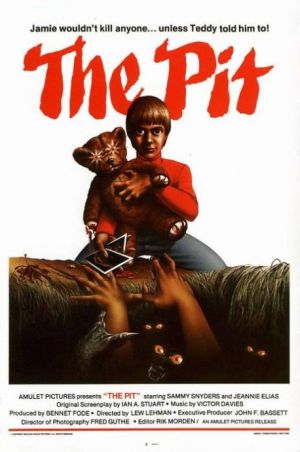
For today’s horror on the lens, we have an odd little Canadian horror film from 1981.
The Pit tells the story of 12 year-old Jamie Benjamin (Sammy Snyders, giving a genuinely creepy performance), a weird kid who lives in rural Wisconsin. Jame is an outcast who is regularly picked on by the other kids. His only friend is a teddy bear with whom he has regular conversations and yes, Teddy does talk back.
One day, Jamie comes across a pit out in the middle of the woods. The pit is full of cannibalistic monsters. Jamie quickly takes a liking to them and starts to bring them raw meat. However, Teddy has a better idea. Maybe Jamie could start feeding them people…
In the original script, both Teddy and the monsters were supposed to be figments of Jamie’s imagination. However, director Lew Lehman made the decision to make the monsters real and to keep the audience guessing as far as Teddy was concerned. The end result is a very odd film about a very odd kid.
And you can watch it below!
(Warning: Though this film is tame by our standards, it would still probably be considered to be NSFW.)
What makes us human? What does it mean to have free will? What is love? What is freedom? The questions and more are asked in the low-budget (and rather odd) science fiction epic The Creation of the Humanoids, which you can view below!
Now, I should warn that Creation of the Humanoids is an extremely talky film. And the plot really doesn’t make much sense. However, I still like it because it’s just such a strange movie. I love it for the colorful set design, the contrast between the resentful robots and the paranoid humans, and the fact that the film — despite being made for next to nothing — actually has more ambition than anything ever made by Michael Bay.
First released in 1962, Creation of the Humanoids was reportedly one of Andy Warhol’s favorite films. Keep an eye out for Plan 9 From Outer Space‘s Dudley Manlove.
I have to admit that I’m always a little bit cynical whenever I hear various film fans bemoaning films that were never made. These are the films that were nearly made but ended up being abandoned because the production company ran out of money or maybe a lead actor died or maybe the studio refused to release it or else they released it in a heavily edited form. There’s a certain tendency among hipsters to decide that any movie that they will never be able to see would automatically have been the greatest film ever. It’s rare that anyone ever suggests that maybe it’s for the best that Stanley Kubrick never made his version of Napoleon or that maybe Ridley Scott’s version of I Am Legend would have been just as bad as the version that starred Will Smith or even that the footage that we have of Orson Welles’s unfinished The Other Side of The Wind doesn’t look that impressive.
In fact, some day, I want to see a documentary about an abandoned film where everyone says, “Oh my God, I’m glad that movie never got made. It would have sucked!”
However, that documentary is never going to be made. The great thing about praising a film that was never made was that you don’t have to worry about anyone watching the film and then going, “You have no idea what you’re talking about!”
For instance, I recently watched an excellent documentary called Jodorowsky’s Dune. This film tells the story of how the iconoclastic director Alejandro Jodorowsky attempted to make a film out of the science fiction novel Dune in the mid-70s. During the documentary, Jodorowsky explains that his version of the story would, in many ways, be different from the book. Since I’ve never read the book nor have I seen any of the various adaptations that actually were eventually produced, I can’t say whether Jodorowsky’s changes would have been an improvement. For that matter, I can’t say whether or not Jodorowsky’s film would have been great or if it would have been a legendary misfire. I’ve seen El Topo and The Holy Mountain so I’m pretty sure that his version of Dune would have been uniquely his own. But there’s no way for me — or anyone else for that matter — to say whether or not the film would have been any good because, after assembling an intriguing cast (Orson Welles, Mick Jagger, Salvador Dali, and David Carradine) and recruiting several talented artists and technicians (H.R. Giger, Dan O’Bannon, Chris Foss, and Moebius), Jodorowsky was never able to make his film. The Hollywood studios took one look at Jodorowsky’s vision and said, “There’s no way were paying for that.”
However, the documentary goes on to make a very intriguing argument that Jodorowsky’s Dune may be the most influential film never made. Many of the people who collaborated with Jodorowsky would go on to work on other science fiction films and, when they did, they brought with them many of the ideas and concepts that were originally developed for Dune. The documentary not only suggests that this might be true but also offers up some pretty compelling evidence, showing us how everything from Raiders of the Lost Ark to Prometheus has featured scenes that originally appeared in Jodorowsky’s Dune storyboards.
I may not be totally convinced that Jodorowsky’s Dune would have been the greatest film ever made but I love this documentary. The majority of it is spent just listening as Jodorowsky, alternating between English and Spanish, tells us the story of what he hoped to do with Dune and how, ultimately, he could not do it. Jordorowsky’s love of film and art is obvious with each word that he says. Whether he’s talking about meeting Salvador Dali or passionately advocating for creativity and imagination, Alejandro Jodorowsky is never less than charming and inspiring.
If you love movies, you’ll love Jodorowsky’s Dune. If you don’t love movies, Jodorowsky’s Dune will change your mind.
Every year, we get another Black List. Despite the name, the Black List is not the annual list of actors and directors who need to be run out of America because of their political beliefs. Instead, the Black List is a survey of the “most liked” unproduced scripts that are currently floating around Hollywood.
Now, of course, to a large extent, the Black List is basically just another marketing gimmick. A lot of the scripts that have appeared on the Black List were already in development at the time that they appeared and, undoubtedly, there are clever studio execs who think to themselves, “Junomight be a difficult sell so let’s make sure it gets on the Black List!”
However, every year, there are a few films that are put into production directly as a result of the script appearing on the Black List. What’s interesting is just how many of these films turn out to be, if not quite terrible, at least rather forgettable. Transcendence, for instance, was on the Black List. Cedar Rapids was on the Black List. Broken City was on the freaking Black List. Consider this: The Beaver would never have been made except for the fact that it was on The Black List!
What’s particularly interesting is that the script was often the worst thing about these films. These were films with overly complicated scripts that often tried too hard to be both crowd pleasing and quirky. If nothing else, the Black List proves that being the “most liked” doesn’t mean that a script is good, interesting, or intelligent. It just means that it covered all the bases.
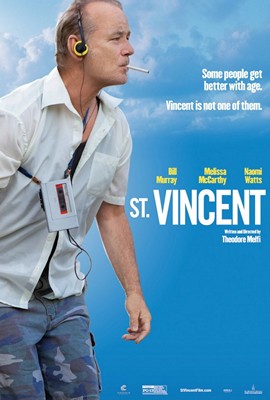
Case in point: the new film St. Vincent. St. Vincent sat on top of the Black List and was apparently so “well-liked” that screenwriter Theodore Melfi not only saw his script produced but he also got to direct it. And wouldn’t you know it — the two biggest failings of St. Vincent are the script and the direction.
It’s easy to point out why the direction is bad so I’ll start there. St. Vincent essentially looks like the pilot for one of those sitcoms that would be described as being edgy just because it was about a cranky old man. There is no visual flair to the film. The images just sit there flat on the screen.
As for the script, it would be likable if it didn’t try so hard. St. Vincent is about a guy named Vincent, a war hero who is now a cantankerous old alcoholic and a pathological gambler. His best friend is a pregnant Russian stripper. He owes money to a violent bookie. Every weekend, he visits his wife in a nursing home and he pretends to be a doctor. His wife no longer recognizes him. When the recently divorced Maggie and her awkward son Oliver move in next door, Vincent agrees to babysit after school. At first, Vincent just does it for the money but, as the movie progresses, he teaches Oliver how to stand up for himself and Oliver makes Vincent a little less grumpy. Eventually, Oliver has to do a report for a school about someone in his life that he considers to be a real-life saint and guess who he picks?
St. Vincent tells the type of story that would usually bring me to tears and I’ll admit that there were a few times when I did get teary-eyed. But, ultimately, the script was too heavy-handed for me to maintain those tears. I love crying at movies but, at the same time, I resent it when a movie demands that I cry just because it happens to be mashing down on all of the right buttons. This is one of those movies that doesn’t trust the audience. Instead of letting us react to the characters, it just keeps piling on development after development. It’s not enough that Maggie is a single mother who feels guilty about not being able to pick her son up from school. Instead, Maggie’s ex-husband has to suddenly sue for custody. It’s not enough that Vincent is struggling to pay the bills. Instead, he has to have a bookie who shows up at random and threatens to kill him. There’s more to an effective dramedy than just having half of your cast act as if they’re in a sitcom while the other half acts as if they’re appearing in an old episode of Law & Order.
And yet, despite the script and despite Melfi’s direction, St. Vincent does work and it really works only for one reason. Melfi has managed to assemble a truly outstanding cast. In the role Maggie, Melissa McCarthy proves that she deserves better than having to spend her career making movies like Identity Thief. Jaeden Lieberhrer is likable and sympathetic as Oliver. Playing the pregnant Russian stripper, Naomi Watts does the best that anyone probably could do with that poorly written character.
But, ultimately, the film is totally about Bill Murray. Bill Murray plays Vincent and he saves the entire film. Whether he’s being funny or being serious, Bill Murray gives the type of great performance that justifies his reputation for being a national treasure. When those tears did come to my eyes, it was all due to Murray’s performance.
St. Vincent is a deeply flawed film but it’s worth seeing for Bill Murray.
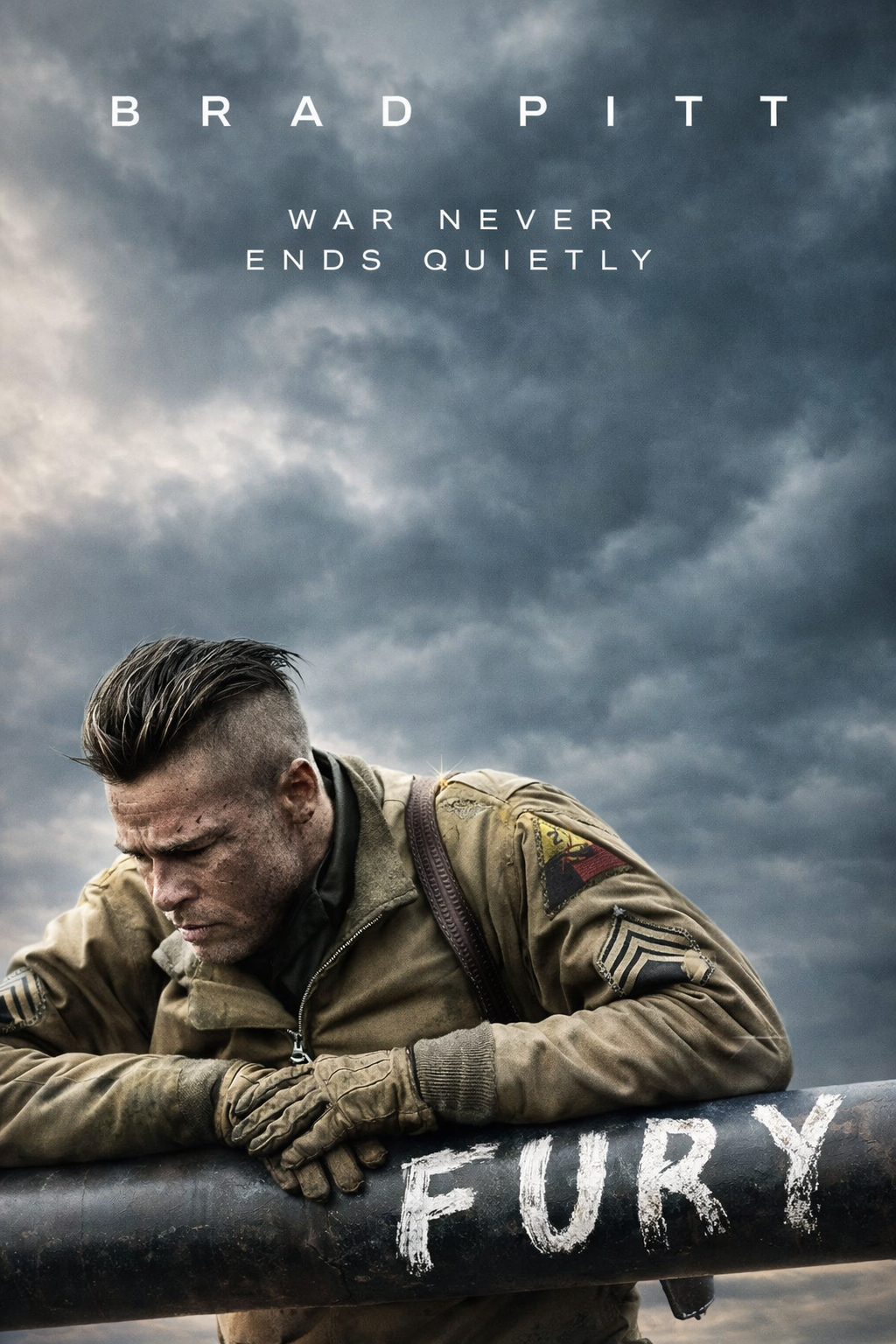
You know that feeling when a war movie tries so hard to be gritty that it forgets to be anything else? Fury, directed by David Ayer, flirts with that problem but mostly stays on the right side of the line. Released in 2014, this WWII drama follows a five-man American tank crew as they push deeper into Nazi Germany in April 1945. The war is almost over, but as the film constantly reminds us, that only makes the fighting more desperate and meaningless. Ayer, who wrote Training Day and directed End of Watch, clearly wanted to make a grimy, claustrophobic, and visceral experience—not a clean, heroic adventure. And for the most part, he succeeds. But the movie is also uneven, sometimes brilliant, and occasionally frustrating. One thing becomes clear early on: Ayer is not just making a war movie. He is trying to out-war the war movie that changed everything. Saving Private Ryan raised the bar for realistic combat violence in 1998, and ever since, directors have been chasing that opening Omaha Beach sequence. Fury spends its entire runtime trying to shove that bar even higher, especially in its final act, where the violence tips over from realistic into something almost performative—as if Ayer is daring you to look away.
The plot is simple. We meet Don “Wardaddy” Collier, played by Brad Pitt, as the seasoned commander of a Sherman tank nicknamed “Fury.” His crew includes Boyd “Bible” Swan (Shia LaBeouf), the religious gunner; Coon-Ass (Jon Bernthal), the volatile loader; and Grady (also Bernthal, though the character is actually Grady “Coon-Ass” Travis; the movie gives everyone a nickname). The crew loses their assistant driver in the opening scene, and they get a replacement: Norman Ellison (Logan Lerman), a young typist who has never fired a gun and has no intention of killing anyone. The rest of the film is basically a crash course in how war turns gentle men into monsters—or at least into effective killers.
What works best in Fury is the sense of being trapped inside a steel coffin. Ayer films almost everything from inside the tank or right next to it. You hear every shell clank, every engine strain, every bullet ping off the hull. The sound design is incredible—it’s the kind of movie where you feel the bass in your chest during combat scenes. And the tank battles are brutally realistic. There’s no slick choreography here. When a German Tiger tank shows up, the fight becomes static, clumsy, and terrifying. The Sherman isn’t some superhero; it’s outgunned and out-armored, and the crew wins only because they’re desperate and lucky. That sequence alone is worth the price of admission. You can feel Ayer’s respect for Saving Private Ryan in those moments—the same handheld cameras, the same sudden death, the same sense that no one is safe. But then the film goes further.
Brad Pitt gives one of his tougher, quieter performances. Wardaddy isn’t a philosopher or a hero. He’s a tired man who has seen too much and made too many compromises. He forces Norman to execute a German prisoner, not out of cruelty but out of a cold, broken logic: if Norman can’t kill, he’ll get the whole crew killed. Pitt sells the weight of that decision without grand speeches. Shia LaBeouf is surprisingly restrained as Bible, a character who prays before each battle but never preaches. The real surprise is Logan Lerman. He starts as a scared kid who vomits at the sight of corpses and ends the film doing things that would ruin anyone’s soul. His transformation is uncomfortable to watch, but that’s the point.
However, the movie has some clunky moments. One extended scene has Wardaddy and Norman sharing a meal with two German women in an abandoned apartment. It’s supposed to show a brief flash of normal life—eggs, music, a soft bed—but it feels oddly staged. The women are just props. They have no real personality except to be gentle and then get killed offscreen. It’s a rare moment where Ayer’s macho instincts flatten the story instead of deepening it. But the real problem is the final act. The crew holds a crossroads against an entire SS battalion of about 200 men, doing it with a broken-down tank that cannot move. Realistically, they’d be dead in minutes. But Ayer turns it into a grim last stand that feels more like a Western than a WWII movie. The Germans attack in waves like idiots, running straight into machine-gun fire. And here is where you sense Ayer’s real intention: he is not trying to be realistic anymore. He is trying to one-up Saving Private Ryan by making the violence not just brutal but excessive, almost numbing. Limbs fly. Faces get torn open. The camera lingers on wounds long past the point of necessary storytelling. It feels like Ayer is saying, “You thought Spielberg was intense? Watch this.” But instead of adding emotional weight, the violence starts to feel like a dare. The movie becomes less about these five men and more about proving it can stomach more than any other war film.
Thematically, Fury is about how institutions crush individuality. Norman was a decent person who typed letters and likely never hurt anyone. By the end, he is sitting in the commander’s seat, pulling triggers without hesitation. The movie doesn’t celebrate this—it presents it as a tragedy. But the final act undercuts that tragedy because it becomes so cartoonishly violent that you stop feeling for the characters and just wait for the bloodshed to end. Unlike Saving Private Ryan, which uses its famous opening sequence to establish horror and then pulls back for character moments, Fury seems to think that more gore equals more truth. It doesn’t. It just equals more gore.
If you’re looking for a clean story with clear good guys and bad guys, this isn’t it. The Germans are offscreen most of the time, and the real enemy is the war itself. Wardaddy even says, “The only thing that separates us from them is this uniform.” That’s a heavy line, and the film never really resolves it. It just lets it hang there. Some critics called Fury shallow because it raises moral questions without answering them. I’d argue that’s the point. War doesn’t come with footnotes. You just survive or you don’t. But the film’s desperate need to prove it is tougher than its predecessors does make it feel, at times, like a younger brother showing off.
On a technical level, the cinematography by Roman Vasyanov is beautiful in a grim way. Colors are desaturated—browns, grays, washed-out greens. Mud and blood look the same. The camera shakes when it needs to, but it’s not the hyperactive Bourne style. It’s controlled chaos. And the final shot, where the camera slowly pulls back from the dead tank, is haunting. It stays with you.
So, final verdict? Fury is a solid, often great war film that trips over its own ambitions in the last thirty minutes. It wants to be a small, character-driven horror show, then pivots to a heroic last stand that feels like it belongs in a different movie—one that cares more about shocking you than moving you. The comparison to Saving Private Ryan is unavoidable, and Fury clearly wants to be mentioned in the same breath. But where Spielberg used violence as a doorway into human cost, Ayer sometimes uses it as a blunt instrument. The performances are strong, the tank combat is second to none, and the atmosphere is suffocating in the best way. It’s not Come and See, but it’s also not Pearl Harbor. If you can handle the tonal whiplash and the occasional macho posturing, you’ll find a movie that respects its audience enough to leave them feeling dirty. Just don’t expect a clean exit—and don’t expect it to earn every drop of blood it spills.
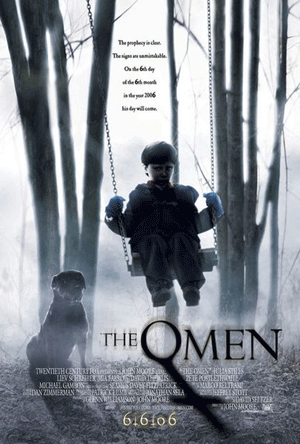
There’s really only one reason to see the 2006 remake of The Omen and that’s the fact that the priest who convinces Ambassador Thorn to adopt the Antichrist is played by the great Giovanni Lombardo Radice.
If you’re a fan of Italian horror, you’ll immediately know who Radice is and, whenever he appears in The Omen, you’ll be momentarily excited. After all, Radice is an actor who has given memorable performances in films made by iconic directors like Lucio Fulci, Ruggero Deodato, Antonio Margheriti, Michele Soavi, and Martin Scorsese. He’s appeared in everything from City of the Living Dead to Cannibal Apocalypse to The House On The Edge of the Park toStagefright to Gangs of New York. As both a horror icon and an excellent actor who has always been gracious and friendly to his fans, Giovanni Lombardo Radice is one of those actors who movie bloggers like me are always happy to see in any film.
(And, if anyone deserves a role in a Quentin Tarantino film, it’s Giovanni Lombardo Radice.)
And Radice gives a really great performance in The Omen. He plays the role with just the right combination of menace and regret. When he first appears, you can tell that he’s determined to get Robert Thorn to adopt Damien but that he’s not particularly happy about having to do it. He may be one of the bad guys but he’s a bad guy with a conscience. Later, when Radice makes a second appearance, it momentarily re-energizes the film. He’s just got such a unique screen presence that, whenever he’s on-screen, Radice reminds you of the film that you want The Omen to be.
As for the rest of the remake — well, it’s all kind of pointless. The film is largely a scene-by-scene remake of the first Omen and, unfortunately, it never quite answers the question of why the film needed to be remade in the first place. The Gregory Peck role is played by Liev Schrieber while his wife is played by Julia Stiles. The doomed photographer is played by David Thewlis. Mia Farrow shows up in the role of the sinister nanny and Mia actually does a pretty good job but whenever she was delivering her lines, it was impossible for me not to imagine a remake of The Final Conflict where Ronan Farrow plays Damien.
Otherwise, the same characters die as in the original film and, often times, they die in the exact same way. It’s really almost lazy how little the remake changes from the original. And, ultimately, it makes the entire movie feel more than a little pointless. You’re left with the feeling that the only reason the Omen was remade was so that it could be released on June 6th, 2006 (a.k.a. 6-6-06).
So, when it comes to The Omen, stick with the original but watch the remake for Giovanni Lombardo Radice.
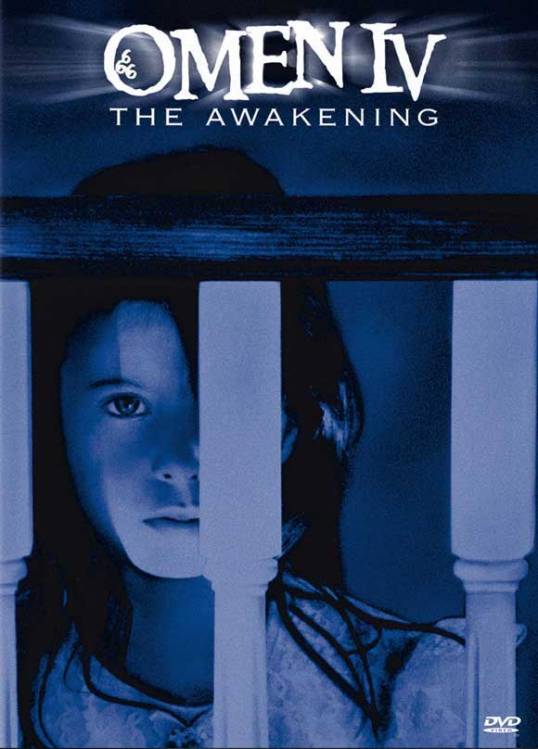
That was the question that I asked myself many times last night as I watched Omen IV: The Awakening.
Seriously, it is just the WORST* and, if not for my own need to be a completist, I probably would have stopped watching after the first ten minutes. But you know what? I love movies, I love this site, and even more importantly — I LOVE YOU! And I would do anything for you so I watched Omen IV: The Awakening so you wouldn’t have to.
Of course, when would you ever have to? I probably should have considered that before I sat down to watch the film.
ANYWAY — let’s keep this quick. The Omen IV: The Awakening was made for television and was originally broadcast way back in 1991. It tells the story of Virginia Congressman Gene York (Michael Woods) and his wife, Karen (Faye Grant, who is currently in the news because of a tape that’s surfaced of her ex-husband Stephen Collins confessing to being a child molester). Gene and Karen cannot have children so they adopt a baby from a bunch of nuns. What they don’t suspect is that some of the nuns are actually in league with Satan and that their new daughter is actually the child of Damien Thorn!
Seven years later, they’ve named their daughter Delia and Delia has grown up to be something of a sociopath. A bunch of new age hippie types suspect the truth about Delia but, whenever they get close to revealing that truth, they end up getting killed in freak accidents. Meanwhile, Gene insists nothing is wrong while Karen…
Oh, forget it. This movie is so bad that it’s painful to even try to describe the plot.
Let’s just say that this is an amazingly bad movie that has none of the power of the first Omen. Nor is it as unintentionally fun as Damien: Omen II. And none of the actors do as good as job as Sam Neill did in The Final Conflict. Instead, it’s just a rather dull film where the tedium is only occasionally interrupted by somebody dying a terrible death. There are two effective sequences — one in which a private detective (Michael Lerner) is chased by demonic spirits and another where a snake handler gets distracted just long enough to get bitten a few thousand times. Otherwise, Omen IV: The Awakening deserves its terrible reputation.
AVOID IT AT ALL COSTS!
(Which probably won’t be hard since I imagine that the only way you could be tricked into watching it would be if you’re one of those film bloggers who insists on being a completist…)
—–
* Yes, it’s so bad that it gets the all caps treatment.
Originally, it had been planned that the Omen franchise would be made up of six or seven films and that each movie would check in on another year in the life of Damien Thorn, a bit like an apocalyptic version of Boyhood. However, after Damien: Omen II failed to perform up to expectations, plans were changed.
Instead of continuing the story of Damien’s adolescence, the 1981 film Omen III: The Final Conflict jumps straight into Damien’s adulthood. Now 32 years old and played by a very young (and handsome) Sam Neill, Damien Thorn is now the CEO of Thorn Enterprises. With the help of his loyal assistant Harvey Dean (Don Gordon), Damien has become one of the most popular and powerful men on the planet. Thorn Enterprises, having followed Paul Buhler’s scheme from the second film, is now responsible for feeding a good deal of the world. Damien is seen as being a humanitarian and a future President. When the U.S. Ambassador to the United Kingdom reacts to spotting a black dog in the park by committing suicide, Damien is appointed to the position.
(Needless to say, everyone in London is happy to see Damien. Nobody says, “I just hope you don’t end up going crazy and dying a violent death, like everyone else in your family and immediate circle of acquaintances.” But they’re probably thinking it…)
Now in London (and also appointed to be head of the United Nations Youth Organization, which just goes to show that your crazy uncle is right and the United Nations is a conspiracy), Damien pursues a rather creepy romance with journalist Kate Reynolds (Lisa Harrow) and makes plans to prevent the Second Coming by killing every single baby born on the morning of March 24th. (But Harvey’s son was born on March 24th — wow, could this lead to some sort of conflict?)
Meanwhile, a group of priests (led by an embarrassed-looking Rossanno Brazzi) have recovered these damn daggers of Megiddo and are now all attempting to assassinate Damien. Unfortunately, none of them are very good at their job. (“You had one job, Father! One job!”)
Bleh.
The Final Conflict is not that good. It’s boring. The plot is full of holes. For instance — and yes, these are SPOILERS — why have we sat through two movies listening to characters insist that Damien has to be stabbed by all seven of the daggers when apparently, just one dagger will do the job? Why, after being told that Jesus is going to be reborn as a child, does he then appear as an adult at the end of the film? And finally, why does nobody ever seem to find it strange that everyone that Damien knows end up suffering a freak accident?
I will say that there are two good things about The Final Conflict.
First off, Sam Neill gives a good performance as Damien Thorn. He’s handsome, he’s charismatic, and he’s not afraid to be evil. But, unfortunately, Damien’s just not that interesting of a character anymore. In the first Omen, he was interesting because he was an evil five year old. In the second Omen, he was at least occasionally conflicted about his role. In the third Omen, Damien is just evil and evil without nuance is boring.
Secondly, there’s that sequence where Damien’s followers go after the babies born on March 24th. Oh my God, that was so disturbing and it was one of the few moments when The Final Conflict actually became horrific.
Otherwise, The Final Conflict is a thoroughly forgettable sequel to a memorable film.
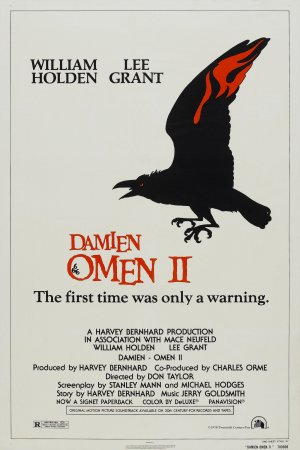
The first sequel to The Omen was 1978’s Damien: Omen II. Damien: Omen II is an odd film, one that is not very good but yet remains very watchable.
Damien: Omen II takes place 7 years after the end of the original Omen. Antichrist Damien Thorn (now played by Jonathan Scott-Taylor) is now 12 years old. He lives with his uncle Richard (William Holden) and Richard’s 2nd wife, Ann (Lee Grant). His best friend is his cousin Mark (Lucas Donat). In fact, the only problem that Damien has is that his great-aunt Marion (Sylvia Sidney) can’t stand him and views him as a bad influence. Fortunately, as usually seems to happen whenever someone puts an obstacle in Damien’s life, there’s always either a black dog or a black crow around to help out.
Damien and Mark are cadets at a local military academy where Damien deals with a bully by glaring at him until he falls to the ground, grabbing at his head. In history class, Damien shocks his teacher by revealing that he knows the date of every battle ever fought. Damien’s new commander, Sgt. Neff (Lance Henriksen), pulls Damien to the side and tells him to stop showing off and to quietly bide his time.
Meanwhile, Richard is busy running Thorn Industries. One of his executives, Paul Buhler (Robert Foxworth), wants to expand Thorn’s operations into agriculture but his plans are opposed by Richard’s executive vice president, Bill Atherton (Lew Ayres), who considers Paul to be unethical. However, during an ice hockey game, Bill falls through the ice and, despite the efforts of everyone to break through the ice and save him, ends up floating away. Paul is promoted and pursues his plans to make money off of world famine. In between all of this, Paul finds the time to speak to Damien and tell him that he has a great future ahead of him.
Along with Thorn Industries, Richard also owns the Thorn Museum in Chicago. The museum’s curator is Dr. Charles Warren (Nicholas Pryor) who was a friend of the archeologist Karl Bugenhagen (Leo McKern) who, in the first film, revealed that not only was Damien the antichrist but that the only way to kill him was by stabbing him with the Seven Daggers of Meggido. Dr. Warren is also friends with Joan Hart (Elizabeth Shepherd), a reporter who both knows the truth behind Bugenhagen’s death and who has also seen an ancient cave painting that reveals that the Antichrist looks exactly like a 12 year-old Damien Thorn.
Much as in the first film, just about everyone who comes into contact with Damien ends up getting killed in some odd and grotesque way. Crows peck out eyes. Trucks run over heads. One unfortunate victim is crushed between two trains. Another is chopped in half by an elevator cable. At times, Damien: Omen II feels less like a sequel to The Omen and more like a forerunner to Final Destination.
Damien: Omen II is one of those films that I like despite myself. It’s bad but it’s bad in a way that only a film from the 1970s could be and, as such, it has some definite historical value. The script is full of red herrings, the acting is inconsistent, and the film can never seem to make up its mind whether Damien is pure evil or if he’s conflicted about his role as Antichrist. As I watched the film, I wondered why the devil could so easily kill some people but not others.
And yet, Damien: Omen II is so ludicrous and silly that it’s undeniably watchable. If the first film was distinguished by Gregory Peck’s defiant underplaying, the second film is distinguished by the way that William Holden delivers every line through manfully clenched teeth. Everyone else in the cast follows Holden’s lead and everyone goes so far over-the-top that even the most mundane of scenes become oddly fascinating.
For me, the film is defined by poor Lew Ayres floating underneath that sheet of ice while everyone else tries to rescue him. On the one hand, it’s absolutely horrific to watch. I’m terrified of drowning and, whenever the camera focused on Ayres desperately pounding on the ice above him, I could barely bring myself to look at the screen. But, at the same time, we also had William Holden screaming, “OH GOD!” and Nicholas Pryror enthusiastically chopping at the ice with a big axe and dozens of extras awkwardly skating across the ice. Somehow, the scene ended up being both horrifying and humorous. It should not have worked but somehow, it did.
And that’s pretty much the perfect description of Damien: Omen II. It shouldn’t work but, in its own way, it does.