And now, suddenly, I’m really looking forward to seeing J.C. Chandor’s latest film.
Here’s the first trailer for A Most Violent Year, which many people are predicting might be a last minute contender in this year’s Oscar race.
And now, suddenly, I’m really looking forward to seeing J.C. Chandor’s latest film.
Here’s the first trailer for A Most Violent Year, which many people are predicting might be a last minute contender in this year’s Oscar race.
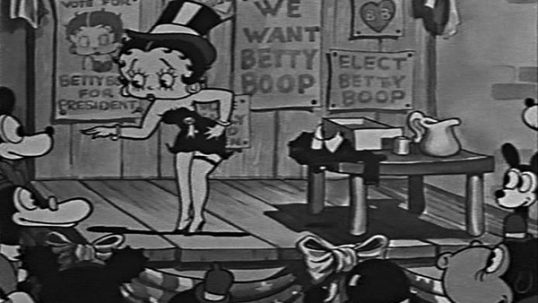
Here in the States, it’s Election Day! Have you voted yet?
Now, I understand why you may not want to vote. The candidates aren’t inspiring. None of the issues seem to have much to do with your life. Washington never changes. Blah blah blah. All I know is that it’s been raining here all day and I still took the time to vote! So there!
Myself, I’m in Texas and we pretty much already know who is going to win all of the elections down here. However, if I lived in California’s 24th Congressional District, I definitely would have voted for Chris Mitchum for Congress. Why? Because he’s Robert Mitchum’s son, of course!
(And he looks a lot like his father too!)
And, just in the interest of bipartisanship, I hope that Clay Aiken does well in his race up in North Carolina because my ultimate hope is that we’ll eventually have a Congress that is completely made up of reality show contestants and retired grindhouse movie actors.
A girl can dream, can’t she?
Anyway! As you watch the election results come in and you either get really happy or really depressed, why not take a trip back to the 1932 with this cartoon Betty Boop For President? If nothing else, it proves that dysfunctional politics existed before 2014 and will continue to exist long after 2014.
Enjoy!
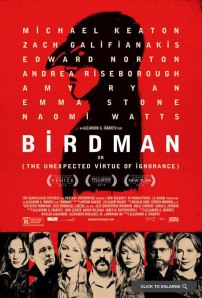 To help you understand how little I knew going into this film, there was a time where I seriously thought Birdman or (The Unexpected Virtue of Ignorance) was a film adaptation of the old Hanna Barbarra cartoon character. I later found out it wasn’t (to my disappointment), but that it was a Michael Keaton movie helped to keep my interest. If Harvey Birdman is what you’re expecting, stop right there. You’re looking for the wrong film.
Here’s the short of it:
If you enjoy the Theatre, Birdman may be right up your alley. With a focus on a play, it takes the view through the nuances of getting the play into action. There are terrific, funny performances throughout (particularly from Keaton and Edward Norton) and it just flows so incredibly well. Birdman explores what it means to be into your craft (in this case, acting), the nature of what Fame actually is these days, and how much a person is willing to get/keep it. You could basically watch this back to back with Black Swan.
From a script by Iñárritu, along with 3 others, Birdman is the tale of a once famous actor dancing a fine line between total irrelevance and greatness. Hoping to reclaim that fame, he attempts to produce, direct and star in a Broadway play, but not everything is going to plan.
Forget any promos and just see it. I skipped a lot of the advertising for this and after watching the movie last night, I saw a commercial for the film that already feels like it gives too much of the film away. If you’ve followed them all, you’ve seen most of Birdman. Had I not already watched Richard Linkater’s “Boyhood”, I might consider Birdman one of the best films I’ve seen this year, especially in terms of the way it was made.
The Long Haul:
Let’s start with the Cinematography, but this will the element that stands out more than anything with this film. Emmanuel Lubezki (Gravity, Children of Men) is at the top of his game here with the use of a seemingly single tracking shot that lasts almost the entire movie. The camera moves from scene with such fluidity that I wonder if it’s entirely CGI. Most of those shots have to be.
Remember that part in Goodfellas where the camera stayed with Karen and Henry Hill on their first date, moving with them through the back of a restaurant all the way to when they took their seats? Or more recently, True Detective’s fantastic shot of an escape/arrest that had McConaghey moving behind houses and over fences? Or the opening “unpacking” tour of the haunted house in The Conjuring? Those are tracking shots. It’s one long take from Point A to Z, instead of cuts at B, C, and so on. If anyone makes a mistake during filming, the crew has to move back to the start of the take and try again if they want the entire shot to be seamless. I have no idea how it was pulled off in Birdman, but it’s beautiful to behold. If the movie gets nothing else come Awards season, Cinematography should be theirs, right now. One could argue it moves like a found footage film sans the shakiness, but you’d have a hard time selling me on that one.
My only nitpick about Birdman, the only problem I had with it was the representation of Critics. Not that what’s said about them is entirely incorrect, but I kind of hunkered down in my seat at some of the commentary. While I wouldn’t consider myself a Critic, I do share my opinions on films. That doesn’t necessarily mean we’re all out to gut the next release on Friday.
It seems almost too appropriate that Michael Keaton – once a Dark Knight himself – has this role. He’s had his ups (Batman, Beetlejuice, and my personal favorite, Johnny Dangerously), his downs (That horrid Robocop remake, blech) and his in-betweens with Need for Speed earlier this year. He carries the character with a depth that rivals Joaquin Phoenix’s performance in The Master. It’s strange, but it works.
At one time, Riggin Thompson (Keaton) was famous in Hollywood as the superhero Birdman, but after passing on a second sequel (much like Keaton leaving Batman behind and passing the baton to Kilmer and Schumacher), he hasn’t found much fame since then. The story starts with Riggin hoping to reclaim his former glories with a revival of “The Things We Talk About When We Talk About Love” on Broadway. When one of his theatre cast members are injured on set, they recruit a popular actor (played with a slightly over the top Edward Norton) that may prove too much to handle. Add to this Riggin’s shaky relationship with his daughter Sam (Emma Stone), an off again / on again love interest (Oblivion’s Andrea Riseborough) a lawyer trying to keep him afloat (Zack Galifinakis), and a voice in his head reminding him of the problems he faces…well, he’s just a mess. Then again, everyone here is a mess in their own way and maybe because of it, they all kind this good sense of chemistry.
The film is backed by a percussion score from Antonio Sanchez, which doesn’t get in the way at all. I’m not sure I’d call it a soundtrack, though. The music sounds great outside of the scope of the film, but you probably won’t recall the music afterward in the way you would for a soundtrack with a full on orchestra.
Birdman is the first film I’ve watched by Alejandro González Iñárritu. I remember that he was nominated for an Oscar with either Babel or 21 Grams. I feel like I’ve missed out on something grand because Birdman is good. Not that “good” you say when when someone puts a broken bone back into place (“Yeah, I’m good.”, he cried), but that “good” that comes from your first taste of creamy Tiramisu. (“Omigod, that is goood!”, he purred). It’s definitely one I can consider catching one more time before it ends it’s run in the cinema.
Last night, I gathered with about 17 friends over at SyFyDesigns and we watched an obscure little fantasy film from 1983, Prisoners of the Lost Universe.

Why Were We Watching It?
We were watching it because we are the late night movie crew and that’s what we do. We watch movies and we watch them late at night and, since we are all intelligent and snarky people, we have a natural tendency to pick movies with titles like Prisoners of the Lost Universe.
(Add to that, since Prisoners of the Lost Universe is in the public domain, it has been included about a dozen different Mill Creek Box sets and it’s also on YouTube. So, it was an easy film for everyone to watch.)
What Was It About?
News reporter Carrie (Kay Lenz) is interviewing Dr. Hartmann (Kenneth Hendel) when a sudden earthquake hits California. Dr. Hartmann stumbles into an interdemensional transporter and disappears! Then Dan (Richard Hatch) stops by Hartmann’s house and he stumbles into the transporter and disappears as well! And then, after that, Carrie stumbles into the transporter and she vanishes! Why is everyone in this movie so clumsy?
Anyway, Carrie is transported to the Lost Universe, which looks a lot like South Dakota. (Actually, the movie was made in South Africa so apparently, South Africa also looks a lot like South Dakota.) Carrie wanders around for a little while and spends a while talking to herself about how much she hates being in the Lost Universe. Part of Carrie’s problem was that she was wearing high heels. If you’re going to visit South Dakota, South Africa, or the Lost Universe, be sure to wear sensible shoes.
Eventually, Carrie is reunited with Dan and they meet a lot of other citizens of the Lost Universe. They meet a green man. They meet a gigantic cave man. They meet a bearded thief. They also meet a tribe of angry people who all have glowing red eyes. When they’re climbing up a mountain, Dan offers a helping hand. “Take your hand off my butt!” Carrie snaps back. They’re not exactly Hepburn and Tracy.
Finally, Carrie is kidnapped by an evil warlord who happens to be played by John Saxon. The warlord has a dueling pistol with him that he uses to enforce his will on everyone else in the Lost Universe. He explains that it was built for him by a sorceror from another universe. Any guess who that is going to turn out to be?
Anyway, it’s up to Dan to rescue Carrie and hopefully end the tyranny of John Saxon.
What Worked?
Prisoners of the Lost Universe is one of those otherwise forgettable films that suddenly becomes the most entertaining thing in the world if you’re watching it with the right people. Last night, I watched it with the right people and our natural wit and snarkiness elevated the entire film.
Beyond the snarkiness, John Saxon made for a good and fun villain. And I liked the Green Man. He had an above-it-all attitude that was very entertaining.
What Did Not Work?
To be honest, it’s really a very bad movie. If I hadn’t been watching this movie with 17 other snarky and talkative people, I imagine I would have been bored out of my mind. If Prisoners of the Lost Universe had been produced by Crown International Pictures, it probably would have been a lot more fun.
“Oh my God! Just like me!” Moments
I have a feeling that if I accidentally got transported to the Lost Universe, I’d probably be wearing high heels as well. And I’d probably complain a lot. Who wouldn’t?
Lessons Learned
Why go to the Lost Universe when you can just go to South Dakota?

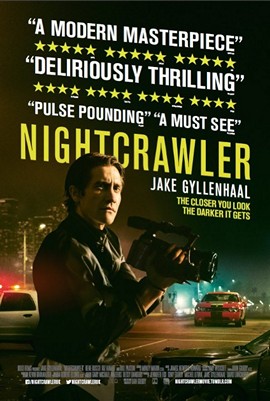
The new film Nightcrawler tells the story of a strange man named Lou Bloom (played, in the performance of his career, by Jake Gyllenhaal). From the minute that we first see Lou, we can tell that there is something off about him. He is a bit too quick to smile and his friendly manner is sharply contrasted with his sunken features. He watches the world with shifty eyes that are surrounded by dark circles that make it appear as if he hasn’t slept for weeks. (And it is interesting to note that, at no point during the film, do we actually see him sleep. He’s always awake.) When he speaks, it’s in an optimistic and ingratiating tone that can barely disguise the fact that everything he is saying is a cliché. He speaks in the language of self-help books and inspirational speakers. What’s interesting is that as empty as Lou’s constant patter may be, he always sounds as if he believes every single word of it.
Despite the fact that Lou is on screen during every minute of Nightcrawler, we learn very little about his background. We don’t learn where he was born. We don’t know how he eventually came to be the person that he is at the start of the film. He has no family. He has no friends. He lives in a small apartment that is distinguished only by how anonymous it ultimately is. The only thing we really know for sure about Lou is that he watches a lot of television. In one of the few moments in the film where Lou actually lets down his guard, he tries to have a conversation with a reporter on a screen despite the fact that the reporter can not hear a word that he is saying.
Lou is first introduced stealing and selling scrap metal. When he’s confronted by a security guard, Lou smiles and says a few friendly words before suddenly attacking the guard and throwing him to the ground. Disturbingly, we never find out what exactly Lou did with that security guard but, when we next see Lou, he’s wearing the guard’s watch.
However, Lou has bigger plans than just being a common thief. When he comes across a car accident, he sees a freelance video journalist (also known as a nightcrawler) filming the police. When Lou finds out how much money he can make by simply filming human misery and then selling the footage to a local news station, Lou trades a stolen bicycle for a radio scanner and cheap camcorder.
After several nights of struggling to get some good footage and discovering that the police don’t like nightcrawlers, Lou manages to get some footage of a dying shooting victim. He sells the footage to a local news station and meets Nina (an excellent Rene Russo), the station’s news director. Nina is impressed with the footage and encourages Lou to find more. She explains to him that she needs crime and disaster footage. She needs footage that will both scare and intrigue her white middle-class audience — violence in the suburbs, families being threatened, and — most importantly — white people being victimized by minorities. As she tells Lou, “The perfect story is a screaming woman with her throat cut, running down a street in a good neighborhood.”
Soon, Lou is finding a lot of success as a nightcrawler, to the extent that he even gets an intern named Rick (Riz Ahmed) to serve as his assistant. Rick is an interesting character and Riz Ahmed gives an excellent performance, one that is overshadowed by the more flamboyant performances of Gyllenhaal and Russo but which is just as important. In many ways, RIck serves as the film’s conscience. Alone among the film’s characters, Rick has a sense of morality but, unfortunately, he’s not observant enough to realize that he’s the only one.
Lou is a complete and total sociopath but Gyllenhaal gives such a compelling performance that you often forget until Lou gives you no choice but to remember. As the film progresses, it becomes obvious that both Lou and Nina depend on bad news for their very existence and, in Lou’s case, he’s not above creating the news that he covers.
Marking the directorial debut of veteran screenwriter Dan Gilroy, Nightcrawler is a hyperkinetic portrait of society at its absolute worst. As some reviewers have pointed out, Nightcrawler is often a bit heavy-handed when it comes to portraying the vacuousness of television news but then again, have you watched your local station recently? Have you looked at any of the clickbait articles that are floating around the internet? If Nightcrawler portrays television news as being shallow and hypocritical — well, why shouldn’t it? The usual suspects will claim that Nightcrawler‘s portrayal of televised media is flawed but we all know the truth, don’t we? Even if the film’s satire is heavy-handed, it still captures a larger and undeniable truth.
Not only is Nightcrawler a thought-provoking look at our paranoid society but it also features Jake Gyllenhaal’s best performance. Gyllenhaal reportedly lost 20 pounds for the role and his commitment to the role pays off as he turns Lou into a truly fascinating monster, making him the most compelling sociopath this side of Christian Bale’s Patrick Bateman.
Admittedly, the film does have a few flaws. A scene in which Lou is seen cutting a van’s brake line almost inspired me to shout out, “Direct to video!” because it seriously felt as if it belonged in a lesser film. (Every direct-to-video thriller features a scene of someone tampering with brakes.) But, overall, Nightcralwer is one of the best films of the year so far.

Do you want to see a strange horror film?
Just check out The Visitor, a 1979 Italian film that has recently been re-released by Drafthouse Films and occasionally shows up on TCM. In many ways, The Visitor is a total and complete mess. But, as is so often the case with Italian horror films, that very messiness — combined with some genuinely imaginative narrative and directorial choices — serves to make The Visitor into one of the most memorable films that you (possibly) have never heard of.
Like many of the Italian exploitation films released in the 70s and 80s, The Visitor is a rather blatant rip-off of a successful American film. What makes The Visitor unique is the amount of different movies that it rips off. The Visitor takes films that you would assume had no connection and mixes them together to create something wonderfully odd.
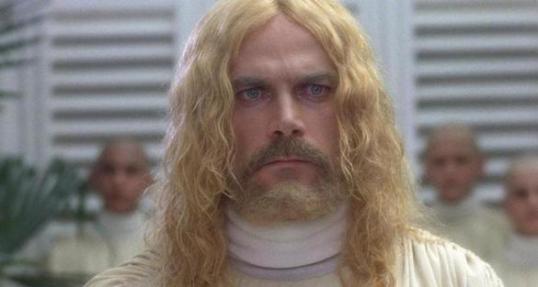
Franco Nero as Jesus in The Visitor
Much like Close Encounters of the Third Kind and 2001: A Space Odyssey, The Visitor opens with the idea that intergalactic beings have been visiting Earth for centuries and are subtly influencing the development of humanity. The Visitor literally opens with Jesus Christ (played by Franco Nero!) sitting on a satellite and telling a version of the creation story to a bunch of bald children. He explains that, long ago, he battled an evil intergalactic demon known as Sateen. Sateen (who, the film implies, is better known on Earth as Satan) was eventually blown up but his genes were spread throughout humanity. The bald children surrounding him are the descendants of Sateen. Whenever one of them is born, Jesus sends an old man named Jerzy Colsowicz (played by director John Huston) to Earth so that Jerzy can bring the child to the satellite. Of course, whenever Jerzy isn’t kidnapping kids for Jesus, he spends his time hanging out in a psychedelic dimension.
Yes, you did read that correctly.
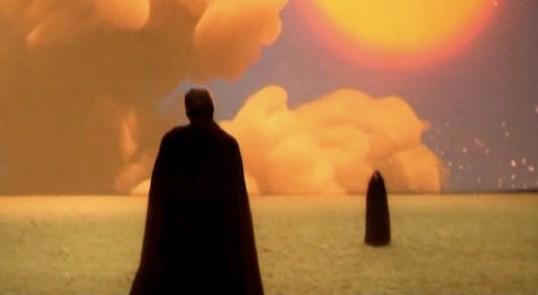
This is where Jerzy lives.
Once you get past the intergalactic part of the story, The Visitor is a pretty obvious rip-off of both The Omen and Damien: Omen II, with the main difference being that the demon child here is not a cherubic little boy but instead is a rather bratty 8 year-old little girl named Katy (Paige Collins). However, Katy is not the Antichrist. Instead, her job is to mate with a male child who also has Sateen’s genes and then her baby will be the Antichrist. In order to get this male child, Katy is pressuring her mother (Joanne Nail) to have sex with businessman Raymond Armstead (Lance Henriksen, who was also in Damien II: The Omen) so that Katy can have a half-brother to mate with. (Ewwwwwwww!) Raymond is a follower of Sateen and, adding to the film’s already odd feel, he also happens to own a basketball team.
(So, along with everything else going on, The Visitor also features a lot of basketball footage, which I guess would be exciting if I knew anything about basketball.)
Despite being a pretty powerful figure in the Sateenist hierarchy Raymond is not the head Sateenist. No, the head Sateenist is played by Mel Ferrer, an actor who was once married to Audrey Hepburn and who will be familiar to anyone who has ever watched an Italian horror film. (You can spot Ferrer in Zombie Holocaust, for example.) Ferrer and the other Sateenists are all old, distinguished looking white men who spend all of their time meeting in an ornate corporate boardroom.
So, Jerzy comes down to Earth to, with the help of a nanny played Shelley Winters, try to kidnap Katy but, for some reason, he doesn’t just do that. Instead, he spends most of his time just watching Katy do destructive things.
Much as in The Omen, anyone who gets too close to discovering the truth about Katy ends up dying an elaborate and bloody way. Often times, their death involves black crows, who the film suggests might actually be all of those little bald kids in animal disguise. So is Jesus sending those crows to kill people? Seriously, this movie is weird.
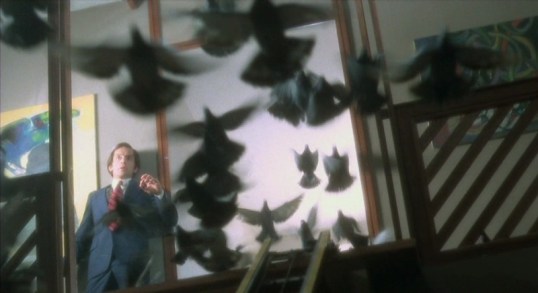
Beware the Crows
Meanwhile, Katy’s mom is having doubts about both Raymond and her daughter. She even goes and talks to her ex-husband, an abortionist who is played by yet another film director, in this case Sam Peckinpah. Katy gets annoyed with her mom and, after happening to come across a gun hidden away inside of a birthday presents, shoots her in the back and leaves her paralyzed.
And did I mention that Katy is telekinetic, much like Carrie? That’s right! During my favorite scene, Katy goes skating at the local mall’s ice rink and, after a group of boys bully her, she uses her powers to send those bullies flying all over the mall. Oddly enough, nobody seems to notice this chaos. Except, of course, for Jerzy who just stands off in the corner and watches without doing anything…
Seriously, I love The Visitor. Along with being surprisingly well-acted and visually inventive, the film is just so weird! In many ways, it epitomizes everything that I love about the old Italian exploitation films. While it is rather shameless about ripping off other movies, the film still brings its own unique spin to everything.
Normally, I’d say that The Visitor is a good film for Halloween but you know what? Anytime is a good time for an Italian horror film!

Welcome

Happy Halloween!
Here at the Shattered Lens, we’re all about tradition! And what could be a better tradition than watching Night of the Living Dead on Halloween?
Watch it below and enjoy! And then, after you’ve watched it, be sure to read Arleigh’s excellent review!
For today’s Horror on The Lens, we have a Spanish film that was originally made in 1969 and given an international release in 1970. In the United States, it was released under several different names: Monsters of Terror, Assignment: Terror, and Dracula vs. Frankenstein.
Despite the title, this film really isn’t about Dracula fighting Frankenstein. There is, of course, a Frankenstein monster in the film and there is a vampire who, in some versions of the film, is referred to as being Dracula and, in other versions, is referred to by a lot of other names. (What’s he called in the version below? You’ll have to watch to find out.)
What this film is about is Waldemar Danisky, a tragic werewolf who was played by Paul Naschy in a series of films. In this, his third appearance, Waldemar and a host of other monsters are brought back to life by aliens who are looking to take over the Earth. Fortunately, Waldermar is a werewolf with a conscience and battles not only the aliens but the other monsters as well.
Yes, it’s all a bit silly and really doesn’t make much sense but you really owe it to yourself to watch at least one Paul Naschy film before this October ends..
We previously shared and reviewed this movie two Halloweens ago but so what? It’s a horror classic and watching it is a bit of a Halloween tradition and here at the Shattered Lens, we are all about tradition! Add to that, this is one of the most influential films of all time. First released in 1922, The Cabinet of Dr. Caligari both introduced the world to German expressionism and it was one of the first films to feature a twist ending.
So, the next time you’re thinking about how much you love M. Night Shyamalan, be sure to say a word of thanks to Robert Wiene for directing The Cabinet of Dr. Caligari!

(After reading my review, please be sure to check out Arleigh’s thoughts on Zombi 2!)
Two questions:
1) Do you love Zombie movies?
2) Have you seen Lucio Fulci’s 1979 film Zombi 2?
If your answer to the first question was yes, then you should definitely have had the same answer for the second. Along with launching the long and extremely influential genre of the Italian zombie film and being one of the best zombie films ever made, Zombi 2 is also one of the best horror films ever made.
First off, a few words about that title. Zombi was the Italian title for George Romero’s Dawn of the Dead. Zombi was a huge hit on Italy and, in that shameless way that is beloved by all Italian horror fans, producers Fabrizio De Angelis and Ugo Tucci decided to take advantage of Zombi‘s success by naming their upcoming zombie film Zombi 2. And, while I have always liked to think of Zombi 2 as being a prequel to Romero’s Dead trilogy, Zombi 2 is actually in no way related to Dawn of the Dead.
It has often been assumed that Zombi 2 was directly inspired by Dawn of the Dead. While Romero’s film certainly provided more of an influence than just providing a title, Zombi 2 was actually in production before Dawn of the Dead opened in Italy. And, ultimately, Zombi 2 is a far different film from Romero’s film. Eschewing the social commentary and satire that ran through Dawn of the Dead, Zombi 2 is instead a work of pure horror. They’re both excellent films but Dawn of the Dead ultimately inspires debate while Zombi 2 inspires nightmares.

Opening with a previously dead body being shot in the head as it slowly sits up on a stretcher and ending with a haunting vision of apocalypse, Zombi 2 is coated in a palpable atmosphere of doom. A boat floats into a New York harbor and the two cops who investigate are greeted by a lumbering and hungry corpse. Tisa Farrow plays the daughter of the boat’s owner. When she and a reporter (Ian McCulloch, giving a likable and bemused performance that often finds him playing straight man to a bunch of decaying corpses and which provides a nice run up for his openly subversive performance in Zombie Holocaust) team up to find her father, their investigation leads them to an isolated island where the haunted and alcoholic Dr. Menard (Richard Johnson, bringing so much gravity and self-loathing to his role that he literally elevates the entire film) is struggling to deal with an outbreak of zombies. Along with a boat captain (Al Cliver) and his girlfriend (Auretta Gay), McCulloch and Farrow try to escape the island before they end up joining the ranks of the undead…
As a director, Lucio Fulci was known for bringing his own unique visual flair to the horror genre. Fulci, perhaps more than any of the other great Italian horror directors working during the Italian horror boom of the 80s and 90s, literally brought nightmares to cinematic life. As a result, Zombi 2 is probably one of the most visually memorable zombie films ever made. From the minute that McCulloch, Farrow, Cliver, and Gay arrive on the island, you can literally feel the oppressively hot wind and dusty wind that blows through every scene. When the dead walk across the desolate landscape, Fulci emphasizes the decayed state of these zombies, forcing the audience to consider just how fragile the human body truly is. The fact that the undead manage to be so pathetic and so dangerous at the same time only serves to make them all the more frightening. When a group of conquistadors come back to life, Fulci films it from their point of view and, for a few minutes, we literally are one of the undead, clawing our way out of a grave. Needless to say, Fulci doesn’t shy away from the gore of a zombie apocalypse either. His zombies are ravenous and destructive. The Walking Dead may be bloody but it’s got nothing on Zombi 2.
Along with the conquistador scene, Zombi 2 is especially remembered for two scenes, both of which showcase the best of both Fulci and Italian horror.

One is the scene where Dr. Menard’s wife (Olga Karlatos) is menaced by zombies after taking a shower. Even after she slams the bathroom door, a zombies hand breaks through the door and grabs her by the hair and starts to pull her through the jagged hole in the door. As she is slowly pulled to her doom, her eyeball is pierced by a splinter of wood. It’s definitely an over-the-top moment, the type of thing that we expect from an Italian horror film. But, as over-the-top as it may be, it’s also incredibly effective and terrifying. It’s a scene that lets us know that there is no escape from our fate. It’s a scene that reminds us that the zombies will always win because there is no way to lock out death.
(In fact, it’s such an iconic scene that almost all of Fulci’s subsequent films would feature a character losing an eye. Adding a certain poignancy to his trademark scenes of ocular destruction was the fact that Fulci, himself, was diabetic and reportedly often feared that he would lose his eyesight.)

The other is a scene that always seems to bring a smile to the face of anyone who see it. That’s the scene where a zombie gets into a fight with a shark while Auretta Gay swims nearby. Again, it’s a bit ludicrous but it’s also incredibly effective. If nothing else, it invites us to wonder how — if a shark can’t beat a zombie — can there be any hope for humanity?
The answer, of course, is that there isn’t. Ultimately, in the world of Fulci’s film, whether by causes natural or unnatural, we’re all destined to become one of the zombies.

(This review is cross-posted over at Fourth-Day Universe where all of October has been Zombie Month!)

