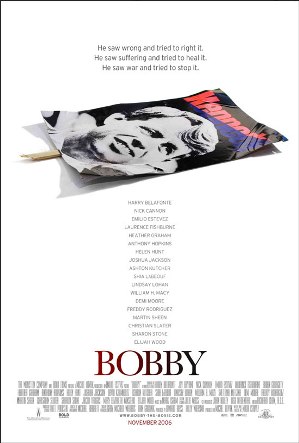
Shattered Politics #80: Bobby (dir by Emilio Estevez)


Bobby_poster

A few years ago, I was on twitter when I came across someone who had just watched The Breakfast Club.  

“Whatever happened to Emilio Estevez?” she asked.

Being the know-it-all, obsessive film fan that I am, I tweeted back, “He’s a director.”

Of course, I could not leave well enough along.  I had to send another tweet, “He directed a movie called Bobby that got nominated for bunch of Golden Globes.”

“Was it any good?” she wrote back.

“Never seen it,” I wrote back, suddenly feeling very embarrassed because, if there’s anything I hate, it’s admitting that there’s a film that I haven’t seen.

However, Shattered Politics gave me an excuse to finally sit down and watch Bobby.  So now, I can now say that I have watched this 2006 film and … eh.

Listen, I have to admit that I really hate giving a film like Bobby a lukewarm review because it’s not like Bobby is a bad film.  It really isn’t.  As a director, Emilio Estevez is a bit heavy-handed but he’s not without talent.  He’s good with actors.  Bobby actually features good performances from both Lindsay Lohan and Shia LaBeouf!  So, give Estevez that.

And Bobby is a film that Estevez spent seven years making.  It’s a film that he largely made with his own money.  Bobby is obviously a passion project for Estevez and that passion does come through.  (That’s actually one of the reasons why the film often feels so heavy-handed.)

But, with all that in mind, Bobby never really develops a strong enough narrative to make Estevez’s passion dramatically compelling.  The film takes place on the day of the 1968 Democratic California Presidential Primary.  That’s the day that Robert F. Kennedy won the primary and was then shot by Sirhan Sirhan in the kitchen of the Ambassador Hotel.  However, it never seems to know what it wants to say about Kennedy or his death, beyond the fact that Estevez seems to like him.

(Incidentally, it’s always interesting, to me, that Dallas is still expected to apologize every day for the death of JFK but Los Angeles has never had to apologize for the death of his brother.)

Estevez follows an ensemble of 22 characters as they go about their day at and around the Ambassador Hotel.  As often happens with ensemble pieces, some of these characters are more interesting than others.

For instance, Anthony Hopkins plays a courtly and retired doorman who sits in the lobby and plays chess with his friend Nelson (Harry Belafonte).  It adds little to the film’s story but both Hopkins and Belafonte appear to enjoy acting opposite each other and so, they’re fun to watch.

Lindsay Lohan plays a woman who marries a recently enlisted soldier (Elijah Wood), the hope being that his marital status will keep him out of Vietnam.  The problem with this story is that it’s so compelling that it feels unfair that it has to share space with all the other stories.

Christian Slater plays Darrell, who runs the kitchen and who spends most of the movie talking down to the kitchen staff, the majority of whom are Hispanic.  Darrell is disliked by the hotel’s manager (William H. Macy) who is cheating on his wife (Sharon Stone).

And then, you’ve got two campaign aides (Shia LaBeouf and Brian Geraghty) who end up dropping acid with a drug dealer played by Ashton Kutcher.  Unfortunately, Estevez tries to visualize their trip and it brings the film’s action to a halt.

Estevez himself shows up, playing the husband of an alcoholic singer (Demi Moore).  And Estevez’s father, Martin Sheen, gets to play a wealthy supporter of Kennedy’s.  Sheen’s wife is played by Helen Hunt.  She gets to ask her husband whether she reminds him more of Jackie or of Ethel.

(Actually, Martin Sheen and Helen Hunt are cute together.  Much as with Lohan and Wood, you wish that more time had been devoted to them and their relationship.)

And there are other stories as well.  In fact, there’s far too many stories going on in Bobby.  It may seem strange for a girl who is trying to review 94 films in three weeks to say this but Emilio Estevez really tries to cram too much into Bobby.

At the same time, too much ambition is better none.  Bobby may have been a misfire but at least it’s a respectable misfire.
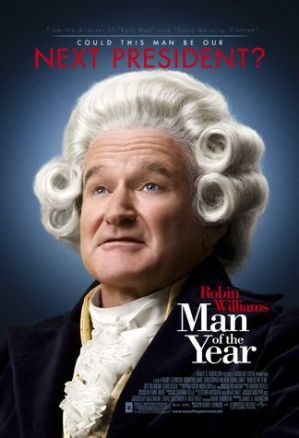
Shattered Politics #79: Man of the Year (dir by Barry Levinson)


Man_of_The_Year_(2006_film)

The 2006 comedy Man of the Year is a difficult film to review.  Some of that is because it’s not that interesting of a film.  It’s simplistic and predictable.  In fact, the only reason that I’m reviewing this film for Shattered Politics is because I needed an example of a bad, mainstream political film.

However, that’s not the only reason why it’s difficult to write about Man of the Year.  The bigger reason is that Man Of The Year stars Robin Williams and, in many ways, it’s typical of one of his later lesser films.  After his tragic death, it’s even harder to watch Robin Williams waste his talents in a bad film.

And, make no mistake about it, Man of the Year is a bad film.

Robin Williams plays Tom Dobbs.  Dobbs, we are told, is the most famous political commentator in America.  Watching the film, it’s obvious that Dobbs is meant to be the film’s equivalent of Jon Stewart and Stephen Colbert.  However, the difference is that Stewart and Colbert are both obviously liberal whereas, from what little we see of Tom Dobbs show, Dobbs doesn’t appear to have any positions beyond the few vague platitudes that pass for political thinking in most mainstream films.  Dobbs is against special interests.  He’s against career politicians.  He’s against … well, he’s against everything that most people are against and for everything that most people are for.  About the closest that Tom Dobbs come to being edgy is when he makes a stupid joke about Pope Benedict being German.

Anyway, Dobbs is recruited to run for President and he manages to get on the ballot in 13 states!  And he’s even doing well because, apparently in this film’s version of reality, Catholic voters have no problem supporting someone who makes fun of Pope Benedict for being German.  And he’s even invited to take part in a presidential debate.  When asked his first question in the debate, Dobbs starts talking and, because he’s being played by Robin Williams, he doesn’t stop.  The debate spirals out-of-control.  Dobbs goes on and on about the state of America, all the while assuming weird accents and slipping in and out of different personalities.

“Oh my God,” I thought, “he’s had a nervous breakdown.”

Except, of course, he hasn’t.  And, since this is a movie, everyone in America loves his performance.  On election night, Tom Dobbs apparently wins all 13 of his states and he’s elected President!

Except, of course, he hasn’t been.  It turns out there was an error with the voting machines.  Eleanor Green (Laura Linney), who works at the company that built the machines, figures out what happened.  In order to keep her from revealing the truth, the company drugs her and attempts to destroy her credibility and…

Wait, this is a Robin Williams comedy, isn’t it?  Well, it is and it isn’t.  Half of the film is devoted to Tom Dobbs saying things that are supposed to be funny but the other half deals with Eleanor trying to expose a giant cover-up without getting killed.  Director Barry Levinson can’t seem to figure out whether his film is supposed to be an unfunny comedy or a boring drama.  So, he tries to do both and … well, taken by that criteria, the film actually works.  If Levinson set out to be unfunny and boring, he succeeded.

One of the biggest dangers of making a film about a comedian is that, for the film to work, you have to believe that people would actually find the comedian to be funny.  When the jokes aren’t funny, it doesn’t matter how many reaction shots of people laughing that you stuff into the film.  Man of the Year is full of reaction shots.  During the debate, we continually see Eleanor’s teenage son laughing.  (How many teenagers, other than the weird ones and the ones assigned to do so for homework, actually watch a presidential debate?)  During one particularly painful moment, Tom starts rambling while traveling on the campaign bus and we are subjected to countless reaction shots of Christopher Walken and Lewis Black laughing so hard that they look like they might faint from exhaustion.

The problem is that it’s rare that a few hundred people will all start laughing and stop laughing at the exact same time.  Whenever you listen to a truly good comedian, you always hear a few giggles that indicate that at least a few audience members are still thinking about the last joke or else that they’re anticipating the next joke.  Often times, when a comedian says something especially funny or unexpected, you don’t even hear laughter.  You might hear a gasp of shock.  You might hear tittering.  You might hear applause.  You might hear someone shouting like they’re at a sporting event.

What I’m saying is that everyone reacts to humor in their own individual way.  Everyone has a laugh of their very own.  Uniform laughter, like the laughter in Man of the Year, sounds fake because it is fake.

Add to that, nothing that Tom Dobbs says is particularly funny.

So, no — don’t watch Man of the Year.  Watch Dead Poets Society.  Watch Good Will Hunting or Awakenings.  You could even watch Cadillac Man!  But don’t watch Man of the Year.

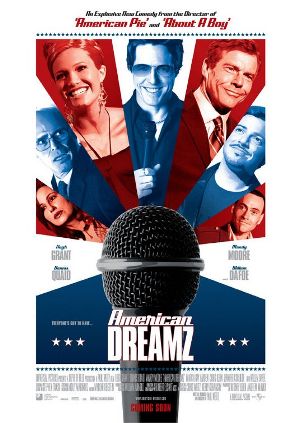
Shattered Politics #78: American Dreamz (dir by Paul Weitz)


Americandreamz

Nothing ages worse than heavy-handed satire and, if you need proof of that, just try watching the 2006 film American Dreamz.  American Dreamz is a satire of two things that are no longer exactly relevant, the presidential administration of George W. Bush and Simon Cowell-era American Idol.

Dennis Quaid plays President George W. Bush Joseph Stanton.  Stanton has just been reelected to a second term.  One morning, he impulsively decides to read a newspaper for the first time in his life and he ends up having a nervous breakdown.  “The world isn’t black-and-white,” he declares, “Instead, it’s gray.”  Sinking into a deep depression, Stanton isolates himself from the American people and his approval rating starts to plunge.  His evil Chief of Staff (William DaFoe, made up to look like Joe Biden but, I’m assuming, meant to be Dick Cheney) comes up with a plan to restore Stanton’s popularity.  President Stanton will serve as a guest judge on his favorite television show, American Idol American Dreamz!

(To be honest, I think Obama would be more likely to show up as a guest judge than Bush.)

The host of American Dreamz is a self-loathing Englishman named Martin Tweed (Hugh Grant).  Tweed hates both the show and himself.  Early on in the film, he’s literally seeing begging for American Dreamz to be canceled.  However, American Dreamz is the number one show in the country and the show must go on.

Along with President Stanton, the latest season of American Dreamz features a group of contestants who all have dramatically compelling backstories.  Sally Kendoo (Mandy Moore) emerges as a favorite, largely do to her ability to manipulate the camera and the fact that her well-meaning but simple-minded boyfriend (Chris Klein) was wounded in Iraq.

Oh wow — reality shows manipulate reality and contestants are rarely as innocent as they seem!?

Tell me more, American Dreamz!

Also competing on American Dreamz is Omer (Sam Golzari), a former jihadist who proved to be too clumsy to take part in the various propaganda videos being shot by his terrorist cell.  Omer was sent to America, where his love for show tunes eventually landed him on American Dreamz.  With the finale rapidly approaching, Omer has been instructed to blow both himself and the President up on national TV.

The satire of American Dreamz really wasn’t all that sharp when the film was first released and now, 9 years later, it feels even weaker.  Quaid and Grant both give good performances but the film’s attempts at humor largely fall flat because they’re all so predictable.  It’s not exactly mind-blowing to say that reality TV is fake or that politics has a lot in common with show business.  The film attempts to add some bite to its message by ending with a surprisingly dark twist but it’s just not enough.  Even a dark ending has to be earned.


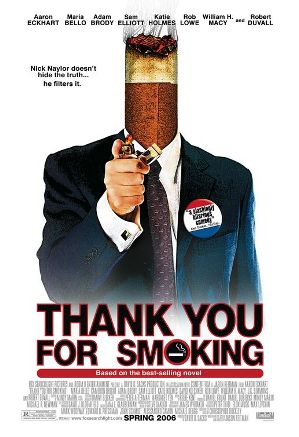
Shattered Politics #77: Thank You For Smoking (dir by Jason Reitman)


Thank_you_for_smoking_PosterI have always hated those Truth.com commercials.  Truth.com is an organization that claims to be dedicated to eradicating smoking.  Their smug commercials are essentially the height of hipster douchebaggery, a bunch of self-consciously cool people wandering around and harassing random people about whether or not they smoke.  And then, of course, there was the commercial where they all gathered outside a tobacco company and pretended to be dead.  Of course, the truth about Truth.com is that they are essentially the same people who, in high school, would get offended whenever anyone wore a short skirt.  I really can not stand people like that.  (And don’t even get me started on those assholes who appear in the Above The Influence commercials.)  Myself, I don’t smoke because I have asthma.  But, seriously, whenever I see a Truth.com commercial, I’m tempted to run down to 711 and start.

And so maybe that’s why I like the 2005 comedy Thank You For Smoking.

The hero of Thank You For Smoking is Nick Naylor (Aaron Eckhart), a lobbyist for the tobacco industry, who is first seen appearing on a talk show and winning over a hostile audience by announcing that the tobacco industry is going to be investing millions in researching way to keep young people from smoking and shaking the hand of a teenage honor student who is dying from lung cancer.  Over the course of the film, Nick shows us how he does business, everything from defending tobacco companies on talk shows to convincing a former Marlboro Man-turned-cancer-patient to drop his law suit.  When Nick isn’t working, he’s hanging out with his best friends (who are lobbyists for both the liquor and the gun industries), trying to bond with his son (Cameron Bright), or having sex with a reporter (Katie Holmes).

Now, in most movies, Nick Naylor would be the villain.  However, in Thank You For Smoking, Nick becomes a hero by default, if just because everyone who disagrees with him is even worse than he is.  Add to that, Nick has the benefit of being played by Aaron Eckhart while all of his opponents are played by balding actors with ugly beards.

Another reason that I liked Thank You For Smoking was because the main villain was a senator from Vermont and it’s about time somebody stood up to the tyranny of Vermont.  Ortolan Finistirre (William H. Macy) has built a career out of campaigning against the tobacco industries and why shouldn’t he?  Who, other than Nick Naylor, is willing to defend them?  Finistirre’s latest plan is to change the law so that every pack of cigarettes has to be branded with a skull and crossbones warning.

When Nick and Finistirre finally face off, it’s a battle between those who believe in allowing people the freedom to make their own choices and those who hide their totalitarian impulse behind claims that they’re working for the greater good.

Thank You For Smoking was Jason Reitman’s first film.  And while it may be a bit too episodic and it frequently struggles to maintain a consistent tone, it’s still a lot better than both Labor Day and Men, Women, & Children.

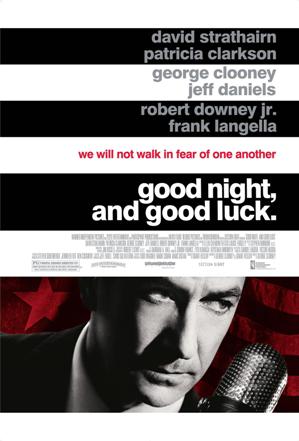
Shattered Politics #76: Good Night, and Good Luck (dir by George Clooney)


Goodnight_posterOne of my favorite episodes of South Park is called Smug Alert!  As you may remember, this is the episode where the citizens of South Park all buy hybrid cars and end up getting so self-satisfied that a dangerous cloud of smug forms over the town.  At the same time, another smug storm is racing across the United States.  This smug storm was created by the speech that George Clooney gave when he won the Oscar for Syriana.  When those two clouds of smug meet, it’s the perfect storm.  It also ends up destroying San Francisco.

The same year that Clooney was named Best Supporting Actor for Syriana, he was also nominated for directing the 2005 best picture nominee, Good Night, and Good Luck.  In his speech, Clooney specifically said that he felt he was winning supporting actor to make up for not winning director and proceeded to give the speech that he would have given if he had won director.

And looking back, I think that we do have to admit that it was a very smug speech.

Fortunately, Good Night, and Good Luck has aged better than Clooney’s speech.

I do have to admit that, when I recently rewatched Good Night and Good Luck, I was a little concerned.  I always manage to forget that the film starts on a really bad note.  The year is 1958 and news anchorman Edward R. Murrow (played by David Strathairn) is receiving an award.  As Murrow stands behind the podium, he proceeds to give a long and self-righteous speech about how television should be used not to entertain but to educate as well.  And, quite frankly, he comes across like such a pompous blowhard that I was dreading the idea of having to spend the next 90 or so minutes with him.

But then, fortunately, the film entered into flashback mode and, until the final few minutes of the film, we didn’t have to listen to anymore of Murrow’s speech.  The majority of Good Night and Good Luck takes place in 1953.  U.S. Sen. Joseph McCarthy (who appears in archival footage throughout the film) has declared that he has the names of communists who hold important positions in both the government and the media.  Murrow and his producer, Fred Friendly (George Clooney) defy the corporate overlords of CBS and bravely investigate and challenge McCarthy’s claims.  McCarthy and his henchmen respond by trying to smear both Murrow and one of his reporters (Robert Downey, Jr.) as a communists.  As always seems to happen in films about McCarthyism, another supporting character reacts to the change of communism by committing suicide.  And, in this particular vision of the fight against Joseph McCarthy, Edward R. Murrow and the media save America.

Of course, if you actually make the effort to learn history, you’ll discover that it wasn’t just Edward R. Murrow who stood up to McCarthy.  In fact, you’ll discover that Murrow stood up to McCarthy after several other prominent people — on both sides of the political divide — had already done so.  If anything, the real-life Murrow seems to have more in common with pompous scold seen at the beginning and end of the film, as opposed to the one that we see standing up to McCarthy.

One can very legitimately debate whether or not Murrow deserves all of the credit that he’s given in this film.  Still, the film does make a larger and very important point.  We, as Americans, have to always be on guard against witch hunts and against demagogues and the forces of fear and paranoia that are always trying to shape our politics.  And, whether or not Murrow was a hero or just a bystander, one cannot deny that the larger message of Goodnight, and Good Luck remains as relevant today as when the film was originally released.

Judging from some of his other films — The Monuments Men and the Ides of March — I don’t particularly feel that George Clooney is that good of a director.  But he does do a good job with Good Night and Good Luck.  (In fact, he does such a good job that you can’t help but feel that it’s the exception to the rule as far as Clooney the director is concerned.)  Filmed in wonderful black-and-white and full of good performances, Good Night, and Good Luck remains surprisingly watchable.

Just avoid any George Clooney Oscar speeches while watching it.  San Francisco has never recovered.

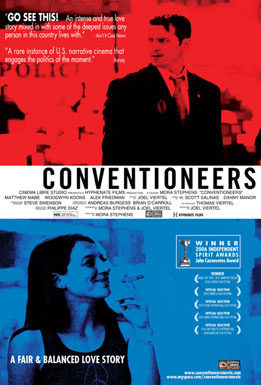
Shattered Politics #75: Conventioneers (dir by Mora Stephens)


Conventioneersposter

As I watched the 2005 indie film Conventioneers, I realized that I could never be a professional protestor.  Conventioneers, you see, was shot at the 2004 Republican National Convention and it combines actual footage of both the conventions and the protests with scenes of a Republican delegate (Matthew Mabes) reuniting with a college friend (Woodwyn Koons) who is now a liberal activist.  When Mabes and Koons first get together, they end up arguing about politics.  When they meet a second time, they end up having sex.  Meanwhile, Koons’ friend Dylan (Alek Friedman) has been enlisted to provide a sign language interpretation for President Bush’s acceptance speech.  Should Dylan use the opportunity to stage his own protest…

Oh, who cares?

Sorry.  I guess I should admit right now that I tend to be allergic to self-righteous and self-important people, regardless of which side of the political divide they call home.

And that’s one reason why I could never be a professional protestor.  Or, at the very least, I couldn’t be the type of protestor who populates Conventioneers.  They’re all so humorless and sure of their own importance and uniqueness (despite the fact that they all pretty much had the same look and the same way of speaking) that, as I watched them discuss and debate every little detail of their ideology, I could only think about how annoying it would be to ever watch a movie with them.  I would want to laugh at the antics of Jonah Hill and Channing Tatum.  They would want to debate the morality of watching a movie where the characters don’t ride bicycles or wear Che t-shirts.  It would just get so tedious!

Add to that, I have a need to smile, even when I’m talking about something important.  As I watched Conventioneers, I was struck by how both the real protestors and the actors always had those, “We’re so serious” scowls on their faces.  You could tell they were thinking, “If we look really pissed off, everyone will be sooooooo impressed.  We’re changing the fucking world!”

Bleh.

And that’s really the problem with Conventioneers.  It’s a left-wing film but all of the left-wing characters are so dogmatic and full of themselves that, had the film come out in time to influence the 2004 elections, Bush probably would have defeated Kerry in a landslide.  Just because you have good intentions and might be on the right side of the issues, that’s no excuse to make a tedious movie.  That’s a lesson that many political filmmakers really need to learn.

Reportedly, while shooting on location, director Mora Stephens and her crew were actually arrested and had to spend a few hours in jail.  That makes for an interesting story but it doesn’t make for a good movie.  If you want to see a good political film that was shot at a political convention, I would suggest watching Medium Cool.

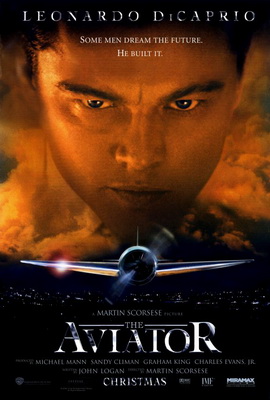
Shattered Politics #74: The Aviator (dir by Martin Scorsese)


The_Aviator_Poster

“The way of the future.” — Howard Hughes (Leonardo DiCaprio) in The Aviator (2004)

As I recently rewatched the 2004 best picture nominee, The Aviator, I realized that, in the film’s scheme of things, Ava Gardner was far more important than Katharine Hepburn.  (Or, perhaps it would be more appropriate to say that Kate Beckinsale’s Ava Gardner was far more important than Cate Blanchett’s Katharine Hepburn.)

Over the course of the film, both Hepburn and Gardner are involved with billionaire-turned aviator-turned film director Howard Hughes (Leonardo DiCaprio).  Throughout the film, Katherine is portrayed as being flighty, pretentious, and overdramatic.  There’s a lot of dark humor to the scene where Katherine breaks up with Howard, largely because Katharine is incapable of not acting as if she’s making a film.  Her every word is so carefully rehearsed that you have to agree when Howard says that she’s incapable of not giving a performance.  Ava, on the other hand, is always direct.  She has a sense of humor.  She has no trouble telling Howard off.  Whereas Katharine put on airs of being an incurable romantic, Ava tells Howard flat out that she doesn’t love him and is only using him to forward her career.

But, while Katharine Hepburn gets more screen time, it’s Ava Gardner who actually saves Howard’s business.  Towards the end of the film, after Howard has had a nervous breakdown and has locked himself in a hotel room, it’s Ava who suddenly shows up, cleans him, and dresses him.  She’s the one who gives Howard the strength to leave his room and to face down the corrupt senator (Alan Alda) who is investigating his business.

Of course, Howard Hughes is best known for once being the world’s richest recluse.  In the 1960s, Howard locked himself away in a hotel room in Las Vegas and spent the next decade laying naked in bed and watching television.  The Aviator doesn’t deal with this period of Howard’s life but it’s full of scenes where we catch glimpses of Howard’s future.  Throughout the film, we watch as Howard obsessively washes his hands.  We watch as he gives precise instructions on how even the simplest of tasks are to be accomplished.  We watch as he grows increasingly paranoid about the germ-filled outside world.  The film suggests that Howard’s obsessive compulsive disorder both served to make him a great engineer and a great filmmaker while, at the same time, ultimately destroying him.

The Aviator was the second film that DiCaprio made with Scorsese.  And, as bad as DiCaprio may have been in Gangs of New York, he’s absolutely brilliant in The Aviator.  As a character, Howard Hughes has so many quirks and tics that it would have been easy for DiCaprio to go overboard.  Instead, he gives a surprisingly subtle performance.  And, even more importantly as far as I’m concerned, he actually sounds authentically Texan when he speaks.

In many ways, much of The Aviator reminds me of Gangs of New York.  Both films are gorgeously produced period epics that try to cover a lot of material.  Both films are absolute cat nip for history nerds like me.  But, whereas Gangs of New York leaves one feeling vaguely dissatisfied, The Aviator actually improves with subsequent viewings.  Whereas the action in Gangs had no center, The Aviator revolves around Howard and the actor playing him.

While the Aviator starts off with Howard making movies and romancing Katharine Hepburn, it’s at its best when Howard appears before a committee chaired by Sen. Owen Brewster (Alan Alda) and passionately defends both himself as an engineer and a businessman and the right of innovators everywhere to freely pursue their passion.  The film suggests that Brewster was bribed by Howard’s main business rival, Juan Trippe (Alec Baldwin, in unapologetic villain mode), and it’s hard not to applaud when Howard stands up for himself.

Speaking of which, it’s odd, so soon after reviewing Alan Alda in The Seduction of Joe Tynan, to see Alda playing a far less ethical politician in The Aviator.  That said, Alda’s corrupt performance in The Aviator is a hundred times better than his cutesy work in Joe Tynan.  If anything, Alda gives a performance here that will remind everyone of why they don’t care much for their congressman.

The Aviator was nominated for best picture but it lost to the far more low-key Million Dollar Baby.  Scorsese would have to wait until the release of The Departed for one of his films to finally win best picture.

Shattered America #73: Team America: World Police (dir by Trey Parker)


Team_america_poster_300px

So, are we once again allowed to watch Team America: World Police?

As you may remember, back in December, the entire nation totally freaked out over the possibility that North Korea might be offended by the James Franco/Seth Rogen comedy The Interview.  Hackers — who many assumed were working for North Korea — released embarrassing emails that were exchanged among Sony executives and filmmakers.  Barely literate threats were posted, warning that any theater showing The Interview would be blown up.  Common sense should have told us that these were empty threats but instead, everyone panicked.

Sony announced that they would not be releasing The Interview.  The film would never see the light of day.  Overdramatic people like me got on twitter and announced that, if Sony didn’t release The Interview, then free speech was dead.  “It is every American’s duty to see The Interview!” I tweeted, “If you don’t see The Interview, you’re letting the terrorists win!”

Then Sony changed their mind and released The Interview after all.  People got to watch it.  Critics got to slam it.  Free speech lived for yet another day.

As for me, I never got around to watching it.

Uhmm, anyway…

What got forgotten in all of this drama is that some theaters announced that they would show the 2004 film Team America: World Police in the place of the Interview.  In many ways, it was a brilliant idea.  Team America, after all, is a brilliantly profane satire from South Park creators Trey Parker and Matt Stone.  Not only was the film a parody of overdone Hollywood blockbusters but it also featured the members of Team America using their powers to take out Kim Jong-il, the father of the political leader targeted for assassination in The Interview.  Even better than that, it featured Team America violently destroying the vapid (and surprisingly well-armed) celebrities who Kim Jong-il had tricked into supporting him.  How can you not love a film that features a puppet of Michael Moore blowing itself up?

Oh, did I mention that the entire movie features puppets?  Because it so does!

The use of puppets allows Parker and Stone to not only create some spectacular action scenes but also to feature parodies of more than a few real-life celebrities, all of whom are portrayed as being stupid, trendy, and easily manipulated.  The fact that Sean Penn saw himself lampooned in the film and then wrote an angry letter to Parker and Stone (ending it with, “Fuck you!”) is one of many reasons to love Team America.

So, we weren’t going to get to see The Interview but at least we could see Team America.  But then Paramount Pictures announced that they were not going to let any theater show Team America.  As annoyed as I was by what happened with The Interview, the ban on Team America was even more annoying.

I mean, we all knew The Interview as probably a really bad film.  But we also knew that Team America was great!  Indeed, banning Team America seemed like exactly the type of thing that one of the film’s puppet celebrities would have demanded.

Plus, as Team America‘s theme song reminded us — “America!  Fuck yeah!”  Bowing down to dictators does not make anyone want to shout, “America!  Fuck yeah!”

More like, “America!  Fuck no!”

Anyway, eventually Sony relented and released The Interview.  But I haven’t heard anything about Team America.  However, it’s currently available on Netflix so I’m going to assume that it is once again legal to watch Team America.  But that doesn’t change the fact that I still felt like I was breaking the law when I recently rewatched it.

Yet another reason to love Team America: World Police.

Shattered Politics #72: Welcome to Mooseport (dir by Donald Petrie)


Welcome_To_Mooseport

The 2004 film comedy Welcome to Mooseport would probably be totally forgotten if not for one thing.  This is the film that was supposedly so bad that co-star Gene Hackman looked at the final cut and then probably looked over at the Oscars he won for The French Connection and Unforgiven and then probably looked back at the final cut and then announced, “I quit!”  There’s a reason why Hackman now spends his time writing novels and, according to most accounts, Welcome to Mooseport is that reason.

In Welcome to Mooseport, Gene Hackman plays Monroe “Eagle” Cole, the former President of the United States.  From the minute we first hear the President’s name, we know exactly what type of film Welcome to Mooseport is going to be.  It’s not enough to give Hackman’s a character a totally over-the-top name like Monroe Cole.  He also has to have a cutesy nickname.  The entire time I watched the film, I found myself wondering if Monroe Cole was listed on the presidential ballots as being Monroe “Eagle” Cole.  Personally, I always find it funny when people feel the need to include their nickname in the credits.  Is it really important for every William out there to let everyone know that some people call him Billy?

Anyway, Eagle is apparently the most popular president ever.  However, he’s also recently divorced and his ex-wife (Christine Baranski, playing the same role that she played in Bulworth) wants all of his property.  Eagle is forced to retire to one of the few residences that he has left, his vacation home in Mooseport, Maine.  In order to keep his wife from claiming that home, Eagle decides to run for mayor of Mooseport…

Now, right here, we’ve got a huge issue.  Eagle’s only motivation for running for mayor is because he doesn’t want to have to give over his vacation home to his wife.  But that could be anyone’s motivation.  One does not have to be President to want to keep the house in a divorce.  It would have been more interesting if Eagle, now out of office and struggling to adjust to no longer being the most powerful man in the world, ran for mayor because he really wanted the job.

But anyway, Eagle is not the only person running for mayor.  Hardware store owner Hardy Harrison (Ray Romano) is also running.  At first, Hardy wants to withdraw but then he sees Eagle flirting with Hardy’s longtime girlfriend (Maura Tierney) and Hardy suddenly decides that he’s going to run and he’s going to win.

I actually like Ray Romano as an actor and he doesn’t give a bad performance here.  But, at the same time, it’s obvious that his scenes were written to capitalize on his TV persona.  It’s easy to imagine stumbling across a rerun of Everybody Loves Raymond where Ray runs for mayor and has a panic attack when he loses.  The difference, of course, is that Ray Barone would not have been running against Gene Hackman (much less a former President).

Needless to say, Welcome to Mooseport has a sitcom feel to it.  After every line, you find yourself waiting for a laugh track.  Gene Hackman feels incredibly out-of-place in the film and there’s a discomfort to his performance.  Watching him in this film, you can see the wheels turning in his brain.  You can literally see Gene Hackman thinking, “I’m too old for this shit.”

And I guess he was because, in the 11 years since Welcome to Mooseport was first released, Gene Hackman has not appeared in another film.  Which is bad news for everyone waiting for Welcome to Mooseport Part II…

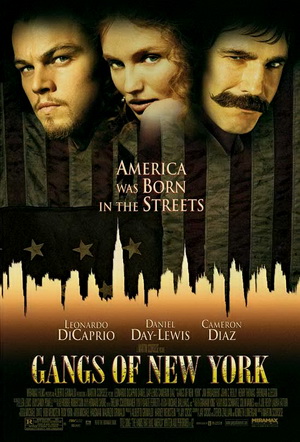
Shattered Politics #71: Gangs of New York (dir by Martin Scorsese)


Gangs_of_New_York_Poster

Despite the fact that it was nominated for best picture and marked the start of his fantastically successful collaboration with actor Leonardo DiCaprio, Martin Scorsese’s 2002 film Gangs of New York does not have the best reputation.  It always seems to be regarded as one of Scorsese’s lesser films and, often times, both The Aviator and The Departed are described as representing a comeback of sorts from Gangs.

To a certain extent, I have to agree.  Gangs of New York is a lesser Scorsese movie but then again, a lesser Scorsese film is still a hundred times better than the greatest films from Brett Ratner or Michael Bay.

The flaws of Gangs of New York are many.  The film, which tells the epic story of how an Irish gang led by Leonard DiCaprio battled a nativist gang led by Daniel Day-Lewis in Civil War-era New York City, runs for nearly 3 hours and yet it somehow still feels rushed and incomplete.  Cameron Diaz is far too contemporary of an actress to be truly believable as a 19th century pickpocket.  For that matter, Leonardo DiCaprio gives one of the worst performances of his career, coming across as being one-note and shrill.  If you only knew DiCaprio from his work in Gangs of New York, you would have a hard time believing that he was capable of doing the type of work that he did in Inception or The Wolf of Wall Street.

And yet, Gangs of New York is one of those flawed films that I can’t help but enjoy.

First off, on a purely personal level, how can I not love a film about how terribly the Irish were treated in the 19th Century?  Seriously, the Irish were regarded as if they were somehow subhuman.  They were attacked for being Catholic.  They were viewed as being criminals.  An entire freaking political party — the American party — was formed specifically to keep the Irish out.  But you know what?  We Irish kept coming, we kept fighting for our rights, and now everyone wishes they could be one of us!

Secondly, and this should not a shock when you consider that the film was directed by Martin Scorsese, the film looks absolutely gorgeous!  Despite the fact that it’s takes place in a 19th century slum and most of the characters are poor, Gangs of New York is a visual feast.  I loved the ornate sets and all the colorful clothes.  I loved the attention to detail that was put into everything.

(My favorite visual from the film: Daniel Day-Lewis and his entourage walking down a street while fireworks explode directly over Day-Lewis’s shoulder.)

Third, there’s Daniel Day-Lewis’s performance as Bill “The Butcher” Cutting.  One reason why DiCaprio’s performance is so noticeably bad is because he’s acting opposite Day-Lewis.  Sporting a handle-bar mustache and speaking in an almost satirically exaggerated New York accent, Day-Lewis turns Bill into one cinema’s greatest villains.

Add to that, the great Italian actor Giovanni Lombardo Radice show up for a few minutes, playing Simon Legree in a theatrical production of Uncle Tom’s Cabin!  Scorsese should make more films with Radice.

But, perhaps the main reason why I enjoy Gangs of New York is because, as I’ve mentioned so many times in the past, I really am a big history nerd.  And Gangs of New York deals with a period in American history that really doesn’t get as much attention as it deserves.  While we all know that the Civil War started when the South seceded from the union, what is often forgotten is that the North was not united in their support of Abraham Lincoln and the Union.  In fact, the Mayor of New York, Fernando Wood, was such a strong supporter of the Confederacy that he, at one point, suggested that New York City should secede from the union as well.  And when Lincoln instituted the draft, NYC — and several other cities in the north — exploded into riots.

Of course, Gangs of New York is not a 100% historically accurate.  For one thing, it compresses the time frame of the draft riots and — as films often do — it downplays the culture of Northern racism and instead portrays racists like Bill Cutting as being the exception to the rule.  But, even with that in mind, Gangs of New York still serves as a good starting point for those who want to learn more about American history than what they’ve been told in school.

My favorite parts of Gangs of New York dealt not with how the gangs fought each other but instead how the gangs were used as political foot soldiers.  One of the major supporting characters in Gangs of New York is William “Boss” Tweed (Jim Broadbent), a real-life politician who was at the center of one of America’s first major political scandals.  When we first meet Tweed, he is using Bill Cutting’s gang to fix elections.  However, as the film progresses, Tweed comes to realize that the political future of New York rests with the Irish.  So, Tweed starts using the Irish gang to fix elections.  For those of us who are into political history, the Boss Tweed scenes are a lot of fun.

Gangs of New York has its flaws.  It’s the type of project that, if it were made today, it would probably be a series on HBO and it would win all sorts of awards.  (Actually, it did kinda.  It was called Boardwalk Empire.)  It’s not perfect, but I like it.