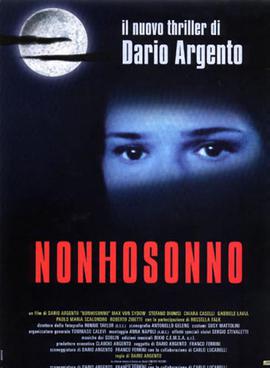
The Films of Dario Argento: Sleepless


In Italy, a young boy named Giacomo Gallo can only hide under a bed as he witnesses his mother being stabbed to death by an English horn. He doesn’t see the murderer, who is believed to be a serial killer known as The Dwarf Killer due to his short stature. All he can remember for sure is the blood and a strange hissing sound. Detective Ulisse Moretti (Max von Sydow) promises Giacomo that he will capture the Dwarf Killer.

Twenty years later, Moretti is retired. He never caught the Dwarf Killer, whose killing spree ended just as abruptly as it began. However, when a sex worker named Angela (Barbara Lerici) is brutally murdered on a train, there is evidence that indicates the Dwarf Killer has returned. Moretti comes out of retirement, determined to close the one case that he never solved. Unfortunately, it’s going to be difficult because Moretti’s memory is failing. As he puts it at one point, there are times when he can’t even remember his late wife’s face. Moretti has forgotten much about the case, though as he investigates, it all starts to come back to him. Moretti finds himself working with the now grown-up Giacomo (Stefano Dionisi), who hopes to finally capture the man who killed his mother. And while Moretti may be struggling to remember the past and Giacomo still isn’t quite sure what he saw while hiding under the bed, it soon becomes clear that the killer remembers both of them.

After the disappointingly mean-spirited Phantom of the Opera, Sleepless was a return to form for Dario Argento. The film is a giallo and, in typical Argento fashion, the mystery involves not just the physical clues but also how people interpret and edit their own memories. The hiss that Giacomo heard turns out to be not what he originally believed. The killer also turns out to be something even more disturbing than what the police originally assumed. At the heart of the mystery is a rather morbid nursery verse, the sort of thing that can be either innocent or dangerous depending on how one interprets the words. Sleepless is a throwback to the type of films that made Mario Bava famous and also the type of films with which Argento started his directorial career. Max von Sydow’s Moretti is not just a detective. He’s also a symbol of an aging genre, a reminder of the clever mysteries that shed blood with style without ever losing their essential humanity.

Argento has often been criticized for not getting particularly complex performances from his actors. I don’t think that criticism is always fair. One need only see David Hemmings and Daria Nicolodi in Deep Red or Jessica Harper in Suspiria to see what Argento can do with the right cast. In Sleepless, Max von Sydow gives a strong performance as Moretti. In fact, it’s probably one of the best performances to have ever appeared in an Argento film. He plays Moretti as being a kindly man on a mission, someone who has seen the worst that the world has to offer but who hasn’t given up his soul. Von Sydow gives us someone who we truly care about, which makes the film’s set pieces (which are bloody even by Argento standards) all the more effective.

It’s become a bit of a cliché to claim that Argento went into a decline after Tenebrae. While it’s true that Argento’s post-Opera films have been uneven, Sleepless shows what he was still capable of producing.
The (Reviewed) Films of Dario Argento:
  1. The Bird With The Crystal Plumage
  2. Cat O’Nine Tales
  3. Four Flies on Grey Velvet
  4. Deep Red
  5. Suspiria
  6. Inferno
  7. Tenebrae
  8. Phenomena
  9. Opera
  10. Two Evil Eyes
  11. Trauma
  12. The Stendhal Syndrome
  13. The Phantom of the Opera
  14. Dracula 3D (Reviewed by Brad Crain)

Embracing the Melodrama Part II #92: Stealing Beauty (dir by Bernardo Bertolucci)


Stealing_Beauty_PosterI love Italy.

Some of that’s because I happen to be a fourth Italian.  And a lot of it is because many of my favorite filmmakers are Italian.  However, Italy is also place of which I have a lot of wonderful memories.  I spent the summer after my high school graduation in Italy and it was amazing.

Venice was full of sensual mystery (and, to be honest, some pretty obnoxious tourists as well).  Naples was dangerous and exciting.  Pompeii made me feel like I was living history.  Rome was full of handsome men and temptation.  When I walked through the Vatican, my inner Catholic girl suddenly woke up and I just had to stop and stare.  And Tuscany — oh my God, Tuscany!  That summer, as far as I was concerned, Tuscany was the most beautiful and romantic place on Earth.  I can still remember standing in the street of Florence and seeing the dome of the Cattedrale di Santa Maria del Fiore in the distance and, for a minute, I almost felt like I was in a painting.  And I actually started to get light-headed and dizzy, I was so overwhelmed by it all.

(That’s right.  Stendhal Syndrome isn’t just a Dario Argento film.)

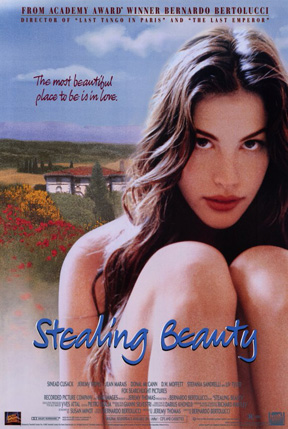
At it’s best, the 1996 film Stealing Beauty made me think about that wonderful summer that I spent in Italy.  And, at its worse, Stealing Beauty made me happy that I made that trip with my sisters and not Lucy Harmon.

Lucy Harmon is the main character in Stealing Beauty.  Played by a young Liv Tyler, Lucy is the teenage daughter of a poet who has recently committed suicide.  Lucy is a poet herself.  Among her poems: “The dye is cast/ The dice are rolled/ I feel like shit/ you look like gold” and “I wait/ I wait so patiently/ I’m as quiet as a cup/ I hope you’ll come and rattle me/ Quick!/ Come wake me up.”  That’s right — Lucy writes the same type of crap that I used to write when I was 17 and trying to impress everyone with the depth of my mind.  The only difference is that Lucy is rich and privileged so her poetry doesn’t actually have to be any good.

Anyway, Lucy comes to Tuscany for three reasons.  First off, she wants to be sculpted by one of her mother’s friends, who lives in a villa.  Secondly, she wants to lose her virginity to an Italian boy who, years before, kissed her.  And, finally, she wants to learn the identity of her father, who she believes to be one of the residents of the villa.

The film’s great when it concentrates on the beauty of Tuscany.  It’s a beautiful film to look at and, as its best, it captures the romance of being young and having your entire life ahead of you.  In that way, the film brought back a lot of good memories and it made me want to revisit Italy.

But then, whenever I was fully content to just enjoy the sight of Tuscany, the film had to try to focus on Lucy and the other people living in the villa and … bleh.  For all of their talk about art and political posturing, they all basically came across as being a bunch of self-righteous fakes, the equivalent of the millionaire with a Che poster in his office.  In the end, there are only two adults that you end up liking.  You like writer Alex Parris (Jeremy Irons) because he’s dying and, as a result, doesn’t feel the need to try to impress anyone.  And, despite the film’s intentions, you end up liking the local fascist, Carlo Lisca (Carlo Checchi), because he doesn’t apologize for or try to rationalize his narcissism.  You like Carlo because all of the other characters dislike him.

In the role of Lucy, Liv Tyler is obviously beautiful and gives as good a performance as the script will allow.  At the same time, as a character, Lucy got on my last nerve.  Judging from what we see of her work, Lucy is not a particularly talented poet.  In fact, Lucy appears to often be an amazingly vapid person.  (Her much-commented on virginity only serves to confirm that Lucy is largely meant to be a male fantasy.)  But, at the same time, she’s rich and she’s got a famous mother and, as a result, the film seems to be telling us that it’s not important that she’s not really that interesting.

So, plotwise, Stealing Beauty did not really work for me.  But the scenery was truly beautiful.