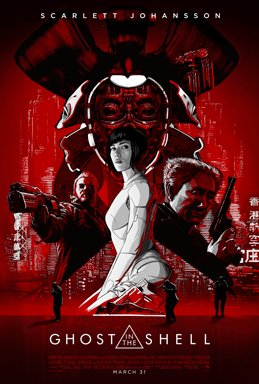
Last night, I finally saw Ghost in the Shell.
Now, before I start in on this review, I should admit that I’m hardly an expert on the manga on which Ghost in the Shell was based. (In fact, as soon as I wrote that previous sentence, I called my boyfriend over and had him read it, just to make sure that I was using the term manga correctly.) A few years ago, I did watch Mamoru Oshii’s 1995 film version. And while I don’t remember a whole lot about the animated Ghost in the Shell, I do remember that I was never bored while watching it. I wish I could say the same about the live action Ghost in the Shell.
Don’t get me wrong. The live action, Westernized Ghost In The Shell is truly a visually impressive film. It takes place in the near future, in the fictional Japanese city of New Port City. New Port City basically looks like the city from Blade Runner, just with a somewhat more colorful visual scheme. Everywhere you look, there are gigantic holographic advertisements and sleek, neon buildings. But, as advanced as New Port City may look at first sight, it’s also full of dark allies, cramped apartments, and gray cemeteries. Visually, it’s a perfect mix of outlandish science fiction and brooding film noir.
Or, at least, it is the first time that you see it. Unfortunately, director Rupert Sanders has a habit of using the visuals as a crutch. It seemed as if, every time a new plot point was clumsily introduced, we would suddenly cut to another shot of New Port City at night, as if the film was saying, “Don’t worry about narrative coherence! Look at the city!”
After about 15 minutes, I decided to take the film up on its suggestion. I stopped paying attention to the slow-moving story and I focused almost exclusively on the visuals. That’s a shame really because, from what I understand, both the manga and the original film are deeply philosophical works that balance style with thematic depth. Unfortunately, since there’s no real depth to the live action Ghost in the Shell, you really have no choice but to focus almost exclusively on the style.
Ghost in the Shell takes place in a world where the line between human and machine has become blurred. Everyone is getting cybernetic upgrades done. One character, Batou (Pilou Asbæk), even gets new eyes halfway through the film. Major (Scarlett Johansson) is unique because, while her brain is human, her body is totally cybernetic. She is a member of Section 9, an anti-terrorism task force. Major has only vague flashes of memory of who she used to be. She’s been told that her parents were killed by terrorists but she doesn’t know if that’s true or if that’s just more manipulation from Cutter (Peter Ferdinando). (It’s no spoiler to say that Cutter turns out to be a not nice guy. He’s the CEO of a Hanka Robotics and when was the last time you saw a movie where a robotics CEO didn’t turn out to be a not nice guy?) After Section 9 thwarts a cyberterrorist attack against Hanka Robotics, Major starts to wonder who she is and who she can trust. Everyone tells her that, because she has a human brain, she’s also a human. But Major still feels lost and without an identity. When she starts to get too close to discovering her past, Cutter sets out to not only destroy her but all of Section 9 as well…
There’s a really good movie in which Scarlett Johansson plays a lost soul looking for her identity in Japan. It’s called Lost in Translation. Or, if you just want to see Scarlett playing someone who is learning more and more about herself and what she’s capable of, you could go watch Lucy. (I don’t care much for that movie but some people seemed to like it.) Or, if you want to see Scarlett play an enigmatic being who explores the world while hiding her true form in a human shell, you can always go watch Under the Skin.
(I highly recommend Under the Skin, which is as thought-provoking as Ghost in the Shell is shallow.)
This is what’s frustrating. Scarlett Johansson gives a really good performance in Ghost in the Shell but she’s continually let down by a script that refuses to take the time to really explore anything. We get a scene or two of Major wondering what it means to be truly human but the movie is always more interested in getting to the next action scene. There’s a lot of talk about what it means to be human but there’s no real exploration. Ghost in the Shell has all the depth of one of those old sci-fi shows where aliens (and, occasionally, androids) approach bemused humans and ask, “What is this thing that you call laughter?”
Ghost in the Shell ends with the hint of more films to come. Personally, I’d rather see Scarlett Johansson in a Black Widow solo film. When is that going to happen, Marvel Studios!? Let’s get to it! As for the live action Ghost in the Shell, it’s just frustrating and forgettable.
But the city looks really good!

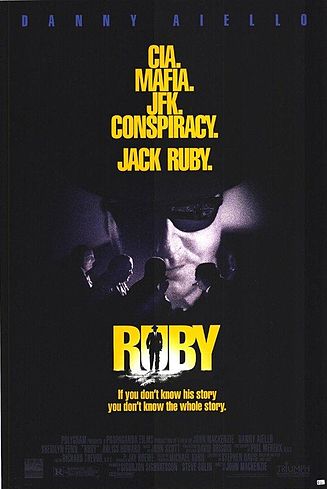 Of all the stars to come out of Twin Peaks, Sherilyn Fenn’s star briefly shined the brightest and sadly, she was the most misused by Hollywood. While it is true that Fenn has worked regularly since Twin Peaks went off the air, she has rarely gotten the great roles that someone with her talent deserves. Instead, her performances have far too often been the best thing about an otherwise mediocre film.
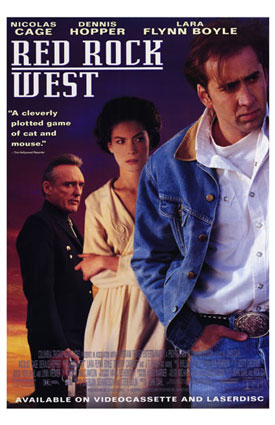 The place is Red Rock, a little town located in the middle of nowhere Wyoming. When a man from Texas (played by Nicolas Cage) wanders into his bar, the owner, Wayne (J.T. Walsh), assumes that the man is Lyle From Dallas, the semi-legendary hit man who Wayne has hired to kill his wife, Suzanne (Lara Flynn Boyle). Wayne gives the man half of his payment in advance and promises the other half after Suzanne is dead. What Wayne doesn’t realize is that Lyle From Dallas is not actually Lyle From Dallas. Instead, he is a drifter named Michael who has just recently lost his job. Michael takes Wayne’s money but, when he sees Suzanne, he tells her that Wayne wants her dead. Suzanne responds by offering to pay Michael to kill Wayne. Michael mostly just wants to leave town but his every effort is thwarted, with him continually only managing to get a mile or two out of town just to then find circumstances forcing him to once again pass the Red Rock welcome sign. Meanwhile, the real Lyle From Dallas (Dennis Hopper) has shown up and he is pissed.
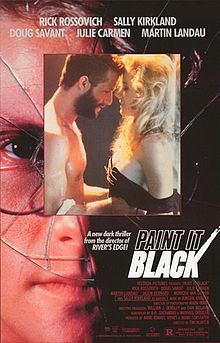 This month, since the site is currently reviewing every episode of Twin Peaks, each entry in Move A Day is going to have a Twin Peaks connection. Paint In Black was directed by Tim Hunter, who directed three episodes of Twin Peaks,
 This month, since the site is currently reviewing every episode of Twin Peaks, each entry in Move A Day is going to have a Twin Peaks connection. Where The Day Takes You is a movie that has not just one but two connections to Twin Peaks.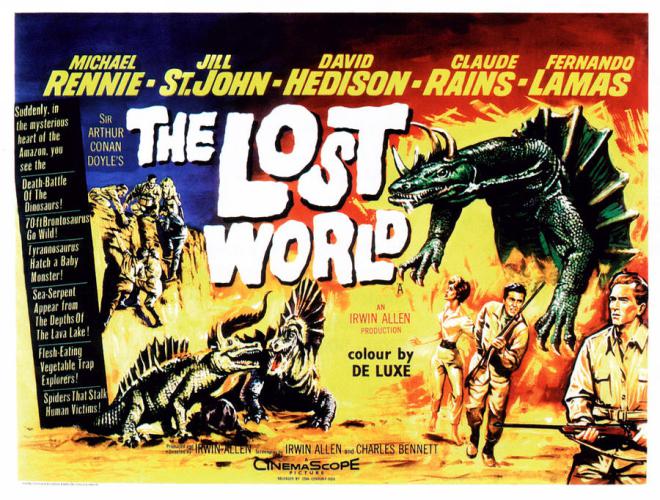
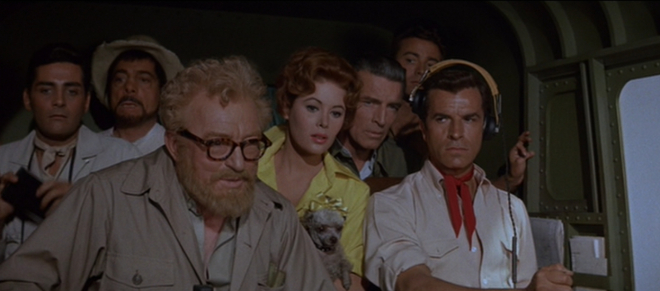
 As everyone surely knows, before they appeared as Dr. Lawrence Jacoby and Benjamin Horne on Twin Peaks, Russ Tamblyn and Richard Beymer co-starred in
 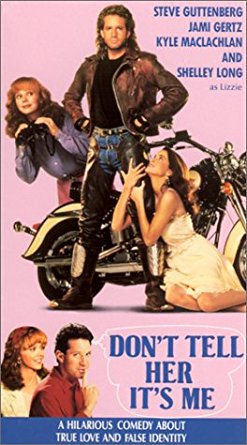 This month, since the site is currently reviewing each episode of Twin Peaks, every entry in Move A Day is going to have a Twin Peaks connection. I am going to start things with Don’t Tell Her It’s Me, a movie that I normally would never think of as having anything to do with Twin Peaks or anything else that David Lynch has ever been associated with.
 As Lisa said in her review of Night Game
