Netflix Review: Mystery Science Theater 3000 11.1 “Reptilicus”


I grew up loving Mystery Science Theater 3000.  Since my favorite was always Tom Servo, it never mattered to me whether Joel or Mike was the host.  Even after the show went off the air, it was always nice to know that I could say, “How much Keeffe is in this movie?” and at least one person would know that the correct answer would always be “Miles O’Keeffe.”

When I first heard about the Kickstarter campaign to bring back Mystery Science Theater 3000, I was worried.  As someone who owns all of the Rhino DVDs, along with The Mystery Science Theater 3000 Colossal Episode Guide and several VHS copies of the original broadcasts on both Comedy Central and SyFy, I was happy to see that there was still life in the show.  At the same time, I was worried that a possibly inferior reboot might ruin some of my favorite childhood memories.

I just finished watching the first episode of the Netflix MST3K and there is no need for alarm or concern.  My childhood will survive.  While it wasn’t perfect, it was still more than good enough.  It may not have ranked up with the classic episodes of MST3K but it’s at least as good as the one where Pearl forced Mike and the Bots to watch the Russian version of Hamlet.

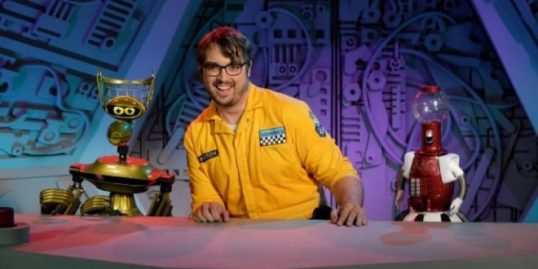
Felicia Day and Patton Oswalt were great as the new Mads.  I appreciated the return of the invention exchange and that the show still had the same deliberately cheap look that we all know and love from the original.  With Tom Servo, Crow, and Gypsy all being voiced by new actors, it’s going to take a while to get used to the new crew on the Satellite of Love but, by the end of the episode, both Hampton Yount and Baron Vaughn had settled into their roles of Tom and Crow.  Considering that it was his first episode and that it is still strange to see someone other than Joel or Mike hanging out with the bots, Jonah Ray did a commendable job as the new host, bringing a laid back vibe to the role that was very reminiscent of the Joel years.  (That’s not surprising, considering that the revival is largely Joel’s baby.)  Tom being able to fly and Gypsy now being suspended from the ceiling are things that sound like they should not have worked but they did.  My one real complaint is that, without the Netflix captioning, it is often difficult to tell the difference between Jonah’s voice and Tom’s.

The movie was Reptilicus.  As a badly dubbed Danish monster movie, it was the perfect “experiment” with which to start off the new MST3K.  Everyone, even Gypsy, got a few good jokes in at the film’s expense.  Among my favorites:

“Something is rotten in the state of Denmark and it’s this movie.” — Crow

“Now, you’re Mr. Filing Cabinet.” — Gypsy, after one of the film’s scientists placed his hat on a filing cabinet.

“The Danish Army, cheaper than extras and less busy.” — Tom

“Reptilicus Returns in Reptilicus 2: 2 Fast 2 Danish.” — Jonah

The show’s best joke came during a host segment, when Crow and Tom asked Jonah to explain how every country has a monster “preferably in rap.”  The chorus of “Every country has a monster/They’re afraid of in their nation/Every monster has a country/Yeah, a station they call home” stayed with me long after the song ended.

Finally, I was happy to see the return of viewer mail segment.  It is nice to know that, in 2017, eight year-olds are still drawing pictures of Tom and Crow on the Satellite of Love.

If you are like me and you were worried that a new Mystery Science 3000 would destroy your childhood, don’t worry.  MST3K is back and, so far, it’s pretty good.
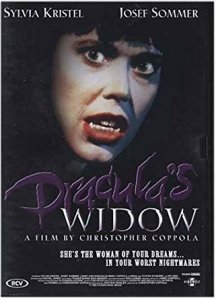
 

A Movie A Day #97: Dracula’s Widow (1988, directed by Chistopher Coppola)


Since we are looking at and reviewing each and every episode of Twin Peaks, every movie-a-day this month has a Twin Peaks connection.  Today’s entry, Dracula’s Widow, stars Lenny von Dohlen, who played reclusive shut-in Harold Smith on Twin Peaks.

Von Dohlen plays Raymond, the nerdy owner of a Los Angeles wax museum.  When he receives six antique chests from Romania, he does not realize that one of them contains, Vanessa (Sylvia Kristel).  Vanessa is a vampire and soon, she is killing the usual collection of perverts, muggers, and occultists.  She also bites Raymond and turns him into her Renfield.  Under her influence, Raymond even dumps his girlfriend, Jenny Harker (Rachel Jones).

However, Vanessa is not just a vampire.  Vanessa is the wife of Dracula, himself.  When she demands that Raymond take her to her husband, Raymond tells her that Dracula was killed nearly a hundred years ago by Prof. Van Helsing.  (How did Vanessa not already know this?)  Vanessa hunts down and kills Van Helsing’s grandson (Stefan Schnabel) but this brings both her and Raymond to the attention of Inspector Lannon (Josef Sommer).

In the 1990s, Dracula’s Widow was a late night HBO mainstay and it still has a cult following.  I could sit here and count out all the ways that Dracula’s Widow does not make any sense but I’ve got a deadline.  For all of this low-budget movie’s flaws, Dracula’s Widow is saved by the sexy presence of Sylvia Kristel and the atmosphere that can only be provided by neon lighting and a fog machine.  Josef Sommer’s hard-boiled narration, in which he refers to Los Angeles as being Tinsel Town, is another highlight.  As for Lenny von Dohlen, his performance as Raymond feels like a dry run for his turn as Harold Smith.

Dracula’s Widow was the directorial debut by Christopher Coppola, whose uncle Francis would later make Bram Stoker’s Dracula and whose brother, Nicolas Cage, ate a cockroach while making Vampire’s Kiss.

A Movie A Day #96: Gladiator (1992, directed by Rowdy Herrington)


What ever happened to James Marshall?

Whenever the subject of Twin Peaks comes up, that question gets asked a lot.  Marshall played the sensitive (and oft-ridiculed) motorcycle-riding rebel James Hurley on Twin Peaks and, after the show’s cancellation, he went on to play a key supporting role in A Few Good Men.  Marshall’s role may not have been huge but he managed to hold his own against actors like Tom Cruise, Jack Nicholson, and Kevin Bacon.

And then after A Few Good Men, nothing.

Why did James Marshall disappear?

He starred in a movie called Gladiator.

No, not the Russell Crowe movie that won all the Oscars.  This Gladiator is about Tommy Riley (played by James Marshall), a teenager who moves to Chicago from Massachusetts.  As one of the only white kids in his new neighborhood, Tommy finds himself being harassed by the local gangs.  One night, he gets into a fight in a parking lot.  (Fortunately, none of the neighborhood gangs carry guns or knives.  They settle everything with fists.)  Pappy Jack (Robert Loggia) is so impressed with Tommy’s fighting skills that he recruits Tommy to fight in illegal, underground boxing matches. Normally, Tommy would say no but he needs the money to help his father (John Heard) pay off his gambling debts.

Once recruited, Tommy is trained by the wise Noah (Ossie Davis) and works for boxing promoter, Jimmy Horn.  Horn is played by all-purpose bad guy Brian Dennehy, who gives such a villainous performance that even Lance Henriksen would say, “Dude, dial it down a notch.”  Tommy befriends two other boxers, Romano (Jon Seda) and Lincoln (Cuba Gooding, Jr.).  At the time that Gladiator was filmed, Marshall was hot off of Twin Peaks and Gooding was hot off of Boyz ‘n The Hood.  Fortunately, Gooding’s role is actually pretty small so he survived Gladiator and was able to go on to win an Oscar for Jerry Maguire and play O.J. Simpson in American Crime Story.  Marshall was less lucky.

At one time, I thought that no one could be a least convincing boxer than Damon Wayans was in The Great White Hype.  Then I watched Gladiator and saw James Marshall dancing around the ring and throwing punches.  Normally, good editing can be used to disguise a lack of athletic ability but both Marshall and Gooding are so miscast as boxers that all the editing in the world can’t help.  Jon Seda, who actually was an amateur boxer before getting into acting, is more convincing in the ring but his character is so saintly that anyone watching will know better than to get too attached to him.

A still notorious flop at the box office, Gladiator was directed by Rowdy Herrington but it’s no Roadhouse.

A Movie A Day #95: The Return of Josey Wales (1986, directed by Michael Parks)


Four years before he played Jean Reanult on Twin Peaks, actor Michael Parks starred in and made his directorial debut with the obscure western, The Return of Josey Wales.

As is obvious from the title, The Return of Josey Wales is a sequel to the iconic Clint Eastwood western, The Outlaw Josey Wales.  In fact, The Return of Josey Wales was based on a novel that author Forrest Carter wrote after the initial success of Eastwood’s film.  Originally, Clint himself was going to direct and star in the sequel.  However, Eastwood withdrew from the project and it would be years before The Return of Josey Wales would eventually be made with a miniscule budget and given a very limited theatrical release.  By the time the film was released, it had long since been discovered that Forrest Carter, who had always portrayed himself as being a Cherokee shaman-turned-writer, was actually Asa Earl Carter, a former member of the Ku Klux Klan who had previously worked as a speech writer for arch segregationist, George Wallace.

Along with taking over from Eastwood as the film’s director, Michael Parks also took over the role of Josey Wales.  Having faked his death, Josey is now living on a small farm in Texas and going out of his way not to draw attention to himself.  One day, a man named Paco (Paco Vela) shows up and tells Josey that a corrupt Mexican policeman has killed one of Josey’s friends and locked another one up in prison.  It’s time for Josey to say goodbye to his new wife, jump on a horse, and head down to Mexico.

The Return of Josey Wales never escapes the shadow of The Outlaw Josey Wales, even though the two films have little in common.  As a director, Michael Parks is no Clint Eastwood and his reliance on stock footage reveals how little of a budget he had to work with.  As an actor, Parks gives a totally different performance from Clint Eastwood’s.  Clint’s Josey Wales was hardened and embittered by his experiences.  Michael Parks plays Josey more as an underestimated hick who is not afraid to use a gun if he has to.  There is a lot of Earl McGraw in this version of Josey Wales.  That does not mean that Michael Parks gives a bad performance.  In fact, his performance is the best thing in the film.

The Return of Josey Wales is for Western completists only.

(This review originally stated that Eastwood left the project after it was revealed that Forrest Carter was Asa Carter.  According to Dan T. Carter’s comment below, Eastwood actually left the sequel long before Forrest Carter’s actual identity was revealed.)

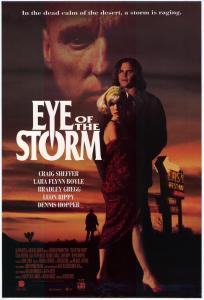
A Movie A Day #94: Eye of the Storm (1991, directed by Yuri Zeltser)


A motel sits off of a highway in the Nevada desert.  One night, two criminals (Ally Walker and German boxer Wilhelm von Homburg) brutally murder the husband and wife who own the motel.  Their youngest son, Steven, flees the criminals by jumping through a window and is left for dead.
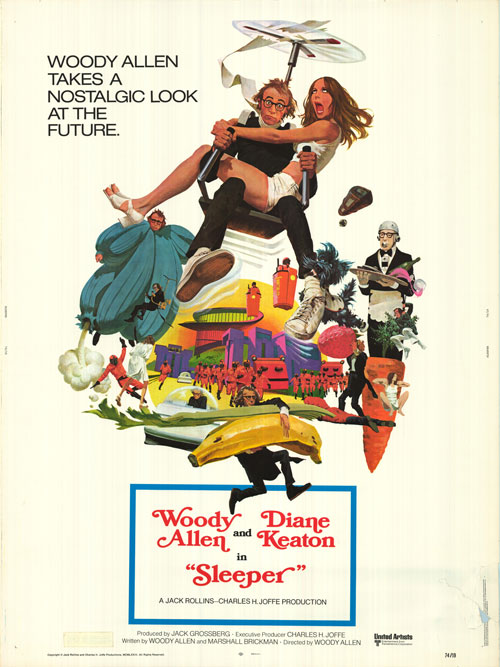
Ten years later, the motel is still sitting off the highway, operated by the blind Steven (Bradley Gregg) and his older brother, Ray (Craig Sheffer).  Ray is very protective of his brother and, when a car pulls up to the motel, he does not even want to turn on the vacancy sign.

The motel’s newest guests are a very unlikely couple.  Marvin Gladstone (Dennis Hopper) is an alcoholic gambler who regularly berates at his much younger trophy wife, Sandra (Lara Flynn Boyle).  Marvin and Sandra were heading to Las Vegas to renew their vows but the drunk Marvin accidentally drove their car off the road.  Now, Marvin and Sandra are stranded at the motel while a dust storm approaches and one of the brothers turns out to be psychotic.

Eye of the Storm is another low-budget and predictable thriller from the 1990s but, taken on its own terms, it’s not bad.  Along with some striking shots of the desert, Eye of the Storm features a quartet of strong performances.  For fans of David Lynch, the main interest here will be seeing Blue Velvet‘s Dennis Hopper and Twin Peaks‘s Lara Flynn Boyle as a couple in trouble.  Hopper especially seems to be enjoying himself and when his character leaves the movie, Eye of the Storm becomes much less interesting.  Lara Flynn Boyle is sexy throughout, enough to make you reconsider everything you thought you knew about Donna Hayward.

See this one on a double bill with Red Rock West.

Strange Days Indeed: Woody Allen’s SLEEPER (United Artists 1973)


gary loggins's avatarcracked rear viewer

(I’m posting a bit earlier than usual so I can head up to the Mecca of baseball, Fenway Park! Go Red Sox!!)

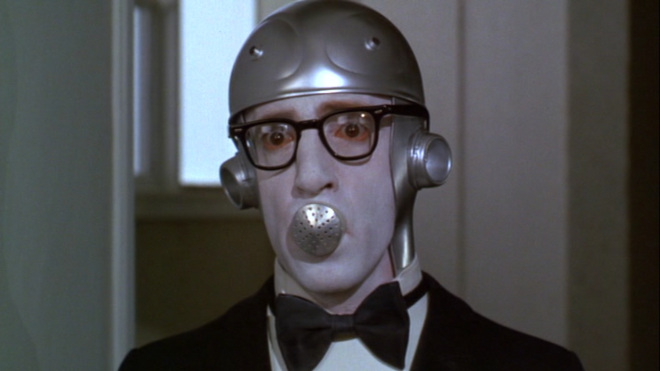
Full disclosure: I lost interest in Woody Allen around the time he decided to become a “serious” filmmaker beginning with INTERIORS. Sure, I thought ZELIG and PURPLE ROSE OF CAIRO were funny, and A MIDSUMMER’S NIGHTS SEX COMEDY had its moments. But for me, the years 1969-1977 were Woody’s most creative period, spanning from the absurd TAKE THE MONEY AND RUN to the Oscar-winning ANNIE HALL. Landing right about midway in that timeline stands his brilliant sci-fi satire SLEEPER, which owes more to Chaplin and Keaton than Asimov and Arthur C. Clarke.

The fun begins when Miles Monroe (Allen) is woken from his cryogenic sleep in the year 2173. Two hundred years earlier, Miles had been the proprietor of the Happy Carrot Health Food store, and went in for minor surgery on…

View original post 588 more words

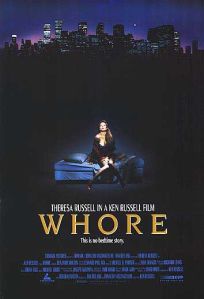
A Movie A Day #93: Whore (1991, directed by Ken Russell)


Liz (Theresa Russell) is a prostitute trying to survive on the mean streets of Los Angeles.  With the help of a homeless performance named Rasta (Antonio Fargas), Liz tries to escape from her abusive pimp, Blake (Benjamin Mouton).
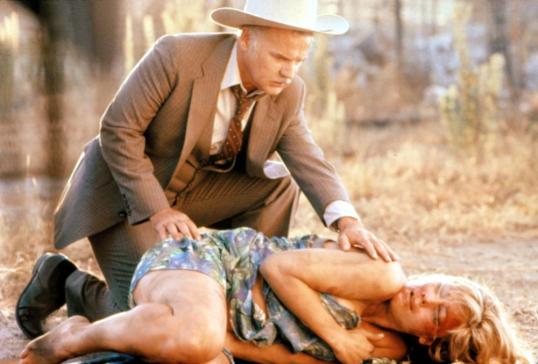
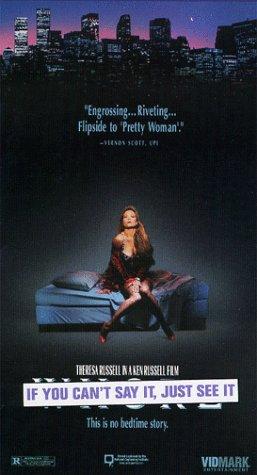
To its credit, Whore was made as a response to the glamorous and irresponsible way that prostitution was portrayed in Pretty Woman but Whore had too much going against it to succeed.  It was based on a theatrical monologue, which was almost always a bad sign.  The majority of the movie was Liz talking straight to the camera, which was another red flag.  Most ominously, it was a Theresa Russell movie that was not directed by Nicolas Roeg and those never seemed to turn out well.  The director of Whore was Ken Russell but it featured none of the excess that Russell was known for.  Stuck with a low-budget and a reportedly unenthusiastic studio, Russell’s direction was uncharacteristically restrained.  (That’s a polite way of saying boring.)

The one good thing about Whore, and the reason why I’m writing about it during this site’s look back at Twin Peaks, was the presence of Jack Nance, playing one of the few men who actually tries to help Liz.  Nance, of course, not only played fishing-obsessed Pete Martell in Twin Peaks but also starred in Eraserhead and appeared in all of Lynch’s films (with the exception of The Elephant Man) up until Nance’s mysterious death in 1996.  Literally credited as playing “Helpful passerby.” Nance only had a few minutes of screen time but made a definite impression as one of the few kind people to be found in Liz’s dark world.

As a reflection of how much times have changed, Whore‘s title was so controversial that, in 1991, it was released in some areas under an alternative title: If You Can’t Say It, Just See It.


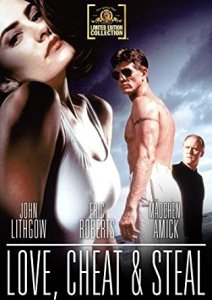
A Movie A Day #92: Love, Cheat, & Steal (1993, directed by William Curran)


Paul Harrington (John Lithgow) is a wealthy banking consultant who has just married a sexy, younger woman, Lauren (Madchen Amick).  Paul thinks that Lauren is perfect but then her brother, Donald (Eric Roberts), shows up.  What Paul does not know is that Donald is not actually Lauren’s brother.  Instead, Donald is Reno, Lauren’s first husband who she never actually divorced. Reno has just escaped from prison where he was serving time for a crime for which he believes Lauren framed him.  While Paul tries to save his father’s failing bank, Reno starts to plan a bank robbery and Lauren tries to balance her old life with Reno with her new life with Paul.


Mild neo noirs like Love, Cheat, & Steal were a dime a dozen in the 1990s.  Love, Cheat, & Steal was made for Showtime and, throughout the 1990s, it used to tempt kids like me with its promise of “Brief Nudity” and “Adult Situations.”  The only thing that makes it memorable is the presence of Madchen Amick, who was always the most beautiful of all of the Twin Peaks starlets, even if she often was overshadowed by Sherilyn Fenn and Lara Flynn Boyle.  Madchen Amick has the right combination of girl next door innocence and enigmatic sultriness to make her perfect for movies like Love, Cheat, & Steal.  Other than the presence of Madchen Amick, Love, Cheat, & Steal is best remembered for being your only chance to see Eric Roberts do a Jack Nicholson imitation.

One final note: Irish actor Dan O’Herlihy has a small role.  Though he is best known for playing Conal Cochran in Halloween 3, he also co-starred with Amick during the second season of Twin Peaks.

After Pluto: I am my new normal


Review of the new web series After Pluto

After pluto

Cast:

Lane Allison as Truman Welles

Griffin Burns as Wes Welles

Christopher Carver as Ian Barnes

Tiffany Commons as Diane Montgomery

Preview:

You are a best selling author, married to the perfect man, having the life you dreamed of and everything is perfe……. Forget about it….

Whoa! Let’s back up for a bit. Birthday partayyy!! *Shhuusssh* we all should just *shush*

It’s Trumans (Lane Allison) birthday and all of her friends are throwing her an unexpected party when then unexpected Tru shows up. As all of the guest listen in, Tru reviles that she has recently filed for divorce. *Suprise* Oh, wait, I did that early; Tru’s husband, Ian shows up to the party. *SUPRISE* …Umm, awkward!

Then a *trip* down the stairs…

Then let’s fall right into this….six weeks later…with no memory of what is going on….

What is left of your life with no memories? How do you put your life back together?

“I am my new normal”

We all love a marriage counselor who can’t get his stories straight! We just need the “meat and potatoes” of this. I love how the “therapist” turns things on himself!

“What is the last thing you remember” “Pluto being downgraded as a planet”

“Shit…” “And you are going to need to soon” I love how Tru an Ian are getting along now!

Just to be honest, I want somebody to love me the way Ian loves Tru!

There are things we need to talk about:

Especially the *slippery condom* But we will get to that later! I hope!

“We need to know about Emma!”

Can Diane be anymore awesome? (she is pretty damn awesome!)

Review:

Actually, I really loved this pilot of a web series!

Looking forward to more episodes, and I have it on good authority from After Pluto’s production company (A Right Forever Productions) that new episodes are coming soon!

After Pluto pilot episode can be found here:


More information about new episodes can be found at their website http://www.afterpluto.com/

Film Review: Ghost in the Shell (dir by Rupert Sanders)


Last night, I finally saw Ghost in the Shell.

Now, before I start in on this review, I should admit that I’m hardly an expert on the manga on which Ghost in the Shell was based.  (In fact, as soon as I wrote that previous sentence, I called my boyfriend over and had him read it, just to make sure that I was using the term manga correctly.)  A few years ago, I did watch Mamoru Oshii’s 1995 film version.  And while I don’t remember a whole lot about the animated Ghost in the Shell, I do remember that I was never bored while watching it.  I wish I could say the same about the live action Ghost in the Shell.

Don’t get me wrong.  The live action, Westernized Ghost In The Shell is truly a visually impressive film.  It takes place in the near future, in the fictional Japanese city of New Port City.  New Port City basically looks like the city from Blade Runner, just with a somewhat more colorful visual scheme.  Everywhere you look, there are gigantic holographic advertisements and sleek, neon buildings.  But, as advanced as New Port City may look at first sight, it’s also full of dark allies, cramped apartments, and gray cemeteries.  Visually, it’s a perfect mix of  outlandish science fiction and brooding film noir.

Or, at least, it is the first time that you see it.  Unfortunately, director Rupert Sanders has a habit of using the visuals as a crutch.  It seemed as if, every time a new plot point was clumsily introduced, we would suddenly cut to another shot of New Port City at night, as if the film was saying, “Don’t worry about narrative coherence!  Look at the city!”

After about 15 minutes, I decided to take the film up on its suggestion.  I stopped paying attention to the slow-moving story and I focused almost exclusively on the visuals.  That’s a shame really because, from what I understand, both the manga and the original film are deeply philosophical works that balance style with thematic depth.  Unfortunately, since there’s no real depth to the live action Ghost in the Shell, you really have no choice but to focus almost exclusively on the style.

Ghost in the Shell takes place in a world where the line between human and machine has become blurred.  Everyone is getting cybernetic upgrades done.  One character, Batou (Pilou Asbæk), even gets new eyes halfway through the film.  Major (Scarlett Johansson) is unique because, while her brain is human, her body is totally cybernetic.  She is a member of Section 9, an anti-terrorism task force.  Major has only vague flashes of memory of who she used to be.  She’s been told that her parents were killed by terrorists but she doesn’t know if that’s true or if that’s just more manipulation from Cutter (Peter Ferdinando).  (It’s no spoiler to say that Cutter turns out to be a not nice guy.  He’s the CEO of a Hanka Robotics and when was the last time you saw a movie where a robotics CEO didn’t turn out to be a not nice guy?)  After Section 9 thwarts a cyberterrorist attack against Hanka Robotics, Major starts to wonder who she is and who she can trust.  Everyone tells her that, because she has a human brain, she’s also a human.  But Major still feels lost and without an identity.  When she starts to get too close to discovering her past, Cutter sets out to not only destroy her but all of Section 9 as well…

There’s a really good movie in which Scarlett Johansson plays a lost soul looking for her identity in Japan.  It’s called Lost in Translation.  Or, if you just want to see Scarlett playing someone who is learning more and more about herself and what she’s capable of, you could go watch Lucy.  (I don’t care much for that movie but some people seemed to like it.)  Or, if you want to see Scarlett play an enigmatic being who explores the world while hiding her true form in a human shell, you can always go watch Under the Skin.

(I highly recommend Under the Skin, which is as thought-provoking as Ghost in the Shell is shallow.)

This is what’s frustrating.  Scarlett Johansson gives a really good performance in Ghost in the Shell but she’s continually let down by a script that refuses to take the time to really explore anything.  We get a scene or two of Major wondering what it means to be truly human but the movie is always more interested in getting to the next action scene.  There’s a lot of talk about what it means to be human but there’s no real exploration.  Ghost in the Shell has all the depth of one of those old sci-fi shows where aliens (and, occasionally, androids) approach bemused humans and ask, “What is this thing that you call laughter?”

Ghost in the Shell ends with the hint of more films to come.  Personally, I’d rather see Scarlett Johansson in a Black Widow solo film.  When is that going to happen, Marvel Studios!?  Let’s get to it!  As for the live action Ghost in the Shell, it’s just frustrating and forgettable.

But the city looks really good!