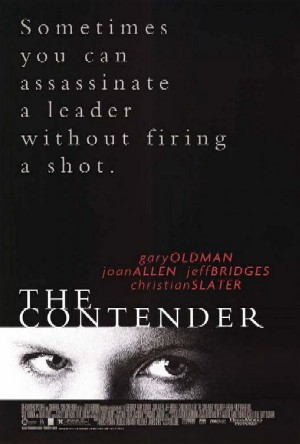
Shattered Politics #67: The Contender (dir by Rod Lurie)


Contenderposter(Spoilers)

The 2000 political melodrama The Contender is one of the most hypocritical films that I’ve ever seen.

The Contender tells the story of what happens when U.S. Sen. Laine Hanson (played by Joan Allen) is nominated to be vice president by President Jackson Evans (Jeff Bridges).  During Laine’s confirmation hearings, Rep. Shelly Runyon (Gary Oldman) dredges up rumors that, at a college frat party, Laine took part in a threesome in exchange for money.

When Runyon asks Laine about the rumors, she replies that she refuses to answer any questions about what she may or may not have done while she was younger.  She replies that it is “simply beneath my dignity” and you know what?  She’s absolutely right.  First off, if someone could be disqualified just because of what they did in college then nobody would eve be eligible to be President.  Secondly, and far more importantly, nobody would care about Laine’s sexual history if she was a man.

For over two hours, Laine refuses to answer any questions about the allegations and instead, she turns the tables on her attackers.  And while this alone would not have made The Contender a good film (because, after all, The Contender was written and directed by Rod “Straw Dogs” Lurie), it at least would have been a film that I could respect.

But, Rod Lurie being Rod Lurie, he just couldn’t help but fuck it all up.

Towards the end of the film, Laine is attending a White House reception.  She and President Evans sit down on the White House lawn and, as the stars shine above them, Evans says, “Just between us, is it true?”

Now, there’s two things that Laine could have said here that would have kept this film from falling apart.  Laine could have said, “It’s none of your business.”  And that would have been the right thing to say because, quite frankly, it is none of the President’s business.  The whole point of the movie has been that it’s not anyone’s business.

Or, if the film actually had any guts, Laine could have said, “Yes, it’s totally true.  Like most people, I experimented when I was in college.  But that doesn’t have anything to do with whether or not I’m qualified to be your vice president.”

But no.  Instead, Laine smiles and says, “Nothing happened.  Two guys propositioned me, I said no, and they spread rumors.”

So, basically, the film is saying, “It’s nobody’s business if Laine was sexually active in college but don’t worry, Mr. and Mrs. American Audience, she was a virgin until she turned 30.  So, it’s still okay for you to like her…”

And that’s the thing about The Contender.  It’s a film that doesn’t have the courage of its own convictions.  It’s a film that drags on for over two hours and it expects you to forgive it just because it pretends to have good intentions.  As a woman, there’s nothing I hate more than being pandered to and, for all of its attempts to come across as being feminist, The Contender is all about pandering.

What makes The Contender an interesting bad film — as opposed to just your usual bad film — is how even the littlest details feel false.  It’s obvious that Lurie knew all of the legal details that go into confirming a Vice President but he didn’t know how to make any of those details dramatically compelling.  So, the film becomes a bit of a know-it-all lecture.  By the time that Saul Rubinek popped up and said, “Do you know what Nelson Rockefeller said about the vice presidency?,” I found myself snapping back, “No, what did Nelson Rockefeller say about the Vice Presidency?  Please tell because ah am so sure that it is just goin’ to be the most fascinatin’ thang that ah will ever hear in mah entire life!”

(The more annoyed I get, the more pronounced my Texas accent.)

There’s a lot of weird little things about The Contender that just don’t work.  They may not sound like major problems but when combined together, they start to add up.  For instance, there’s a long shot where we see U.S. Rep. Reginald Webster (Christian Slater) and his blonde wife at a White House reception and the shot just lingers on them for no particular reason.  Long after you would expect the shot to end, it’s still going.  This wouldn’t be an issue if there was some narrative reason for that shot.  Instead, it’s just randomly dropped in there.

And then, after Laine is nominated, we see the front page of a newpaper and there, in the middle of the page, is a headshot of Joan Allen.  Underneath it, a small headline reads, “It’s Laine!”  It just feels so fake.  Wouldn’t the nomination of the first female vice present actually rate a bigger headline and a more dynamic picture?

Speaking of fake, towards the end of the film, President Evans picks up a framed magazine cover and stares down at it.  The magazine, itself, looks like one of those joke “Man of the Year” pictures that people pose for at a state fair.  On the cover is a picture of Last Picture Show era Jeff Bridges.  The headline on the magazine reads: “President Jackson Evans.  His ideas have changed the world.”  Not his actions, mind you.  Not his policies.  Instead, his ideas have changed the world.  But the film shows us no evidence of this and, during Laine’s confirmation hearings, everyone spends the whole time debating the same old shit that they always seem to be debating in Washington.

(Of course, if you’re lucky enough to have a name like Jackson Evans, I guess you might as well become President.)

Of course, when it looks like Laine might not be confirmed, President Evans speaks before Congress.  “For the first time, a woman will serve in the executive!” he declares, which seems like a hilariously awkward way to put it.  (People in this film don’t talk like human being as much as they talk like characters in some fucked up Washington D.C. fanfic.)  He then adds, “There are traitors among us!”

So, I guess the message here is yay for demagogues.

And don’t even get me started on Kathryn Morris, as the cheerful FBI agent who investigates Laine’s past and who, at one point, announces, “Laine is hope!”  Would a male FBI agent ever have to deliver a line that stupid?

And also don’t even get me started on the subplot about Gov. Jack Hathaway (William Petersen), who stages an auto accident in an attempt to convince President Evans to nominate him for vice president.

The Contender is not a good film but it could have at least been a respectable film.  But then, Rod Lurie had to have President Evans ask whether it was true or not.

Perhaps being a hypocrite was the idea that changed the world.
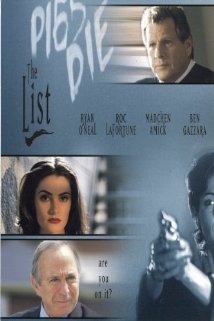


Shattered Politics #66: The List (dir by Sylvain Guy)


The List

“No one pays $15,000 for a back rub.” — Words of wisdom from The List (2000)

 Oh my God.

Listen, I have seen some truly terrible films before but very few were as bad as the 2000 thriller The List.  The List is not just bad.  Instead, it’s bad on a level that very few films manage to reach.  It’s almost as bad as April Rain and that’s pretty bad.

(It’s also currently available on Netflix, just in case anyone wants to take the risk.)

The film opens with a lingerie-clad woman (Madchen Amick) reading the U.S. Constitution to a fat, naked, middle-aged man.  We discover that he’s a judge when she calls him, “your honor.”

“I am no longer your honor,” the naked fat guy says, “I am your dishonor.  And, as for the founding fathers, fuck them.”

Uhmmm…okay.

Anyway, then the police come rushing into the room and arrest both the woman and the judge.  It turns out that the woman is Gabrielle Mitchell (Madchen Amick), a prostitute who is exclusively used by the rich and powerful.  She has a list of her clients, one of whom happens to be the governor of New York state.

Despite the best efforts of her over-the-top pimp Dom Roselli (Roc LaFortune), Gabrielle is convicted and sentenced to prison.  Hoping to get a few years taken off of her sentence, Gabrielle testifies at the judge’s trial.  She hands the list over to yet another judge, Andrew Miller (Ryan O’Neal).

Andrew, who is conservative and very religious, has recently been nominated to the state supreme court.  However, now that he has the list, he find himself being threatened by shadowy figures, one of whom tries to stuff a cow’s tongue down his throat.  Or something like that. I’m not really sure what was going on in that scene and dammit, I’m not going to waste any more of my life trying to figure it out.

Meanwhile, Gabrielle’s associates are also being murdered.  Written in blood near every body: Snitching Pigs Die!

So, if a bunch of community theater actors got together with a film school drop out and attempted to make a film out of a script written by a 16 year-old with authority issues, the end result would look a lot like The List.  When Andrew  holds a press conference, there are about 6 reporters present and only two of them get to ask questions.  When the bad guys all meet to discuss what should be done about Gabrielle, they appear to be sitting in a community college study room.  When a character is found dead, it’s obvious that some crew members got a little bit enthusiastic about splashing red paint all over the set.  The actors may trip over their lines and they may seem frequently confused by what their saying but, obviously, this was one of those films were second takes were considered to be too expensive.

Did I mention that Ben Gazzara is in this thing?  Because he so is!  I can’t being to imagine what path could have led Gazzara from co-starring in Anatomy of a Murder to appearing in something like The List but, let it be said that he actually gives a pretty good performance.  Or, at the very least, he does the best with what he’s been given.

Ryan O’Neal on the other hand…

O’Neal wanders through the film, watching the action through bloodshot eyes and defiantly refusing to show the slightest hint of emotion or interest.  It’s an interesting idea actually, casting an actor who appears to be perpetually hung over in the role of a straight-laced, moralistic judge.

Usually, I make excuses for films that were obviously filmed with next to no budget but seriously, The List could have been made for Avatar money and it would still suck.  I’m sad to say that it doesn’t even manage to raise to the level of being so bad that it’s good.

Instead, it’s just bad.

But, in case you’re into that, it is on Netflix.

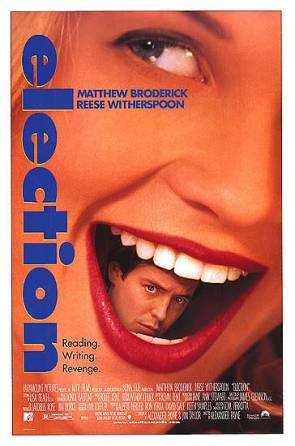
Shattered Politics #65: Election (dir by Alexander Payne)


Election_1999filmLast year, when I did my series of Back to School reviews, it somehow slipped my mind to review Alexander Payne’s 1999 comedy, Election.  Don’t ask me how I managed to do that.  Election, after all, is one of the greatest high school films ever made.  Not only does it feature Reese Witherspoon’s best performance (or, at least, it was her best performance up until the release of Wild) but it also features Ferris Bueller himself, Matthew Broderick, as the type of teacher who regularly inspired Ferris to skip school.  Trust me — when I realized that I had managed to review Cavegirl while somehow ignoring Election, I was mortified.

But then, a few months later, I decided to do Shattered Politics and review 94 films about politics and politicians.  And it occurred to me that Election may have been a high school film but it was also a political satire.  Add to that, it’s totally plausible that Reese Witherspoon’s Tracy Flick will someday end up running for President.

That certainly seems to be the concern of Jim McAllister (Matthew Broderick) in Election.  When he learns that Tracy is planning on running for student body president, Jim is concerned.  Tracy is an overachiever.  Tracy is the type of student who always raises her hand in class and who always has the right answer.  Tracy is the type of student that tends to drive other students crazy.  As Jim puts it, if Tracy is elected Student Body President, who knows where it will end?

Of course. Jim has other reasons for disliking Tracy.  Earlier in the year, for instance, Tracy was seduced by Jim’s fellow teacher and best friend, Dave Novotny (Mark Harelik).  When Tracy’s mother (played by Colleen Camp) discovered the affair, Dave was forced to retire and was subsequently divorced.  When Tracy mentions that if she’s elected President, that means she and Jim will be working closely together, Jim panics.  Jim thinks that Tracy will try to seduce him and he knows that he would be too weak to resist.  Instead, Jim would rather have an affair Dave’s ex-wife (Delaney Driscoll) while trying unsuccessfully to get his own wife (Molly Hagan) pregnant.

So, of course, Jim decides to recruit Paul Metzler (Chris Klein) to run against her.  Paul is a simple-minded but sweet-natured jock who, as the result of breaking his leg while skiing, has become something of a school martyr.  As soon as Paul announces that he’s running, his cynical little sister Tammy (Jessica Campbell) also announces that she’s running, despite the fact that she hates school and thinks that idea of student government is a joke.  Tammy’s main motivation is that her ex-girlfriend, Lisa (Frankie Ingrassia) has announced that she was just “experimenting” and is now dating Paul and managing his campaign.

Got all that?

As the campaign plays out, Jim is panicked to discover that, while Paul may be popular, he’s also amazingly inarticulate and really doesn’t seem to care whether he wins or not.  Meanwhile, Tammy announces that her first action as president will be to destroy the student government.  However, Jim then has reason to believe that Tracy destroyed some campaign signs (mostly because Tracy did) and he comes up with a plan to get her disqualified from the ballot.

Except, of course, it’s not that easy to get rid of Tracy Flick…

One of the things that always amuses me about TV shows set in high school is that they almost always feature an absurdly powerful student council.  Remember that episode of Boy Meets World where Topanga is elected president because she gives a speech about how somebody has to do something about the mold in the cafeteria?  That’s the fantasy view of the student council.  The reality is that, when I was in high school, the student council was something that, whenever we remembered that it actually existed, we all laughed about.

(One of the great things about Degrassi is that it’s one of the few teen shows to acknowledge that the student council has no power.  Considering that the current President of the Degrassi Student Council is Drew Torres, that’s probably for the best.)

But here’s the thing — we all knew someone like Tracy Flick.  We all knew someone who took things like the student council very seriously and who would always get very angry whenever the rest of us showed less reverence for school institutions.  And, in retrospect, you almost have to feel sorry for her because what she never understood was that devotion to the rules and hard work really don’t mean much in either high school or college.  The genius of Reese Witherspoon’s performance is that she brings to life a character that we all know and then, at the same time, makes her a unique human being.  In the role of Tracy, Witherspoon allows us to understand what motivated the girls who always used to get on our nerves.

And then, of course, there’s Matthew Broderick.  Broderick starts out as a glibly self-confident character just to end the film as something of a twisted gargoyle, unshaven because he’s been sleeping in his car and, as the result of a bee sting, a frightfully swollen eye.  By the end of the film, Jim has essentially been destroyed by his fear and obsessive hatred of one student.  Broderick is not exactly playing a sympathetic character here but it’s still a compelling performance because it confirms everything that I always suspected about all of my teachers — i.e., that they specifically and targeted certain students and that most of them were motivated by jealousy.

Thank you, Election, for letting me know that I was right!

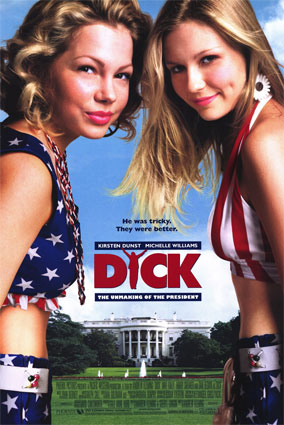
Shattered Politics #64: Dick (dir by Andrew Fleming)


Theatricalposterdick

I wouldn’t necessarily say that I love Dick but I still think it’s a pretty good film.  (Ha ha, see what I did there?)  Of course, to really appreciate this 1999 comedy, it helps to know a little something about political history.  For instance, it helps to know that the Dick of the title is President Richard Nixon (played here by a hilariously paranoid Dan Hedaya).  In 1973, as the result of his attempt to cover up White House involvement of a burglary at the Watergate Hotel, Nixon became the first President to resign from office.

A lot of the credit for Nixon’s downfall was given to two reporters for the Washington Post, Bob Woodward and Carl Bernstein (played, in this film, by Will Ferrell and Bruce McCulloch).  While Woodward and Bernstein investigated the Watergate break-in, they were reportedly fed information by a highly placed informant who was referred to as being Deep Throat.  For years, the identity of Deep Throat was a closely held secret.  Countless books were written that speculated as to who Deep Throat may have been.  (In the film All The President’s Men, he was played by Hal Holbrook.)  Finally, in 2005, it was revealed that Deep Throat was a FBI agent named Mark W. Felt, who was upset because he was passed over for a promotion.

And, quite frankly, that’s kind of a disappointing solution.  When you think about someone who brought down the government, you hope that he or she will turn out to be something more than just a disgruntled employee whose previous work consisted on running counter intelligence operations against domestic political activists.

In fact, it’s hard not to wish that, perhaps, Deep Throat could have been two 15 year-old girls who just happened to stumble across one of the biggest political scandals in American history.

Well, fortunately, this is the theory proposed in Dick.  Betsy (Kirsten Dunst) and Arlene (Michelle Williams) are two friends who, one night in 1972, sneak out of Arlene’s apartment so that they can mail a fan letter to singer Bobby Sherman.  While doing so, they happen to stumble across the Watergate burglars and get a good look at White House aide G. Gordon Liddy (Harry Shearer).

The next day, while on a field trip to the White House, the two girls are spotted by Liddy.  Liddy arranges for them to be pulled to the side and questioned by chief-of-staff H.R. Haldeman (Dave Foley), who determines that the girls barely know who Nixon is and that they don’t understand what they witnessed.  However, before Haldeman can send the girls on their way, Nixon himself enters the office and complains about how poorly planned the break-in was.

This leads to an unlikely relationship between Nixon and Betsy and Arlene.  Hoping to win their loyalty (and their silence), Nixon arranges for them to be his official dog walkers.  Betsy and Arlene, meanwhile, still don’t have the slightest idea of what’s going on.  They accidentally bring pot cookies to the White House (which Nixon particularly enjoys) and Arlene even develops a mad crush on Nixon.

But, of course, Nixon eventually shows his true colors and Betsy and Arlene take down the government….

In many ways Dick is a one-joke film, in which Betsy and Arlene regularly find themselves blissfully unaware while history literally unfolds around them.  But it’s actually a pretty clever joke and it’s also a very plausible one.  People are often unaware that anything important is happening when it’s actually happening.  Often times, it’s only in retrospect that historical moments are seen to be truly historical.  And, ultimately, Watergate itself is such a bizarre scandal that it’s the perfect moment in history to be reinterpreted as a comedy.

Dick is ridiculous enough to be funny but plausible enough to be memorable.

Shattered Politics #63: Primary Colors (dir by Mike Nichols)


Primaryposter

Jack Stanton (John Travolta) is the charismatic governor of an unnamed Southern state.  After spending his entire life in politics, Jack is finally ready to run for President.  Even more ready is his equally ambitious wife, Susan (Emma Thompson).  Jack proves himself to be a strong candidate, a good speaker who understands the voters and who has the ability to project empathy for almost anyone’s situation. He’s managed to recruit a talented and dedicated campaign staff, including the flamboyant Richard Jemmons (Billy Bob Thornton), Daisy Green (Maura Tierney), and journalist Henry Burton (Adrian Lester).  Henry is the son of a civil rights leader and, as soon as they meet, Jack talks about the first time that he ever heard Henry’s father speak.  Within minutes of first meeting him, Henry believes in Jack.

The problem, however, is that there are constant hints that Jack may not be worthy of his admiration.  There’s the fact that he’s a compulsive womanizer who is given to displays of temper and immaturity.  When one of Jack’s old friends reveals that Jack may have impregnated his daughter, Jack and Susan respond with a pragmatic ruthlessness that takes Henry by surprise.

When one of Jack’s mistresses threatens to go public, Henry is partnered up with Libby (Kathy Bates) and sent to dig up dirt on her and her sponsors.  When the former governor of Florida, Freddie Picker (Larry Hagman), emerges as a threat to derail Jack’s quest for the nomination, Henry and Libby are again assigned to research Picker’s background.  Libby is perhaps the film’s most interesting character.  Recovering from a mental breakdown, Libby has no trouble threatening to shoot one political opponent but she’s still vulnerable and idealistic enough that it truly hurts her when Jack and Susan repeatedly fail to live up to her ideals.  As an out lesbian, Libby is perhaps the only character who has no trouble revealing her true self and, because of her honesty, she is the one who suffers the most.

First released in 1998 and based on a novel by Joe Klein, Primary Colors is an entertaining and ultimately rather bittersweet dramedy about the American way of politics.  John Travolta and Emma Thompson may be playing Jack and Susan Stanton but it’s obvious from the start that they’re meant to be Bill and Hillary Clinton.  And while it takes a few minutes to get used to Travolta’s attempt to sound Southern, this is ultimately one of his best performances.  As played by Travolta, Jack Stanton is charming, compassionate, self-centered, and ultimately, incredibly frustrating.  One reason why Primary Colors works is because we, as an audience, come to believe in Jack just as much as Henry does and then we come to be just as disillusioned as Libby.  Emma Thompson’s performance is a little less obviously based on Hillary.  Unlike Travolta, she doesn’t attempt to imitate Hillary’s voice or mannerisms.  But she perfectly captures the steely determination.

Primary Colors captures both the thrill of believing and the inevitability of disillusionment.  It’s definitely a film that I will rewatch in the days leading up to 2016.

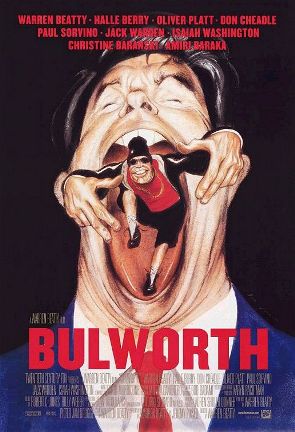
Shattered Politics #62: Bulworth (dir by Warren Beatty)


BulworthSo, if you’ve ever wondered what happened to Robert Redford’s Bill McKay after he was elected to the U.S. Senate at the end of The Candidate, I imagine that he probably ended up becoming something like the protagonist of 1998’s Bulworth, U.S. Sen. Jay Bulworth.

As played by Warren Beatty, Bulworth is a veteran senator.  A former liberal firebrand, he may still decorate his office with pictures of him meeting Bobby Kennedy and Martin Luther King but Bulworth sold out a long time ago.  Now, he just says whatever has to say in order to get elected, including pretending to have a happy marriage. He has become a part of everything that’s wrong with Washington.

Sick of both politics and life in general, Bulworth decides that he’d rather be dead.  But, in order to make sure that his daughter collects on his $10,000,000 life insurance policy, Bulworth cannot commit suicide.  Instead, he arranges for a contract to be taken out on his life.  In two days, Bulworth will be assassinated.

Returning to California for his campaign, Bulworth gets drunk and suddenly starts to say what he actually believes.  He attacks the Washington establishment.  He attacks the voters.  He attacks the insurance companies and comes out for single payer health insurance.  With his desperate press secretary (Oliver Platt) chasing behind him, Bulworth spends the night dancing at a club where he discovers marijuana and meets a girl named Nina (Halle Berry).

(Platt, meanwhile, discovers that he really, really likes cocaine.)

Soon, Nina and Bulworth are hiding out in the ghetto, where Bulworth meets both Nina’s brother (Isiah Washington) and local drug dealer, L.D. (Don Cheadle), and gets a lesson about how economics actually work in the ghetto.  Soon, Bulworth is appearing on CNN where he raps his new political platform and suggests that the solutions for all of America’s problems would be for everyone to just keep having sex until eventually everyone is the same color.

Of course, what Bulworth doesn’t know is that Nina also happens to be the assassin who has been contracted to kill him…

I have mixed feelings about Bulworth.  On the one hand, the film starts out strong.  You don’t have to agree with the film’s politics in order to appreciate the film’s passion,  Bulworth is an angry film and one that’s willing to say some potentially unpopular things.  It’s a film about politics that doesn’t resort to the easy solutions that were proposed by some of the other films that I’ve reviewed for Shattered Politics.  Warren Beatty does a pretty good job of portraying Bulworth’s initial mental breakdown and Oliver Platt is a manic wonder as he consumes more and more cocaine.

But, once Warren Beatty starts rapping, the film starts to fall apart and becomes a bit too cartoonish for its own good.  You get the feeling that Warren Beatty, at this point, is just trying to live out the liberal fantasy of being the only wealthy white man in America to understand what it’s like to be poor and black in America.

Bulworth starts out well but ultimately, it begins better than it ends.

Shattered Politics #61: Murder at 1600 (dir by Dwight H. Little)


Murder_at_sixteen_hundred_ver2Wow.

I have to admit that, seeing as how I was only 11 going on 12 back in 1997, I really wasn’t paying much attention to what was going on in the world at the time.  But, whatever it was, it must have been something big and scary and it must have left people feeling deeply suspicious of the government.  How else do you explain the fact that 1997 not only saw the release of Absolute Power, a film in which the President is a murderer, but Murder at 1600 as well.

Murder at 1600 opens with a White House maid finding the dead body of Carla Town (Mary Moore), an intern whose sole goal in life was apparently to have sex in every single room in the Executive Mansion.  (And, before you judge, that happens to be my goal in life as well.  So there.)  Streetwise homicide detective Harlan Regis (Wesley Snipes) is on the case!

And he’s certainly got a lot of suspects.  Could it be the Vice President (Chris Gillett)?  Or maybe Alvin Jordan (Alan Alda), the National Security Advisor?  Or how about Nick Spikings (Daniel Benzali), the bald-bef0re-bald-was-cool head of the Secret Service?  Or maybe it the President’s son (Tate Donavon)?  Or maybe even the President (Ronny Cox) himself!?

Fortunately, Regis is assigned a partner, Secret Service agent Nina Chance (Diane Lane).  When Regis first meets her, he’s all, “Oh my God, you’re a woman!”  And then Nina’s all, “I also won an Olympic medal for sharp shooting!”  And then Regis is like, “I bet that will be a relevant plot point before the film ends!”

Of course, Regis already has a regular partner, as well.  His name is Detective Stengel and he’s played by Dennis Miller, which just seems strange.  Stengel basically looks like Dennis Miller, sounds like Dennis Miller, and acts exactly like Dennis Miller, except for the fact that he’s a cop.  His jarringly out-of-place presence in this film just adds to Murder at 1600‘s general air of weirdness.

Meanwhile, it turns out that the North Koreans are up to no good and the President is being pressured to take military action.  However, he’s being distracted by this whole criminal investigation thing.  Will the country survive or did its future die at 1600?

(And why doesn’t the President just send in Team America to take care of the situation?  Or maybe James Franco and Seth Rogen.  There are way to deal with the North Koreans….)

(By the way, have you noticed how brave everyone online is when it comes to being snarky about the one country in the world that doesn’t have internet access?  If Kim Jong Whatevuh ever gets a twitter account, I bet everyone will start following him and asking him for retweets.)

Murder at 1600 is an enjoyably ludicrous thriller.  It’s one of those films that you’ll enjoy as long as you don’t take it seriously.  Take it seriously and you’ll end up asking question like why the FBI isn’t involved in the investigation and whether or not the solution to the film’s mystery is a bit too convoluted to make any logical sense.  However, if you simply decide to enjoy Murder at 1600 for what it is, an extremely pulpy thriller that’s full of nonstop melodrama, overwritten dialogue, and a healthy distrust of the government*, then you’ll find this to be an entertaining thriller.

At the very least, a White House full of potential murderers is probably a lot more realistic than anything that you might see in The American President.  

—–

* Oh, everyone knows the government sucks…


Shattered Politics #60: Absolute Power (dir by Clint Eastwood)


Absolute_power

The main reason that I enjoyed the 1997 Clint Eastwood film Absolute Power was because it features a murderer who also happens to be the President.  As someone who dislike the idea of any one person having absolute power, I always get annoyed by the attitude that authority is something that has to be automatically respected.  Instead, I’ve always felt that all authority should be distrusted and continually questioned.

Just take President Alan Richmond (Gene Hackman) for example.  At the start of Absolute Power, he’s a popular President.  He’s quick with a smile.  He’s quick with a memorable line.  I imagine that excerpts from his State of the Union speech would probably be very popular on YouTube.  However, at the start of the film, elderly burglar Luther Whitney (Clint Eastwood) witnesses President Richmond getting violent with Jan Levinson-Gould.  When Jan resists him, two Secret Service agents (Scott Glenn and Dennis Haysbert) run into the room and shoot her.

Okay, technically, the victim was not really The Office‘s Jan Levinson-Gould.  (They both just happen to be played by Melora Hardin.)  Instead, her name was Christy Sullivan and she was also the wife of one of Richmond’s top financial supporters, Walter Sullivan (E.G. Marshall).  After the murder, President Richmond and his chief-of-staff, Gloria Russell (Judy Davis), attempt to frame Luther for the crime.

Absolute Power is pretty much your typical Clint Eastwood action picture.  In the role of Luther, Eastwood snarls his way through the film and never dispatches a bad guy without providing a ruthless quip.  (When one bad guy begs for mercy, Luther replies that he’s “fresh out.”)  Luther has an estranged daughter, a lawyer named Kate (Laura Linney) and, despite the fact that she’s helping the homicide detective (Ed Harris) who is trying to capture him, Luther still pops up to look out for her.  In the end, Luther’s not only try to prove that the President is a murderer but he’s trying to be a better father as well!  Awwwwwww!

Again, it’s all pretty predictable but the film is worth seeing just for the chance to witness Gene Hackman play one of the most evil Presidents ever.  As far as soulless chief executives are concerned, Alan Richmond makes Woodrow Wilson look like a humanitarian!  And Hackman does a good job embodying the affable type of evil that could conceivably translate into an electoral landslide.

Absolute Power may not be a great film but it’s a good one to watch whenever you need an excuse to be cynical about the absolute power of the government.

Shattered Politics #59: Night Falls on Manhattan (dir by Sidney Lumet)


Night_falls_on_manhattan_poster

Oddly enough, right after I watched City Hall, I watched yet another 1997 film about politics and police corruption in New York.  And while Night Falls on Manhattan is definitely not one of Sidney Lumet’s best films, it’s still definitely an improvement on City Hall.

Night Falls on Manhattan tells the story of what happens when two veteran detectives — Liam Casey (Ian Holm) and Joey Allegreto (James Gandolfini) — attempt to arrest drug dealer Jordan Washington (Shiek Mahmud-Bey).  Liam ends up getting shot multiple times before Jordan, disguised as a police officer, flees the scene.  As the cops search for Jordan, they accidentally shoot and kill one of their own.

In short, Manhattan has gone crazy and only the prompt capture and conviction of Jordan Washington will set things right.

However, the police don’t have to spend too much time searching for Jordan because, the very next day, he turns himself in.  He’s accompanied by a veteran radical lawyer named Sam Vigoda (Richard Dreyfuss).  Vigoda announces that yes, Jordan is a drug dealer and yes, he did shoot Liam Casey.  However, Vigoda claims that Jordan has been paying off the cops and that Liam and Joey weren’t actually trying to arrest him.  Instead, they were specifically looking for an excuse to execute him.

Flamboyant District Attorney Morganstern (Ron Leibman) know that his office has to convict Jordan.  And luckily, he has a secret weapon.  Liam’s son, Sean (Andy Garcia), just happens to be a former cop and an assistant district attorney.  He assigns Sean to handle Jordan’s prosecution.

Sean, it turns out, has political ambitions of his own and, by prosecuting Jordan, he not only gets revenge for the shooting of his father but he also furthers his own career.  (He also gets a girlfriend, in this case an associate of Vigoda’s who is played by Lena Olin.)  When Morganstern has a heart attack, Sean suddenly finds himself being mentioned as a candidate to replace him in the upcoming election.

However, even as Sean appears to be shoo-in to be the next district attorney, he also discovers that neither Liam nor Joey were as innocent as he originally assumed..

Night Falls In Manhattan is an occasionally diverting legal and political thriller.  As a director, Sidney Lumet had an obvious feel for New York culture and, as a result, the film feels authentic even when the plot occasionally veers into melodrama.  As opposed to City Hall, you never doubt the plausibility of Night Falls On Manhattan.  Though Andy Garcia is a bit an odd choice to play an Irish-American (and it’s particularly difficult to imagine him being, in any way, related to Ian Holm), the rest of the film is well-cast.  Fans of The Sopranos will enjoy a chance to see James Gandolfini playing someone who, because he’s on the “right” side o the law, is actually more dangerous than Tony Soprano and Rob Leibman is thoroughly believable as a bullying crusader against crime.

After I watched Night Falls on Manhattan, I did some checking online and I was surprised to discover that the film is apparently not better known than it is.  While it definitely uneven, Night Falls On Manhattan is an interesting look at crime, ethics, and urban politics.

Lisa 6 Favorite 2015 Super Bowl Commercials!


While I did watch the Super Bowl tonight, I have to admit that I only watched it for the commercials.  Back in 2013, I did a post on my favorite super bowl commercials and I meant to do the same thing for 2014 but, for whatever reason, I never got around to doing so.  So, I was definitely not going to miss out this year!

Unfortunately, the commercials really weren’t that great this year.  Perhaps if I was looking for a new car, the constant barrage of car commercials would have been more interesting.  I found a lot of the so-called “empowering” commercials to be condescending.  (To be honest, I always resent the idea that I need a commercial to make me feel good about myself.  I’m stronger than that.)  The McDonald’s commercial where people got free food for telling their mom that they loved them upset me because my mom’s not here for me to tell her how much I love her.  And then there were all the commercials about fathers bonding with their sons (never their daughters, interestingly enough) and those made me want to throw stuff as well.

In fact, when all is said and done, my favorite part of the Super Bowl was not watching that commercials.  Instead, it was watching the dancing sharks.

Dance, Shark, dance!

Dance, Shark, dance!

But there were a few commercials that stood out.  For example, there was the Nationwide dead kid commercial, which made me feel like a terrible person because I started giggling as soon as I saw that the TV had fallen over.  And then there was that GoDaddy commercial that was so offensive that it didn’t even make it to air.  (The commercial featured a lost puppy who, upon finally making his way back home, discovers that he’s being sold online.  Dear GoDaddy, I hate you and your asinine commercials.  Stop trying to be edgy, ‘kay?  Okay.)

Oh!  And don’t forget the Nissan commercial about the NASCAR driver who is a crappy father but then makes up for it by showing up at his son’s school in a new car.

My boyfriend actually paid more attention to the game than the commercials, which is like totally the wrong way to do the Super Bowl if you ask me.  But, for the record, his favorite ad was the Victoria’s Secret Super Bowl commercial.  I’m just happy that he got something out of the game.

Anyway, here are my 6 top Super Bowl commercials.

6) Liam Neeson for Clash of Clans

I really don’t know much about Clash of Clans but this commercial made me laugh because this is how I’ve always imagined Liam Neeson passes the time between Taken movies.

5) Pierce Brosnan for Kia

This is actually one of the few car commercials that I actually enjoyed.  Pierce is aging well and appears to have a pretty good sense of humor about how his career will always be defined by James Bond.

4) Nationwide — Invisible Mindy

Everyone was so traumatized by the Nationwide Dead Kid commercial that the Invisible Mindy commercial kinda got lost in the shuffle.  That’s a shame because it’s actually pretty clever.  What really made the commercial, for me, was the Matt Damon cameo at the end.  It was appropriate because Mindy first came to prominence when she and a friend wrote and performed a play called “Ben and Matt,” which told the story of Matt’s bromance with Ben Affleck.

3) The Snickers Machete Bunch Commercial

Danny Trejo and Steve Buscemi!  Need I say more?

2) The Budweiser Puppy Commercial!

This one made me cry.

1) NO MORE’s Official Super Bowl Ad

And finally, here’s my top ad.  This one was powerful and important and all it was selling was hope for a better future.