Just the thought of reviewing Psycho is intimidating.
In the past, I’ve reviewed all of the sequels. I even reviewed a few episodes of Bates Motel. But I’ve avoided reviewing the original 1960 film because I wasn’t sure that there was much left for me to really say about it. It’s one of those films that has been endlessly analyzed. It’s also one of those films that is so famous and which has been imitated so many times that even people who haven’t seen Psycho know what the film is about. Everyone knows about the shower scene. Everyone knows about the twists that took audiences and critics by surprise in 1960. No one is shocked by the revelation about the true nature of Norman Bates and his mother anymore. In fact, most people are more likely to be surprised by Simon Oakland’s hammy performance as the psychiatrist than they are by the ending.
And indeed, probably the best thing that we can say about Psycho is that it still works even when the big twists are no longer a surprise. Janet Leigh’s performance as Marion Crane still holds up as one of the best recorded on film. Even before she arrives at the Bates Motel, we’re scared for her. She spends the first half of the film fleeing Phoenix with an envelope full of stolen cash. Everyone she meets on her journey, from the suspicious highway patrolman (Mort Mills) to the too-eager car salesman (John Anderson), comes across as being a threat. Of course, the bigger threats are the voices in her head as she imagines how people are going to react to her actions. When we hear the patrolman interrogating the salesman, are we hearing an actual interrogation or are we just hearing what Marion fears is happening? We don’t really know and neither does Marion. As played by Janet Leigh, Marion is both a femme fatale (that black bra after she steals the money!) and a relatable and frustrated single woman wondering if she’s waited too long to live her own life (that hotel room with John Gavin’s Sam Loomis!). She’s not a master criminal. She’s someone who did something impulsive and fears she’ll be punished for it.
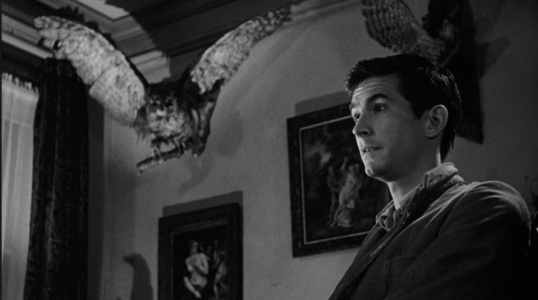
Ironically, Marion’s murder in the shower has nothing to do with the money. When Norman is cleaning up the motel room afterwards, he picks up the newspaper in which Marion hid the money and tosses it into the trunk of her car. Everyone who comes after Marion assumes that Norman knew about the money, but Norman has no idea what they’re talking about. The money itself seems like such a petty thing. The money was stolen from an oilman (Frank Albertson, who also played Sam Wainwright in It’s a Wonderful Life) who confesses that he has a lot more hidden away. Sam’s claim that he can’t marry Marion because he doesn’t have the financial resources feels more like an excuse than a reason. When private detective Milton Arbogast (Martin Balsam) disappears, the sheriff (John McIntire) initially assumes that he stole the money for himself. Marion’s sister Lila (Vera Miles) assumes that Norman stole the money because his motel was struggling. Norman doesn’t care about the money. He sends the money (and Marion’s car) to the bottom of a nearby swamp and he does so in such a casual manner that there’s little doubt it’s not the first time. All Norman cares about is protecting his mother. And all his mother cares about is protecting Norman….
Everyone knows about the shower scene but what makes Psycho truly memorable are the little moments. I love Pat Hitchcock’s performance as Marion’s co-worker. “He was flirting with you. I guess he must have noticed my wedding ring,” is one of the best lines ever written and/or delivered. I love the taciturn sheriff and his oddly cheerful wife (Lurene Tuttle), the one who whispers “in bed.” I love the wonderfully passive-aggressive scenes between Arbogast and Norman. Martin Balsam and Anthony Perkins were two veterans of the New York stage and one can tell that they enjoyed bouncing lines off of each other. I even love John Gavin’s somewhat stiff performance as Sam Loomis. People tend to criticize Gavin but his stolid screen presence provides a nice contrast to Perkins’s nervous Norman. Psycho is a film that creates its own little world and Sheriff Chambers and Sam and Lila and Arbogast all come across as if they have (or, at least, had) lives outside of what we see in the film. Of course, Janet Leigh and later Anthony Perkins both dominate the film and indeed, Anthony Perkins, who had been a romantic lead up until Psycho, never escaped the shadow of Norman Bates. (Perkins was the first and really the only choice for the role, though Hitchcock was willing to offer it to Dean Stockwell if, for some reason, Perkins refused to play Norman.)
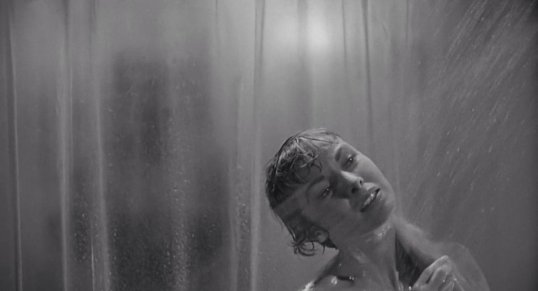
Oh, but the shower. You can’t talk about Psycho without talking about the shower, can you? It’s still a frightening scene, even when you know it’s coming. For Marion, the shower is more than just a shower and as someone who loves to take long showers, I always feel like I know exactly how she’s feeling. She’s decided to return to Phoenix and face the consequences. She’s washing away her guilt and her fear and, being in a motel room with a locked door, she has every reason to believe that she’s safe. But she’s not. We already know that she’s not because we’ve already seen Norman peeping in on her. (As disturbing as Norman’s peeping is, it’s not that much different from what the film’s audience was doing to Janet Leigh during the film’s opening scenes.) Marion discovers the danger too late. I find the scenes of Norman cleaning up the room to be even more unsettling, if just because he’s so professional about it. He knows exactly what to do, which lets us know that this isn’t the first time someone has died in that room. Marion, who we’ve just spent nearly an hour getting to know, is wrapped up in plastic and dumped in the back of her car and the audience is reminded that, when one’s physical life is over, it’s over.
66 years after it was first released, Psycho is still one of the greats.