Jon Moore (Matthew Utley) and his foster sister are fooling around with a Ouija board. Jon wants to contact the spirit of his little brother, Tommy (Jacob Pitoniak). Jon blames himself for his brother’s death and many of his subsequent problems can be linked back to the day that Tommy was killed in a mass shooting. The Ouija board seems to have a mind of its own, with the little pointer tool moving even when Jon takes his fingers off of it. Tommy’s face appear in a candle’s flame, blain Jon for his death and encouraging Jon to take his own life. Jon freaks out. Jon’s foster sister asks him if he’s stoned but otherwise, doesn’t seem to be too concerned about Jon’s suicidal tendences.
Jon’s subsequent attempt at suicide fails but it does lead to a both a huge fire and Jon getting sent to yet another foster family. Feeling lost and alienated and struggling to fit in with his religious community, Jon soon starts spending all of his time in the woods. Eventually, he meets a Native American girl named Isaka (Alexandra Sertik). At first, Jon fears that Isaka might be another demon sent to destroy him. Pastor Mark (Dean Cain) puts his mind at ease.
Jon is soon convinced that he’s in love with Isaka. He tells everyone about his new girlfriend and no one believes him. (That said, they’re rather tolerant of someone who claims to be spending all of his time with someone who they say doesn’t exist.) Jon starts to wonder why he never sees Isaka outside of the woods. Why has he never met Isaka’s parents? Why is Isaka always wearing the same clothes? Why does every picture that he takes of Isaka fail to develop? You can probably guess why. Isaka has a tragic story of her own and a lesson to teach Jon.
ForgivingGod is a faith-based film that has a lot in common with the horror genre, from the Ouija-dominated opening to Jon’s fear that Isaka might be an otherworldly being sent to lead him astray. It’s actually a fairly intriguing story and, compared to most faith-based films, it’s actually told pretty well. Yes, there’s a few moments of awkward humor (faith-based films always seem to have at least one scene of awkward adult-teen dialogue) and some of the performance feel more professional than others. (Dean Cain, it must be said, classes up the joint in his small role.) There’s a sequence set at “bible camp,” which really made me happy that, when I was growing up, my family never stayed long enough in one place for anyone to suggest that my sisters and I should go to camp. That said, the cinematography is impressive, Matthew Utley gives a good performance as Jon, and there’s a fairly effective scene involving a grizzly bear. As far as indie religious films go, ForgivingGod isn’t that bad at all. If anything, it continues Pennsylvania’s tradition of giving us independent cinema. George Romero gave us zombies. This film gives us bears and mysterious forest girls.
Welcome to Late Night Retro Television Reviews, a feature where we review some of our favorite and least favorite shows of the past! On Saturdays, I will be reviewing Saved By The Bell, which ran on NBC from 1989 to 1993. The entire show is currently streaming on Prime and Tubi!
This week, an important lesson is learned about credit cards.
Episode 1.2 “The Lisa Card”
(Dir by Don Barnhart, originally aired on August 28th, 1989)
Lisa’s father (Henry Brown) has given her his credit card and Lisa has charged way too much money on it! Now, she has to figure out how to raise the money to pay it off before he finds out.
I could relate to this episode. When I got my first credit card, I went crazy charging stuff to it. I’m still probably a little bit too quick to reach for it. To be honest, it wouldn’t be until I was 25 that I really came to understand that someone actually has to pay all that money back. I knew what Lisa was going through but I was still surprised at how all of her friends immediately came to her aid. What selfless friends! I can honestly say that, if a friend of mine needed that much money, I would probably not give it to them. Lisa got a job at the Max but Slater, Zach, Kelly, Jessie, and Screech ended up doing most of the work and they all did it for free. Maybe if they had all gotten a job at the Max (as opposed to just volunteering to help) they could have combined their paychecks and paid off that credit card. Zach also sells all of Lisa’s clothing, holding a sale in the middle of the school hallways. (“Closing them!” Zach shouts whenever Belding is nearby.) “Who wants this lingerie?” Zach asks. Screech pledges his life savings. Ummm, Lisa is like fourteen and Screech appears to be considerably younger. That’s kind of icky….
This episode was …. well, I was going to say it was dumb but every episode of Saved By The Bell is dumb. That said, it was dumb in a fun way. Lark Voorhees was always underused on Good Morning Miss Bliss but she really goes all out with this episode. Her nervous twitching when she learned all of her clothes had been given to charity (for free!) was something else to which I could relate.
In the end, Lisa’s father forgives her and Lisa gets upset because he’s not angrier. What? Lisa, you got away with it! Be happy!
Gregory throws a terrible party at his apartment. Mr. Johnson, Barbara, Melissa, and Ava go to the DMV to get their Real IDs. It’s been a while since I’ve laughed at hard at any show as I did while watching this week’s episode of Abbott. Even the things that I was previously getting tired of — like Gregory being socially awkward — once again made me laugh. Abbott Elementary occasionally gets a bit preachy for my tastes but when it work, it’s truly special.
By the way, in Texas, they just give you a Real ID when you renew your driver’s license. It’s pretty simple. I don’t know why the states up north decided to make it complicated for everyone.
Hell’s Kitchen (Thursday Night, FOX)
Poor Bradley. Chef Ramsay even gave him a pep talk and it still didn’t make him a better chef.
It’s The Great Pumpkin, Charlie Brown (Apple TV)
On Thursday night, Erin and I did our annual viewing of this classic holiday special. You can read Erin’s thoughts here. Poor Charlie Brown. “I got a rock!”
Law & Order (Thursday Night, NBC)
This week, a murderer claimed diplomatic immunity. The White House demanded that the DA drop the charges because it had a weapons deal with the UAE. Maroun was not present and was not missed. Price and Baxter spent the entire episode giving each other strained looks of sympathy. Both Price and Baxter are such boring characters that I sometimes struggled to remember which is which. Hugh Dancy and Tony Goldwyn are both totally wasted by this show.
Night Flight (Night Flight+)
On Friday, I watched a “video profile” of musician Annie Lennox. The music was great.
Rogue’s Gallery (Night Flight+)
On Friday night, I watched a documentary on Al Capone. Now that’s crime with style!
Special Forces: World’s Toughest Test (Thursday Night, FOX)
Much as with last week, I found myself wondering why anyone not in the Army would put up with being yelled at for 24 hours a day. I would have walked off the set after an hour.
I missed the game tonight because I was supporting my sister and #ScarySocial but I did check the score when I got a chance and needless to say, I was very happy. After getting crushed last night, the Dodgers came back and won Game Two by a score of 5-1! The series is now tied at 1-1. That means that we will at least get a Game Five.
Congrats, Dodgers! Now, keep it up and win that championship!
For today’s horror on television, we have a 1975 made-for-television movie called The Dead Don’t Die!
The Dead Don’t Die takes place in Chicago during the 1930s. George Hamilton is a sailor who comes home just in time to witness his brother being executed for a crime that he swears he didn’t commit. Hamilton is convinced that his brother was innocent so he decides to launch an investigation of his own. This eventually leads to Hamilton not only being attacked by dead people but also discovering a plot involving a mysterious voodoo priest!
Featuring atmospheric direction for Curtis Harrington and a witty script by Robert Bloch, The Dead Don’t Die is an enjoyable horror mystery. Along with George Hamilton, the cast includes such luminaries of “old” Hollywood as Ray Milland, Ralph Meeker, Reggie Nalder, and Joan Blondell. (Admittedly, George Hamilton is not the most convincing sailor to ever appear in a movie but even his miscasting seems to work in a strange way.)
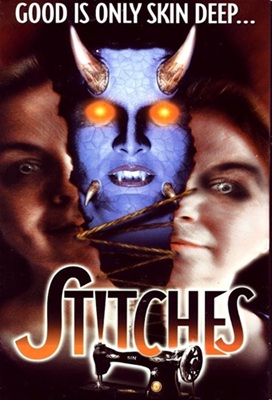
An old lady (Elizabeth Ince) stays at a boarding house at the turn of the 20th Century. At least, I think it was supposed to be the turn of the 20th Century. There weren’t any cars or telephones but, at the same time, everyone had contemporary hair styles and they wore clothes that looked like they were supposed to be vintage but actually weren’t. The movie could have just as easily been taking place in a hipster coffeehouse in 1997.
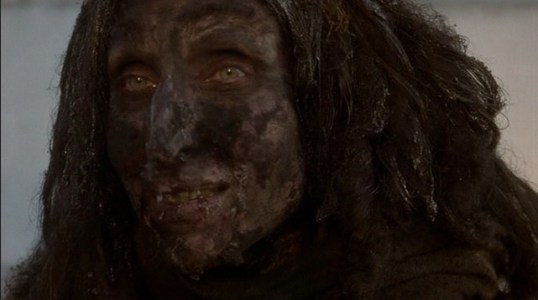
The old lady likes to walk up to people ask them if they want to see proof that demons are real and it never occurs to anyone to just say no. The woman’s back is stitched together and when those stitches are untied, she drops her skinsuit and reveals herself to be the Devil. At least, I think that’s what happened because this was one of those movies where they didn’t have the money to actually show you what happened. You just have to guess by the shadows on the wall. The film’s poster makes it look like a horrifying transformation but sometimes, posters lie.
When the old devil woman steals your soul, she turns you into a paper doll. The boarding house made decides to serve the old woman. That’s pretty much the entire story. Stretching all that out to 81 minutes took some effort and determination so I’ll give the movie credit for that.
I appreciated the movie’s ambition. It’s too bad the wooden acting and the slow pace kept this movie from being as interesting as it should have been. Today’s lesson is don’t hang out with old women who offer to show you a demon. No good will come from it.
“You know nothing. Hell is only a word. The reality is much, much worse.” — Dr. Weir
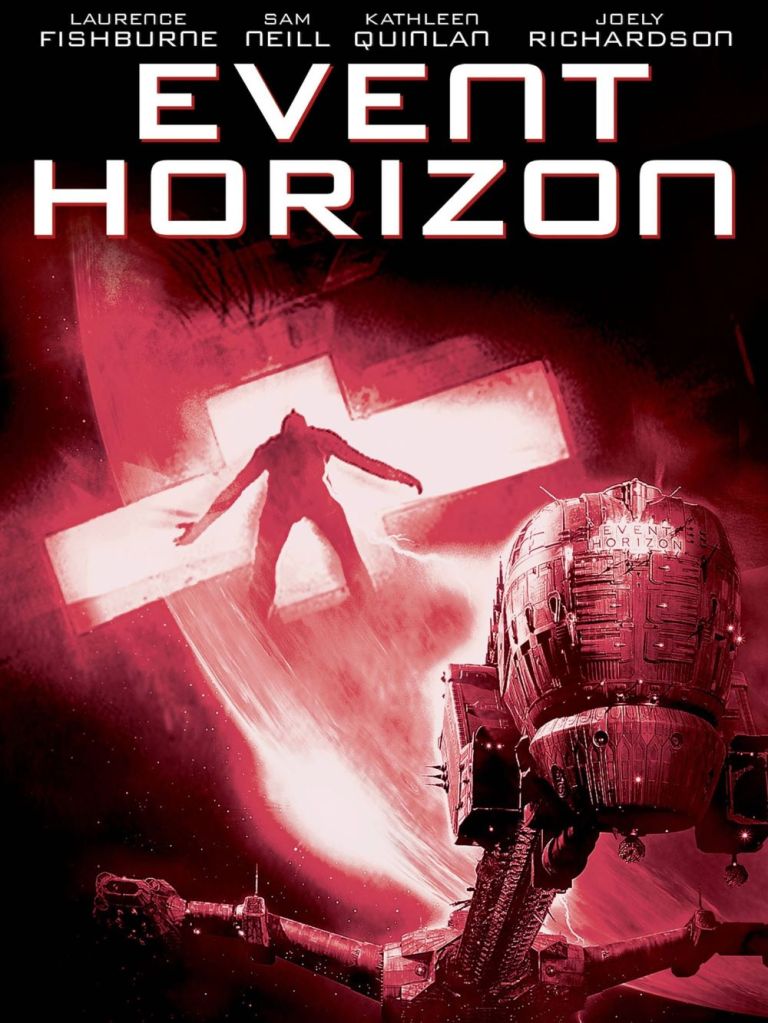
Paul W.S. Anderson’s 1997 film Event Horizon stands out as a memorable mix of science fiction and horror, remembered for its gripping atmosphere and disturbing visuals. The story is set in 2047: a rescue crew aboard the Lewis and Clark is sent out to recover the long-missing spaceship Event Horizon, a vessel built to test a new kind of faster-than-light travel. Onboard with them is Dr. William Weir, the Event Horizon’s creator, who explains that the ship vanished after first activating its “gravity drive,” which can fold space to allow for instant travel across vast cosmic distances.
Soon after reaching the drifting Event Horizon, the crew discovers signs of mass violence and horror. They recover a disturbing audio message and realize something traumatic happened to the original crew. As they search for survivors, they experience intense and personal hallucinations—memories and fears brought to life by the ship. It becomes clear that the Event Horizon didn’t just jump through space; it traveled to a place outside reality, a nightmarish interdimensional realm resembling hell.
What makes Event Horizon particularly unique is its concept of hell as an alternate dimension that can infect and corrupt whatever or whoever crosses into it. The ship’s gravity drive doesn’t simply facilitate faster travel—it accidentally opens a gateway to this chaotic, malevolent place. This portrayal of hell as a dangerous interdimensional reality that preys on minds and bodies echoes the idea found in the massive gaming property Warhammer 40K, where hell is depicted as the Warp, a dimension of chaos that corrupts and drives people insane. Like the Warp, the film’s hell is an unpredictable, hostile realm where sanity and physical form break down, infecting and warping everything that comes into contact.
Visually, the film relies on claustrophobic corridors, flickering lights, and unsettling sounds to keep the audience off-balance. The design of the ship itself—part gothic cathedral, part industrial nightmare—adds to the sense of unease and dread throughout. The use of practical effects and detailed sets grounds the sci-fi terror in something tangible, making it all feel more immediate and believable.
Event Horizon also hints at bigger philosophical questions: how far should science go, and what happens when the drive for knowledge is unchecked by ethics or humility? The gravity drive is a technological wonder, but it’s treated with little caution by its inventor, and the catastrophic results suggest that some discoveries may be better left unexplored. The ship becomes both a literal and figurative vehicle for exploring the limits of human ambition and the dangers of pushing beyond them.
As the movie builds toward its climax, the rescue crew faces increasingly desperate odds. The possessed Dr. Weir, now an outright villain, sees the hellish dimension the gravity drive visited as the next step for humanity—a place of chaos and suffering. Multiple characters die in gruesome ways, and the survivors have to fight their own fears and the haunted ship itself. The ending is chilling and ambiguous, leaving open the possibility that the ship’s evil has not been fully contained.
At release, Event Horizon divided critics and audiences. Some found the violence and nightmare imagery too intense or the story too messy to follow. Others praised its ambition and the way it blends psychological horror with cosmic sci-fi. Over the years, the film has developed a cult reputation, frequently cited as one of the more effective and original space horror movies. Its legacy can be seen in later media, especially in video games that tackle similar haunted spaceship scenarios.
However, the film is not without flaws. Many viewers and critics point out uneven pacing, especially in the second half where tension sometimes drains away. The characters often act inconsistently or make choices that feel unrealistic for trained astronauts, which undermines the suspense. The script’s tonal shifts—from serious psychological drama to moments that unintentionally verge on camp—can jolt the viewer out of the experience. The use of jump scares is sometimes predictable, and the film’s heavy reliance on loud, chaotic sequences instead of quiet suspense can feel overwhelming. Some CGI effects haven’t aged well, contrasting with the otherwise impressive practical effects and set design. Acting performances are mixed too; while Sam Neill and Laurence Fishburne are strong, some supporting cast members lack conviction, making emotional engagement uneven.
Importantly, Event Horizon represents Paul W.S. Anderson at his most subtle and effective in directing. Compared to many of his later films, where his style often becomes frenetic and unchecked—possibly due to a lack of producer control—Event Horizon is more controlled, atmospheric, and haunting. This balance between style and substance makes it one of Anderson’s better directorial works, if not his best to date. The film showcases his interest in spatial geography, the use of negative space, and claustrophobic production design, all elements he would expand on in his later work but never as effectively deployed as here. The haunting visual touches, combined with his ability to direct actors and maintain tension, set Event Horizon apart from his more bombastic, less focused later entries.
Despite its flaws, Event Horizon remains gripping and memorable. Its strengths lie in combining deeply personal psychological horror with the vast, terrifying unknown of space and alternate realities. The film explores not just external threats, but also how guilt, fear, and trauma can be weaponized by forces beyond human understanding. For viewers seeking more than a standard haunted spaceship story, Event Horizon offers a disturbing, thought-provoking glimpse into the dark frontier of science, faith, and madness. It stands as a cult classic of sci-fi horror that continues to inspire discussion about the dangers of pushing too far into the unknown.
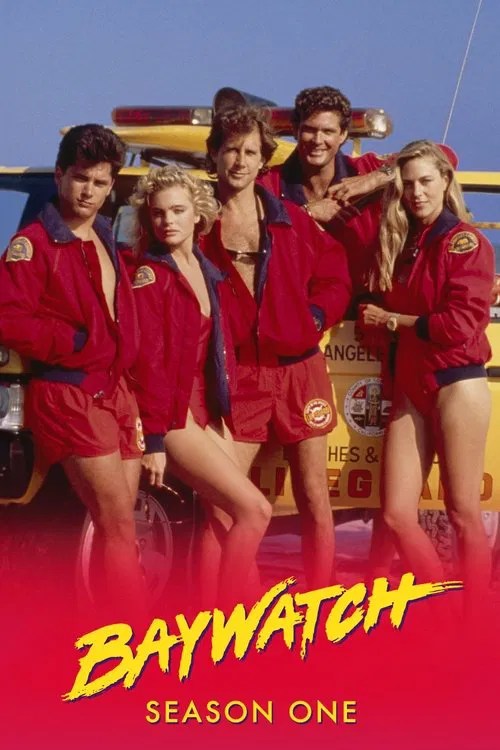
Welcome to Retro Television Reviews, a feature where we review some of our favorite and least favorite shows of the past! On Saturdays, I will be reviewing Baywatch, which ran on NBC and then in syndication from 1989 to 2001. The entire show can be viewed on Tubi.
Trouble comes to Malibu!
Episode 1.3 “Second Wave”
(Dir by Scott Brazil, originally aired on October 13th, 1989)
Jimmy Roche (Daniel Quinn), an old friend-turned-enemy of Eddie’s, is in Malibu and he and his gang are eager to give Eddie a hard time. When Eddie tries to rescue a man in the water, Jimmy trips him and then plays keep-away with Eddie rescue can. Dang, these guys are hardcore!
Eddie doesn’t want to tell anyone about his past, even after Jimmy files an assault complaint against him. (Eddie was provoked into throwing a punch.) Jimmy threatens to robs Gina and Craig unless Eddie gives him some money. Eddie agrees to meet with Jimmy but then tells the cops. Garner Ellerbee decides to set up an undercover sting, which basically means that Garner stands next to Eddie while Eddie waits for Jimmy to show up. Somehow, Jimmy figures out what’s going on. Looks like Eddie will just have to beat Jimmy up on the beach and prove that he’s no longer a delinquent from Philadelphia.
That would be an intense storyline, if not for the fact that Jimmy himself comes across as being kind of a wimp. I mean, a young David Spade is a member of his gang! Eddie allows himself to be intimidated by a young David Spade! Think about that. This storyline just made Eddie seem kind of dumb,
Meanwhile, a young Mariska Hargitay gave a terrible performance as Lisa (hey!), the daughter of the head of the country club. Lisa (!) decided to pursue a romance with the country club’s lifeguard, Trevor, as a way of upsetting her father. When Lisa (!) jumped into the ocean to make a point (though I’m not sure what point), Trevor rescued her. However, Lisa (!) later went into shock because she still had water in her lungs. Trevor was able to get her to the hospital in time but he learned an important lesson about not being a cocky lifeguard.
“The county lifeguards know about secondary drowning,” he’s told.
Okay, so why wouldn’t Trevor know about that? The whole idea behind Trevor’s character is that he was a hotshot lifeguard in Australia before he came to California. So, is the show implying that he wasn’t trained in lifeguard basics in Australia because given how famous Australia is for its beaches, I find that hard to believe.
Anyway, after she recovers Lisa (!) announces that she’s going back to New York and Trevor realizes that she was only using him to make her father angry. Trevor stops by Baywatch HQ and talks to Mitch and admits that he doesn’t enjoy working as a lifeguard. Lifeguard Jill Riley gives him a sympathetic look. It looks like they’re falling in love but I’ve seen this series before so I already know that Jill is going to get eaten by a shark and Trevor is going to vanish after a few more episodes.
It’s not usually described as being a horror film but this scene from David Lynch’s 2001 Mulholland Drive literally made me jump the first time I saw it.
Personally, I think this is the scariest moment that David Lynch ever directed.
The 1997 film Too Close To Comfort tells the disturbing story of the Donahues.
Nick Donahue (Rick Schroder) is a young attorney, a law school grad who has just joined the bar and who is still making a name for himself as a defense attorney. He’s good at his job and if you have any doubts, his mother Diane (Judith Light) will be there to tell you why you’re incorrect. Diane and Nick still live together. They have the type of relationship where Diane casually walks into the bathroom to talk to Nick while he’s in the shower.
In short, they have a very creepy relationship.
Nick talks about needing to get a place of his own but his mother says that it’s too soon for him to spend all that money. Nick wants to fall in love and marry a nice girl and start a family. Diane doesn’t want Nick to have a life separate from her. When Nick does end up marrying the sweet-natured Abby (Sarah Trigger), Diane snaps. One night, Abby is abducted and is later found murdered. Nick sobs and Diane holds her son and she doesn’t mention the fact that she’s the one who arranged for Abby to be killed.
The police figure it out, of course. Diane wasn’t that clever. When Diane is arrested and put on trial for murder, Nick is shocked. With his mother facing the death penalty for murdering his wife, Nick steps forward to defend his mother in court.
Agck! This movie! Admittedly, this is a made-for-TV movie but it’s still creepy as Hell. If anything, the fact that it was made for television make it even creepier than if it was a uncensored feature film. Held back by the rule of television, the film has to hint at what would probably otherwise be portrayed as explicit. That makes all of the little moments that indicate Diane’s madness all the more disturbing and frightening because they could be read several different ways. This is a film where every line is full of a very icky subtext. Diane is more than just an overprotective mother. Her feelings for Nick are on a whole other level.
Fortunately, Judith Light is one of those actresses who excels at communicating subtext. She delivers every line with just enough of an inflection that we know what she’s saying even if she doesn’t actually say it. From rolling her eyes when Nick asks her to turn around when he gets out of the shower to the scene where she flirts with Nick’s new landlord, Light leaves little doubt as to what really going through Diane’s mind. Rick Schroder has a far more simpler role as Nick but he still does a good job with the role. He’s sympathetic, even when he’s refusing to accept the truth about his mother.
This film is all the more disturbing due to being loosely based on a true story. The real Diana Donahue was named Elizabeth Ann Duncan and she was convicted of killing her son’s wife in the 1950s. (Too Close To Home is set in the 90s.) Her son really did defend her, all the way until her execution. In real life, her son continued to practice law until 2023, when he was disbarred by the state of California.
As for the film, it’s a classic true crime made-for-TV movie that features Judith Light at her disturbing best.





 Through the Shattered Lens