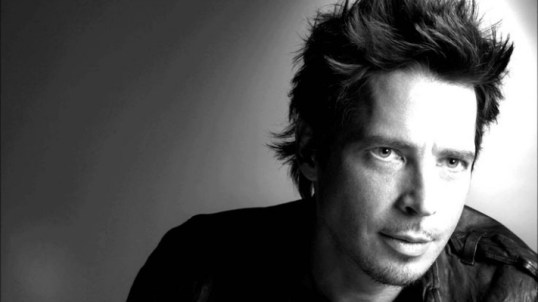
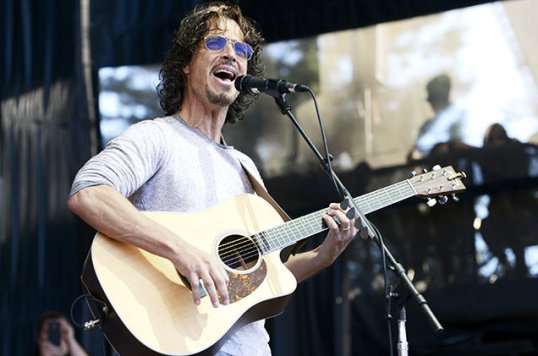
Chris Cornell passed away on May 17, 2017 and the world is that much more empty with his passing.
He was 52 and joins the others Gods of Rock in the afterlife.
R.I.P. Chris Cornell.
I Am the Highway
Pearls and swine bereft of me Long and weary my road has been I was lost in the cities Alone in the hills No sorrow or pity for leaving I feel
I am not your rolling wheels I am the highway I am not your carpet ride I am the sky
Friends and liars don’t wait for me ‘Cause I’ll get on all by myself I put millions of miles Under my heels And still too close to you I feel
I am not your rolling wheels I am the highway I am not your carpet ride I am the sky I am not your blowing wind I am the lightning I am not your autumn moon I am the night, night
I am not your rolling wheels I am the highway I am not your carpet ride I am the sky I am not your blowing wind I am the lightning I am not your autumn moon I am the night, night Yeah, yeah, yeah, yeah
Earlier today, I got off work early and I finally saw The Circle!
The Circle is a film that I’ve been curious about for a while. It’s based on a novel by Dave Eggers, a book that I absolutely loved when I first read it. It stars Emma Watson, Tom Hanks, Patton Oswalt, and John Boyega. It’s directed by James Ponsoldt, who may not be a household name but who has previously directed such beloved films as The Spectacular Now and The End of The Tour. It sounded like a film to which everyone should have been looking forward but instead, even with Watson appearing in the blockbuster Beauty and the Beast at the same time, The Circle opened with very little fanfare.
Then the reviews came out and, with a few notable exceptions, they were all negative. I did a little research and I discovered that, though filming was initially completed in 2015, The Circle spent a year and a half sitting on the shelf. In January of this year, 16 months after shooting wrapped, a few scenes were refilmed. That’s never a good sign. One gets the feeling that, if not for John Boyega’s role in Star Wars: The Force Awakens and the excitement over Emma Watson starring in Beauty and the Beast, The Circle probably would have ended up going straight to VOD.
But here’s the thing. I loved the book. The book managed to put a new spin on the otherwise tired topic of how social media has changed our way of looking at the world. The book was an Orwellian masterpiece, an homage to 1984 by a writer who, as opposed to most people who are currently claiming to appreciate the novel’s dark vision, understood what George Orwell was actually saying.
In fact, the more I thought about it, the easier it was for me to assume that most critics probably missed the point of the movie. It was entirely possible, I decided, that the negative reaction to The Circle had to do with audiences not knowing how to deal with a movie that truly challenged their assumptions. Naively, I assumed that the story and the themes of the novel had been brought to the screen and the critics couldn’t handle it.
Well, as I said earlier, I finally saw The Circle for myself and it turns out that I was wrong. The Circle is an absolute mess. Despite being co-written by Dave Eggers, this film actually has very little in common with the novel that it’s based on. The novel was a sharply satiric portrait of a world that has become brainwashed by technology and social media. The movie is a nagging anti-internet screed that would have felt out-of-touch in 2002. The book ends with a powerful “and he loved Big Brother” moment. The movie ends on a note that feels so completely false that you just know it was studio mandated.
Emma Watson plays Mae Hubbard, a recent college grad whose degree in Art History is pretty much going to waste. (Speaking as the proud recipient of an Art History degree, I can verify that the film gets this detail absolutely right.) Through a college friend named Annie (Karen Gillian, for once not having to disguise her Scottish accent), Mae gets a job working for The Circle, an all-powerful internet company that is pretty obviously based on Google Plus. Through a series of silly events, Mae becomes the public face of The Circle. The Circle wants to use technology (cameras everywhere, social media addiction, everyone carries tablet, you must have a credit card to join The Circle, oh my!) to do away with the concept of privacy. When everyone is a member of the Circle, no one will be a stranger. No one will have any privacy. Anyone can be found. Anyone can be watched. And, of course, it’ll be easier to tell everyone what to think and who to support…
…and all of this would be shocking if The Circle had been made in a time before Twitter and Facebook.
Anyway! The Circle was founded by three men. Two of them (Tom Hanks, Patton Oswalt) are totally sinister. Oswalt glowers in the background. Hanks appears to channeling Christoph Waltz. Meanwhile, the third man (John Boyega) has become disillusioned with The Circle. He shows up occasionally, standing in the background and watching as Mae does stuff.
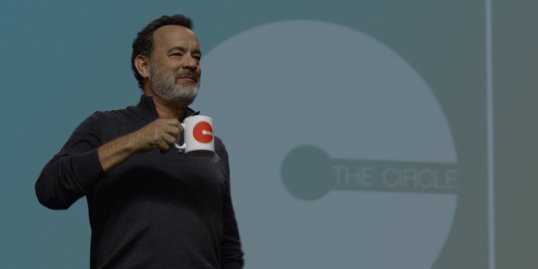
Throughout the film, Tom Hanks gives lectures to his employees. They all applaud as he introduced the latest technology from The Circle. These scenes are fun because it looks like Tom Hanks is appearing in a commercial for The Criterion Collection.
Anyway, Mae loves the brave new world but a few people don’t. Her parents (Bill Paxton and Glenne Headly) are skeptical. Though his role is small, Bill Paxton gave a good performance in this, his latest released film. I got a bit emotional watching him, especially as he was playing a character struggling with his own poor health. Ellar Coltrane, of Boyhoodfame, plays the other voice of skepticism, Mae’s childhood friend who wants to live off the grid. Coltrane is supposed to be the voice of reason but he gives such a strange and awkward performance that the main thing that comes across is that Luddites are weird.
Actually, with the exception of Bill Paxton and Karen Gillan, it’s hard to think of anyone who actually gives a good performance in The Circle. (This is especially shocking when you consider that, in the past, Ponsoldt has proven himself to be an excellent director when it comes to getting noteworthy work from his cast.) Everyone comes across like they were wishing that they were somewhere else. Emma Watson, in particular, is bad. That said, in her defense, Watson is also totally miscast. Mae is meant to be someone searching for an identity in an overly complicated world but Watson plays her as just being dourly earnest. As played by Watson, Mae’s just the boring person that you dread having to take a class with. Neither Watson nor the film, as a whole, seems to be sure who exactly Mae is. (In the novel, the character works because Mae isn’t meant to be likable. The film, however, tries to have it both ways, making her both a true believer in the Circle and a sympathetic character. It doesn’t work.)
For that matter, the film also appears to be confused as to just why exactly Hanks and Oswalt are villains. We know that we’re supposed to distrust them because Hanks is way too quick to smile and Oswalt is always standing in the background and looking like he’s just deliberately killed all of his Sims. But how evil are they actually supposed to be? What are the stakes? The film doesn’t appear to be sure.
Now, I’m not totally trashing The Circle. There were a few moments that I did like. I enjoyed the scenes that were meant to illustrate the cult-like atmosphere at the Circle. There’s a hilarious scene where two enthusiastic Circle employees interrogate Mae as to why she never told them that she enjoys kayaking. (“I enjoy kayaking! We could have kayaked together!”) And there’s another scene where Hanks and Oswalt talk about how, if countries allow The Circle to run their elections, they could then require everyone to join The Circle and then make voting mandatory. Mandatory Voting is a really terrible idea, the type that is always embraced by people who should know better. I appreciated seeing the idea exposed for being the ticket to totalitarianism that it truly is.
But, for the most part, The Circle was just a mess. Like a lot of cautionary tales (especially ones dealing with the internet), The Circle will probably eventually become a bit of a camp classic. But for now, everyone involved with the film has done better work in the past and, hopefully, will continue to do so in the future.
There are some things that just make you smile and, for me, this video is one of those things. I love this song. I love the dancing. I love the whole spirit of the video. It brings me enjoyment at a time when the world seems like a very negative place. What more need I say about it?
Gagarin was the first single to be released from Public Service Broadcasting’s 2nd album, The Race For Space. As you can probably guess just from the title (and the song), the entire album deals with the history of the space race and the rivalry between the Americans and the Russians. Gagarin is specifically about Yuri Gagarin, the first man ever to journey into space.
Did Yuri Gagarin find time to dance during his orbit around the Earth? No, of course not. He was in a tiny Vostok spacecraft and, as a Communist, he probably wasn’t allowed to dance. (This is the main idea behind communism, isn’t it? No dancing unless you’re listening to Rage Against The Machine or something like that.) Gagarin was lucky in that, unlike a lot of other participants in the Russian space program, he actually survived his journey. Still, if it had been allowed and if there had been room and maybe a source of gravity, I bet he would have danced.
Gagarin was directed by Alex Kemp, who has two other videos to his credit: Public Service Broadcasting’s Signal and Duotone’s Alphabet. The choreography is credited to Kieran Donovan.
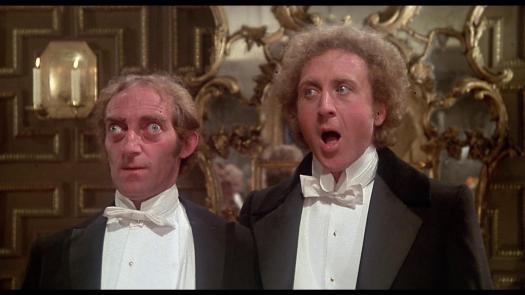
The late Gene Wilder was well loved by filmgoers for his work with Mel Brooks, his movies alongside Richard Pryor, and his iconic role as Willie Wonka. Wilder had co-written the screenplay for Brooks’ YOUNG FRANKENSTEIN, and now branched out on his own as writer/director/star of 1975’s THE ADVENTURE OF SHERLOCK HOLMES’ SMARTER BROTHER.
The zany tale, set in 1891, finds Sherlock’s jealous brother Sigerson (Wilder, who derisively calls his more famous sibling “Sheer-Luck”) assigned to the case of music hall singer Jenny Hill (Madeline Kahn) who’s being blackmailed by opera singer Eduardo Gambetti (the enormously funny Dom DeLuise ). Assisting Sigerson is his own Watson, the pop-eyed Sgt. Orville Stacker (Marty Feldman), blessed with “a photographic sense of hearing” that he can only access by whacking himself upside the head. The plot thickens as Sigerson learns Jenny’s a practiced liar (who only trusts men when she’s sexually aroused), she’s…
No, this latest movie a day is not about Lisa and Erin’s cat.
Instead, Doc is yet another retelling of the famous gunfight at the O.K. Corral. Most cinematic depictions of that event present Wyatt Earp as being an upright hero, Doc Holliday as being his roguish friend, and the Clantons as being black hat-wearing villains. Doc takes the opposite approach. In this one, Wyatt (Harris Yulin) and his brother are sociopaths whose feud with the Clantons comes down to Ike Clanton’s (Mike Whitney) refusal to bow to their authority. Wyatt is a coward and a physical weakling, who gets beaten up by Ike and is only saved when his friend, Doc Holliday (Stacy Keach), steps forward to protect him.
In this film, Doc is clearly dying from the minute he first appears. Not only is Doc so thin that his bride actually carries him over the threshold, he is also constantly coughing. His misery is only relieved by opium, herbs, and the love of Katie Elder (Faye Dunaway), the prostitute that he wins in a poker game at the start of the film. Doc would rather just spend his remaining days with Katie but, because of his friendship with Wyatt, he is dragged into the Earp/Clanton fight.
Like most revisionist westerns of the early 1970s, Doc is a heavy-handed metaphor for the Vietnam War, with Wyatt Earp serving as an LBJ/Nixon stand-in and Doc Holliday standing in for all the leaders who enabled them. It sounds interesting and Stacy Keach gives a good performance but Doc is glacially paced and Harris Yulin is thoroughly miscast as Wyatt. It takes forever to get to the gunfight and the Doc is so determined to be revisionist that it forgets to be interesting. Doc is an unfortunate misfire.
Today’s music video of the day is Drugs by Ratatat.
Some of my friends have told me that they actually found this video to be the creepiest thing that they had ever seen and that they would never forgive me for making them watch it. Myself, I think it’s only as creepy as you choose to make it.
Visually, this video is entirely made up of Getty stock footage. None of the images are actually connected, beyond the fact that they were all designed so that they could basically mean just about anything. As viewers our natural instinct is to try to force everything we see and experience into a coherent storyline. That’s an instinct that this video exploits to perfection. In short, this video means whatever you think it means. And what you think it means says more about you than the video.
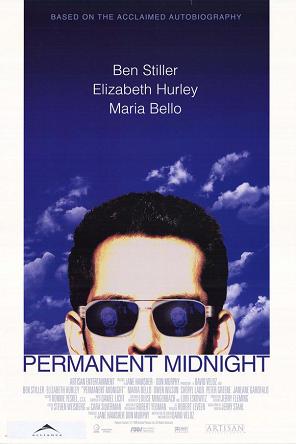
That was largely my reaction to watching the 1998 film, Permanent Midnight. In this film, Ben Stiller plays Jerry Stahl, a real-life screenwriter who had a fairly successful career going in the 80s and early 90s. He came out to Los Angeles looking to be a serious writer but, instead, he ended up writing for silly puppet show and getting addicted to heroin. He also married a British television executive named Sandra (Elizabeth Hurley), so that Sandra could get her green card. When the star of a show that he writes for tells him to kick his habit or lose his job, Jerry ends up smoking crack cocaine with a new dealer (Peter Greene). When Sandra tells him that she’s pregnant, Jerry responds by shooting up in the bedroom. When he’s trusted to spend the day taking care of his baby daughter, he drives her around the seediest sections of Los Angeles while he searches for his drug dealer. As the baby cries beside him, Jerry shoots heroin into his jugular. Jerry ends up unemployable and abandoned by every friend that he had. He works at a fast food restaurant, or at least he does until he meets another recovering addict (Maria Bello). She’s the one to whom he tells his story, in between sex and bouts of impotence. In the end, what’s left for Jerry Stahl to do but write a book and then a movie about his life as a junkie?
It’s a harrowing story and I guess Stahl deserves some credit for writing the screenplay for a movie that doesn’t exactly make him look good. However, Permanent Midnight runs into the same problem that afflicts most movies about drug addiction. With very few exceptions, drug addicts are just not that interesting. The only thing more boring than watching someone shoot up is then having to listen to that person explain why he shoots up. (Trainspotting is the obvious exception but Trainspotting benefits from Danny Boyle’s frenetic direction, Ewan McGregor’s explosively charismatic lead performance, a witty script, and a killer soundtrack. These are things that Permanent Midnight lacks.) The film attempts to build up some sympathy for Stahl by telling us about his difficult childhood, his father’s suicide, and his mother’s instability but, in the end, Jerry is a junkie who shoots up in front of his baby. Regardless of how crappy his childhood was, it’s hard to care about whether or not he ever gets his shit together. Mostly, you just want someone to step in and make sure he never gets near that baby again.
Permanent Midnight makes another mistake, one that is all too common when it comes to films about troubled artists. It continually tells us that Jerry is a talented and important writer without ever showing us any evidence of that fact. We’re supposed to feel bad that Jerry is stuck working on a sitcom called Mr. Chompers but, at no point, does the film really convince us that he deserves anything better. Everyone says that Jerry is talented but we don’t really get to see any evidence of that fact. It’s hard not to feel that maybe Jerry should just be happy that, unlike the majority of writers in Los Angeles, he actually has a steady job.
(Jerry does get one good line, when he appears on The Maury Povich Show to promote his book and says, “People always ask, ‘What’s the worst thing heroin drove you to do?’ I always answer, ‘showing up on Maury.'”)
Of course, for most people, the main appeal of seeing Permanent Midnight will be the chance to see Ben Stiller shooting up heroin while soaked in withdrawal sweat. Stiller gives a serious performance, good enough that you regret that his acting career now seems to mostly consist of starring in bad movies and making cameos in even worse ones. There’s actually a lot of familiar faces in Permanent Midnight: Elizabeth Hurley, Maria Bello, Fred Willard, Owen Wilson, Sandra Oh, Janeane Garofalo, Andy Dick, and others. They all give good enough performance but ultimately, this is aimless and ultimately rather frustrating movie.


 No, this latest movie a day is not about Lisa and Erin’s cat.
 Through the Shattered Lens