Review: 100 Bullets Vol. 1 – First Shot, Last Call


“I never told you to kill him. I just gave you the opportunity.” — Agent Graves

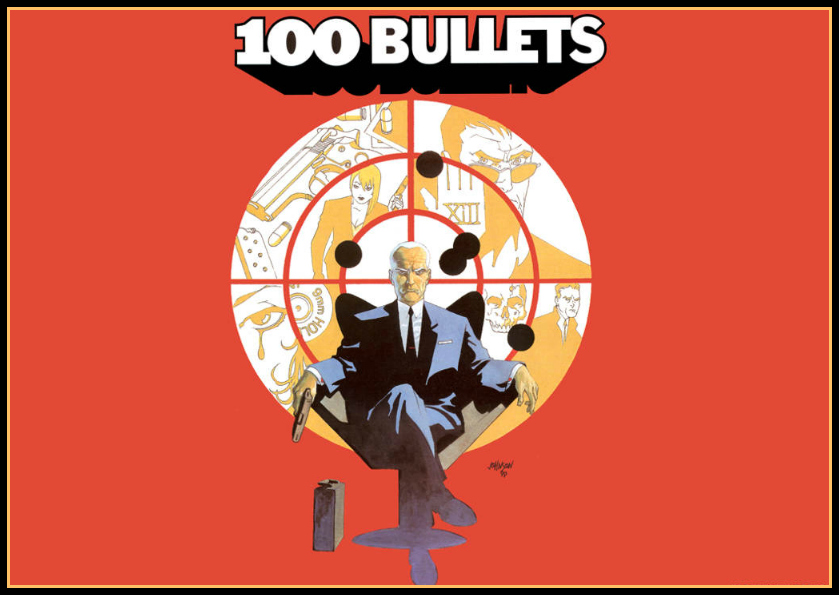
Brian Azzarello’s 100 Bullets stands as one of the strongest examples of mature storytelling to emerge from DC’s Vertigo imprint. From the outset, the series announces itself as something more than a standard crime comic. It is a hardboiled noir thriller, but one that pushes beyond mere style and atmosphere into the terrain of moral ambiguity, personal trauma, revenge, and consequence. In that sense, it recalls the classic detective and crime fiction of Dashiell Hammett, Mickey Spillane, and Raymond Chandler, while also feeling like a darker, more intricate evolution of the hyper-noir sensibilities Frank Miller explored in Sin City.

It would be easy to compare the two and simply declare one superior to the other, but the truth is more complicated than that. Sin City thrives on stark immediacy: its stories are blunt, violent, and stripped down to their most primal elements. 100 Bullets, by contrast, is more layered and methodical. Its stories take their time, constructing a web of motives, betrayals, and hidden histories that slowly reveal themselves. That extra complexity gives the series a different kind of power. Where Miller’s work depends on the force of simplicity, Azzarello and Risso create something that feels colder, more deliberate, and more psychologically unsettling.

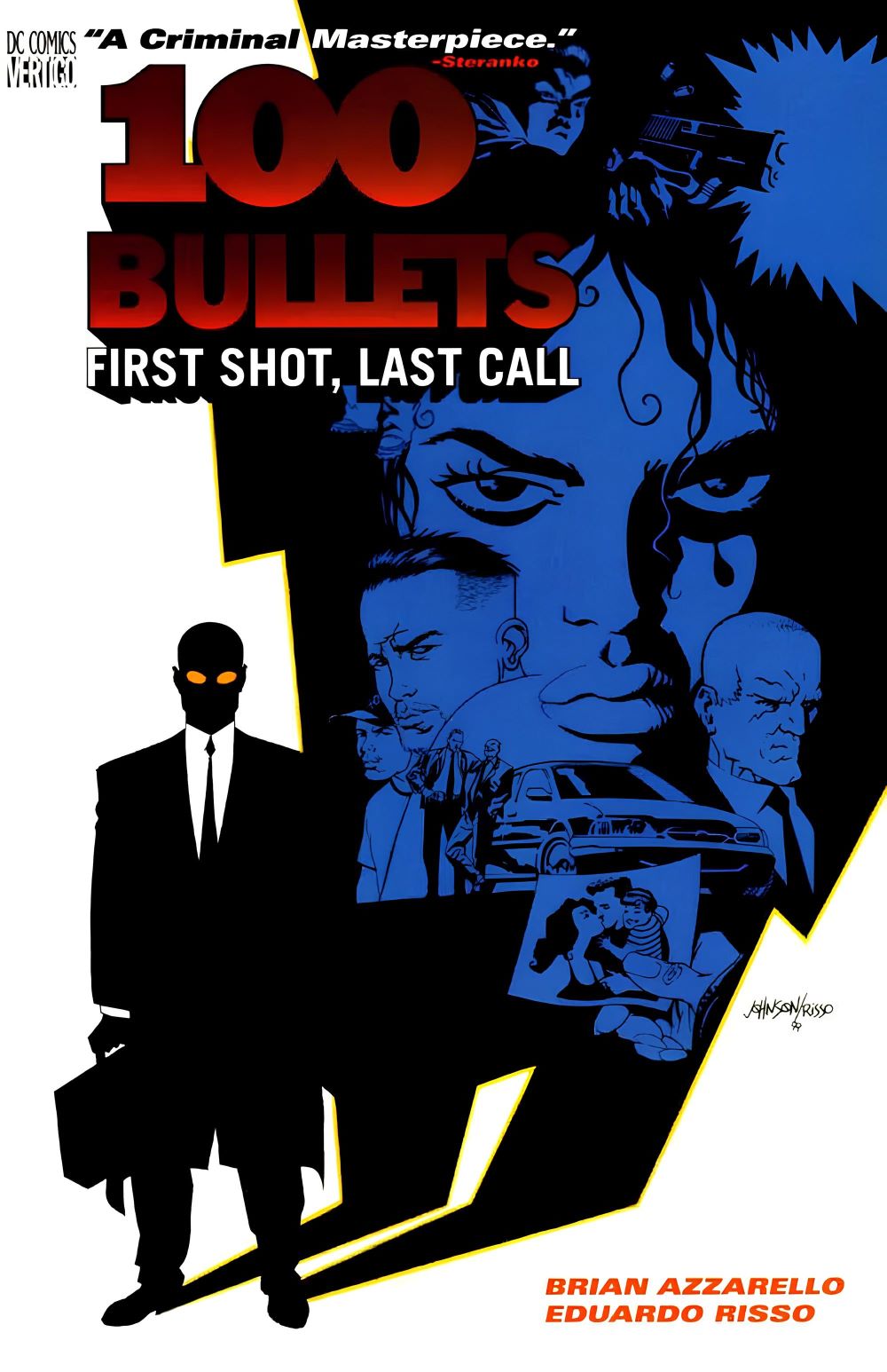
The first collected volume, First Shot, Last Call, serves as a perfect introduction to the series’ central premise and tone. It introduces Agent Graves, the enigmatic figure who functions as the series’ catalyst and perhaps its most important symbol. Graves looks like the kind of man who has walked out of a government conspiracy, a private war, or a decade-long nightmare and come out the other side untouched. He approaches recently paroled Dizzy Cordova with an offer that sounds impossible: an attaché case containing a gun, 100 untraceable bullets, and proof that the people responsible for destroying her life are known and reachable. The choice, however, is entirely hers. Graves does not force revenge; he simply places it within reach.

That premise is the genius of 100 Bullets. On the surface, it is a crime story built around assassination, hidden conspiracies, and the promise of vengeance. But underneath, it becomes a series about free will and the burden of choice. The question is never just whether a character will kill. It is whether revenge can ever truly heal the wounds that created the desire for it in the first place. Azzarello understands that vengeance is seductive precisely because it feels so simple. It offers closure where life has given none. Yet the series continually suggests that closure is an illusion, and that the acts people commit in the name of justice or revenge often become the first step toward deeper destruction.

Dizzy Cordova is a strong opening example of this theme. She is not written as a simplistic victim, nor as an idealized avenger. She is angry, wounded, and psychologically cornered, but she is also complicated and fully human. Her eventual decision feels earned because the story understands her pain rather than merely exploiting it. Azzarello writes her as someone whose past has stripped away the comfort of easy morality. The same can be said of Lee Dolan in the second major story arc. Dolan’s life has been shattered by an accusation that contaminated both his public identity and his personal relationships. He, too, is offered Graves’s case and the temptation of retaliation. But his response is different from Dizzy’s, and that difference matters. It shows how carefully Azzarello constructs his characters as individuals rather than as variations on a single revenge fantasy.

What makes these early stories especially effective is that each one feels self-contained while also contributing to a much larger design. Even in this first volume, Azzarello is laying the groundwork for a sprawling narrative that will eventually run exactly 100 issues. The structure gives the series an unusual density: every issue matters, every choice matters, and every seemingly isolated encounter feels like it may be part of a larger hidden architecture. That sense of design keeps the book from ever becoming repetitive. Instead, it feels like a slow-burning conspiracy thriller where the real mystery is not just who is manipulating whom, but why these people are vulnerable to manipulation in the first place.

Eduardo Risso’s artwork is the perfect visual counterpart to Azzarello’s writing. His style is often described in relation to other noir-influenced artists, but it would be inaccurate to call it merely minimalist. Risso’s pages have a cinematic rhythm that gives the book a visual identity all its own. His compositions are deceptively economical: characters are posed with dramatic clarity, shadows are used with purpose, and every panel seems designed to move the eye like a camera tracking through a scene. Even in moments where little physical action occurs, there is a sense of tension and motion in the framing.

Risso also has a strong eye for character design. His people are not rendered with perfect realism, nor are they reduced to exaggerated caricatures. Instead, they occupy a space that feels stylized but believable, which is ideal for a story like this. Their faces and bodies communicate attitude before they even speak. That matters in a noir story, where so much of the drama lies in what characters conceal as much as what they reveal. The women in particular are drawn with a confident sensuality that reflects the hard-edged world of the series without reducing them to empty decoration. Characters like Dizzy Cordova and Megan Dietrich feel distinct not just because of Azzarello’s writing, but because Risso gives them physical presence, posture, and visual identity that reinforce who they are.

What is especially impressive is that Risso’s art enhances the noir mood without becoming self-conscious about it. The book never feels like it is trying too hard to imitate classic crime fiction. Instead, the visuals and writing work together to create a world that is stylish, dangerous, and morally unstable. That balance is difficult to achieve, and 100 Bullets succeeds because both creators understand that atmosphere alone is not enough. The mood has to be supported by character, and the character has to be supported by consequences.

100 Bullets: First Shot, Last Call is therefore more than just a strong debut volume. It is a declaration of intent. Azzarello shows that he is willing to write adults as flawed, desperate, and self-deceiving people rather than as heroes or villains in any conventional sense. Risso, meanwhile, gives the story a visual voice that is sleek, uneasy, and unmistakably noir. Together, they create a comic that is intelligent, hard-hitting, and deeply memorable.

As an opening volume, it does exactly what it should: it hooks the reader, establishes the mythology, and makes clear that this is a story about choice, consequence, and the cost of acting on one’s darkest impulses. More importantly, it does so with confidence and style. 100 Bullets earned its reputation not because it imitates the best noir stories, but because it understands what makes noir endure: wounded people, dangerous opportunities, and the terrible freedom of deciding what to do next.
Review: The Losers (dir. by Sylvain White)


There’s something to be said about DC’s attempt to try and take some of the thunder away from Marvel as the two battle it out over the hearts and wallets of the film-going public. With the exception of Christopher Nolan’s Batman Begins and The Dark Knight DC’s properties has lagged behind that of Marvel when it comes to being adapted to the big-screen. Some would say that this is a good thing in that DC hasn’t flooded the market with too many comic book titles adapted to film. Marvel’s track record has been very good but they’ve also had some very awful comic book-to-film titles which at times almost derails this Golden Age of comic book films. But even with the misses Marvel has released they’ve done a good job of keeping their name brand in the film public’s eye.  DC hasn’t been very good at this but this may be changing soon.

While not part of the DC Universe proper the Vertigo line of titles do belong under the DC umbrella. Vertigo has always been the more mature-oriented publishing arm of DC with well-known and critically-acclaimed writers such as Grant Morrison, Garth Ennis, Warren Ellis and Alan Moore being the top names releasing titles under that aegis. There’s already been several films based-off of the Vertigo line with Constantine and League of Extraordinary Gentlemen being two. Two examples which haven’t gone over well with comic book fans and film-goers. We now have another title from DC/Vertigo which hopes to break that cycle of mediocrity. The Losers (written by Andy Diggle) as directed by Sylvain White (Stomp the Yard) is a funny and exciting action-comedy which definitely had a chance to be one of the great comic book films if it actually had a coherent storyline.

The Losers is pretty much the name of the special-ops covert team the audience gets to know from start to finish. The basic premise to this film is actually straight out of late 80’s and early 90’s action films. A team of badass operatives gets betrayed during a covert mission by unknown parties who may or may not be working for the very organization the team has worked loyally for. For this particular reiteration of that action flick staple the team literally calls themselves the Losers and their betrayal occurs while in a secret mission inside Bolivia to take out a narco-terrorist. While their mission to take out this bad man does happen it does so with some new wrinkles such as first saving 25 innocent Bolivian children before the airstrike called in by them happens within 8 minutes. This eventual betrayal now forces the Losers’ commander, a military colonel called Clay (played by Jeffrey Dean Morgan), to take his 5-man team deep under while convincing their CIA masters that they died during the operation.

The rest of the film revolves around the Losers being discovered by a third-party as still being alive and given a choice. The choice being to remain under the Agency’s radar, stay dead and in Bolivia or take on this third-party’s mission to take out the very man who betrayed them, get back their good name and return to their families or, for some, their old lives. Heading up this mysterious benefactor is the one and lovely Zoe Saldana (fresh-off a little flick called Avatar). She’s pretty much the only female of note in the whole film. One would think she’s the token female, but she’s more than capable of holding her own in a testosterone-fueled action-comedy.

What would an action-comedy about betrayed badass special-ops guys (and gal) without a bad guy to match. In The Losers we get the betrayer of the team in Max (played with an almost James Bond villainish flair by Jason Patric). He’s the one who gave them the team their last official mission in Bolivia and the same one to frame them for the a heinous crime they didn’t commit. To say that Max is over-the-top in terms of on-screen villainy would be an understatement. While the character doesn’t prance or growls his way through the film he does have a certain je ne sais quois about him that doesn’t pigeonhole him as your typical uber-bad guy.

One would think that with such a simple enough revenge and wronged team-on-a-mission set-up it would be quite an easy story to create and film around. I would have to say that the screenplay adapting the first two volumes of the original source material had left much to be desired. While it wasn’t a total waste there wasn’t enough of a story beyond creating set-pieces for the characters to either shoot at and blow stuff and people up, Max to show the audience how evil he really is, or show Saldana’s and Morgan’s character together either fighting or getting it on. The whole script used almost seemed like it was culled from a much bigger one.

What we do see on the screen was exciting and funny enough that it helps cover up enough of that major flaw of a non-existent story. In fact, I would say that the film behaved almost like an extended, well-shot and well-casted pilot for a new tv action series. It’s almost what I would expect USA Network’s excellent spy-comedy Burn Notice to look like if shot on 35mm, given a multi-million dollar budget and shot on exotic locations. The film definitely would’ve benefited from an additional 20-30 more minutes to help add muscle to the story. The fact of the matter is that the story actually was able to flesh out the main characters enough that they were all quite distinct in personalities without ever becoming cardboard copy caricatures.

It’s the chemistry between the ensemble cast which shines in The Losers. While Jeffrey Dean Morgan (Watchmen), Zoe Saldana and Jason Patric were the three main leads (with each of them pushing their own agenda over the other two) the rest of the players were very good in their roles. Idris Elba (The Wire) as Clay’s second-in-command Roque does a very good job of balancing out the cool-headed team leader. his name may not be spelled like it but he definitely was the rogue factor in the whole film. While the team itself wasn’t an amoral team of killers and expert covert ops operators it was the character Roque who came closest and Elba played him with enough menace that one might’ve wondered why he was actually still with the team instead of going off on his own. Columbus Short as driver extraordinaire and Óscar Jaenada as Cougar (got a hilarious reaction from Saldana’s character upon hearing of the name) the expert marksman who never seems to miss are good in their roles as well, but the one who stole every scene he was in was Chris Evans as Jensen who filled the role of team tech and communications expert.

Chris Evans is definitely not a novice when it comes to being part of a comic book film. He’s already done two portraying the wise-ass brother in the Fantastic Four franchise and already tapped to play one of Marvel Comics’ most iconic characters in Captain America. His character portrayal of the Losers’ Jensen is more akin to his work as Johnny Storm in the FF franchise. He was the funniest thing and most lively character in The Losers. He pretty much got the best dialogue and his comedic timing was on point. He definitely kept the film from leaning towards the too-serious side of the equation. His singing of Journey’s classic motivational song, “Don’t Stop Believing”, was one of the funniest moments in the film and the song itself ended up being the closing credits musical choices which I thought was quite appropriate.

Sylvain White’s work in this film I would say would constitute as being good and, at times, bordering on being very good. There were a few stylistic choices by White which elevated the action sequences into comic book territory such as sudden pauses in the action to capture a good kill or scene like one would see in a panel of a comic book page. Even some of the camera angles mimicked those angles used by comic book artists to create a more dynamic and stylized point of view of the scene. I thought his use of the slo-mo shots of the team walking towards the screen was done overmuch. It was good to show the team together for the first time with something exploding in the background, but just once would’ve been enough. His background as a music video director showed too much in The Losers that at times it became too distracting. Fortunately, it didn’t detract from the fun everyone seemed to be having on-screen. There’s talent in White as a filmmaker if he would just trust in his growing sense as a feature filmmaker and not fall back on his music video directing days. I did like the choice of using the original comic book art to highlight the starting and ending credits of the film. Artist Jock’s artwork was great to see on the screen.

Overall, I enjoyed my time with The Losers. I enjoyed the film despite a glaring flaw in the story (which was really nowhere to be seen). The film took the comic book film staple of “origin story” a bit too far and made the whole production look like a glorified and high-budgeted tv pilot for an action series. In fact, if DC and Warner Brothers wanted to make a series out of The Losers they already have said pilot in the can and just continue things from there. What really saves this film from becoming a huge disappointment was the cast and how much fun they had on-screen. The action scenes were not great but they had life in them and when propped up by some of the comedic stylings of one Chris Evans made the sequences enjoyable. While The Losers will not be anything to scare Marvel Studio into cranking out something similar it does help bring attention to some of the more non-superhero properties DC has in its Vertigo line. The film definitely has more excitement in it despite its major flaw than either Constantine and League of Extraordinary Gentlemen. I do hope it does well enough that a sequel gets greenlit and helps build more of a story in the follow-up now that introducing the characters and the world are now out of the way.