Review: Hard Candy (directed by David Slade)


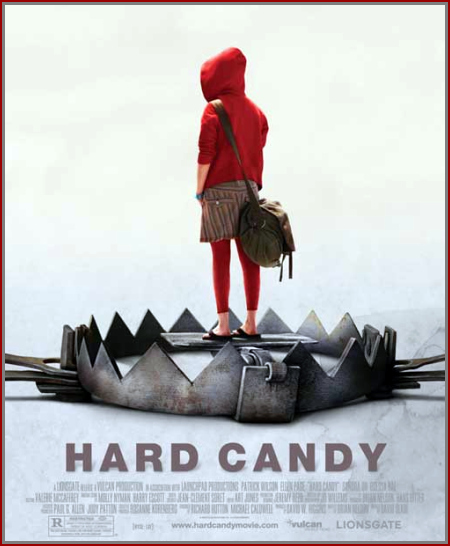
The film directed by David Slade and written by Brian Nelson seems disturbing enough for just the subject matter alone, but it’s also eerie in how timely it’s release has been. With reports of teenage girls becoming victims of internet sexual predators appearing in all types of news media, Hard Candy arrives in the theaters through a limited release to highlight this current trend. Slade and Nelson has created an disturbing and, at times, a very uncomfortable film that shows the many twists and turns that happens when the roles of prey and predator become interchangeable.

There’s no denying that Hard Candy aims to put a new twist on the exploitation subgenre of the rape-revenge films that dominated the late 70’s and early 80’s. Brian Nelson’s clearly channeling the influences from such rape-revenge fantasy films like Mastrosimone’s Extremities and the very disturbing and exploitative I Spit On Your Grave (Day of the Woman) by Meir Zarchi. From the beginning the audience is shown the set-up of an adult instant messenging another person with the screen name of Thonggrrl14. Thonggrrl14 is in fact a 14 year-old teenage girl named Hayley and the adult on the other end a 32 year-old photographer named Jeff who goes by the screen name Lensman319. Jeff has an unhealthy and disturbing penchant for pubescent girls as the subject of his camera lens.

From their first meeting meeting at a coffee house where Jeff gradually begins a flirtatious conversation with the young Hayley to the point in the first act when he finally convinces her to go back to his house whcih doubles as his studio. There’s really no denying the sense of unease that permeates the first act as Hard Candy gradually paints Jeff as the sexual predator that he is. There’s no denying the fact that a man of his age should not be flirting and behaving as if the girl across from him is a fully-grown and developed woman of similar age. Hayley also comes across during this first act like a teenage girl dazzled by an older man who treats her older than her real age. It’s really a disturbing look at just how easily an adult can seduce a child into doing things they normally shouldn’t be doing.

Hayley (played by Juno herself, Ellen Page) soons shows just how wrong and mistaken Jeff has been in picking her as his new prey. I don’t use that word loosely for that was what this film truly was when boiled down to its basic component. A one-on-one three-act play (Brian Nelson’s experience as a playwright shows in the stage-like sequences from beginning to end) between a predator and prey. This time around the prey has turned out to be the one who has done the hunting and the consequences on the wanna-be predator that is Jeff leads to a slow and deliberate set-up that looks like something out of Takashi Miike’s Audition. Hayley’s turning the tables on her stalker shows that girls her age are intelligent enough to know that what Jeff’s doing was wrong. Hayley’s answer to that is to be the hunter instead and fix Jeff’s “problem” through what she calls as “preventive maintenance.” What she calls “preventive maintenance” will definitely cause many men watching this film to sit very uncomfortably and wince on more than once occassion.

The acting job done by Ellen Page was dazzling and really showed why she was listed as an up and coming talent years before Juno. She was technically 15 year-old when the film was made and already she showed a keen grasp of the script which deals with disturbing topics. There’s a scene in Jeff’s car as they reach his home where a passing glance of the camera at her face shows not a gullible teenager, but a determined and somewhat oft-kiltered individual who knows what she will be doing in the coming hours will be medieval harsh but in her mind justified. Patrick Wilson as Jeff plays the would-be sexual predator admirably. His range of emotions go from outright denials of Hayley’s accusations to impotent rage and desperation as his fate is described to him in Miike-like detail by his teenage captor.

If there’s a flaw to mar the intense and suffocating atmosphere this stage-like film creates it would be in the script itself. At times the Hayley character becomes a one-note individual whose beyond her years demeanor seemed too cold and rehearsed. I really can’t put the blame for this on Ms. Page, but on the writer himself. It seems like Brian Nelson was trying too hard to add twist and turns on the story being told. He seems to enjoy overmuch his ability to tug back and forth on his audiences’ emotional investment in the film and the two characters. He actually pulls off the trick of making the sexual predator earn the audiences’ sympathy at what is about to be done to him. But instead of continuing on with that tangent and thus putting Hayley on a darker and more sinister light, Nelson backs off and pulls the audience back to wanting physical and emotional destruction to be visited on Jeff. Nelson used too much zig-zagging in making his script look more complicated than it ought to be. A rape-revenge film works best in its most simplest form.

The direction by David Slade (well-known as a music video director) was actually very subdued and deliberate in its pacing. Slade doesn’t fall back onto his music video experience with unnecessary quick-cut editing that’s plagued his music video director brethren. Slade managed to pull off a very Hitchcockian-style of directing by letting the stage and the actors speak for the scene without much bells and whistles to clutter things. There’s a few sequences where he lets the camera film things through one long, continuous take thus adding a sense of realism to the situation developing inside Jeff’s home.

The use of too much twists and turns in the script notwithstanding, Hard Candy is a tour de force piece of suspenseful filmmaking that borders on the great psychological horror films of the 70’s. In fact, the subject matter on the screen lends a sense of real horror to the film with its timely release and story. Any parent or adult who knows teenagers who use social networking sites like Facebook, MySpace and Twitter would think hard about wanting to know more of what their kids are doing on the net. Hard Candy can be brutal at times and almost suffocating at others with little or no levity to break the tension. It’s a difficult film to sit through and probably won’t be the type of film for some, but just watching the performance by Ellen Page is worthy of the price of a viewing. The subject matter is very adult and straddles the line of what constitute a rated R film and one strictly for adults only. Hard Candy definitely falls on the latter.

10 Best Films of 2009


While some have called 2009 as not being so great in terms of quality films, there have been others who think the year was a very good year for films from start to finish. Not all the best films of 2009 came out during the so-called “awards season” from October thru December. Some of the worst films, in my opinion, were released very late in the year and clearly done so to try and force its way into award contention. While the year of 2009 saw some very good films come out early in the year and, to my surprise, even during the popcorn and brainless season of the summer blockbusters.

My list consists of the 10 films I saw in 2009 which I believe to be the best of all them. Some people will probably agree with me on and some won’t. Some of my picks may have been little seen outside of independent arthouse theaters or film festivals but it doesn’t diminish just how much I think it deserves inclusion in a “best of” list. In the end, I thought these films doesn’t just celebrate what’s great about films but also celebrating those filmmakers who show that when given room to breathe and do things their way magic can still happen.

10. Bad Lieutenant: Port of Call – New Orleans (dir. Werner Herzog)

9. The Messenger (dir. Oren Moverman)

8. Collapse (dir. Chris Smith)

7. Moon (dir. Duncan Jones)

6. Der Baader Meinhof Komplex (dir. Uli Edel)

5. Avatar (dir. James Cameron)

4. Up In The Air (dir. Jason Reitman)

3. District 9 (dir. Neill Blomkamp)

2. Inglourious Basterds (dir. Quentin Tarantino

1. The Hurt Locker (dir. Kathryn Bigelow)

Past Review: The Prestige (dir. by Christopher Nolan)


2006 has been a quiet year for event films. The predicted blockbusters this past summer pretty much underperformed despite some being exactly as good as I thought they’d be. Other than Johnny Depp and the gang’s Pirates of the Caribbean: Dead Man’s Chest, every blockbuster didn’t blow the industry out of the water. It’s a very good thing that I had smaller films to tide me over. This year has been a very good ones for some independent-minded and smaller films which came out during the slow first couple months of the year and during the graveyard release months between the end of summer and the start of the late year holidays. I’ve already had the chance to see such very good films like Running Scared from Wayne Kramer and Hard Candy from David Slade to The Proposition from John Hillcoat. I am glad to say that Christopher Nolan’s film adaptation of Christopher Priest’s novel, The Prestige is another non-blockbuster that excites, entertains and, in the end, keeps the audience mystified but not confused.

I’ve read Christopher Priest’s novel about dueling late 19th-century London magicians. It’s a novel written in epistolary format with each chapter and section written as entries into the journal of one of the main characters in the story. The novel itself is pretty straightforward as it tells the story in near chronological order. I was hesistant to embrace this film adaptation when I first heard about it since alot of the mystery of of the story wouldn’t translate so well in film if they followed the strict order of how the story was told in the novel. For Christopher Nolan and his brother, Jonathan, to just adapt the novel straight-out would’ve made for a dull and boring mystery-thriller. I was glad that the Nolan brothers were inventive enough to borrow abit from Christopher Nolan’s first feature film, Memento. Their film adaptation of The Prestige doesn’t go backwards in its narrative, but it does mixes up the chronological order of the story somewhat, but not to the point that Tarantino does in Pulp Fiction and Kill Bill. The two Nolans fudges abit with the timeline to add some backstory filler to help give the characters that Christian Bale and Hugh Jackman portrays with the reason for their pathological obsession with each other.

Christopher and Jonathan Nolan’s screenplay for The Prestige was able to keep the mystery of the story intact, but it also keeps the amount of red herrings in such films to a minimum. Michael Caine’s character, Harry Cutter, opens up the film explaining just exactly what constitutes a magic trick on stage. How it’s divided into three parts. First, there’s “The Pledge” wherein the magician shows the audience something ordinary he or she will use in the trick. Soon, the magician will follow this up with “The Turn” where the abovementioned ordinary object does something extraordinary in front of the audience. The pay-off of the magician’s trick is “The Prestige” where the audience’s astonishment occurs as they fail to deconstruct and figure out the means of the trick. That’s pretty much the film in a nutshell. It’s one big magic trick. The clues are there for the audience to see, gather and extrapolate their answer to the mystery that is the story. The screenplay doesn’t treat the audience as if they need to be hand-held throughout the film. In fact, anyone who pays attention will be able to solve one-half of the mystery by the first hour. I won’t say exactly whose half of the mystery it will be but people will be kicking themselves afterwards if they don’t figure it out right away.

This magic trick of a film does have its many underlying layers of themes to add some complexity, drama and tension to the characters of Alfred Borden (Christian Bale) and Rupert Angier (Hugh Jackman). I’ve already mentioned that throughout the film their mutual obsession about each other is due to a backstory detailing their past. A past where they were initially friends — rivals even — and apprentices to the magician Milton (played by Ricky Jay) and Harry Cutter (excellently played by Michael Caine as the only voice of reason throughout the film) who creates and maintains the devices used in all the stage tricks. Borden and Angier’s obsession is not just in ruining and sabotaging each other’s magic tricks and lives, but also trying to find out each other’s secrets as they both learn magic tricks which amaze and thrill the gentry of London’s stage. From the beginning of the film these two characters begin a journey towards a path of destructive behavior which puts not just each other’s lives at risk, but those who they care about. All of it in the name of humiliating and upstaging the other due to a tragic incident early in their mutual careers. These two individuals were not sympathetic characters and I applaud Christopher Nolan and his brother for not softening up their hard edges.

Most adaptors will try to make a story’s characters more sympathetic and likable. They went the opposite in The Prestige. But even these two dark characters continue to exude the charisma and strong personalities that the audience will root for one or the other. Should they root for the charismatic and born shownman that Hugh Jackman’s Angier character plays or go for the perfectionist Borden character Christian Bale plays. A perfectionist whose technical skills surpasses that of Angier’s but whose introverted and brooding personality makes him little or no stage presence.

Both Jackman and Bale play their characters well. The film wouldn’t be so good if it wasn’t for the work of these two actors. It helps that they’re surrounded by quality supporting character like Michael Caine as the seasoned, veteran mentor to the dueling magicians. Even Scarlett Johansson does very well with the part she’s given. It’s a part that many sees as more of a throwaway character. A piece of very good-looking distraction for both the story and the audience. But she gamely plays the role of pawn for both Angier and Borden. Unlike Michael Caine’s character who remains the singular voice of sanity in the film, even Johansson’s character of Olivia gets pulled into the obsessions and betrayals that’s plagued both Angier and Borden. But in the end, she’s just part of the process of “The Turn” and if people have been watching the film closely right from the beginning then she’s also a clue as to the secret of one of the amazing magic tricks shown by the two magicians.

The Prestige also has a distinct look about it. The 19th-century London just before the start of the new millenium gives it a certain sense of Victorian-era familiarity. Production designer Nathan Crowley shows a London at the height of its Gilded Age, but soon gives way to a certain steampunk look as inventor Nikola Tesla makes an appearance during an integral part of the story. David Bowie portrays Tesla as an eccentric genius whose search for the secrets of the universe will lead to the discovery of what many of that era would consider magic. It’s the ingenius looking technology created for the Tesla sequence which finally gives The Prestige it’s root in fantasy and science-fiction. The film doesn’t dwell on this new development but from that part of the story and until the end, the film takes on a look and feel of a steampunk mystery-thriller. There’s not enough films that tries to mine this new subgenre and I, for one, am glad that Christopher Nolan added this new dimension to the film’s overall look.

In the end, The Prestige really needs to be seen to be appreciated and for people to make up their minds about the film. Some will see it as a thriller with twists and turns that doesn’t insult the intelligence of its audience. Some may see the film as just one large gimmick from start to end. Those people will probably be correct as well. The film at its most basic level is one long magic trick with all three acts. It has “The Pledge” which is then followed up by “The Turn” and then ends with “The Prestige”. It will be up to each individual who sees the film to make the final decision as to whether they’ve bought into all three acts of the magic trick that is The Prestige, or come away having felt like they’ve wasted their time. I’ve not come across many who felt like the latter, even those whose own feelings about the film don’t reach the same level of praise as I have for Christopher Nolan’s latest offering. All I know is that this is a film that delivers on its premise to confound and amaze. It also continues to validate my views that Bruce Wayne and Batman are in very good hands with Christopher Nolan at the wheel. The Prestige was easily one of the best film of 2006.

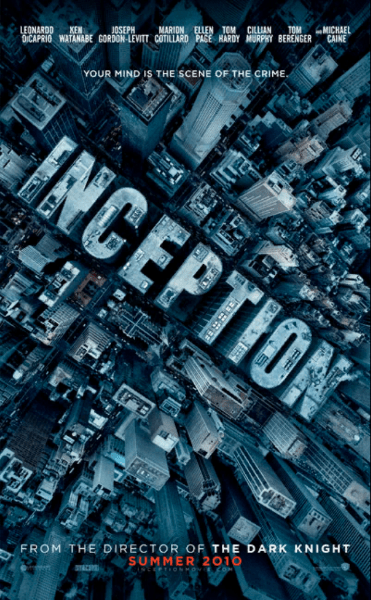
Inception 2nd Teaser Trailer


I still have no clear idea what Christopher Nolan’s follow-up film to The Dark Knight is all about. Inception seems to be about the power of the mind to alter things. From this latest trailer there a sense of Proyas’ Dark City in the some of the visuals and more than just a passing influence from the Wachowski Brothers’ Matrix Trilogy. But this being Nolan whatever influences we may see will probably be supplanted by his own take on the nature of reality, memory and dreams.

If rumors are true about the supposed budget for this film (some saying it’s 200million or more) then Nolan is really inching towards Cameron territory when it comes to acquiring the sort of budget to make his ideas come to life. I’m interested in knowing if Nolan will be shooting some of this film on IMAX like how he did some of the more expansive sequences in The Dark Knight. From the look of some of the scenes in this trailer I wouldn’t be shocked if he did.

ThinkHero: http://www.thinkhero.com/2009/12/28/inception-teaser-trailer-2-video/

HD ver. @Quicktime: http://www.apple.com/trailers/wb/inception/