The Unnominated #13: Heat (dir by Michael Mann)


Though the Academy of Motion Picture Arts and Sciences claim that the Oscars honor the best of the year, we all know that there are always worthy films and performances that end up getting overlooked.  Sometimes, it’s because the competition too fierce.  Sometimes, it’s because the film itself was too controversial.  Often, it’s just a case of a film’s quality not being fully recognized until years after its initial released.  This series of reviews takes a look at the films and performances that should have been nominated but were, for whatever reason, overlooked.  These are the Unnominated.

First released in 1995, Heat is one of the most influential and best-known films of the past 30 years.  It also received absolutely zero Oscar nominations.

Maybe we shouldn’t be too surprised that Academy — especially the Academy of the 1990s — didn’t shower the film with nominations.  For all of its many strengths, Heat is still a genre piece, an epic three-hour crime film from director Michael Mann.  It’s a film about obsessive cops and tightly-wound crooks and it’s based on a made-for-TV movie that Mann directed in the late 80s.  While the Academy had given a best picture nomination to The Fugitive just two years before, it still hadn’t fully come around to honoring genre films.

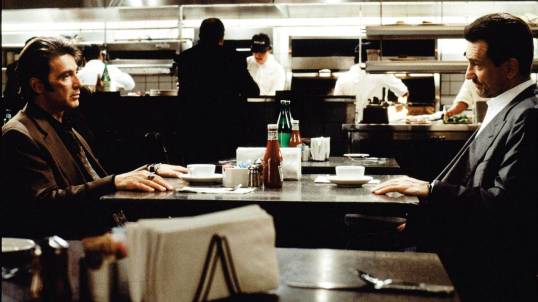
And yet one would think that the film could have at least picked up a nomination for its editing or maybe the sound design that helps to make the film’s signature 8-minute gun battle so unforgettable.  (Heat is a film that leaves you feeling as if you’re trapped in the middle of its gunfights, running for cover while the cops and the crooks fire on each other.)  The screenplay, featuring the scene where Al Pacino’s intense detective sits down for coffee with Robert De Niro’s career crook, also went unnominated.

Al Pacino was not nominated for playing Vincent Hanna and maybe we shouldn’t be too surprised at that.  Pacino yells a lot in this movie.  When people talk about Pacino having a reputation for bellowing his lines like a madman, they’re usually thinking about the scene where he confronts a weaselly executive (Hank Azaria) about the affair that he’s having with Charlene (Ashley Judd), the wife of criminal Chris Shiherlis (Val Kilmer).  And yet, I think that Pacino’s performance works in the context of the film and it’s often forgotten that Pacino has quite scenes in Heat as well.  Pacino’s intensity provides a contrast to Robert De Niro’s tightly controlled career criminal, Neil McCauley.  McCauley has done time in prison and he has no intention of ever going back.  But, as he admits during the famous diner scene, being a criminal is the only thing that he knows how to do and it’s also the only thing that he wants to do.  (“The action is the juice,” Tom Sizemore says in another scene.)  If any two actors deserved a joint Oscar nomination it was Pacino and De Niro.  In Heat, they’re the perfect team.  Pacino’s flamboyance and De Niro’s tightly-controlled emotions come together to form the heart of the picture.

No one from the film’s supporting cast was nominated either, despite there being a wealth of riches to choose from.  Ashley Judd and Val Kilmer come to mind as obvious contenders.  Kilmer is amazing in the shoot-out that occurs two hours into the film.  Ashley Judd has a killer scene where she helps her husband escape from the police.  Beyond Judd and Kilmer, I like the quiet menace of Tom Sizemore’s Michael Cheritto.  (Just check out the look he gives to an onlooker who is getting a little bit too curious.)  Kevin Gage’s sociopathic Waingro is one of the most loathsome characters to ever show up in a movie.  William Fichtner, Jon Voight, Danny Trejo, and Tom Noonan all make a definite impression and add to Michael Mann’s portrait of the Los Angeles underworld.  In an early role, Natalie Portman plays Hanna’s neglected stepdaughter and even Amy Brenneman has some good moments as Neil’s unsuspecting girlfriend, the one who Neil claims to be prepared to abandon if he sees “the heat coming.”

I have to mention the performance of Dennis Haysbert as Don Breedan, a man who has just been released from prison and who finds himself working as a cook in a diner.  (The owner of the diner is played by Bud Cort.)  Haysbert doesn’t have many scenes but he gives a poignant performance as a man struggling not to fall back into his old life of crime and what eventually happens to him still packs an emotional punch.  For much of the film’s running time, he’s on the fringes of the story.  It’s only by chance that he finds himself suddenly and briefly thrown into the middle of the action.

Heat is the ultimate Michael Mann film, a 3-hour crime epic that is full of amazing action sequences, powerful performances, and a moody atmosphere that leaves the viewer with no doubt that the film is actually about a lot more than just a bunch of crooks and the cops who try to stop them.  Hanna and McCauley both live by their own code and are equally obsessed with their work.  Their showdown is inevitable and, as directed by Michael Mann, it takes on almost mythological grandeur.  The film is a portrait of uncertainty and fear in Los Angeles but it’s also a portrait of two men destined to confront each other.  They’re both the best at what they do and, as a result, only one can remain alive at the end of the film.

I rewatched Heat yesterday and I was amazed at how well the film holds up.  It’s one of the best-paced three-hour films that I’ve ever seen and that epic gunfight is still powerful and frightening to watch.  Like Martin Scorsese’s Casino, it was a 1995 film that deserved more Oscar attention than it received.

Heat (1995, dir by Michael Mann, DP: Dante Spinotti)

Previous entries in The Unnominated:

  1. Auto Focus 
  2. Star 80
  3. Monty Python and The Holy Grail
  4. Johnny Got His Gun
  5. Saint Jack
  6. Office Space
  7. Play Misty For Me
  8. The Long Riders
  9. Mean Streets
  10. The Long Goodbye
  11. The General
  12. Tombstone


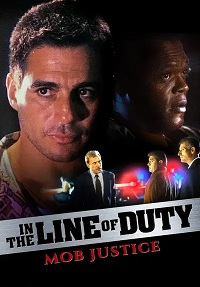
In The Line of Duty: Mob Justice (1991, directed by Peter Markle)


The fourth of NBC’s In The Line of Duty movies, Mob Justice opens with the murder of an undercover DEA agent by a low-level gangster who has just been released from prison.  While the gangster goes into hiding, the DEA mobilizes and starts to make life so difficult for all of the other mobsters in New York that soon, the Mafia is as determined to get justice as law enforcement.

This was the first In The Line Of Duty film not be directed by Dick Lowry.  Lowry’s fast-paced style is missed as Mob Justice takes forever to get going and regularly gets bogged down with scenes lifted from other mafia movies.  The old mobsters talk about the importance of family, play cards in the backroom, and eat big dinners.  Opera blares on the soundtrack when the DEA starts to harass them.  For a movie that is supposed to honor the work and the sacrifice of federal law enforcement, the DEA actually comes across as being thoroughly incompetent in Mob Justice.  A dumb mistake leads to the first murder.  A series of other misjudgments lead to the Mafia dispensing the own type of violent justice before the DEA can arrest their man.

The most interesting thing about Mob Justice is the cast.

The trigger-happy gangster is played by Tony Danza, who I guess was trying to prove himself as a dramatic actor after spending years on Taxi and Who’s The Boss but who still comes across like Tony Micelli having a bad day.  His best friend is played Nicholas Turturro, who later played a straight arrow detective on NYPD Blue.  Frank Vincent and Leonardo Cimino plays the mob bosses who knows that murdering a federal agent is bad for business.

The head of the investigation is played by Ted Levine, who has had a long career but will always be remembered as the killer from The Silence of the Lambs.  Working under him is Dan Lauria, who a generation will instantly recognize as being the long-suffering and frequently angry father from The Wonder Years.  You know that this is a big case is Buffalo Bill and Jack Arnold are working together.  (Dan Lauria actually appeared in several In The Line of Duty films, always playing different characters.)

And finally, the murdered DEA agent is played by none other than Samuel L. Jackson.  It’s never a good thing when the best actor in a movie is killed off after the first fifteen minutes.

The cast is great but Mob Justice is forgettable.  The main problem is that, after Jackson is taken out of the picture, the rest of the movie is just Danza hiding in different apartments while Levine and Lauria annoy Frank Vincent.  Danza’s murderer is never smart nor interesting enough to be a compelling antagonist and there’s never any doubt that, one way or another, he will pay for his stupidity.  There is one memorable scene where Danza freaks out while wearing a blonde wig but otherwise, Mob Justice doesn’t leave much of an impression.

18 Days of Paranoia #11: Betrayed (dir by Costa-Gavras)


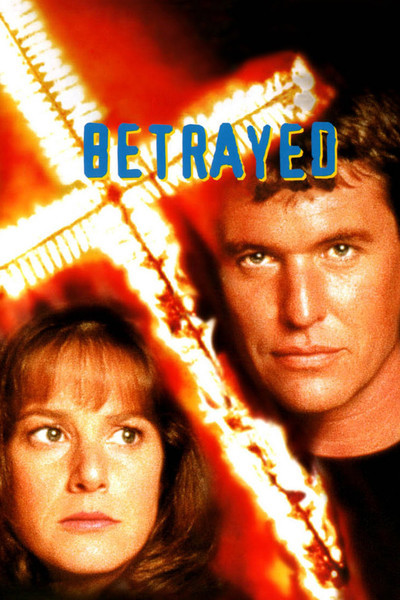
The 1988 film, Betrayed, starts out on a strong note but then quickly becomes annoying as Hell.

It opens with shots of a radio talk show host, an outspoken liberal named Sam Kraus (Richard Libertini).  Kraus berates his callers.  Kraus ridicules anyone who is to the left of Bernie Sanders.  When a man with a rural-accent calls in and attacks Karus for being Jewish, Kraus calls the man an idiot.  After he gets off the air, Kraus walks through a parking garage and stops in front of his car.  Another car pulls up beside Kraus and suddenly, a masked man with a gun opens fire on Kraus, killing him.  The gunman gets out of the car and spray paints, “ZOG” on Kraus’s car before then fleeing the garage.

(ZOG stands for Zionist Occupational Government.  It’s a term used by the type of anti-Semitic dipshits who thinks that the Protocols of Elder Zion are real.)

From this shockingly brutal opening, we cut to panoramic shots of beautiful farmland and crops being harvested in the American midwest, the heartland.  Gary Simmons (Tom Berenger) owns a farm.  He’s a Vietnam vet who nearly received the medal of honor.  He lives with his mother and he has two children.  (He’s divorced and his ex-wife died as the result of a mysterious hit-and-run in California.)  Almost everyone in his small hometown seems to worship Gary.  They’re certainly curious about his new girlfriend, Katie Phillips (Debra Winger).

And really, they probably should be.  Katie Phillips isn’t Katie Phillips at all.  She’s actually an FBI agent named Cathy Weaver and she’s been sent undercover to investigate whether or not Gary was involved in the murder of Kraus.  Cathy, who comes from a broken family and who we’re told has always been seeking some sort of deeper meaning in her life, is charmed by both Gary and his family.  In fact, she falls in love with Gary.  She tells her superior, Mike Carnes (John Heard), that there’s no way Gary is dangerous.  Mike doesn’t believe her but, of course, Mike has a personal stake in this because he and Cathy used to be romantically involved.

(That’s right, everyone.  Betrayed is so narratively lazy that it resorts to making Mike a scorned lover, even though the film’s plot would have worked just as well if he wasn’t.)

As I said, the first part of the movie works.  Debra Wingers gives a strong performance and Tom Berenger is a charming roughneck.  For the first half-hour or so, the film does a good job of showing why men like Gary and his friends are susceptible to conspiracy theories and why they feel that the entire world is stacked against them.  You can understand why Cathy is so troubled by her assignment because Gary’s friends are hardly master criminals.  For the most part, they’re farmers who feel like their entire way of life has been taken away from them.

Unfortunately, almost immediately after Mike refuses to allow her to end her investigation, Cathy returns to the farm and sleeps with Gary.  Not only is this a plot development a disservice to everything that has previously been established about Cathy as a character but it also marks the point where the movie entirely falls apart.  Immediately after sleeping with Cathy, Gary suddenly goes from being a complex but troubled character to being a cartoonish super villain.  And listen — we’ve all been there.  You meet a guy.  He’s handsome.  He says all the right things.  He seems like he’s sensitive.  He makes you feel safe.  You let down your defenses for one night and the next morning, he’s yelling at you for wearing a short skirt in public.  It happens.  Of course, in Gary’s case, it means that he’s not only criticizing the way that Cathy dresses but he’s also taking her on a hunt where the prey is terrified person of color who Gary and his friends have kidnapped.  It also means that Gary drags Cathy along on a bank robbery and then expects her to join him when he wants to assassinate a presidential candidate.  Even after all that, Cathy remains conflicted about what to do with Gary.  The problem is that it’s not like Gary’s a guy who needs sensitivity training or who spends too much time watching ESPN.  Gary is a guy who is carting around weapons and talking about how he wants to kill “mud people.”  That Cathy still has mixed emotions after all of that goes against everything that the film previously asked us to believe about her.  Gary becomes too cartoonish to be plausible and, as a result, he drags down Cathy’s character as well.

Unfortunately, as the film’s narrative falls apart, so do the majority of the performances.  While Debra Winger struggles to make her character’s motivations plausible, Tom Berenger is reduced to doing a lot of glaring.  (Poor John Heard spends most of the movie shouting and bugging his eyes.)  About the only actor who comes out Betrayed unscathed is John Mahoney, who plays Shorty.  Shorty is one of Gary’s friends.  He’s a friendly and personable guy who seems to sincerely care about everyone and who has a charmingly gentle smile.  He’s also a total racist and the contrast between Shorty’s amiable nature and his hateful thoughts provide the latter half of Betrayed with its only powerful moments.  Mahoney gets one big scene, where he talks to Cathy about how much he hates violence but, at the same time, he feels that the world has left him no other choice.  Mahoney does a great job with his small role.  It’s unfortunate that the rest of Betrayed couldn’t live up to his performance.

Other Entries In The 18 Days Of Paranoia:

  1. The Flight That Disappeared
  2. The Humanity Bureau
  3. The Private Files of J. Edgar Hoover
  4. The Falcon and the Snowman
  5. New World Order
  6. Scandal Sheet
  7. Cuban Rebel Girls
  8. The French Connection II
  9. Blunt: The Fourth Man 
  10. The Quiller Memorandum

Ghosts of Sundance Past #2: The Report (dir by Scott Z. Burns)


Remember The Report?

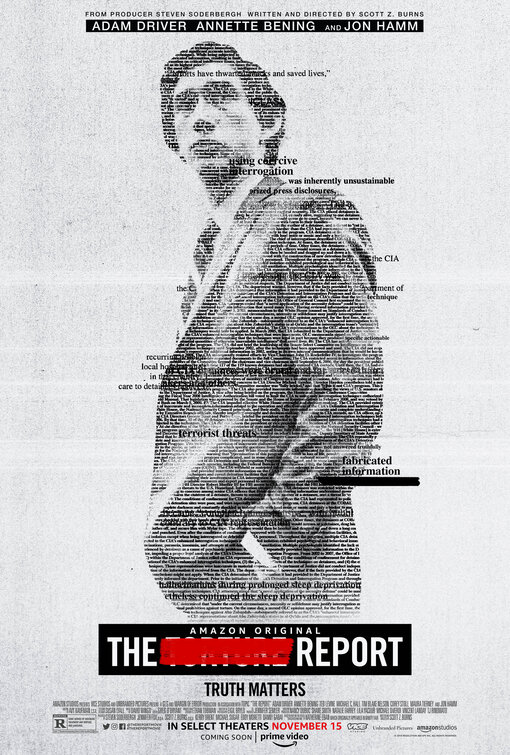
The Report premiered at last year’s Sundance Film Festival, where it was a hit with the critics who saw it.  Amazon acquired the distribution rights and, for the first part of 2019, The Report was one of those films that was regularly discussed as being a potential Oscar nominee.  Not only was it based on a true story but it starred Adam Driver and Annette Bening.  There are several online film critics and award bloggers who are convinced that any film featuring Annette Bening will automatically be an Oscar contender, despite the fact that it rarely seems to work out that way.

Certainly, that ended up being the case with The Report.  Despite all of the hype from Sundance, The Report kind of fizzled when it was finally released.  That it didn’t do much business at the box office makes sense because it was only given a limited release and everyone knew that it would soon be available to stream on Prime.  But even after it was made available on Prime, The Report never really seemed to make much of a dent in the public consciousness.  When the Oscar nominations were announced, The Report was not mentioned once.  Adam Driver did receive a nomination for Best Actor but it was for Marriage Story.

What happened to The Report?  It may have been too low-key for audiences (and, let’s be honest, critics) who have come to expect even a movie about a Senate committee to be experimental and overly stylized.  It could be that, even though the film was critical of the CIA and the War on Terror, it wasn’t angry enough for the same people who thought Adam McKay’s Vice was a brilliantly conceived work of political cinema.  A more realistic explanation is probably that, in this hyper political age, people didn’t want to watch a 2-hour movie about a senate staffer.  Instead, people wanted an escape from all that.

It’s understandable but it’s also a shame because The Report is a very good film.  I mean, I usually hate films like this but I was surprised by how much I liked it.

The Report deals with the efforts of Senate staffer Daniel Jones (Adam Driver) and the members of the Senate Intelligence Committee to investigate the CIA’s use of torture in the aftermath of 9-11.  Skipping back and forth through time, the film shows us how Jones was first assigned to lead an investigation into the CIA’s activities in 2005 and how, over the course of seven years, Jones puts together not one but two reports that absolutely nobody wants released.  Along the way, Jones goes from being a generally idealistic and optimistic staffer to eventually becoming the type of paranoid and obsessive man who meets with reporters in underground garages and who considers leaking classified information.  Daniel has what he believes to be proof that using torture is not only unethical but also counter-productive but, as he discovers, even the members of his own political party aren’t particularly interested in releasing his report.  Adam Driver gives a memorably intense performance of Daniel, playing him as someone whose obsession with his report sometimes threatens to push him over the edge and transform him from being a crusader to being a zealot.

Annette Bening plays Daniel’s boss, Sen. Dianne Feinstein.  It’s interesting casting and, to be honest, it doesn’t quite work.  I almost feel like it would have been better for the film to have either kept Feinstein off-screen or to have at least minimized her role.  The problem is that Dianne Feinstein is a widely-known figure and it’s jarring to see Annette Bening, another well-known figure (at least among film fans), in the role.  Bening plays Feinstein as being a ethical and serious-minded stateswoman and she does what she can with what the film gives her but, at the same time, it’s still kind of a boring performance.  The film presents Feinstein, a not uncontroversial figure, in a positive light and I’m sure some, on both the Right and the Left would say that it’s perhaps a bit too positive.  One gets the feeling that Feinstein’s main role in the film is to assure us that the system works but we just have to take one look at Adam Driver losing his mind to realize that it doesn’t.

That misstep aside, The Report still works far better than I was expecting it too.  Taking obvious inspiration from All The President’s Men, Scott Z. Burns directs the film as if it were a thriller and the deeper that Adam Driver gets into his research, the darker and more shadowy Washington D.C. seems to become.  Even though the film clearly has an agenda, Burns gives the other side a chance to make their case without presenting them as being cartoonish villains.  In other words, this is the opposite of an Aaron Sorkin or Adam McKay-style diatribe.  Instead, this is an intelligent movie about intelligent people.  It’s a film that makes some of the same points as many other similarly liberal films but it makes them without taking cheap shots or resorting to a heavy hand. Long after Vice has been forgotten, The Report will be remembered.

And, if you haven’t seen it yet, it’s on Prime!

Lisa Reviews An Oscar Winner: The Silence of the Lambs (dir by Jonathan Demme)


Oh, The Silence of the Lambs, I have such mixed feelings about you.

On the one hand, I’m a horror fan and Silence of the Lambs is a very important film in the history of horror.  Back in 1992, it was the first horror film to win the Academy Award for Best Picture!  It even made history by winning all of the big “five” awards — Picture, Director, Actor, Actress, and Adapted Screenplay!  It was the first film since One Flew Over The Cuckoo’s Nest and It Happened One Night to pull that off!

Beyond that, it’s one of the most influential films ever made.  Every erudite serial killer owes a debt to Anthony Hopkins’s performance as Hannibal Lecter.  Every competent but untested and unappreciated female FBI agent owes a debt to Jodie Foster’s performance as Clarice Starling.  Even though the whole criminal profiler craze probably owes more to Manhunter (a film to which Silence of the Lambs is a sequel, though that often seems to go unacknowledged) than to anything else, this Oscar winner still definitely played a part.  I mean, how many people watched Manhunter for the first time, specifically because Lecter mentioned the events in that earlier film in Silence of the Lambs?

Plus, this won an Oscar for Jonathan Demme, one of my favorite directors!  And while I’m sure Jodie Foster would have gone on to have a strong career regardless of whether she had played Clarice Starling or not, it’s generally acknowledged that Silence of the Lambs revitalized the career of Anthony Hopkins.  So for that, we should all be thankful.

And yet, it can be strange to watch Silence of the Lambs today.  All of the imitations (not to mention some ill-thought sequels and prequels) have lessened its bite.  I can only imagine how it must have freaked out audiences when it was first released but I have to admit that I was slightly disappointed the first time that I watched the film.  Looking back, I can see that disappointment was due to having been told that it were one of the scariest movies of all time but, because, I had seen a countless number of imitations, parodies, and homages, I felt as if I had already watched the film.  So, I wasn’t shocked when Lecter turned out to be ruthlessly manipulative and dangerously charismatic.  Nor was I shocked when he managed to escape and poor Charles Napier ended up strung up in that cage.  I’m sure that audiences in 1991 were freaked out, though.

Actually, as good as Foster and Hopkins and Scott Glenn are, I think the best performance in the film comes from Ted Levine, playing Buffalo Bill.  Seriously, Levine’s performance still freaks me out.  It’s the voice and the way he says, “Precious.”  Levine’s performance, I found to be a hundred times more frightening than Anthony Hopkins’s and I think it’s due to the fact that Hannibal Lecter was clearly an author’s invention while Levin’s Buffalo Bill came across like he might very will be hiding in an alley somewhere, waiting for one of your friends to walk by. (Interestingly enough, I had the same reaction when I first saw Manhunter.  Brian Cox did a good job as Lecter but he still came across as a bit cartoonish.  Meanwhile, Tom Noonan was absolutely terrifying.)  Levine has subsequently gone on to play a lot of nice guy roles.  He was a detective on Monk, for instance.  Good for him.  I’m glad to see he was able to escape being typecast.  Admittedly, I do kinda wonder how many serial killer roles he had to turn down immediately after the release of The Silence Of The Lambs.

Still, it’s a good film.  Time may have lessened it’s power but The Silence of the Lambs is still an effective and well-directed thriller.  It’s impossible not to cheer for Clarice.  It’s impossible not to smile at the fun that Anthony Hopkins seems to be having in the role of Lecter.  Jonathan Demme creates a world of shadows and darkness and still adds enough little quirks to keep things interesting.  (I especially liked Lecter watching a stand-up special in his cell.)  It’s the little details that makes the world of The Silence of the Lambs feel lived in, like Clarice’s nervous laugh as she gives a civilian instructions on what to do in case she accidentally gets trapped in a storage locker.  Even the film’s final one liner will make you smile, even though it’s the type of thing that every film seemed to feel the need to do nowadays.  It’s still a good movie, even if it no longer feels as fresh as it once may have.

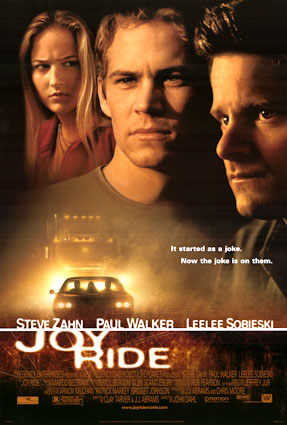
Horror Film Review: Joy Ride (dir by John Dahl)


The 2001 film Joy Ride is an example of a subgenre of horror that I like to call the Don’t Fuck With Truckers genre.  It all started with Duel back in the early 70s and since then, there’s been a large number movies about ordinary people who end up getting on the wrong side of a trucker.

Myself, I would never piss off a trucker.  First off, I have a few cousins who are proud members of the Teamsters and I can tell you, from personal experience, that you don’t want to get on their bad side.  Secondly, those trucks are really, really big and it takes a certain amount of skill to drive them, certainly more skill than it takes me to drive my little convertible.  (Truckers can make turns in those gigantic trucks and somehow do it without crashing into a stop light.  I can barely parallel park.)  Trucks block out the road, making it impossible to see anything beyond them, which makes the prospect of trying to pass them all the more frightening.  Essentially, if you get into a vehicle fight with a trucker, you’re going to die.  There’s just no way your little car is going to be able to beat that giant truck.

Now, I have to admit that I really like Joyride but sometimes, I feel like maybe I shouldn’t.  It basically comes down to two things:

Number one, I have always defended horror movies against the charge that they always feature people making the stupidest possible decisions.  My defense is usually that people in real life are actually far more stupid than they realize and that whenever anyone says, “I would never be stupid enough to wander around a deserted camp ground in the middle of the night!,” they are essentially lying.  Seriously, everyone would do that just so they could later joke about how it was just like being in a horror movie.

That said, the majority of the characters in Joy Ride are really, really dumb.  Basically, two brothers (Steven Zahn and Paul Walker) are driving from California to Colorado so that they can pick up Walker’s best friend (Leelee Sobieski).  Along the way, Zahn and Walker decide to have some fun by getting on the CB radio and telling a trucker who calls himself Rusty Nail (voiced by Ted Levine, who was also the killer in The Silence of the Lambs) that there is a prostitute named Candy Cane waiting for him in a motel room.  The joke, of course, is that Zahn and Walker know that an obnoxious businessman is actually staying in the room.

The next morning, after playing their little joke and then listening to Rusty Nail and the businessman have a huge fight, the brothers are informed that the businessman has been found on the side of the road.  He’s still alive but his jaw was ripped off.  The brothers’ reaction is to get the Hell out of town.

Okay, so far, so good.  The joke was mean but people are mean.  Leaving town instead of helping with the police investigation was selfish but people are selfish.  What drives me crazy is that, once they’re on the road, the brothers get back on the CB radio and inform Rusty Nail that there was no Candy Cane and that they were just playing a joke on him.

IDIOTS!  Seriously, you’ve just been told that the guy ripped off another man’s jaw and now you’re going to piss him off more?

My other problem is that Leelee Sobieski’s character is so underdeveloped.  The film’s nearly halfway over before Zahn and Walker reach Colorado and pick her up.  Just a few scenes later, Sobieski is kidnapped by Rusty Nail.  Characterwise, she pretty much only exists to be kidnapped and held hostage.  It seems like a waste of Sobieski’s talents and the flatness of her character is especially disappointing when you consider how well-developed the characters played by Walker and Zahn are.

And yet, despite all of that, I really like Joy Ride.  It’s just a well-made film, a relentless thrill ride that succeeds largely because director John Dahl never gives the audience any time to relax and think about whether or not the film makes any sense.  As a largely unseen threat, Rusty Nail is both plausible and seemingly supernatural at the same time.  I mean, that truck literally pops up out of nowhere sometimes.  Zahn and Walker are very well-cast as brothers, with Zahn’s natural goofiness nicely paired up with Walker’s natural earnestness.  You like them, even if they are selfish idiots.

Almost despite itself, Joy Ride is a good movie and it features an important message: Don’t fuck with truckers.

http://www.youtube.com/watch?v=udKUOQ2czWg

A Movie A Day #25: Next of Kin (1989, directed by John Irvin)


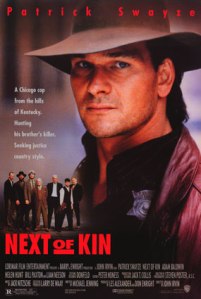
next-of-kinTruman Gates (Patrick Swayze) may have been raised in Appalachia but, now that he lives in Chicago, he’s left the old ways behind.  He has a job working as a cop and his wife (Helen Hunt) is pregnant with their first child.  When Truman’s younger brother, Gerald (Bill Paxton), shows up in town and asks for Truman’s help, Truman gets him a job as a truck driver.  But, on his first night on the job, Gerald’s truck is hijacked by a Sicilian mobster named Joey Rosellini (Adam Baldwin) and Gerald is killed.  Truman’s older brother, Briar (Liam Neeson), soon comes to Chicago and declares a blood feud on the mob.
Of the many action films that Patrick Swayze made between Dirty Dancing and Ghost, Roadhouse may be the best known but Next of Kin is the best.  Next of Kin spends as much examining the family dynamics of Rosellini’s family as it does with Truman’s, suggesting that there is not much of a difference between the two groups.  There’s even a scene where Joey’s uncle (played by Andreas Katsulas) tells Joey that the Sicily was the Appalachia of Italty.  Next of Kin also has a better supporting cast than most of the films that Swayze made during this period.  Along with Paxton and Neeson, the hillbillies are represented by actors like Ted Levine and Michael J. Pollard while Ben Stiller has an early role as Joey’s cousin.  Patrick Swayze gives one of his better performances as Truman but the entire movie is stolen by Liam Neeson, who is a surprisingly believable hillbilly.

Playing Catch-Up With 6 Quickie Reviews: The Big Game, The Connection, Graduation Day, McFarland USA, Taken 3, and War Room


Here are 6 more reviews of 6 other films that I watched this year.  Why six?  Because Lisa doesn’t do odd numbers, that’s why.

The Big Game (dir by Jalmari Helander)

In The Big Game, Samuel L. Jackson plays the President of the United States and you would think that fact alone would make this film an instant classic.  Unfortunately, this film never really takes advantage of the inherent coolness of Samuel L. Jackson playing the leader of the free world.  When Air Force One is sabotaged and crashes in the wilderness of Finland, President Jackson has to rely on a young hunter (Onni Tommila) from a group of CIA agents disguised as terrorists.  Tommila does a pretty good job and the scenery looks great but at no point does Samuel L. Jackson says, “Check out this executive action, motherfucker,” and that’s a huge missed opportunity.  As for the rest of the film, it takes itself a bit too seriously and if you can’t figure out the big twist from the minute the movie starts, you obviously haven’t seen enough movies.

The Connection (dir by Cedric Jiminez)

Taking place over the 1970s, the French crime thriller tells the largely true story of the efforts of a French judge (played by Jean Dujardin) to take down a ruthless gangster (Gilles Lellouche) who is the head of one of the biggest drug cartels in the world.  The Connection run for a bit too long but, ultimately, it’s a stylish thriller that does a very good job of creating a world where literally no one can be trusted.  Dujardin, best known here in the States for his Oscar-winning role in The Artist, does a great job playing an honest man who is nearly driven to the point of insanity by the corruption all around him.

Graduation Day (dir by Chris Stokes)

Hey, it’s another found footage horror film!  Bleh!  Now, I should admit that this horror film — which is NOT a remake of that classic 1980s slasher — does have a fairly clever twist towards the end, that goes a long way towards explaining a lot of the inconsistencies that, up until that point, had pretty much dominated the film.  But, even with that in mind and admitting that Unfriended and Devil’s Due worked wonders with the concept, it’s still hard to feel any enthusiasm about yet another found footage horror film.

McFarland USA (dir by Niki Caro)

McFarland USA is an extremely predictable but likable movie.  Kevin Costner plays a former football coach who, while teaching at a mostly Latino high school, organizes a cross country team that goes on to win the state championship.  It’s based on a true story and, at the end of the film, all of the real people appear alongside the actors who played them.  There’s nothing about this film that will surprise you but it’s still fairly well-done.  Even Kevin Costner, who usually gets on my last nerve, gives a good performance.

Taken 3 (dir by Olivier Megaton)

Bryan Mills (Liam Neeson) is back and he’s killing even more people!  Fortunately, they’re all bad people but you really do have to wonder what type of dreams Bryan has whenever he goes to sleep.  In Taken 3, Bryan’s wife (Famke Janssen) has been murdered and Bryan has been framed.  He has to solve the case and kill the bad guys while staying one step ahead of the police (represented by a bored-looking Forest Whitaker).  Neeson does all of his usual Taken stuff — the intense phone conversation, the steely glare, and all the rest — but at this point, it has literally been parodied to death.  If you’re into watching Liam Neeson kill ugly people, Taken 3 will provide you with adequate entertainment but, for the most part, it’s but a shadow of the first Taken.

War Room (dir by Alex Kendrick)

I saw the War Room in Oklahoma.  It was being shown as part of a double feature with The Martian, of all things!  Anyway, this film is about an upper middle class family that hits rock bottom but they’re saved by the power of prayer!  Lots and lots of prayer!  Seriously, this film almost qualifies as “prayer porn.”  Anyway, the film was badly acted, badly written, incredibly heavy-handed, and ran on way too long but, on the plus side, it did eventually end.

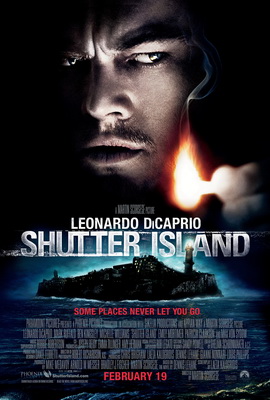
Embracing the Melodrama Part II #119: Shutter Island (dir by Martin Scorsese)


Shutter IslandThe 2010 film Shutter Island finds the great director Martin Scorsese at his most playful.

Taking place in 1954, Shutter Island tells the story of two detectives, Teddy Daniels (Leonardo DiCaprio, giving an excellent performance that, in many ways, feels like a test run for his role in Inception) and Chuck Aule (Mark Ruffalo, also excellent), who take a boat out to the Ashecliffe Hospital for The Criminal Insane, which is located on Shutter Island in Boston Harbor.  They are investigating the disappearance of inmate Rachel Solando, who has been incarcerated for drowning her three children.

Ashecliffe is one of those permanently gray locations, the type of place where the lights always seem to be burned out and the inmates move about like ghostly visions of sins brought to life.  It’s the type of place that, had this movie been made in the 50s or 60s, would have been run by either Vincent Price or Peter Cushing.  In this case, the Cushing role of the cold and imperious lead psychiatrist is taken by Ben Kingsley.  Max Von Sydow, meanwhile, plays a more flamboyantly sinister doctor, the role that would have been played by Vincent Price.

When a storm strands Teddy and Chuck on the island, they quickly discover that neither the staff nor the patients are willing to be of any help when it comes to tracking down Rachel.  As Teddy continues to investigate, he finds himself stricken by migraines and haunted by disturbing images.  He continually sees a mysterious little girl.  He has visions of his dead wife (Michelle Williams).  A horribly scarred patient in solitary confinement (Jackie Earle Haley) tells him that patients are regularly taken to a lighthouse where they are lobotomized.  When Teddy explores more of the island, he comes across a mysterious woman living in a cave and she tells him of even more sinister activity at Ashecliffe.  Meanwhile, Chuck alternates between pragmatic skepticism and flights of paranoia.

And I’m not going to share anymore of the plot because it would be a crime to spoil Shutter Island.  This is a film that you must see and experience for yourself.

This is one of Martin Scorsese’s most entertaining films, an unapologetic celebration of B-movie history. He knows that he’s telling a faintly ludicrous story here and, wisely, he embraces the melodrama.  Too many directors would try to bring some sort of credibility to Shutter Island by downplaying the film’s more melodramatic moments.  Scorsese, however, shows no fear of going over the top.  He understands that this is not the time to be subtle.  This is the time to go a little crazy and that’s what he does.

Good for him.

Review: The Hills Have Eyes (dir. by Alexandre Aja)


Many people have issues about remakes and reboots. They see it as unnecessary and a proof that the film industry has run out of ideas. I can’t say that either points have no validity to them, but I disagree with both.While all genres of film have had it’s share of remakes and reboots its the horror section of the film aisle which has seen the most. This shouldn’t come as a shock since horror has always been ripe for remakes. The stories in horror films have always been quite simple and producers take advantage of this by remaking them for a new generation. Take the simple set-up, change the time and setting with a new cast of cheap, unknown actors and you got yourself a horror flick which should make back its budget and make its filmmakers a profit.

While most horror remakes usually range from average to truly dreadful there comes a time when one comes out of the horror remake heap to actually show promise and quality not seen in its remake brethren. One such film is in the Alexandre Aja directed and Wes Craven produced The Hills Have Eyes. Aja’s The Hills Have Eyes is the rare horror remake in that its more than a match to Wes Craven’s original and, at times, surpasses it.

Alexandre Aja first burst onto the horror-cinema scene with his ambitious and grisly homage to grindhouse horror: Haute Tension. Haute Tension was one nasty piece of horror filmmaking which brought to mind 70’s and early 80’s horror exploitation and grindhouse mentality. Aja’s directorial debut was a no-hold-s-barred punch and kick to the stomach that was overtly violent and sublimely painful for the audience to watch. Aja was soon tapped by Wes Craven to lead the remake project of his own The Hills Have Eyes and to Aja’s growing reputation as a rising star of horror, he grew as a filmmaker and more than earned this reputation.

Aja’s The Hills Have Eyes follows pretty much the very same story and characters as the original. This remake has abit more of a political sense to its storytelling in that it doesn’t just pit the basic premise of civilized humans versus the primal inbred, mutant hill dweller, but also the different demographics of red state versus blue state. This theme was hammered through to the audience through the subsurface conflict between Big Bob Carter’s (well-played by industry veteran Ted Levine) red state gung-ho ex-detective and his son-in-law Doug’s (X2‘s Aaron Stafford) pacifist mentality. I think this new wrinkle in the original’s sparse and tight story was unnecessary and unsubtly done. I really didn’t want to know what political leanings and motivations the Carter family members followed. What I did care about was how they would react to the outside forces that was soon to menace and attack them.

The first half of the film was very deliberate in its set-up as it slowly built up the tension and dread as the Carter family’s journey through a supposedly short-cut through the desert put them closer and closer to the dangerous people who dwelt amongst the hills bordering the desert road. Once the family becomes stranded in the middle of nowhere the fun begins for horror-aficionados. For those who have seen the original this remake doesn’t deviate from the main story. The hill people who, up until now have only been glimpsed through quick shadowy movements across the screen, were the true cause of the family’s predicament attack in a brutal and grisly fashion. None of the Carter family members were spared from this attack. From Big Bob Carter, his wife Ethel, their three children, son-in-law and young granddaughter they all suffer in one form or another. The night attack on the camper is the main highlight of the film and shows that Aja hasn’t lost his touch for creating a horror setpiece that doesn’t hold back. From the brutal rape of the Carter’s youngest daughter Brenda to the sudden deaths of several Carter family members. This sequence was both fast-paced and chaotic in nature. It also helped push the definition of what constitute a very hard R-rating. Just like Zombie’s The Devil’s Rejects and Roth’s Hostel, The Hills Have Eyes pushed the limits and boundaries of what the MPAA has allowed so far in terms of on-screen violence when it was first released in 2006. I’m very surprised that some of the violence and deaths in this film made the final cut. This film definitely brings back the 70’s style horror.

The cast for this remake was one high point that the original didn’t have. Where Craven had a very inexperienced cast for the original film. Aja had the luxury of a bigger budget to hire a more competent and able group of actors. A cast that was led by Ted Levine who shined in his role as the patriarch of the civilized Carters. Kathleen Quinlan as the mother of the bunch soldiers on even though its almost predestined in films such as this that she would be one of the doomed. The two daughters as played by Vinessa Shaw and Lost’s Emilie De Ravin were quite good in roles that involved some very graphic rape sequences. Much kudos must go to De Ravin for having to perform through her scene during the trailer-camper attack. But the two actors who excelled in the film has to be pacifist turned avenging angel Doug as played by Aaron Stafford. We see in his character Doug the lengths a civilized human being would go through to survive and protect those he cares for. Even if this means resorting to becoming more brutal and primal than the inbred, mutant hill dwellers. It’s in Doug’s character where the basic premise of the clash of the modern with the primitive comes close to matching the same theme in the original. To a smaller degree this was also echoed in the Carter’s teenage son Bobby. Dan Byrd of Entourage plays Bobby Carter and its in him we see the level-headedness of the family. Despite all the horror and carnage he has seen the hill dwellers have inflicted on his family, Bobby remains somewhat calm and even-keeled to protect what is left of his family. The only drawback as to the cast itself was that the opposing family seemed to have been shortchanged. In the original we actually got to understand some of the motivations that drove the hill dwellers to prey on unsuspecting travelers through their area. In this remake the hill dwellers seem more like superhuman monsters and boogeymen. It didn’t bother me as much, but then it also lessened the impact of the story’s basic premise of civilization versus primitives.

Lastly, the look of the film helps add to the grindhouse nature of Aja’s remake. The film has an oversaturated look and feel that took advantage of the desert location and the high-sun overhead. This oversaturation of the film’s look also lends some credence to its grindhouse sensibilities. It looked, felt and acted like something made during the late 70’s and early 80’s. For most fans of horror it would really come down to the special-effects used to show the death and violence’s impact on the audience. Once again, Greg Nicotero and his crew at KNB EFX house show that they’re the premiere effects house. The make-up used to show the mutant effects on the survivors of the original inhabitants of the hills was excellently done. The same goes for the gags used to show the many brutal and messy deaths of both families.

There’s no denying that The Hills Have Eyes was all about pain when boiled down to its most basic denominator. This film is all about pushing the boundaries and piling on violence upon violence. The Hills Have Eyes is not a film that tells us violence solves nothing. Here it does solve the problem for the Carter clan and is also the only avenue of survival of the remaining Carters. The same goes for the nuclear survivors and their offspring who stayed in the irradiated zones that was their home. This film is all about survival and the levels and heights individuals would take to achieve it.

The Hills Have Eyes might not be the original second helping some have expected from Aja after his brilliant, if somewhat flawed first major film with Haute Tension, but it does show his growth as a filmmaker and his clean grasp of what makes horror cinema truly terrifying and uncomfortable. Two ingredients that makes for making a genre exploitation fare into something of a classic. I’m sure that outside of the horror-aficionado circles this film will either be met with indifference or disgust, but for those who revel in this type of filmmaking then it’s a glorious continuation of the grindhouse horror revival that began with Aja’s own Haute Tension, continued by Zombie’s The Devil’s Rejects, Roth’s Hostel  and continues to live each and every year with the many direct-to-video releases of cheap, but very good horror films. It truly is a great time to be a fan of horror and Aja’s The Hills Have Eyes more than holds its own against Craven’s original.