Here Are The North Carolina Film Critics Association Nominations!


For Christmas, there was a temporary pause in the flood of precursor awards.  Now that Christmas has passed, Oscar season is back in full swing.

Today, the North Carolina Film Critics Association announced their nominations for the best of 2016!

And here they are:

BEST NARRATIVE FILM
Arrival
Hell or High Water
La La Land
Manchester by the Sea
Moonlight

BEST DOCUMENTARY FILM
13th
I Am Not Your Negro
Life, Animated
O.J.: Made in America
Weiner

BEST ANIMATED FILM
Finding Dory
Kubo and the Two Strings
Moana
Sausage Party
Zootopia

BEST FOREIGN LANGUAGE FILM
Elle
The Handmaiden
A Man Called Ove
Toni Erdmann
Things to Come

BEST DIRECTOR
Damien Chazelle — La La Land
Barry Jenkins — Moonlight
Kenneth Lonergan — Manchester by the Sea
David Mackenzie — Hell or High Water
Chan-woo Park — The Handmaiden

BEST CINEMATOGRAPHY
Chung-hoo Chung — The Handmaiden
James Laxton — Moonlight
Giles Nuttgens — Hell or High Water
Linus Sandgren — La La Land
Bradford Young — Arrival

BEST SPECIAL EFFECTS
Arrival
Captain America: Civil War
Doctor Strange
Jungle Book
Rogue One: A Star Wars Story

BEST ACTOR
Casey Affleck — Manchester by the Sea
Joel Edgerton — Loving
Ryan Gosling — La La Land
Viggo Mortensen — Captain Fantastic
Denzel Washington — Fences

BEST SUPPORTING ACTOR
Mahershala Ali — Moonlight
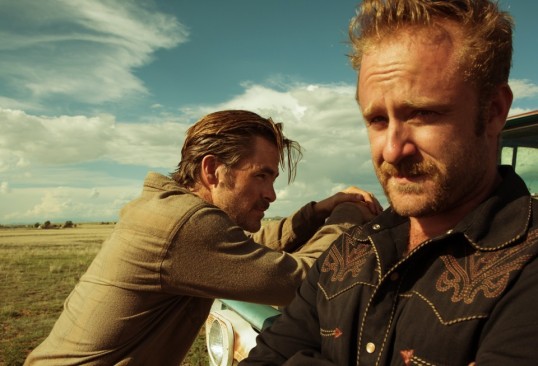
Jeff Bridges — Hell or High Water
Ben Foster — Hell or High Water
Lucas Hedges — Manchester by the Sea
Sam Neill — Hunt for the Wilderpeople

BEST ACTRESS
Annette Bening — 20th Century Women
Kate Beckinsale — Love & Friendship
Ruth Negga — Loving
Natalie Portman — Jackie
Emma Stone — La La Land

BEST SUPPORTING ACTRESS
Viola Davis — Fences
Greta Gerwig — 20th Century Women
Naomie Harris — Moonlight
Nicole Kidman — Lion
Michelle Williams — Manchester by the Sea

BEST ORIGINAL SCREENPLAY
Damien Chazelle — La La Land
Barry Jenkins — Moonlight
Kenneth Lonergan — Manchester by the Sea
Mike Mills — 20th Century Women
Taylor Sheridan — Hell or High Water

BEST ADAPTED SCREENPLAY
Tom Ford — Nocturnal Animals
Eric Heisserer — Arrival
Seo-kyeong Jeong and Chan-wook Park — The Handmaiden
Whit Stillman — Love & Friendship
Taika Waititi — Hunt for the Wilderpeople

KEN HANKE MEMORIAL TAR HEEL AWARD
(To an artist or film with a special connection to North Carolina.)
Anthony Mackie
Jeff Nichols
Starving the Beast

Horror Scenes I Love: In the Mouth of Madness


sutter-canes-agent

John Carpenter’s contribution and influence in horror and genre filmmaking could never be disputed. This man’s films, especially his work from the 70’s and early 80’s have made him one of the undisputed masters of horror (joined by such contemporaries as Wes Craven and George A. Romero). While his worked had become so-so at the tail-end of the 1990’s and quite sparse during the 2000’s his name still evokes excitement whenever something new comes out where he’s intimately involved in it’s creation (these days a series of synth-electronic albums).

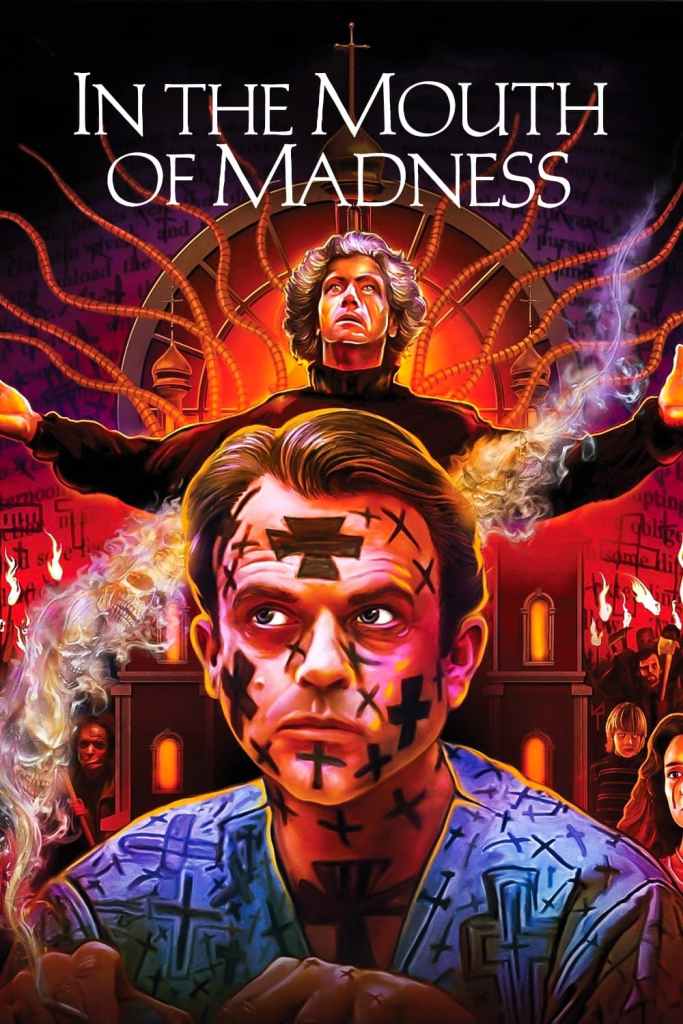
It was during the mid-1990’s that we saw a John Carpenter already tiring of constantly fighting the Hollywood system, yet still game enough to come up with some very underrated and underappreciated horror and genre films. One such film was 1995’s In the Mouth of Madness. This was a film that didn’t so well in the box office yet has become a cult horror classic since. Part of his unofficial Apocalypse Trilogy (The Thing and Prince of Darkness the other two), In the Mouth of Madness combined Lovecraftian eldritch horror with the horror of the mundane that made Stephen King so popular with the masses.

This scene early in the film just showcases not just Carpenter’s masterful camera and editing work, but was ahead of its time in exploring the toxic nature of fandoms and groupthink. In 1995 such a concept might have been relegated to B-movie horror, but in 2016 it’s become synonymous with such everyday occurrences and topics as Gamergate, Tea Party and Trump supporters to SJW crusaders, Marvel vs. DC and Democrats and Republicans. Everyone believes their group to be the only righteous in whatever argument they happen to be part of and everyone else must be silenced (and in the scene below silenced equates to death).

John Carpenter might have turned into that old and cantankerous, albeit cool, dude who couldn’t care less what you thought of him, but it seems that he saw what was happening today as far back as the 1990’s.

Horror Film Review: Event Horizon (dir by Paul W. S. Anderson)


event_horizon_ver1

Event Horizon, a sci-fi/horror hybrid from 1997, is one of those films that starts out with a series of title cards:

“2015 First permanent colony established on moon.”

Wait … 2015?  How did I miss that?

” 2032 Commercial mining begins on Mars.”

Yay!  Only 16 more years to wait until we’re finally on Mars!

“2040 Deep space research vessel ‘Event Horizon’ launched to explore boundaries of Solar System. She disappears without trace beyond the eighth planet, Neptune. It is the worst space disaster on record.”

Wow, that sucks.  But things happen…

“2047 Now…”

Alright, let’s get this story going!

Seven years after it disappeared, the Event Horizon suddenly sends out a distress signal.  It turns out that it didn’t blow up like everyone assumed.  Instead, it’s still out in space.  The surly crew of the Lewis & Clark is called off of leave and sent on a rescue mission.  (And when I say surly, I do mean sur-ly!  Seriously, nobody on the Lewis & Clark is in a good mood … ever!)  Accompanying the crew is Dr. Weir (Sam Neill), the scientist who designed the Event Horizon.  Captain Miller (Laurence Fishburne) may not be happy about having Dr. Weir on his ship but, then again, Captain Miller always seems to be annoyed about something.

The Event Horizon appears to be deserted.  The walls are covered with blood.  The captain — at least it appears to be the captain — has been crucified and left on display.  Dr. Weir explains that the Event Horizon was designed to create an artificial black hole and it’s possible that the ship went into another dimension and that it may have brought something back with it.  Other crew members speculate that the Event Horizon may have accidentally been transported to Hell.  Either way, it’s not a good thing but, after the Lewis & Clark suffers some damage, the crew find themselves stranded on the Event Horizon.

Soon, the crew members are having hallucinations.  The ship’s doctor (Kathleen Quinlan) sees her son running through the ship.  Captain Miller sees the burning corpse of a friend that he had to abandon during a previous mission.  Another crewman appears to be possessed and attempts to commit suicide by opening up the airlock.  Dr. Weir has visions of his dead wife.  Things get darker and darker.  People die.  Eyes are ripped out of sockets.  A video of the original crew is found and it’s like something out of a painting by Hieronymus Bosch.  Miller wants to blow up the Event Horizon.  Dr. Weir replies, “We are home!”

Agck!

Seriously, Event Horizon is a curious film.  I’ve seen it a few times and I have to admit that it’s never quite as good as I remembered.  If you want to get really technical about it, Event Horizon is a poorly paced film that is overly derivative of the Alien franchise and it features perhaps the worst performance of Laurence Fishburne’s career.

(Yes, even worse than his performance in Contagion…)

But, at the same time, even if I’m always somewhat disappointed with the film, Event Horizon is also a movie that stays with you.  Whatever flaws the film may have, it is genuinely scary and disturbing.  Director Paul W.S. Anderson does a good job of turning that spaceship into the ultimate floating haunted house and, even more importantly, he keeps you off-balance.  This is one of the few horror films where literally anyone can die, regardless of whether they’re top-billed or have an Oscar nomination to their name.  Whatever the evil is that has possessed the Event Horizon, it is ruthlessly and sadistically efficient.

Plus, there’s that video.  If you’ve seen the movie, you know what I’m talking about.  Anderson has complained that the studio made him cut a lot of footage out of the video but what remains is disturbing enough.  Seriously, you’ll never want to hear another Latin phrase after watching Event Horizon.

Horror Film Review: Omen III: The Final Conflict (dir by Graham Baker)


Omen_III_the_final_conflict

Originally, it had been planned that the Omen franchise would be made up of six or seven films and that each movie would check in on another year in the life of Damien Thorn, a bit like an apocalyptic version of Boyhood.  However, after Damien: Omen II failed to perform up to expectations, plans were changed.

Instead of continuing the story of Damien’s adolescence, the 1981 film Omen III: The Final Conflict jumps straight into Damien’s adulthood.  Now 32 years old and played by a very young (and handsome) Sam Neill, Damien Thorn is now the CEO of Thorn Enterprises.  With the help of his loyal assistant Harvey Dean (Don Gordon), Damien has become one of the most popular and powerful men on the planet.  Thorn Enterprises, having followed Paul Buhler’s scheme from the second film, is now responsible for feeding a good deal of the world.  Damien is seen as being a humanitarian and a future President.  When the U.S. Ambassador to the United Kingdom reacts to spotting a black dog in the park by committing suicide, Damien is appointed to the position.

(Needless to say, everyone in London is happy to see Damien.  Nobody says, “I just hope you don’t end up going crazy and dying a violent death, like everyone else in your family and immediate circle of acquaintances.”  But they’re probably thinking it…)

Now in London (and also appointed to be head of the United Nations Youth Organization, which just goes to show that your crazy uncle is right and the United Nations is a conspiracy), Damien pursues a rather creepy romance with journalist Kate Reynolds (Lisa Harrow) and makes plans to prevent the Second Coming by killing every single baby born on the morning of March 24th.  (But Harvey’s son was born on March 24th — wow, could this lead to some sort of conflict?)

Meanwhile, a group of priests (led by an embarrassed-looking Rossanno Brazzi) have recovered these damn daggers of Megiddo and are now all attempting to assassinate Damien.  Unfortunately, none of them are very good at their job.  (“You had one job, Father!  One job!”)

Bleh.

The Final Conflict is not that good.  It’s boring.  The plot is full of holes.  For instance — and yes, these are SPOILERS — why have we sat through two movies listening to characters insist that Damien has to be stabbed by all seven of the daggers when apparently, just one dagger will do the job?  Why, after being told that Jesus is going to be reborn as a child, does he then appear as an adult at the end of the film?  And finally, why does nobody ever seem to find it strange that everyone that Damien knows end up suffering a freak accident?

I will say that there are two good things about The Final Conflict.

First off, Sam Neill gives a good performance as Damien Thorn.  He’s handsome, he’s charismatic, and he’s not afraid to be evil.  But, unfortunately, Damien’s just not that interesting of a character anymore.  In the first Omen, he was interesting because he was an evil five year old.  In the second Omen, he was at least occasionally conflicted about his role.  In the third Omen, Damien is just evil and evil without nuance is boring.

Secondly, there’s that sequence where Damien’s followers go after the babies born on March 24th.  Oh my God, that was so disturbing and it was one of the few moments when The Final Conflict actually became horrific.

Otherwise, The Final Conflict is a thoroughly forgettable sequel to a memorable film.

Embracing the Melodrama #43: The Piano (dir by Jane Campion)


I recently watched the 1993 best picture nominee The Piano and all I can say is that it is going to be a struggle to put into words just how much I loved this film.

Taking place in the 19th century, The Piano tells the story of Ada (Holly Hunter), a Scottish woman who hasn’t spoken since she was 6 years old.  Like many things in this enigmatic film, the reason why Ada stopped speaking is never clearly stated.  What is known is that she communicates through sign language and by playing her piano.  While Ada is usually a black-clad and somber figure, she comes to life when she plays the piano.  Ada also has a daughter named Flora, the result of a brief affair that Ada had with one of her teachers.  Unlike her mother, Flora (played by 10 year-old Anna Paquin, long before True Blood) is rarely silent and delights in telling elaborate lies about how her father died.

the-piano-01

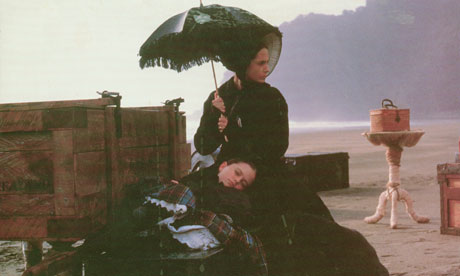
Ada’s father sells her into marriage to a New Zealand frontiersman named Alisdair (Sam Neill), a man who Ada has never even met.   When Ada and Flora first arrive in New Zealand, they are dropped off on the beach and forced to wait a night until Alsdair can meet them.  In the film’s most hauntingly beautiful scenes, Ada plays her piano on that beach while Ada dances in the surf.  It’s during those scenes that The Piano reveals three of its greatest strengths: the lush cinematography of Stuart Dryburgh, the haunting score composed from Michael Nyman, and the fact that Hunter and Paquin are totally believable as mother and daughter.  Not only is it easy to imagine Paquin growing up to look like Holly Hunter, but the two actresses even manage to perfectly imitate each other’s gestures and facial expressions.  Most of the reviews that I’ve read of  The Piano tend to emphasize the film’s focus on the conflict between the sensual and repressed but to me, the film works just as well as an exploration of the strong bonds that naturally exist between mothers and daughters.  I’m not ashamed to admit that when I look at the picture above, I reminded of how, when I was Flora’s age, I also used to hide behind my mom whenever I saw anyone that I didn’t know coming our way.

When Alisdair does finally show up to take them to their new home, he proves to be a rather cold and distant figure.  It would have been very easy for the film to portray Alisdair as being a completely heartless villain but, as played by Sam Neill, Alisdair is potrtayed as being less a traditional villain and more as just being a painfully unimaginative man who is incapable of understanding why Ada’s piano is so important to her.  To Ada, the piano and its music equals the life and freedom that she’s not allowed to experience.  To Alisdair, the piano is simply a bulky object that will not fit into his small house.  Over Ada’s objections (luckily, Flora is on hand to translate her sign language), Alisdair first leaves the piano on the beach and then agrees to sell it to Baines (Harvey Keitel), another white settler who — unlike Alisdair — is comfortable with the natives and their customs.

Baines, however, allows Ada to come over to his hut and play the piano.  He offers to give the piano back to her — key by key — if she agrees to continue to come to his hut and play while he watches and “pleasures” himself.  Reluctantly, Ada agrees but soon, she and Baines are falling in love.

Needless to say, when Alisdair finds out what has been going on at Baines’s hut, he is not happy.  As he largely considers to be his property, bought and paid for, he also feels that he has the right to decide whether or not she’s capable of playing her piano…

The Piano: Holly Hunter and Anna Paquin

The Piano is a simply an amazing and visually sensual film that is blessed with excellent lead performances from Hunter, Keitel, Neill, and Paquin.  As directed by Jane Campion, The Piano plays out as both a delirious homage to gothic romanticism and a feminist parable about the way that even women who aren’t mute are still punished for expressing their honest desires.

And, of course, there’s that amazing score:

6 Late Reviews: Atlas Shrugged: Part II, Project X, This Means War, A Thousand Words, Trouble With The Curve, The Vow


2012 is quickly drawing to an end and seriously, where has the time gone?  I’m seriously running behind in reviewing all of the films that I’ve seen in 2012 so, in the interest of getting caught up, here are six quick (and late) reviews of some of the film that I saw earlier this year.

(Fortunately, seeing as how we live in a world of Netflix, DVD, Blu-ray, and On Demand service, it’s never too late to review any film.)

1) Atlas Shrugged: Part II (dir by John Putch)

Picking up where the first Atlas Shrugged ended, Atlas Shrugged: Part II continues to tell the story of how America was ruined by elitist do-gooders and how the smartest people in the world responded by uttering the phrase, “Who Is John Galt?” and then vanishing.

There’s a lot of bad stuff that I could say about Atlas, Shrugged Part II.  I could point out how close to nothing actually happens in the film.  I understand that this is the second part of a proposed film trilogy but, seriously, that’s all that Atlas Shrugged Part II has in common with The Two Towers.  With the exception of the great Patrick Fabian (who has a lot of fun playing a weasel), the cast isn’t memorable and the film is full of slow spots.

Part II was made by a different director and with a far more professional cast than Part I but that proves to be a mistake.  Part of the odd charm of Atlas Shrugged, Part I was that it was such a low-budget, pulpy affair.  Atlas Shrugged, Part II is a lot more slick and, as a result, it feels a lot less sincere.

That said, I couldn’t help but enjoy Atlas Shrugged, Part II because, much like For Greater Glory, the film flew so completely in the face of conventional cinematic political statements.  Atlas Shrugged Part II might not be a great (or even a good) film but it annoyed all of the professional film critics and it’s always amusing to watch the same critical establishment that embraced Avatar whine about how any other film is too heavy-handed.

Am I, therefore, recommending Atlas Shrugged, Part II?  Not really.  I tend to learn towards the Libertarian point of view when it comes to politics and even I found the film to be tedious.  That said, if you ever really want to annoy your wannabe hipster friend (the same one who leaves a hundred comments a day over at the A.V. Club), Atlas Shrugged, Part II might make the perfect holiday present.

2) Project X (dir by Nima Nourizadeh)

In California, two loathsome high school students — Costa (Oliver Cooper) and J.B.(Johnathan Daniel Brown) — throw a birthday party for their friend Thomas (Thomas Mann).  Thomas is a stereotypical nice guy but he’s also friends with Costa and J.B. and that makes him loathsome by association.  The party quickly gets out of control and eventually, houses are destroyed and a SWAT team is called in to restore order.

Oh!  And the entire film is presented as being a bunch of “found footage.”  What that means is that we have to sit through all the usual stuff of people acting awkward in an attempt to convince us that we’re not watching a movie, despite the fact that we clearly are.

Project X fails on so many levels that it’s hard to even know where to begin.

It’s impossible to sympathize with the film’s three main characters and let’s just say that Oliver Cooper is no Jonah Hill.

There’s no real build-up to the party getting out of control and hence, most of the film’s comedy falls flat.  This is the type of film where a midget happens to show up at the party just so he can then be tossed into an oven.  Uwe Boll would probably call that genius but, for the rest of us, it just feels like desperation on the part of the filmgoers.  (You can just here them going, “Midgets are always funny!”)

Finally, worst of all, Project X is the latest film to use the whole found footage gimmick as a way to try to explain away the fact that it’s just not a very good movie.  Seriously, mediocre filmmakers of America — it’s time to move on to a new gimmick!

3) This Means War (dir. by McG)

Two CIA Agents (Chris Pine and Tom Hardy) set aside their friendship and go to war when they realize that they’re both attempting to win the heart of the same woman (played by Reese Witherspoon).   Fortunately for them, they’ve both managed to fall in love with the one woman in the world too stupid to realize that there’s anything strange going on.  Chelsea Handler is also in this film.  She plays Witherspoon’s best friend and delivers all of her lines in this kind of depressed monotone that seems to suggest that she’d rather be co-starring with Whitney Cummings.  Eventually, a lot of things explode and well, anyway … bleh.

Seriously, This Means War has absolutely no right to be as boring as it is.  Outside of this film, Chris Pine and Tom Hardy are both hot, Reese Witherspoon is likable, and even Chelsea Handler still makes me laugh on occasion.  And yet, when all four of these people are put together in the same film, the end result is a mess that just gets more and more annoying with each passing second.

Most of the blame has to be put on the director.  McG never finds a consistent tone for his film and never seems to be sure whether he’s parodying or celebrating the conventions of both action films and romantic comedies.

Myself, I just find it funny that people actually address him as “McG.”

4) A Thousand Words (dir by Brian Robbins)

Jack (Eddie Murphy) is a literary agent who talks too much.  So, one night, a tree with a thousand leaves magically appears in his back yard.  Every time that Jack says a word, a leaf falls off of the tree.  Luckily, Jack happens to know a new age guru (Cliff Curtis) who explains that once every leaf has fallen, Jack will die.  As a result, the formerly glib Jack learns the importance of saying just the right thing and he becomes a better husband, father, and son as a result.

A Thousand Words is just as bad as the above plot synopsis suggests and that’s all that really needs to be said about it.  Wasting a thousand words talking about A Thousand Words would be a mistake indeed.

5)  Trouble With The Curve (dir by Robert Lorenz)

Widower Gus (Clint Eastwood) is an aging baseball scout who is slowly losing his eyesight.  Mickey (Amy Adams) is Gus’s daughter, a driven lawyer who has a strained relationship with her father.

And together … they solve crimes!

No, not really.  Instead, Gus is given one last assignment and Mickey, who is both concerned for her father’s well-being and wants to try to repair their fractured relationship, accompanies him.  At first, Gus doesn’t want Mickey around but she eventually proves her worth to him and gets to flirt with a young scout played by Justin Timberlake as well.  So, it’s a win-win.

 I don’t know much about baseball (beyond the fact that my sister Erin yells at the TV a lot whenever the Rangers are playing) but Trouble With The Curve is such a predictable movie that you really don’t have to know much about the game to be able to follow the plot.  That said, Trouble With The Curve might be predictable but it’s also a genuinely sweet and likable film.  Timberlake and Adams make for a really cute couple and it’s always fun to watch Eastwood growl at a world that never fails to disappoint him.

6) The Vow (dir by Michael Sucsy)

Paige (Rachel McAdams) and her husband Leo (Channing Tatum) are in a horrific car accident.  Paige is sent flying through the windshield and when she recovers consciousness, she no longer remembers being married or anything else about her life after she first met Leo.  While Leo attempts to get Paige to fall in love with him for a second time, Paige’s parents (Sam Neill and Jessica Lange) attempt to convince her to divorce him and return to her previous life as a pampered law student with a rich fiancée (played by Scott Speedman).

The Vow is a lot like Trouble With The Curve in that it’s totally predictable but, at the same time, it’s so sweet and likable that anyone who complains about the film being too predictable probably doesn’t have a heart.  Rachel McAdams and Channing Tatum have a lot of chemistry and anyone who complains that this film is too much like a Lifetime movie has obviously never experienced a really great Lifetime movie.

Quick Review: In the Mouth of Madness (dir. by John Carpenter, 1995)


In the Mouth of Madness is one of those films that in essence seems like a good idea, but later becomes strange and unwieldily to the point that you have to ask yourself “What am I watching, and why did I do so?”

Jumping right of of Memoirs of an Invisible Man, In the Mouth of Madness reunites Sam Neill (Jurassic Park) with Carpenter. Neill plays John Trent, an Insurance Investigator whose latest case deals with a horror writer named Sutter Cane (Jurgen Prochnow). Cane’s novels have the strange ability to affect anyone who reads them. After Cane’s own agent/publicist falls his influence and is abruptly killed, Trent is sent to find Cane (who is missing) and help bring back his latest story , “In the Mouth of Madness” to the agency. When he sets off on his mission, he slowly finds his sense of reality unraveling.

If Neill’s character is the Scully, Julie Carmen (Fright Night Part II) plays the Mulder in this equation. Sent along with Trent, her character witnesses more of the horror than he does. She’s the audience witness for a while and proves Trent wrong when he’s ready to disbelieve what’s occurring. She good here, but her reactions, mixed with Trent’s had me slapping my forehead. I’ll get to that in a moment.

I’m told that the film is something of a homage to H.P. Lovecraft’s stories. While I’ve never read Lovecraft, I’m somewhat familiar with the Cthulhu myths and there does seem to be some tentacled beasts near the last third of the film.  Overall, some of those references escape me. The movie’s fun in a Donnie Darko mind bending way and it’s that strangeness that actually helps the film a little.

I hate the fact that Sam Neill’s character simply  won’t accept that what’s happening is real. I’m not a big fan of stuffing square pegs into round holes. If it doesn’t fit – you’re being told “This is how it goes”, and you’re seeing that’s how it’s happening – then why in the world are you still holding on to the same train of thought that isn’t working / fitting the situation? I found that extremely annoying. It’s almost the opposite of Slither, where it didn’t take long for the characters to recognize that:

1.) People were becoming zombies.

-And-

2.) It just wasn’t normal for the situation. Accept and adjust. Cover your mouth.

Overall, it was okay, but it really needed something. I’m just not sure what.

Horror Review: In the Mouth of Madness (dir. by John Carpenter)


“There are things in this world that go beyond human understanding.”

John Carpenter’s reputation as one of the great American horror directors rests on his ability to merge the cinematic with the philosophical—to craft films that stay frightening not because of what they show, but because of what they suggest. Yet by the early 1990s, Carpenter’s once unshakable relationship with audiences had weakened. His influence remained undeniable, but several of his later films seemed to miss the spark that defined HalloweenThe Fog, or The Thing. Then arrived In the Mouth of Madness (1995), a work that signaled a late creative resurgence. It paid intelligent homage to two pillars of horror literature—Stephen King and H. P. Lovecraft—while offering a disturbing reflection on authorship, sanity, and the power of belief. The film reasserted Carpenter’s command not only over frightening imagery but also over the psychological territory that underpins enduring horror.

At a narrative level, In the Mouth of Madness follows John Trent (Sam Neill), an insurance investigator known for exposing fraud and deception. His skepticism becomes both his strength and undoing. Trent is hired by publishing executive Jackson Harglow (played by the legendary Charlton Heston) to locate Sutter Cane, a best-selling horror novelist whose disappearance threatens both the company’s finances and the stability of Cane’s obsessed fanbase. Every sign points to something far stranger than a publicity stunt. Cane’s readers are exhibiting troubling behavior, as though the author’s new book has triggered more than just entertainment—it has become contagion.

Carpenter crafts Trent’s descent into uncertainty with meticulous pacing. At first, Neill’s character regards the assignment as routine, dismissing the hysteria surrounding Cane’s novels as marketing excess. But when his investigation hints that the locations and events in Cane’s fiction may correspond to real places and real disturbances, the film begins to twist the rational into the uncanny. The story’s sense of unreality builds with deliberate restraint—incidents grow progressively stranger, but never so overt that Trent can confidently identify what’s madness and what’s truth. Carpenter thrives on this ambiguity, pulling both protagonist and viewer into an atmosphere where logic erodes and fiction itself seems to rewrite reality.

Accompanying Trent on his search is Linda Styles (Julie Carmen), the publisher’s editor assigned to ensure the investigation runs smoothly. While her performance has sometimes been considered subdued, Styles functions as the audience’s second perspective: observant, mildly skeptical, and gradually aware that the world around her no longer behaves according to its former rules. Carpenter positions her as a necessary counterpoint to Trent’s brittle rationalism, highlighting the conflict between recognizing patterns and succumbing to fear. As they move closer to locating Cane, their surroundings take on the familiar haunted quality of an archetypal New England town—Hobb’s End—built from the shared DNA of King’s Castle Rock and Lovecraft’s Arkham. The town becomes more than setting; it is a physical embodiment of literary influence and psychological instability.

The choice of Sam Neill proves essential to the film’s success. His trademark combination of intelligence and emotional vulnerability allows Trent’s transformation from calculating skeptic to disoriented seeker to feel natural rather than theatrical. Few actors could portray a man so evidently rational who nonetheless finds himself seduced by forces his disciplined mind cannot resist. Neill’s body language carries much of the horror; his expressions shift between dry disbelief and quiet terror, suggesting that intellect offers no protection once perception itself begins to betray you. Carpenter exploits this performance with close framing and asymmetric compositions, visually trapping Trent in spaces that subtly curve or distort. The director’s technical command ensures that even ordinary scenes seem charged with quiet wrongness.

While In the Mouth of Madness never references the mythos of Lovecraft by name, its influence saturates the film. Lovecraft’s hallmark—cosmic indifference—exists here not through tentacled gods but through the crumbling borders between fiction and the human mind. The suggestion is that the very act of creating and consuming stories might awaken something ancient and uncontrollable. When Trent confronts the nature of Cane’s work, Carpenter’s direction avoids overstatement. Instead of grand confrontations, he conveys horror through disorientation—the feeling that language, images, and even memory are slipping toward incoherence. Reality itself becomes a character, unstable and untrustworthy.

Jürgen Prochnow’s portrayal of Sutter Cane adds another layer of unease. His calm, confident manner diverges from standard portrayals of deranged genius. Prochnow makes Cane unnerving precisely because he appears so certain of his vision. The author views himself not as a mere storyteller but as a conduit, claiming that what he writes merely reveals a preexisting truth. Through him, Carpenter explores a potent question that haunts all creators: does imagination serve human purpose, or is it an independent force that uses human minds as tools? Cane’s conviction blurs that line, turning the creative process into possession. To audiences familiar with the concept of “mad artists” in literature, his belief offers both fascination and dread.

Carpenter imbues this theme with visual invention. The cinematography and set design combine the mundane with the surreal—painted walls pulse, corridors bend, horizons vanish. Rather than relying on excessive gore or digital spectacle, the director emphasizes textures and shadows, creating optical unease rather than overt shock. The town of Hobb’s End seems perpetually detached from time, its streets looping back on themselves. By employing low, creeping camera movements and deliberate color desaturation, Carpenter evokes a dreamscape decaying from within. The film’s sound design—especially Carpenter’s own pulsating score, co-composed with Jim Lang—heightens that tension with rhythmic basslines reminiscent of a heartbeat slowing to a stop. Every technical choice reinforces the narrative’s central sensation: uncertainty.

Michael De Luca’s screenplay deserves particular credit for its clever structure. The film is framed as a story told from inside an asylum, immediately hinting that the perspective may be unreliable. This framing allows Carpenter to shift between psychological thriller and cosmic horror without losing cohesion. As viewers, we are made complicit in Trent’s investigation but warned not to trust his perceptions. The resulting experience is disorienting yet coherent—a cinematic maze where each turn feels inevitable once taken. The writing never lingers long on exposition, instead suggesting connections through implication and repetition. In this way, De Luca’s script succeeds in translating Lovecraftian dread into visual terms: a fear of knowledge itself.

Very few directors have managed this particular tone as successfully. Lovecraft’s fiction often resists cinematic adaptation precisely because its greatest horror lies in what cannot be shown. In the Mouth of Madness solves this problem by making the act of storytelling itself the subject of terror. By focusing on an author whose imagination reshapes reality, Carpenter transforms literary horror into filmic language. In doing so, he edges close to achieving what decades of other attempts had failed to capture—a true Lovecraftian mood rendered on screen, grounded not in spectacle but in existential dislocation.

Despite its craftsmanship and intelligence, In the Mouth of Madness struggled at the box office upon release. Its ambiguity, self-reflexivity, and intellectual leanings proved challenging for mid-1990s audiences who expected more conventional scares. Yet over time, the film’s reputation has flourished. Today, it is often regarded as the concluding entry in Carpenter’s loosely connected “Apocalypse Trilogy,” following The Thing (1982) and Prince of Darkness (1987). All three films share a fascination with humanity confronting forces it cannot comprehend—scientific, metaphysical, or divine. In each, Carpenter presents apocalypse not as fiery destruction but as revelation: the moment when human understanding collapses under greater cosmic truth. That philosophical core links these works across more than a decade of filmmaking.

Revisiting In the Mouth of Madness now, one is struck by how prophetic it feels. Its concerns about cultural contagion and media-induced madness anticipate contemporary conversations surrounding viral misinformation, fandom extremism, and the blurring between online identity and reality. The “disease” in the film—ideas that rewrite perception—mirrors our present anxiety about the stories and images that shape collective belief. Carpenter’s horror, always grounded in social awareness, here expands into a warning about a world unable to distinguish narrative invention from lived experience.

Even limited in budget, Carpenter demonstrates confident control of visual tone and rhythm. His filmmaking reminds viewers that suggestion often unsettles more deeply than spectacle. Rather than overwhelming audiences with jump scares, he leads them through gradual disintegration, where each logical step seems to justify the next until coherence itself fractures. The film invites reflection rather than relief, leaving viewers haunted by the possibility that the boundaries between art and life are far thinner than comfort allows.

While Carpenter would go on to direct more films after 1995, In the Mouth of Madness stands as one of his last profoundly accomplished achievements. It encapsulates the elements that made his earlier works enduring: tight pacing, minimalist storytelling, and ideas that resonate beneath genre tropes. The film’s legacy continues among filmmakers who explore metafictional or cosmic horror, from Guillermo del Toro’s long-sought adaptation of At the Mountains of Madness (a feat that may never come to fruition outside of concept art and videos) to the psychological labyrinths of contemporary horror auteurs. Though Carpenter’s film never directly adapts Lovecraft, it succeeds where many literal adaptations fail—by preserving the essence of incomprehensible terror rather than translating it into spectacle.

Ultimately, In the Mouth of Madness remains a rare horror film that asks not just what we fear, but why we need fear in the first place. Its central notion—that imagination itself can undo reality—strikes at the heart of storytelling. Carpenter’s mastery lies in letting that idea linger long after the credits roll. What begins as an investigation grows into a philosophical nightmare, compelling viewers to question how much of their world is built from collective belief. In that sense, the film transcends its genre to become one of Carpenter’s most unsettling reflections on human perception. Decades later, its message still resonates: the stories we consume may shape us more profoundly than we realize.