96 years ago today, Marlon Brando was born in Omaha, Nebraska.
Unfortunately, Brando is one of those actors who, later in his life, became better known for his eccentricities than for his performances. Though Brando never stopped being a good actor, it’s undeniable that some of his later performances reveal an actor who often did seem to be a bit bored with the films that he was making. It’s sad to think that there’s people out there who might only know Brando because they stumbled across The Island of Dr. Moreau on Starz at like 3 in the morning.
Regardless of the reputation that he developed in his later years, Marlon Brando was one of the best actors of all time. His early performances are still exciting to watch and, even when his work was becoming progressively more eccentric in the 70s and 80s, he still continued to give performances that could grab your attention and leave you surprised by their power.
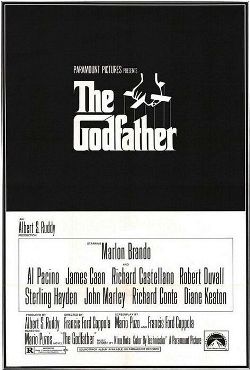
Of course, my favorite Brando film remains The Godfather so it only makes sense to share a scene from that film on Brando’s birthday. In this beautifully acted scene, Tom Hagen (Robert Duvall) informs Don Vito (Brando) that Sonny has been killed. Of course, first, Tom has to have a drink. This scene might not be as iconic as some of the other scenes in The Godfather but it’s wonderfully performed by both actors and it reminds us that The Godfather is powerful not because it’s a crime film but because it’s a film about family.
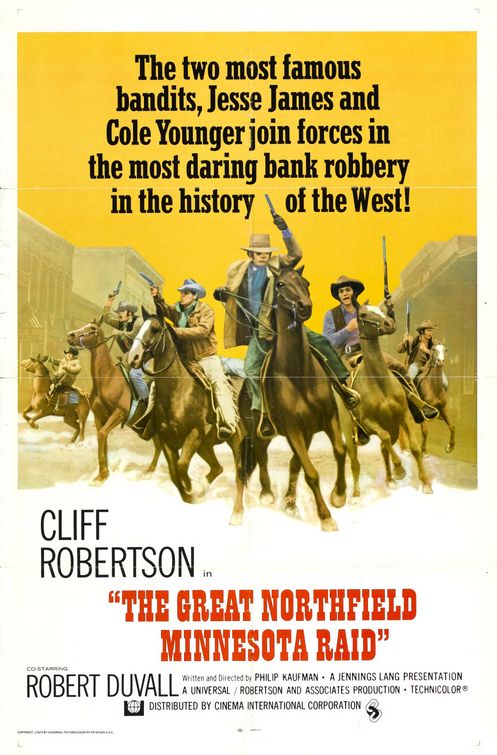
Despite having received pardons from the Missouri legislature in recognition of their military service to the Confederacy, Jesse James (Robert Duvall) and Cole Younger (Cliff Robertson) simply cannot stop robbing banks. The James-Younger Gang has set their sights on the bank in Northfield, Minnesota, which is said to be the biggest bank west of the Mississippi. Cole arrives in Northfield before the rest of the gang and scouts the location. What he discovers is that most of the town’s citizens aren’t putting their money in the bank because they all assume that it will eventually be robbed. With Jesse determined to pull off the crime of the century, Cole and Jesse have to figure out not only how to escape after the robbery but also how to get the people to deposit their money in the bank’s vault in the first place.
Philip Kaufman is a director who made a career out of reinterpreting history (his best known film is The Right Stuff) and, when it was first released in 1972, The Great Northfield Minnesota Raid was a revisionist western that mixed moments of comedy with moments of brutal violence. Today, of course, presenting Jesse James and Cole Younger as being ruthless outlaws is no longer that daring of a narrative choice. In The Great Northfield Minnesota Raid, Robert Duvall plays Jesse as being the western equivalent of a corrupt businessman, sending others to do his dirty work and not accepting any of the consequences for his own bad decisions. Robertson plays Cole as being more a free spirit, an outlaw who is determined to enjoy himself. Both of them give interesting performances but they also seem to be too contemporary for the characters that they’re playing.
Like most revisionist westerns of the early 70s, the film is full of hints that the old west and the time of the outlaws is coming to an end. There’s a steam engine sitting outside of the bank and Kaufman spends almost as much time focusing on people reacting to that as he does on the planning and execution of the robbery. When the robbery does finally occur, it’s not an easy robbery like you might find a 1940s western. Instead, it’s a violent comedy of errors that leaves much of the film’s characters dead or wounded in the streets of Northfield. The contrast between the quirky comedy of the first part of the film and the violence of the robbery is occasionally interesting but it often feels forced. Sometimes, Kaufman seems like he’s trying too hard to be Sam Peckinpah. In the end, Kaufman often doesn’t seem to be sure what he’s trying to say with this film. He seems to be suggesting that Jesse and Cole are soon to be relics of a bygone era but why then cast Duvall and Robertson in the roles and have them play the roles like two mid-level hoodlums in 20th Century New York?
It’s an interesting but muddled film that never quite works. For the definitive film about the James/Younger Gang, check out Walter Hill’s The Long Riders.
In his memoir, Room to Dream, Lynch wrote that he was sent the film’s script while he was looking for a project to serve as his follow-up to The Elephant Man. Lynch wrote that he liked the script, which was written by Horton Foote (who had previously won an Oscar for adapted To Kill A Mockingbird), but that Lynch also felt that it just wasn’t the right project for him at the time. Tender Mercies was eventually directed by Bruce Beresford and Lynch mentioned that he felt that Beresford did a “brilliant” job.
After I posted the article, it occurred to me that Tender Mercies is not a film that’s as well-known as it deserves to be. It received five Oscar nominations, including one for Best Picture. Robert Duvall won his first (and, to date, only) Oscar for playing the lead role. It’s an acclaimed film but it also plays it in a rather low-key style, particularly when compared to some of the other films that were released in the early 80s. (1983 may have been the year of Tender Mercies but it was also the year of Scarface, Flashdance, Return of the Jedi, and Risky Business.) As such, it’s a film that’s been a bit overshadowed over the years.
Tender Mercies takes place in rural Texas. Mac Sledge (Robert Duvall) is a former country-western star whose career has collapsed due to his alcoholism and his own self-destructive behavior. One morning, a hungover Mac wakes up in a roadside motel. Not having any money on him, Mac asks the motel’s owner — Rosa Lee (Tess Harper), who lost her husband in Vietnam — if he can work at the motel in return for a room. Rosa Lee agrees, on the condition that Mac not drink while he’s working.
As the days pass, Mac and Rosa Lee grow closer and Mac becomes a surrogate father to Rosa Lee’s young son, Sonny (Allan Hubbard). Eventually, Mac and Rosa Lee marry and Mac becomes an accepted member of the community. However, Mac remains troubled. His ex-wife, Dixie (Betty Buckley), has built a career on singing the songs that he wrote for her but she refuses to consider anything new that he’s written. His teenage daughter (Ellen Barkin) stops by the motel and announces that she’s running away to get married. There’s tragedy but there’s also hope and forgiveness.
Tender Mercies is a simple but affecting film about a good man who is struggling to deal with the fact that he was once a very bad man. What makes Tender Mercies interesting is what doesn’t happen. The first time I saw it, I spent the entire movie expecting Mac to fall off the wagon and break everyone’s heart. Instead, Mac manages to keep his promise to his new family but what he discovers is that being sober doesn’t automatically exempt one from pain or guilt. He still has to deal with sadness and disappointment but now, he has to do it without using alcohol as a crutch. Instead of getting his strength from booze, he now gets it from love.
It’s a wonderfully sweet movie, featuring naturalistic performances from Harper, Hubbard, and especially Robert Duvall. It seem appropriate that, after making his film debut as Boo Radley in a film written by Horton Foote, Duvall would win his first Oscar for another film written by Foote. Duvall plays Mac as a plain-spoken and weary soul who is still just enough of a romantic to find some sort of redemption in the world. It’s a great performance and it’s a good film and I’d suggest checking it out if you ever need a good cry.
Widows is one of those films that I’ve been looking forward to seeing since I first read about it. Based on a BBC miniseries and featuring an amazingly talented cast, Widows is also director Steve McQueen’s first film since the Oscar-winning 12 Years A Slave.
The film deals with four women whose husbands are all killed during a failed heist. The widows, under the leadership of Viola Davis, join together to pull off the heist themselves. That may not sound like a typical Oscar movie but Widows has got tremendous buzz. Plus, you’ve got a cast that’s full of past Oscar nominees and winners (Viola Davis, Robert Duvall, Daniel Kaluuya, Jacki Weaver, Liam Neeson) and actors who seem to be destined to be nominated some day (Colin Farrell, Michelle Rodriguez, Andre Holland, Carrie Coon, Garrett Dillahunt). All in all, there’s a lot of reasons to get excited for this one!
The 1981 film True Confessions tells many different stories.
It’s a story about Los Angeles. It’s not necessarily a story about Los Angeles as it exists. Instead, it’s a story about Los Angeles as we always imagine it. It’s the late 40s and, having vanquished the Nazis in Europe, men are returning to California and looking for a new life. Meanwhile, aspiring starlets from across the country flood into Hollywood, looking for stardom. It’s a city where glitz and ruin exist right next to each other. It’s the mean streets that were made famous by Raymond Chandler and, decades later, James Ellroy.
It’s a murder mystery, one that is based on one of the most notorious unsolved homicides of all time. The bisected body of woman named Lois Fazenda has been found in a vacant lot. When the newspapers discover that Lois was both a prostitute and a Catholic, she becomes known as “the Virgin Tramp.” One need not have an encyclopedic knowledge of unsolved crimes to recognize that Lois Fazneda is meant to be a stand-in for Elizabeth Short, the tragic and infamous Black Dahlia.
It’s a story about corruption. Crooked cops. Rich perverts. Greedy politicians. Sinful clergy. They’re all present and accounted for in True Confessions. As quickly becomes apparent, Los Angeles is a city where you can do anything as long as you have the money to pay the right people off.
And finally, it’s a film about two brothers. Tom and Des Spellacy grew up in a strong Irish Catholic family but, as they got older, their lives went in different directions. Tom (Robert Duvall) became a detective, the type who is willing to cut corners but who, in the end, takes his job seriously. Des (Robert De Niro) entered the priesthood and is now a monsignor in the Los Angeles diocese. Des is ambitious and he has a powerful mentor, Cardinal Danaher (Cyril Cusack).
Though Tom and Des have gone their separate ways, they are still linked by Jack Amsterdam (Charles During). To the public, Jack is a wealthy and respected businessman. However, Tom and Des both know the truth. When Tom first joined the department, he worked as a bagman for Jack and he knows that Jack made most of his money through a prostitution ring. Des know that Jack donates to the Church as way to cover up his own corruption but Des looks the other way. The Cardinal, after all, wants Jack’s money.
When Tom starts to investigate Lois’s death, it doesn’t take him long to figure out that Jack is probably the one responsible. Meanwhile, Jack and his lawyer (Ed Flanders) start to pressure Des to convince his brother to let the case go. Finding justice for Lois Fazneda could mean the end of both Tom and Des’s career.
Based on a novel by John Gregory Dunne, which was adapted into a screenplay by Dunne and Joan Didion, True Confessions is an imperfect but intriguing film. This is one of Robert Duvall’s best performances and he brings a manic edge to the role that keeps the audience off-balance. In the role of Jack Amsterdam, Charles Durning is the epitome of casual corruption and Burgess Meredith does a good job as an aging priest. On the other hand, Robert De Niro seems strangely uncomfortable in the role of Des and you never quite believe that he and Duvall are actually brothers. Director Ulu Grosbard does a good job of creating a proper noir atmosphere but, at the same time, he denies the audience the dramatic climax to which the film appears to be building up to.
That said, for whatever flaws True Confessions may have, it’s an always watchable and thought-provoking film.
Right now, when it comes to predicting the Oscars, there are two big questions to consider.
First off, will Burden ever find a distributor? From the reviews in Sundance, it sounds like the type of film that could be embraced by the Academy but, if it can’t get in theaters, it’s not going to get any nominations.
Secondly, will Martin Scorsese’s The Irishman came out in 2019 or 2018? Right now, Netflix says that The Irishman will be released in 2019 but we all remember what happened with The Wolf of Wall Street.
As of now, I’m going to choose to believe that Burden will get a 2018 release date and that The Irishman will come out in 2019.
I’m also going to chose to believe that Black Panther will be the first “comic book” movie to be nominated for best picture.
Also be sure to check out my predictions for January and February!
— Loren Hardeman Sr. (Sir Laurence Olivier) in The Betsy (1978)
Here’s a little thought experiment:
Imagine if The Godfather had starred Laurence Olivier and Tommy Lee Jones.
That may sound strange but it actually could have happened. When Francis Ford Coppola first started his search for the perfect actor to play Don Vito Corleone, he announced that he could only imagine two actors pulling off the role. One was Marlon Brando and the other was Laurence Olivier.
As for Tommy Lee Jones, he was among the many actors who auditioned for the role of Michael Corleone. At the time, Jones was 26 years old and had only recently made his film debut in Love Story. As odd as it may be to imagine the quintessentially Texan Tommy Lee Jones in the role, Coppola always said that he was looking for a brooder as Michael and that’s definitely a good description of Jones.
Of course, as we all know, neither Olivier nor Jones were ever cast in The Godfather. Marlon Brando played Don Vito and Al Pacino was cast as Michael. However, a few years later, Olivier and Jones would co-star in another family saga that combined history, organized crime, and melodrama. That film was 1978’s The Betsy and, interestingly enough, it even co-starred an actor who actually did appear in The Godfather, Robert Duvall.
Of course, now would probably be a good time to point out that The Godfather is perhaps the greatest American film of all time. And The Betsy … well, The Betsy most definitely is not.
The film’s German poster even gives off a Godfather vibe
Based on a novel by Harold Robbins, The Betsy exposes the secrets of Detroit. Decades ago, Loren Hardeman founded Hardeman Motors and started to build his considerable fortune. Sure, Loren had to break a few rules. He cut corners. He acted unethically. He had an affair with his daughter-in-law and then drove his gay son to suicide. Loren never said that he was perfect. Now in his 80s, Loren has a vision of the future and that vision is a new car. This car will be called the Betsy (named after his great-granddaughter) and it will be the most fuel-efficient car ever made.
Since the film appropriates the flashback structure used in The Godfather Part II, we get to see Loren Hardeman as both an elderly man and a middle-aged titan of industry. Elderly Loren is played by Laurence Olivier. Elderly Loren spends most of the film in a wheelchair and he speaks with a bizarre accent, one that I think was meant to be Southern despite the fact that the film takes place in Michigan. Elderly Loren gets really excited about building his new car and, at one point, shouts out “Wheeeeeee!”
Middle-aged Loren is played by … Laurence Olivier! That’s right. Olivier, who was 71 years old at the time, also plays Loren as a younger man. This means that Olivier wears a hairpiece and so much makeup that he looks a bit like a wax figure come to life. Strangely, Middle-aged Loren doesn’t have a strange accent and never says “wheeeee.”
To build his car, Loren recruits race car driver Angelo Perino (Tommy Lee Jones). Angelo’s father was an old friend of Loren’s. When Angelo agrees, he discovers that the Hardeman family is full of drama and secrets. Not only is great-granddaughter Betsy (Kathleen Beller) in love with him but so is Lady Bobby Ayers (Lesley-Anne Down), who is the mistress of Loren’s grandson, Loren the 3rd (Robert Duvall).
Because he blames his grandfather for the death of his father, Loren the 3rd has no intention of building Loren the 1st’s car. Loren the 3rd wants to continue to make cars that pollute the environment. “Over my dead boy!” Loren the 1st replies. “As you wish, grandfather,” Loren the 3rd replies with a smile.
But we’re not done yet! I haven’t even talked about the Mafia and the union organizers and the automotive journalist who ends up getting murdered. From the minute the movie starts, it’s nonstop drama. That said, most of the drama is so overdone that it’s actually more humorous than anything else. As soon as Laurence Olivier shouts out, “Wheeeee!,” The Betsy falls into the trap of self-parody and it never quite escapes. There’s a lot going on in the movie and one could imagine a more imaginative director turning the trashy script into a critique of capitalism and technology. However, Daniel Petrie directs in a style that basically seems to be saying, “Let’s just get this over with.”
The cast is full of interesting people, all of whom are let down by a superficial script. Nothing brings out the eccentricity in talented performers quicker than a line of shallow dialogue. Jane Alexander, who plays Duvall’s wife, delivers all of her lines in an arch, upper class accent. Edward Herrmann, playing a lawyer, smirks every time the camera is pointed at him. Katharine Ross, as Olivier’s mistress and Duvall’s mother, stares at Olivier like she’s trying to make his head explode. Tommy Lee Jones is even more laconic than usual while Duvall always seems to be struggling not to start laughing.
And then there’s Olivier. For better or worse, Olivier is the most entertaining thing about The Betsy. He doesn’t give a good performance but he does give a memorably weird one. Everything, from the incomprehensible accent to a few scenes where he literally seems to bounce up and down, suggests a great actor who is desperately trying to bring a spark of life to an otherwise doomed project. It’s a performance so strange that it simply has to be seen to be believed.
Tomorrow, we take a look at another melodrama featuring Robert Duvall, True Confessions!
Could Black Panther be the first comic book movie to receive an Oscar nomination?
Last year, around this time, we were asking the exact same question about Logan. Logan didn’t pick up a Best Picture nomination but it was nominated for Best Adapted Screenplay, which would seem to suggest that the Academy is slowly coming around to accepting that so-called “Super Hero Films” can also be legitimate Oscar contenders.
As for Black Panther, it is currently the most critically acclaimed and financially successful film of 2018. For those who say that there’s no way the Academy will ever nominate a comic book film for best picture, it should be remembered that there was a time when people said that Academy would never nominate a horror comedy for Best Picture. Much like Get Out, Black Panther could prove the naysayers wrong.
Anyway, here are my Oscar predictions for February. As always, it ‘s really way too early to be making these predictions. Usually, Sundance provides at least a little bit of a guide but this year, Sundance was pretty low-key. The most obvious Sundance Oscar contender — Burden — doesn’t even have a release date yet.
Also, the uncertain status of The Weinstein Company has thrown a lot of films into limbo. Some of the unreleased TWC films might find homes with other studios. Others will probably be left in limbo. Then again, even if those films do get a release, I doubt the Academy is going to nominate any films stained with the noxious fingerprints of the Weinsteins.
Even more than usual, the guesses below are random. At this time next year, we’ll probably look at this list and laugh. Some of you might laugh today.
Well, it depends on how you look at it. You can predict the Oscars at any time during the year. However, predicting them correctly is next to impossible before October. That said, I’m going to give it a shot!
Now, to be clear, this is not an attempt to predict who and what will be nominated later this month. Instead, these are my predictions for what will be nominated next year at this time! I’ll be updating my predictions every month of this year.
So, with all that in mind, here are my way too early predictions for what will be nominated in January of 2019! As of right now, these predictions are a collection of instinct and random guesses. For all we know, some of these films might not even get released in 2018. In all probability, we’ll look back at this list in December and laugh.
Best Picture
Chappaquiddick
First Man
Lizzie
Mary Queen of Scots
The Miseducation of Cameron Post
Mortal Engines
A Star is Born
Widows
Wildfire
The Women of Marwen
Best Director
Desiree Akhavon for The Miseducation of Cameron Post
Damien Chazelle for First Man
Paul Dano for Wildfire
Steve McQueen for Widows
Robert Zemeckis for The Women of Marwen
Best Actor
Steve Carell in The Women of Marwen
Jason Clarke in Chappaquiddick
Ryan Gosling in First Man
Jake Gyllenhaal in Wildfire
Joaquin Phoenx in Don’t Worry, He Won’t Get Far On Foot
Best Actress
Viola Davis in Widows
Chloe Grace Moretz in The Miseducation of Cameron Post
Los Angeles in the 80s. Beneath the California glamour that the rest of America thinks about when they think about L.A., a war is brewing. Bloods vs Crips vs the 21st Street Gang. For those living in the poorest sections of the city, gangs provide everything that mainstream society refuses to provide: money, a chance to belong, a chance to advance. The only drawback is that you’ll probably die before you turn thirty. Two cops — veteran Hodges (Robert Duvall) and rookie McGavin (Sean Penn) — spend their days patrolling a potential war zone. Hodges tries to maintain the peace, encouraging the gangs to stay in their own territory and treat each other with respect. McGavin is aggressive and cocky, the type of cop who seems to be destined to end up on the evening news. With only a year to go before his retirement, Hodges tries to teach McGavin how to be a better cop while the gangs continue to target and kill each other. The cycle continues.
Colors was one of the first and best-known of the “modern gang” films. It was also Dennis Hopper’s return to directing, 17 years after the notorious, drug-fueled disaster of The Last Movie. Hopper took an almost documentary approach to Colors, eschewing, for the most part, melodrama and instead focusing on the day-to-day monotony of life in a war zone. There are parts of Colors that are almost deliberately boring, with Hodges and McGavin driving through L.A. and trying to stop trouble before it happens. Hopper portrays Hodges and McGavin as being soldiers in a war that can’t be won, combatants in a concrete Vietnam. Colors is nearly 20 years old but it holds up. It’s a tough and gritty film that works because of the strong performances of Duvall and Penn. The legendary cinematographer Haskell Wexler vividly captures the harshness of life in the inner city. Actual gang members served as extras, adding to the film’s authentic, documentary feel. Among the actors playing gang members, Don Cheadle, Trinidad Silva, Glenn Plummer, and Courtney Gains all make a definite impression. In a small but important role, Maria Conchita Alonso stands in for everyone who is not a cop and who is not a gang member but who is still trapped by their endless conflict.
One person who was not impressed by Colors was future director John Singleton. Boyz ‘n The Hood was largely written as a response to Colors‘s portrait of life in South Central Los Angeles.