Retro Television Reviews: The Love Boat 2.20 “Best of Friends/Aftermath/Dream Boat”


Welcome to Retro Television Reviews, a feature where we review some of our favorite and least favorite shows of the past!  On Wednesdays, I will be reviewing the original Love Boat, which aired on ABC from 1977 to 1986!  The series can be streamed on Paramount Plus!

This week’s cruise is just weird.

Episode 2.20 “Best of Friends/Aftermath/Dream Boat”

(Dir by George Tyne, originally aired on February 10th, 1979)

This cruise is all about excitement and letdowns.

For instance, Doc Bricker is super excited because his former mentor, Dr. Art Akers (Richard Anderson), is a passenger on the cruise.  But then Bricker is letdown when he discovers that, due to a traffic accident, Dr. Akers has lost his arm and can no longer practice medicine.  Bricker also discovers that Dr. Akers feels that Bricker has wasted his potential by taking a job as a cruise ship doctor.  As Dr. Akers puts it, Doc Bricker should be performing surgery and working in a hospital and not wasting his time dealing with seasick debutantes.  Obviously, we’re meant to feel that Dr. Akers is being unfair and Akers is definitely a jerk.  At the same time, it is really hard to think of very many times that this show actually showed Dr. Bricker doing anything other than hitting on the passengers.  I know that there was an episode where he delivered a baby and another where he performed surgery while at sea but, for the most part, Doc does seem to spend most of his time drinking at the bar and hanging out at the pool.

Anyway, Doc Bricker does get a chance to prove himself.  He notices that Akers’s wife, Laura (Diana Muldaur), appears to be hooked on the anti-anxiety pills that she’s been taking ever since the car accident that cost her husband his arm.  At first, Akers refuses to listen to Bricker but then Laura ends up stumbling around the ship in a daze and Akers is first to admit that his wife is a junkie and Doc Bricker is actually a doctor.  So, I guess that’s a happy ending to that story.

Carol Gilmore (Carol Lynley) is super excited when she boards the cruise because she’s going to finally meet the man who is engaged to her best friend, Gwen (Donna Pescow).  She’s also excited because a handsome passenger named Paul (Ben Murphy) hits on her as soon as he sees her.  However, she’s letdown when she subsequently discovers that Paul is Gwen’s fiancé!  Even after he learns that Carol is Gwen’s best friend, Paul asks Carol to meet him on the deck at midnight.  Carol does so and Paul tells her that he hit on her because he was feeling nervous about getting married but that he felt terrible and ashamed as soon as he did so and that hitting on Carol only reminded him of how much he loves Gwen.  Carol thinks that is the most romantic thing that she’s ever heard.  Gwen is far less impressed and she dumps both her fiancé and her best friend.  However, Gwen reconsiders when she later sees Paul dancing with Carol and she decides that she needs both of them in her life.

Finally, the crew is super excited when Captain Stubing is offered a job as the captain of the Lorelei, which is a legendary cruise ship.  Though they don’t want to lose him, they do want Stubing to be happy so they spend the entire cruise telling the Lorelei’s owner (Hans Conreid) about what a great guy the Captain is.  However, the Captain does not want to leave the Pacific Princess so he starts acting like a jerk in hope that the offer will be rescinded.  When the Lorelei’s owner announces that Stubing is such a great captain that he’ll hire him even if he is a jerk, Stubing is forced to finally admit that he doesn’t want the job.

This was a weird episode.  All of the stories felt as if they were only halfway written before filming started.  The stuff with Gwen, Carol, and Paul felt especially strange, as there was really absolutely no reason for Gwen to change her mind about taking Paul back, beyond the fact that the story had to resolve itself somehow.  The storyline about Dr. Akers was a bit more developed but Akers himself was such a jerk that it was hard to really care about him or his bitterness over Bricker having an enjoyable life.  As for Captain Stubing’s storyline, it required Stubing to act in ways that were totally out-of-character for him.  A Stubing who can’t speak his mind is not the Stubing that the viewers know.

Yeah, this was a weird cruise.  I’m just glad everyone made it back home.
Horror on the Lens: The Night Strangler (dir by Dan Curtis)


For today’s horror on the lens, we have 1973’s The Night Strangler.

This is the sequel to The Night Stalker and it features journalist Carl Kolchak (Darren McGavin) in Seattle.  (After all the stuff that happened during the previous movie, Kolchak was kicked out of Las Vegas.)  When Kolchak investigates yet another series of murders, he discovers that paranormal murders don’t just occur in Las Vegas and aren’t just committed by vampires.

I actually prefer this movie to The Night Stalker.  The Night Strangler features a truly creepy villain, as well as a trip down to an “underground city.”  It’s full of ominous atmosphere and, as always, Darren McGavin is a lot of fun to watch in the role in Kolchak.

Enjoy!

Horror on TV: Thriller 1.7 “The Purple Room” (dir by Douglas Heyes)


For tonight’s televised horror, we have The Purple Room, an episode of Thriller!  This was an anthology series, which was hosted by Boris Karloff.  Admittedly, Thriller was not always a horror show.  Several of the episodes were crime stories that had a diabolical twist.  But anything hosted by Boris Karloff is perfect for October viewing.

The Purple Room is the story of what happens when a skeptic (played by a young Rip Torn) learns that he must spend a year living in a house that may or may not be haunted.  This episode is enjoyably creepy and, of course, it has a twist.

This episode originally aired on October 25th, 1960.

Horror On TV: Darkroom Season 1 Episode 1&2 “Closed Circuit/Stay Tuned, We’ll Be Right Back” (dir by Rick Rosenthal and Paul Lynch)


While I was looking through YouTube for TV shows to use for this year’s horrorthon, I came across something called Darkroom.  Apparently, Darkroom was a horror anthology series that aired for a few months in 1981.

So, I figured, why not share!

(Apparently, each episode of Darkroom was made up of two thirty-minute stories.  For syndication purposes, it appears that the each 30 minute segment was considered to be a separate episode.)

Below is the first episode of Darkroom!  It originally aired on Nov. 27th, 1981.  In Closed Circuit, an aging anchorman discovers that he’s about to be replaced by a computer.  In Stay Turned, We’ll Be Right Back, a man discovers that his radio can be used to contact the past and must decide whether or not to change history.  The show is introduced and hosted by James Coburn.

Closed Circuit was directed by Rick Rosenthal, who directed Jamie Lee Curtis in Halloween II.  Stay Tuned is directed by Paul Lynch, who directed Jamie Lee Curtis in Prom Night.

Enjoy!


Film Review: A Cry In The Night (dir by Frank Tuttle)


cryinthenight01f

Thanks to TCM, I’ve gotten the chance to discover a lot of old films that I, otherwise, would have probably never even heard about.  One of those films is A Cry In The Night, a low-budget, 1956 crime story that I randomly came across last month.

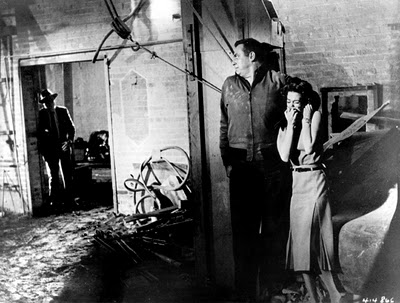
Harold Loftus (Raymond Burr) has issues.  He lives in a shack, he’s totally dominated by his overbearing mother, and he spend most of his time secretly peeping at couples who are parked at the local lover’s lane.  When he comes across Liz (Natalie Wood) and her boyfriend Owen (RIchard Anderson), he overpowers Owen and kidnaps Liz.  Now, Owen must work with Liz’s overprotective policeman father, Dan (Edmond O’Brien), to track down Harold and Liz.  Making things difficult is the fact that Dan blames Owen for the kidnapping and simply cannot bring himself to accept that his daughter was actually “one of those girls” who spent her Saturday night sitting in a car and sharing chaste kisses with her boyfriend.

(Seriously, the film made it sound like this was the worst possible thing that a girl could do with her time.  I’m not sure if Dan was supposed to come across like a reactionary or if this was just a case of the film having been made in 1956.  Personally, if that’s what the 50s were like, I’m glad I wasn’t born until the 80s.)

As directed by Frank Tuttle, A Cry In The Night tells its story in a stark, no-nonsense, semi-documentary manner.  (There’s even narration at the beginning and end of the film.)  O’Brien bellows his way through the role and Anderson’s colorless performance does little to make Owen seem like any less of a wimp.  However, Raymond Burr makes for a disturbingly plausible pervert and Natalie Wood is well-cast as Liz.  The film came out a year after Rebel Without A Cause and, watching her performance in A Cry In the Night, you can tell why Natalie Wood was Hollywood’s favorite vulnerable teenager.

I have to admit that I love films like A Cry In The Night, not so much because they’re great films (and, while always watchable, A Cry In The Night is certainly not a great film), but because they’re totally a product of their time.  As opposed to the big budget extravaganzas that were churned out by the Hollywood studio system during the 50s and 60s, low-budget B-movies like A Cry In The Night were designed to exploit contemporary headlines and contemporary concerns and, therefore, provide a lot of insight into what was going on with the American psyche at the time.

A Cry In The Night combines several themes that ran through the majority of the films of the period.  In the role of Harold, Raymond Burr is the epitome of the 1950s weirdo.  As opposed to the normal, all-American boys who make out with their girls in cars, Harold can only bring himself to lurk about and attempt to catch a peek of what normal society does on Saturday night.  When he kidnaps Liz, he’s not only threatening Natalie Wood, he is by extension attacking America itself.  Meanwhile, Liz’s boyfriend comes across like the type of intellectual liberal who probably cast two ballots for Adlai Stevenson while her father is definitely an Eisenhower man.   Boyfriend and father do not get along at first but what’s important is that they set aside their difference so that they can vanquish the other.  By the end of the film, the father is willing to invite the boyfriend to dinner and the boyfriend has learned that sometimes, you have to be willing to fight.

For those of you who keep crying about how the solution for all of America’s problems lie in bipartisan compromise, A Cry In The Night is the film for you!

For the rest of us, A Cry In The Night is an occasionally entertaining time capsule.