Retro Television Review: Homicide: Life On The Street 5.10 “Blood Wedding”


Welcome to Retro Television Reviews, a feature where we review some of our favorite and least favorite shows of the past!  On Sundays, I will be reviewing Homicide: Life On The Street, which aired from 1993 to 1999, on NBC!  It  can be viewed on Peacock.
This week, Pembleton gets his first case as the primary.

Episode 5.10 “Blood Wedding”

(Dir by Kevin Hooks, originally aired on December 13th, 1996)

A robbery at a bridal store leave public defender Meryl Hansen (Delanie Yates) dead.  Meryl was the fiancée of State’s Attorney Ed Danvers.  Danvers was with her when she was shot and he’s now obsessed with getting justice.  He is not happy when he discovers that Pembleton is the primary on the case.  Pembleton is still recovering from a stroke.  In fact, this is his first case as primary since he returned to active duty.  Meanwhile, Pembleton is not happy with the way Danvers keeps trying to tell him how to do his job.

Meanwhile, Giardello meets with the former members of Kellerman’s squad and asks them if they are planning on naming Kellerman to the Grand Jury.  Everyone says that they’re not going to name him …. except for one former detective who explains that, if he names Kellerman, his own sentence will be reduced.  Giardello even goes to the police commissioner (Al Freeman, Jr.) in search of help.  The Commissioner resents Giardello’s independent streak.  He’s not only not going to help, he’s also going to actively make Giardello’s life difficult.

As for Kellerman, he spends his time either sitting on his boat or drinking at the Waterfront or bothering his new lover, Dr. Cox, at work.  When he’s informed that the Grand Jury has been delayed until the end of January, it’s another weight on his shoulders.

In the end, Pembleton does find the man who shot Meryl Hansen but, by the time the Julius Cummings (R. Emery Bright) is captured, he’s already disposed of the gun used in the crime.  There’s enough evidence to put Cummings away for an unrelated robbery but not for murder.  Danvers suddenly wonders if he’s been to quick to compromise as a prosecutor.  After Danvers goes to the jail and tells Cummings that he will spend the rest of his life proving that Cummings is guilty of murder, Cummings hangs himself in his cell.

I have to admit that, for once, I actually found the Kellerman stuff to be more compelling than the main story.  Don’t get me wrong.  Andre Braugher and Kyle Secor were both great.  Zeljko Ivanek was excellent and he had a few good scenes with Melissa Leo, who has been rather underused this season.  But the main storyline felt more like something one would find on Law & Order than Homicide.  Pembleton’s very first case as primary turning out to be a red ball?  It was a bit too much of a coincidence to be effective.

The Kellerman stuff, however, gave Yaphet Kotto a chance to do something more than just give out orders.  Watching him go from detective to detective and slyly ask them if they were going to name Kellerman was a joy.  The scene between him and Al Freeman, Jr. was well-played by both actors.

That said, let’s hope this Kellerman thing gets resolved soon.  Lewis needs his partner!
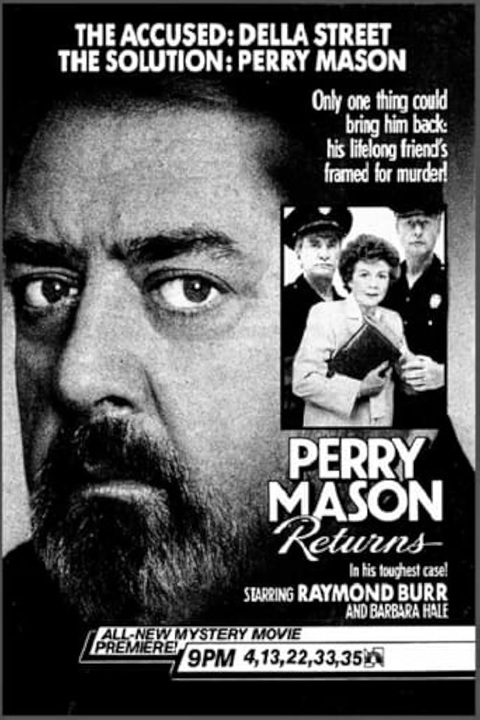
I Watched Perry Mason Returns (1985, Dir. by Ron Satlof)


When his former secretary, Della Street (Barbara Hale), is arrested for murdering wealthy businessman Arthur Gordon (Patrick O’Neal), Judge Perry Mason (Raymond Burr) resigns from the bench so that he can defend her in court.

Perry Mason Returns reveals who the killer is when the murder happens.  The killer is a lowlife named Robert Lynch (James Kidnie), who is wearing a gray wig and a frumpy dress so that everyone will mistake him for Della.  It doesn’t take Perry and private detective Paul Dark, Jr. (William Katt) long to discover that Lynch is the murderer but, after someone shoots Lynch, they have to figure out who hired Lynch to kill Gordon.  Gordon had recently disinherited his entire family so Perry and Paul have a lot of suspects to consider.  30 minutes in, I thought I knew who the killer was but it turned out I was wrong.

My Aunt Kate loved her detective stories and, when I was growing up, I would always watch them with her whenever we were visiting for the holidays.  Watching Perry Mason Returns really made me feel nostalgic, even if it also made me feel dumb for not being able to guess who the killer was.  Perry gives up being a judge so that he can defend Della Street in court.  That’s true love.  William Katt, who plays Paul Drake’s son, was Barbara Hale’s real-life son so I think that proves my theory that Della loved both Perry and Paul.

Perry Mason Returns was fun to watch.  It had more action than I was expecting because Paul Drake, Jr. was always getting into tight situations.  The movie really tried to make William Katt into an action star.  The murder mystery held my attention and, of course, Perry got the murderer to confess on the stand and on the record.  Some things never change!  One thing that really amused me was that, as soon as Perry took the case, everyone naturally assumed he would win.  Della wasn’t worried for a minute, even though she was facing life in prison.  “You didn’t tell me Perry Mason was her lawyer!” Robert Lynch yelled at the person who hired him.  He knew the gig was up.  Perry Mason always wins!

Watching Perry Mason Returns, I felt like I was a kid again, watching movies with my Aunt Kate and trying to solve the mystery with her.  All of the Perry Mason made-for-TV movies are on YouTube so I’ll be reviewing more of them in the future.

Retro Television Review: Homicide: Life On The Street 3.12 “Partners”


Welcome to Retro Television Reviews, a feature where we review some of our favorite and least favorite shows of the past!  On Sundays, I will be reviewing Homicide: Life On The Street, which aired from 1993 to 1999, on NBC!  It  can be viewed on Peacock.

This week, the bar finally opens!

Episode 3.12 “Partners”

(Dir by John McNaughton, Originally aired January 20th, 1995)

As you can tell by the title, this episode was all about partners.

For instance, Megan Russert realized that her former partner from narcotics, Douglas Jones (Robert Clohessy, with his Bronx accent), has been beating up his wife, Natalie (Lily Knight).  He regularly puts her in the hospital, though Natalie always insists that she either fell down the stairs or walked into a door.  Jones, who is now working homicide during the night shift and under Russert’s command, insists that he would never hurt his wife.  When Russert asks Jones’s former boss if Jones had been having any trouble while working narcotics, he refuses to give her specifics.  It’s a boys club and the boys protect each other.  Eventually, Natalie ends up shooting Jones with his own gun, probably killing him.  (We’re told that he’s barely holding on.)  This storyline was well-acted and well-written but watching it, I was reminded of just how awkwardly this show tends to use Russert.  Because she commands a different shift, she doesn’t really get much interaction with the other main characters.  Her affair with Beau Felton has never really made sense.  From what I understand, Russert was created by NBC demanded more personal drama and some glamour.  Isabella Hofman does about as good a job as anyone could with her often underwritten character but there’s really just not much for her to do.

Meanwhile, with Pembleton under suspension and threatening to quit, Bayliss doesn’t have a regular partner.  His attempt to partner up with Lewis ends in disaster when Lewis’s bad (albeit hilarious) driving leads to Bayliss getting a minor concussion.  Fortunately, Pembleton does return to the Homicide Department, though not before nearly burning down his kitchen while trying to make dinner.  Unfortunately, before Pembleton can return to his job, he has to take the fall for offering to drop the investigation into Congressman Wade’s false kidnapping report.  Andre Braugher perfectly plays the scene in which Pambleton testifies in court.  It’s easy to see the emotional and mental pain that Pembleton feels as he essentially commits perjury, taking the blame and letting Commissioner Harris of the hook.  Pembleton is forced to compromise and it eats away at his soul.  At the same time, he also gets to return to doing what he does best.  Early on in the episode, Giardello acknowledges that he and Pembleton are not friends.  “I’ve never been to your house, I’ve never met you’re wife …. I am not your friend ….” but Giardello explains that Pembleton is a good detective.  He turns “red names black” and that’s why he wants and needs Pembleton to return.

Bayliss, Lewis, and Munch finally open their bar and, at the end of the episode, it looks like the entire city of Baltimore has turned out.  Bolander even looks like he’s having a good time!  Munch raises a glass in a toast to the best partners that anyone could hope for and I got tears in mismatched eyes.  Seriously, I was so happy to finally see that bar open!  It was also nice to see everyone else happy for once.  That doesn’t often happen on Homicide.

Retro Television Review: Homicide: Life on the Street 3.11 “Cradle to Grave”


Welcome to Retro Television Reviews, a feature where we review some of our favorite and least favorite shows of the past!  On Sundays, I will be reviewing Homicide: Life On The Street, which aired from 1993 to 1999, on NBC!  It  can be viewed on Peacock.

This week, secrets are uncovered and trust is betrayed.

Episode 3.11 “Cradle to Grave”

(Dir by Myles Connell, originally aired on January 13th, 1995)

Police Commissioner James Harris (Al Freeman, Jr.) gives Pembleton a special assignment.  A congressman (Dick Stillwell) claims to have been temporarily abducted by a man in a van but he also says that he doesn’t want to press charges.  Both Harris and Pembleton suspect that the Congressman is lying and that he filed a false police report, which is itself a crime.  Pembleton’s investigation leads to the discovery that the abduction story was actually the congressman’s attempt to cover-up a quarrel between him and his lover (Christopher Glenn Wilson).  Pembleton goes to the congressman and offers to drop the investigation into the abduction so that the congressman’s personal life will not be exposed.  The congressman agrees.

Unfortunately, news of the false police report still gets out and Pembleton is sold out by Harris, who claims that he never gave Pembleton permission to drop the investigation, even though Harris made it clear that he wanted the problem to go away.  Outraged over being sold out by his boss and also by Giardello’s refusal to back him up (Giardello is upset that Pembleton lied to him about the investigation), Pembleton turns in his badge and quits the force.

Meanwhile, Lewis and Much investigate the murder of a biker.  What they discover is that the biker sacrificed his own life after it was discovered that his wife was an FBI informant.  In order to keep the gang from going after his daughter, the victim agreed to be killed in retribution.

And finally, Felton and Howard try to investigate a murder but …. where’s the body!?  It turns out that the body is on the move.  First, it’s accidentally sent to the hospital before Felton and Howard can get a look at it.  Then, it’s returned to the crime scene while Felton and Howard are heading to the morgue.  Apparently, this was based on a true story and I can believe it.  There’s no incompetence like bureaucratic incompetence.

This was not a bad episode.  Andre Braugher did a great job of capturing Pembleton’s pain at being betrayed by his mentor, Commission Harris.  Even the biker stuff was well-handled, with Timothy Wheeler giving a strong performance as the club’s “warlord.”  The biker stuff had an interesting subplot, with one of the bikers revealing himself to be an undercover FBI agent trying to make a RICO case.  As with the case involving the congressman, it helped to create a definite atmosphere of mistrust that ran through the entire episode.  Whether it was the FBI or the congressman or just the EMTs, no one could be trusted and no one knew what they were doing.

It’s a good episode.  I hope Pembleton reconsiders quitting.  The city needs him.