Italian Horror Showcase: Witchery (dir by Fabrizio Laurenti)


Like many Italian horror films, Witchery is a film that is known by many names.

When it was originally released in Italy, it was called La Casa 4 and it was sold as being a sequel to Sam Raimi’s Evil Dead films.  (In Italy, Evil Dead was called La Casa.)  In countries where Umberto Lenzi’s Ghosthouse was a hit, this film was entitled Ghosthouse 2.  (Adding to the confusion, Ghosthouse was called La Casa 3 in Italy, even though it had nothing to do with the Evil Dead films.)  In countries where neither Ghosthouse nor La Casa were hits, this film was sometimes called Witchcraft and sometimes called Witchery.  For the purposes of this review, I’m going with Witchery, just because Witchcraft is kind of a bland title.

Anyway, the main lesson to be learned from Witchery is that David Hasselhoff will never be anyone other than David Hasselhoff.  In this film, he plays a character named Gary but, from the minute you see him and he starts talking, it’s impossible to think of him as being anyone other than David Hasselhoff.  You spend the film thinking, “Uh-oh, David Hasselhoff’s getting sexually frustrated.  Uh-oh, that witch is coming for David Hasselhoff.  Did they just throw David Hasselhoff through a window?”

David Hasselhoff and his friend Leslie (Leslie Cumming) are in Massachusetts, staying at an abandoned hotel.  It’s rumored that, living nearby, there’s a reculsive actress, known as the Woman in Black (Hildegard Knef), who decades ago made some sort of deal with the devil or a witch or something like that and the hotel is now some sort of portal to Hell.  Leslie is determined to discover whether the rumors are true but all David Hasselhoff cares about is the fact that Leslie is still a virgin.  “It’s not normal,” he tells her, with a look in his eye that suggests that he’s willing to help her out.  Somehow, Leslie manages to resist Hasselhoff.

Before Hasselhoff can continue to make his case, both he and Leslie have to hide in the hotel because a group of people show up.  It turns out that the Brooks family is interested in buying the hotel so that they can renovate it and hopefully make some money!  Now, they’ve arrived and they’re looking to inspect the property.  There’s Jane (Linda Blair), who is pregnant.  There’s Jane’s obnoxious stepmother, Rose (Annie Ross), who won’t stop complaining.  There’s two real estate agents, Linda (Catherine Hickland) and Jerry (Rick Farnsworth).  And then there’s a little kid who has a Sesame Street cassette player with him.  Have you ever wanted to hear a demonic chant come out of a bulky box decorated with Big Bird and Oscar the Grouch?  Well, this is the film for you!

Anyway, the Brooks family ends up getting stranded at the hotel for a night, which gives the Woman In Black several chances to pop up and send people to Hell.  It turns out that the hotel is crawling with all sorts of demonic creatures and not even David Hasselhoff can scare them off.  One person gets their lips sewn together and is hung in a fireplace.  Someone else gets crucified upside down.  Someone else gets impaled on a marlin.  Because she’s played by Linda Blair, Jane gets possessed….

It’s a real mess of a film and not one that ever makes much sense.  You keep wondering just what exactly the Woman In Black is hoping to accomplish but then you realize that the film itself has no idea so you stop worrying about it.  Witchery may not be a good film but it’s such a strange film that it’s a little bit hard to resist.  I mean, how many other films combine demonic chants with Big Bird?  How many other films feature David Hasselhoff playing himself and getting into a fight with Linda Blair?  Watching the film, you get the feeling that everyone involved just kinda made it up as they went along.

I’m not exactly recommending Witchery but it is one of those films that’s weird enough to justify viewing it at least once.

Horror Film Review: Anaconda (dir by Luis Llosa)


In many ways, the 1997 monster film Anaconda is an incredibly dumb movie but let’s give credit where credit is for.  Whoever was in charge of casting this movie managed to assemble the most unlikely group of co-stars that you would ever expect to see in a movie about a documentary crew who run into a giant snake while sailing down the Amazon River.

I mean, let’s just consider the most familiar names in the cast.  Jennifer Lopez.  Ice Cube.  Jon Voight.  Owen freakin Wilson.  I mean, it’s not just that you wouldn’t expect to come across these four people all in the same movie.  It’s that they all seem to come from a totally different cinematic universe.  They’ve all got their own unique style of acting and seeing them all on the same small boat together is just bizarre.  You’ve got Jennifer Lopez, delivering her lines with a lot of conviction but not much sincerity.  And then you’ve got Ice Cube coolly looking over the Amazon and basically daring the giant snake to even think about trying to swallow him.  Owen Wilson is his usual quirky self, delivering his lines in his trademark Texas stoner drawl.  And then you’ve got Jon Voight.

Oh my God, Jon Voight.

Voight plays Paul Serone, a Paraguayan who says that he can help the documentary crew find an isolated Amazon tribe but who, once he gets on the boat, basically takes over and announces that he’s actually a snake hunter and he’s planning on capturing the biggest anaconda in existence.  It takes a while for the snake to show up.  When it finally does, it’s actually a pretty impressive throw-back to the type of cheesy by entertaining monsters that used to show up in drive-in movies back in the 50s and the 60s.  But really, the biggest special effect in the movie is Jon Voight.  Wisely, Voight doesn’t waste any time trying to be subtle or in anyway believable in the role of Serone.  Instead, Voight gives a performance that seems to be channeling the spirit of the infamous Klaus Kinski.  Voight growls, snarls, and glares as if the fate of the world depended upon it and he rips into his Paraguayan accent with all the ferocity of a character actor who understands the importance of being memorable in an otherwise forgettable movie.  It’s as if Voight showed up on set and looked at what was going and then said to himself, “Well, Jon, it’s all up to you.”  Serone is really a pretty vicious character.  I mean, he literally strangles a character to death with his legs!  But, thanks to Voight’s crazed energy he’s still the most compelling character in the movie.  It’s really scary to think about what the film would have been like without Voight shaking things up.  Along amongst the cast, Voight seems to understand just how silly Anaconda truly is.  Voight takes a rather middling monster movie and, through sheer force of will, manages to make it at least somewhat entertaining.

Personally, I’d like to see a remake of Anaconda, one that would feature the same cast but would be directed by Werner Herzog.  Just imagine if Herzog had told the story of that trip down the Amazon.  Gone would be the bland dialogue and rudimentary character motivations.  Instead, we’d have Jennifer Lopez slowly going insane while hundreds of monkey lay siege to the boat and Ice Cube musing on the never ending conflict between man and nature.  Herzog’s Anaconda would probably be just crazy enough to keep up with Jon Voight’s performance.

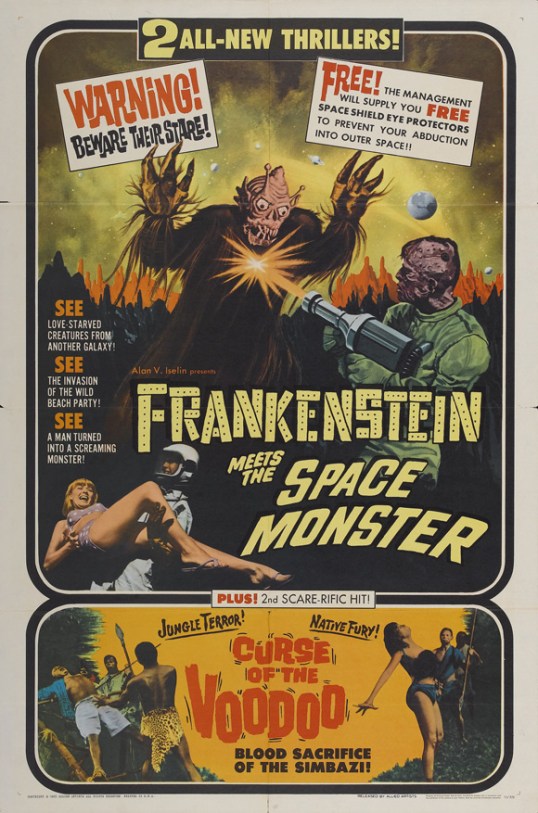
Horror On The Lens: Frankenstein Meets The Space Monster (dir by Robert Gaffney) (RIP, James Karen)


Today’s horror on the lens is dedicated to the memory of the great character actor James Karen.  Horror fans will remember him from Return of the Living Dead and Poltergeist.  He appeared in a countless number of films, usually playing men of authority.  1965’s Frankenstein Meets The Space Monster featured him in a rare starring role.

Despite the movie’s title, it’s not about Frankenstein.  Instead, it’s about an astronaut named Frank who is actually an android.  When his latest mission into space goes wrong, Frank ends up crashing in Puerto Rico.  Now malfunctioning, Frank causes some major chaos.  Can his creator, Dr. Adam Steele (James Karen), track Frank down and put an end to his reign of terror?

And what about the Martians?  Android Frank isn’t the only threat in Puerto Rico.  A group of Martians have landed and are determined to kidnap any girl wearing a bikini so that they can use them to repopulate their race.  We’re told that every woman on Mars — with the apparent exception of Princess Marcuzan, played with evil haughtiness by Marilyn Hanold — has been killed as the result of an atomic war.  Assisting Princess Marcuzan is Dr. Nadir (Lou Cutell), a short, bald Martian with pointy ears.

One of the oddest things about Frankenstein Meets The Space Monster is that, despite being a standard — if wonderfully nonsensical — low-budget B-movie, it features a great soundtrack!

Enjoy!

Music Video of the Day: Halloween Mask by Peach Kelli Pop (2015, dir by Lizzy Walker)


To be honest, I think this song is more about the masks that people wear as a part of everyday life, as opposed to being specifically about Halloween masks.  Just check out the lyrics:

Fashion magazines
Anti-aging creams
Tape measure around your waist
Whitening toothpaste
Behind this mask
Lies an ugly face
An entitled child dressed in lace

Halloween mask
I wear it every day
Halloween mask
Beneath my skin is gray

Fashion magazines
Anti-aging creams
Tape measure around your waist
Whitening toothpaste
Behind this mask
Lies an ugly face
An entitled child dressed in lace

Halloween mask
I wear it every day
Halloween mask
Beneath my skin is gray

Still, even if it’s not really a “horror” video, it’s a good song and I still think that Peach Kelli Pop should be hired to perform the Silver Shamrock jingle next Halloween.

Enjoy!

Horror On TV: Kolchak The Night Stalker 1.14 “The Trevi Collection” (dir by Don Weis)


Tonight on Kolchak….

After witnessing the murder of an informant, Kolchak finds himself being targeted by the mob!

Of course, after some of what Kolchak has been through, a simple Earth-bound threat like the Mafia would be a nice change of pace.  However, Kolchak soon discovers that he’s also got a witch after him!  With the help of a model (Lara Parker), Kolchak sets out uncover the witch at the heat of Chicago’s fashion industry!

This episode originally aired on January 24th, 1975.

Enjoy!

Horror Film Review: Let’s Scare Jessica To Death (dir by John D. Hancock)


In the 1971 film, Let’s Scare Jessica To Death, Zohra Lampert played Jessica, a woman who is struggling to remain sane.

As the film begins, Jessica has just been released from a mental institution.  As Jessica explains it, she’s been hearing voices ever since her father died.  She struggles with depression and sometimes, she gets paranoid.  Her husband, Duncan (Barton Heyman), has just purchased a farm in Connecticut, a place where he believes that Jessica can find some peace.  Their friend, Woody (Kevin O’Connor), will be moving out to the farm with them.  Woody is a bit of a hippie.  Some people would say that Jessica and Duncan are hippies as well but honestly, both of them seem to be more like people who desperately want other people to believe that they’re hippies as opposed to genuine members of the counterculture.

Upon arriving at their new farm, Jessica is shocked to discover a woman named Emily (Mariclare Costello) standing in their farmhouse.  When the shocked Jessica calls out for Duncan, he immediately assures her, “I see her, too!”  Emily explains that she’s spent the last few months living in the deserted farmhouse.  Though Emily offers to leave, Jessica insists that Emily have dinner with them and spend the night.  When it becomes obvious that Woody likes Emily, Jessica suggests that Emily should be allowed to live with them.

Duncan agrees to let Emily stay and, much like Jessica, you immediately start to wonder about his motives.  Is he merely letting Emily stay to keep Woody happy?  Or is he agreeing with Jessica because he’s scared that disagreeing with her will cause her have another breakdown?  Or is it possible that he’s attracted to Emily himself?

As the days pass, Jessica struggles to adjust to life in the middle of nowhere.  The location is beautiful but, because it’s so remote, it’s menacing as well.  The people in the nearby town are strangely hostile and they always seem to be wearing bandages on their necks.  Jessica starts to hear voices in the distance, taunting her and telling her that she has no place out in the country.  Are they real or is it just her imagination?  Is Jessica trying so hard to convince everyone that she’s okay that she’s actually pushing herself to a relapse?  And what about the mysterious blonde girl that keeps appearing in the distance, watching Jessica but running away whenever Jessica tries to approach her?

And then there’s the picture that Jessica finds in an antique shop.  It appears to be a picture of Emily but the shop’s owner assures her that the picture is over 100 years old….

Apparently, the script for Let’s Scare Jessica To Death was originally called It Drinks Hippy Blood and it’s intent was satirical.  You wouldn’t be able to guess that from watching Let’s Scare Jessica To Death, which is one of the creepiest and most dream-like horror films that I’ve ever seen.  Unfolding at a leisurely pace and featuring hazy but gorgeous cinematography, Let’s Scare Jessica To Death keeps both Jessica and the audience off-balance.  You’re never quite sure if Jessica is right about Emily and the town or if she’s relapsed and is drowning in a sea of her own paranoia.  Duncan and Woody both treat Jessica as if she might fall apart at any second.  At times, Duncan and his constant concern is so suffocating towards her that you feel that, if Emily hadn’t been there waiting for them, Jessica would have had to create her.  As frightening as Emily may be, only Emily can set Jessica free from her domineering husband.

More than being just a character study of a woman struggling to remain above water, Let’s Scare Jessica To Death is also a portrait of the death of counterculture idealism.  Jessica, Duncan, and Woody appear to have a chance to live the ideal hippy life on their Connecticut farm but that dream collapses under the weight of all the petty human emotions and foibles that they wrongly thought they could escape.  Duncan treats Jessica like a child, gaslighting her whenever she questions anything that’s going on.  Woody seems like a good guy but he’s so laid back that he refuses to stand against the tide.  Jessica is betrayed by everyone around her.  In the end, not even the mysterious blonde girl is willing to actually warn Jessica about what’s happening.

Zohra Lampert gives a wonderfully empathetic performance as Jessica and Mariclare Costello and Gretchen Corbett are well cast as the enigmatic strangers that Jessica can’t seem to escape.  Let’s Scare Jessica To Death is a creepy and atmospheric dream of dark and disturbing things and it’s definitely one to see.

Horror on the Lens: Final Sacrifice (dir by Tjardus Greidanus)


Today’s horror on the lens comes to us all the way from Canada!

In the 1990 film, The Final Sacrifice, a lot of stuff happens.  In fact, the plot is almost as hard to follow as the plot of Raiders of the Living Dead.  There’s a cult leader named Satoris, who is always wearing a suit.  There’s a bunch of professional wrestlers who wear masks and are always running through the woods.  There’s a teenager who looks like a cross between Anthony Perkins and Roddy McDowall.  He’s being chased by the cultists but, fortunately, he meets a guy with a mullet.  Together, they meet a wiley old prospector and they all work together to discover a lost city or something like that.

Did I mention that this film makes no sense?  If you need further proof, you can check out my review over at Horror Critic.

That said, The Final Sacrifice is kinda fun, especially if you’re a fan of Candian exploitation films like I am.  It might not make much sense but at least it’s weird and that surely must count for something.

The TSL’s Horror Grindhouse: Diary of the Dead (dir by George Romero)


I have to admit that I was a little bit hesitant about watching the 2007 film, Diary of the Dead.

It wasn’t that I don’t like zombie movies.  In fact, it was the complete opposite.  I love zombie films and Night of the Living Dead is one of my favorites.  George Romero, of course, went on to make several sequels to Night of the Living DeadDawn of the Dead, Day of the Dead, and Land of the Dead are certifiable horror classics.  However, I had heard mixed things about the two zombie films that Romero directed after Land of the Dead.  Seeing as how Diary of the Dead was Romero’s second-to-last film before he passed away in 2017, I was worried that I would watch the film and discover that I hated it.  I didn’t want experience anything that would tarnish Romero’s cinematic legacy.  It didn’t help my expectations that Diary of the Dead is a found footage film and the conventions of the found footage genre tend to get on my last nerve.

(Seriously, nothing makes me throw a shoe at a screen quicker than the sound of someone in a horror movie saying, “Are you filming this?”)

But you know what?

I did watch Diary of the Dead and it’s actually not bad.  It may not reach the heights of Romero’s other zombie films but it’s definitely a worthwhile companion piece.  It opens with news reports about the start of the zombie apocalypse, meaning that Diary of the Dead is meant to take place at roughly the same time as Night of the Living Dead.  (Never mind that Diary of the Dead is full of references to YouTube and blogs and other things that most people probably couldn’t even imagine when Night of the Living Dead first came out.)  A group of film students are in the woods, filming a terrible mummy movie when they first hear reports of the dead coming back to life.  Some say that there’s no way it could be true.  Others say that something must be happening but surely the dead aren’t actually coming back to life.  They soon discover that the dead have indeed returned.

We follow the students as they travel across Pennsylvania, trying to find a place that’s safe from the Dead and discovering that there’s literally no such place left in America.  Along the way, they also discover that the government has no intention of telling the people the truth about what’s happening.  In fact, a group of national guardsmen turn out to be just as dangerous as the zombies.  In their efforts to survive, the students are forced to rely on an underground network of bloggers and video makers.

Diary of the Dead has all of the usual zombie mayhem that you would expect from a film like this but, at the same time, it’s got a lot more on its mind than just the dead returning to life.  Much as he did with Land Of The Dead, Romero uses Diary of the Dead to comment on the state of America under the Patriot Act.  With the government using the zombie apocalypse as an excuse to suspend civil liberties and increase their own power, the film’s characters are forced to depend on new and independent information sources.  It’s not hard to see the parallel that Romero is making between the War on the Living Dead and the War on Terror.  As well, making all of the characters film students allows for some discussion about whether or not horror films should simply concentrate on being scary or whether they should also attempt to deal with real-world issues.  The film leaves little doubt where Romero came down on that issue.

On the negative side, Diary of the Dead struggles a bit to overcome the limitations of its low budget and none of the characters are as compelling as Ben in Night of the Living Dead or Fran in Dawn of the Dead.  At times, you find yourself wishing that Diary of the Dead featured just one actor who was as into their role as Duane C. Jones or Ken Foree were in Night of the Living Dead and Dawn of the Dead, respectively.  But Diary of the Dead still features enough zombies and enough of Romero’s trademark political subtext to be an acceptable addition to Romero’s vision of the apocalypse.

Book Review: Room to Dream by David Lynch and Kristine McKenna


It’s been a few months since I read Room to Dream and I’m still thinking about it.  It’s definitely one of the most fascinating and frustrating Hollywood memoirs that I’ve ever read.

It’s fascinating because the book is not only about David Lynch but it’s also by him.  Lynch, in his own words, tells us about his childhood, his time as an art student, his struggle to complete Eraserhead, and all the rest.  He tells us about directing some of the greatest British thespians of all time in The Elephant Man and also shares with us the frustrations of directing Dune.  He tells us about Twin Peaks and how Mulholland Drive went from being a rejected pilot to being an award-winning film.

All of the familiar stories are here.  He tells us about the time when he was a child and he saw a naked and bloodied woman stumbling down the street.  (This image would later reappear in Blue Velvet.)  We hear about how he was essentially homeless while directing Eraserhead and how, during the casting of Blue Velvet, Dennis Hopper called him up and announced that he was Frank Booth.  Not surprisingly, Lynch writes extensively about the importance of meditation in both his life and his art.

At the same time, there’s also a lot of new stuff in this book.  Did you ever want to know who Lynch believes to have been behind the Kennedy assassination?  Well, it’s right there in the first chapter.  Want to know how Lynch actually feels about using drugs as a creative aide?  It’s in there.  Did you know that among the films that David Lynch has been offered (and turned down) were Return of the Jedi, American Beauty, Tender Mercies, and The Ring?  You do now.  He writes about his occasionally difficult but very real friendship with actor Jack Nance.  He writes about some of the legendary actors and producers that he’s met and what’s interesting is that he rarely has a bad word to say about anyone.  Even when he writes about how difficult Anthony Hopkins was on the set of the The Elephant Man, Lynch still allows that Hopkins may have just been dealing with stuff in his own life.  Lynch comes across as being as generous, artistic, and eccentric as you would hope that he would.

Clocking in at over 600 pages, the book has an interesting format.  The book is divided into sections, each one dealing with a different period of Lynch’s life.  Each section opens with Kristine McKenna discussing what was happening in Lynch’s life at the time and interviewing Lynch’s friends and collaborators.  It’s only after McKenna has given us the facts of what was going on in Lynch’s life that Lynch then gives us his interpretation and recollections of the facts.  It makes for a challenging but often interesting read.  One thing that immediately becomes clear is that Lynch is far more comfortable talking about his art than talking about his relationships with other people.  Lynch comes across as being the epitome of the artist who spend almost of all of his time in his own head.  Room to Dream gives us a chance to see the world through Lynch’s eyes and he tends to remember most of the events of his life as if they were just another atmospheric scene in one of his movies.

Lynch discusses his work with such enthusiasm that it’s impossible not to get carried away with him.  At that same time, this is not the book to read if you’re expecting Lynch to explain what’s going on underneath the surface of some of his more surrealistic films.  If you’re expecting Lynch to explain why Bill Pullman turns into Balthazar Getty in Lost Highway, you’ll be disappointed.  If you’re expecting Lynch to explain what’s real and what isn’t in Eraserhead, Mulholland Drive, and Inland Empire, it’s not going to happen.  And if you’re expecting to understand the finale of Twin Peaks: The Return after reading Room to Dream, you’re out of luck.  If anything, Lynch seems like even more of an enigma, albeit an incredibly likable enigma, after you read Room To Dream than before.

And yes, it can be frustrating but you know what?  That’s okay.  In fact, it seems appropriate.  The brilliance of David Lynch lies in the mystery.  When I first heard about Room to Dream, I feared that Lynch would reveal too much and the mystery would be lost.  Instead, it’s even more fascinating than ever.