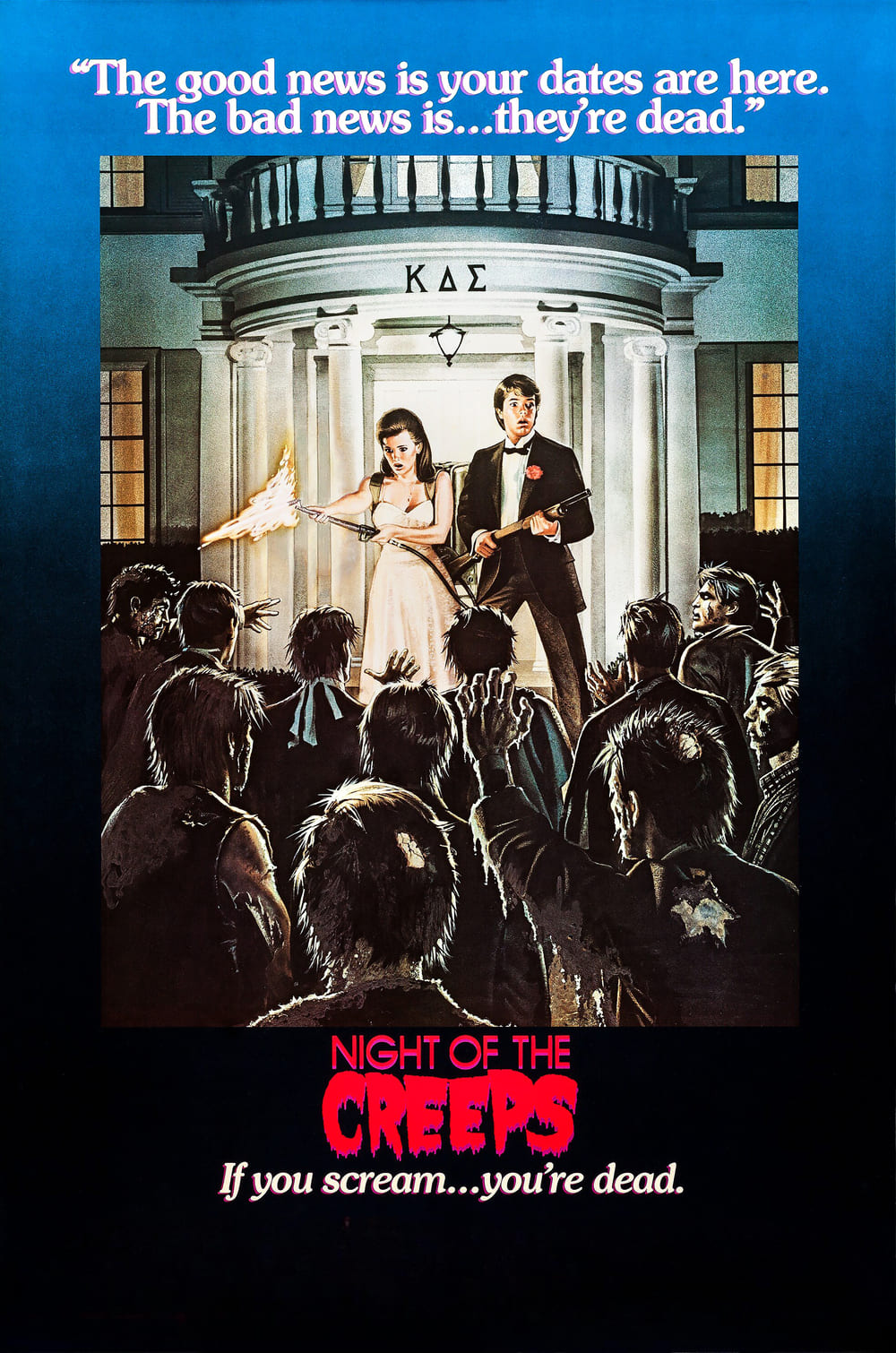
“Zombies, exploding heads, creepy-crawlies… and a date for the formal. This is classic, Spanky.” — Detective Ray Cameron
College is supposed to be a time for making questionable choices, but accidentally helping alien parasites invade campus probably falls outside the usual learning experience. That’s the basic joke behind Night of the Creeps, and Fred Dekker gets an impressive amount of mileage out of it. His 1986 horror comedy mixes the social embarrassment of a campus movie with the bodily violations of a creature feature, then throws in a detective who looks like he hasn’t enjoyed either company or daylight in years. The ingredients are familiar, but the combination has real personality. It’s messy, funny, occasionally touching, and much more interested in entertaining you than looking respectable.
Before the college kids get their chance to make everything worse, Dekker establishes that trouble has been brewing for decades. An opening aboard an alien spacecraft leads into a black-and-white stretch set in 1959, where young love runs into both an escaped axe murderer and an extraterrestrial experiment. It’s a wonderfully excessive introduction, almost daring you to question whether one movie needs all these threats. Somehow, the pieces fit. The opening establishes a history that will eventually catch up with the present, making the later outbreak feel like the continuation of a very bad night rather than a completely random disaster.
In 1986, Chris Romero, played by Jason Lively, has more ordinary concerns. He’s interested in Cynthia Cronenberg, played by Jill Whitlow, and figures pledging a fraternity might improve his romantic prospects. His best friend J.C., played by Steve Marshall, accompanies him on an initiation assignment to steal a corpse. This is, unsurprisingly, not a great plan. Their search brings them to a preserved body, and disturbing it helps unleash the alien slugs that drive the rest of the story. Dekker makes the escalation amusingly direct: Chris wants a more exciting social life, and the universe supplies one with considerably more decomposing flesh than he probably imagined.
The campus setting gives the movie an enjoyable contrast between petty problems and catastrophic ones. Fraternity status and romantic competition seem important until people start becoming breeding grounds for something from outer space. Still, the college-comedy material is also where the film feels most routine. The fraternity antagonists are obnoxious in predictable ways, and Chris spends a fair amount of time being the awkward underdog you’ve seen before. Lively keeps him sympathetic, but the character could use more spark. Cynthia is similarly likable without being especially developed. Whitlow gives her warmth, though the romance never becomes as engaging as the friendships surrounding it.
J.C. is a big reason those friendships work. Marshall brings a loose, teasing energy that makes his exchanges with Chris feel comfortable rather than written purely to deliver information. He can recognize that his friend is being ridiculous without making his affection seem conditional. That gives their relationship some substance beneath the jokes. In a lesser version of this movie, J.C. would exist only to encourage the romance and provide sarcastic commentary. Here, he becomes its emotional anchor. When the danger reaches him, the film briefly stops feeling like a harmless parade of genre references, and that change carries a genuine sting.
Tom Atkins gives the movie a different kind of personality as Detective Ray Cameron. He’s gruff, sarcastic, and seemingly irritated that another day has required his participation. Atkins knows exactly how to sell the dialogue, making “Thrill me” sound like the natural greeting of someone who expects disappointment and would appreciate being surprised. But Cameron isn’t just a collection of quotable lines. His connection to the events of 1959 gives his bitterness a history. Atkins lets that sadness sit beneath the swagger, which makes the character entertaining without reducing him to a tough-guy impersonation. He’s easily the strongest presence whenever he enters a scene.
Dekker deserves credit for allowing those feelings to coexist with the ridiculousness. Night of the Creeps has an obvious sense of humor about itself, but it doesn’t treat caring about its characters as another joke. The actors generally play the danger straight, leaving the comedy to emerge from their reactions and the increasingly unreasonable situation. That approach gives the darker moments room to land. The movie has heart, not because it pauses to insist on its importance, but because friendship and regret remain meaningful even when someone’s head might become a delivery system for space slugs.
The practical effects make that threat suitably unpleasant. There’s something especially nasty about creatures that don’t need to overpower you so much as find an opening, and the slugs turn an exposed mouth into a source of tension. The walking corpses have a grubby physicality that suits the film’s scrappy atmosphere. You can enjoy the craftsmanship while still appreciating how disgusting the result looks. The pacing isn’t quite as dependable: a few stretches of campus business delay the monster action, and the shifts between broad comedy and distress occasionally feel abrupt. Once the outbreak builds toward the formal dance, though, the movie finds the momentum it needs.
What ultimately makes Night of the Creeps work is that its foolish decisions have consequences worth caring about. Chris’s attempt to improve his college experience opens the door to a grotesque disaster, but Dekker doesn’t leave the story at “look what these idiots did.” He gives the characters reasons to stand by one another when their ordinary concerns become irrelevant. That makes the finale more satisfying than a simple procession of creature effects. The movie delivers its share of slime, corpses, and deadpan jokes, then leaves behind a surprisingly warm impression. For a story about things crawling inside people, it’s remarkably good company.


