Horror Film Review: Night of the Creeps (dir. by Fred Dekker)


“Zombies, exploding heads, creepy-crawlies… and a date for the formal. This is classic, Spanky.” — Detective Ray Cameron

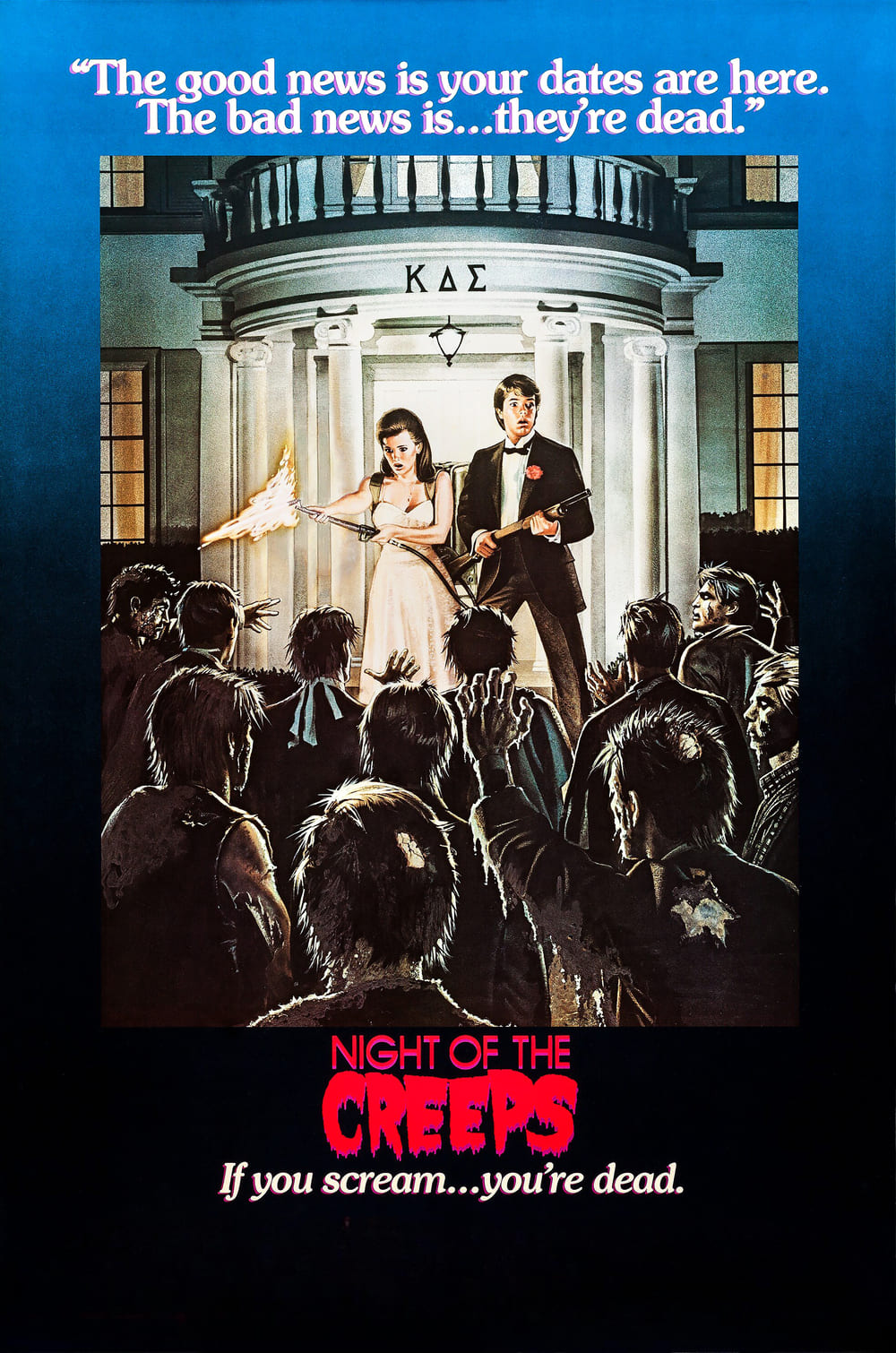
College is supposed to be a time for making questionable choices, but accidentally helping alien parasites invade campus probably falls outside the usual learning experience. That’s the basic joke behind Night of the Creeps, and Fred Dekker gets an impressive amount of mileage out of it. His 1986 horror comedy mixes the social embarrassment of a campus movie with the bodily violations of a creature feature, then throws in a detective who looks like he hasn’t enjoyed either company or daylight in years. The ingredients are familiar, but the combination has real personality. It’s messy, funny, occasionally touching, and much more interested in entertaining you than looking respectable.

Before the college kids get their chance to make everything worse, Dekker establishes that trouble has been brewing for decades. An opening aboard an alien spacecraft leads into a black-and-white stretch set in 1959, where young love runs into both an escaped axe murderer and an extraterrestrial experiment. It’s a wonderfully excessive introduction, almost daring you to question whether one movie needs all these threats. Somehow, the pieces fit. The opening establishes a history that will eventually catch up with the present, making the later outbreak feel like the continuation of a very bad night rather than a completely random disaster.

In 1986, Chris Romero, played by Jason Lively, has more ordinary concerns. He’s interested in Cynthia Cronenberg, played by Jill Whitlow, and figures pledging a fraternity might improve his romantic prospects. His best friend J.C., played by Steve Marshall, accompanies him on an initiation assignment to steal a corpse. This is, unsurprisingly, not a great plan. Their search brings them to a preserved body, and disturbing it helps unleash the alien slugs that drive the rest of the story. Dekker makes the escalation amusingly direct: Chris wants a more exciting social life, and the universe supplies one with considerably more decomposing flesh than he probably imagined.

The campus setting gives the movie an enjoyable contrast between petty problems and catastrophic ones. Fraternity status and romantic competition seem important until people start becoming breeding grounds for something from outer space. Still, the college-comedy material is also where the film feels most routine. The fraternity antagonists are obnoxious in predictable ways, and Chris spends a fair amount of time being the awkward underdog you’ve seen before. Lively keeps him sympathetic, but the character could use more spark. Cynthia is similarly likable without being especially developed. Whitlow gives her warmth, though the romance never becomes as engaging as the friendships surrounding it.

J.C. is a big reason those friendships work. Marshall brings a loose, teasing energy that makes his exchanges with Chris feel comfortable rather than written purely to deliver information. He can recognize that his friend is being ridiculous without making his affection seem conditional. That gives their relationship some substance beneath the jokes. In a lesser version of this movie, J.C. would exist only to encourage the romance and provide sarcastic commentary. Here, he becomes its emotional anchor. When the danger reaches him, the film briefly stops feeling like a harmless parade of genre references, and that change carries a genuine sting.

Tom Atkins gives the movie a different kind of personality as Detective Ray Cameron. He’s gruff, sarcastic, and seemingly irritated that another day has required his participation. Atkins knows exactly how to sell the dialogue, making “Thrill me” sound like the natural greeting of someone who expects disappointment and would appreciate being surprised. But Cameron isn’t just a collection of quotable lines. His connection to the events of 1959 gives his bitterness a history. Atkins lets that sadness sit beneath the swagger, which makes the character entertaining without reducing him to a tough-guy impersonation. He’s easily the strongest presence whenever he enters a scene.

Dekker deserves credit for allowing those feelings to coexist with the ridiculousness. Night of the Creeps has an obvious sense of humor about itself, but it doesn’t treat caring about its characters as another joke. The actors generally play the danger straight, leaving the comedy to emerge from their reactions and the increasingly unreasonable situation. That approach gives the darker moments room to land. The movie has heart, not because it pauses to insist on its importance, but because friendship and regret remain meaningful even when someone’s head might become a delivery system for space slugs.

The practical effects make that threat suitably unpleasant. There’s something especially nasty about creatures that don’t need to overpower you so much as find an opening, and the slugs turn an exposed mouth into a source of tension. The walking corpses have a grubby physicality that suits the film’s scrappy atmosphere. You can enjoy the craftsmanship while still appreciating how disgusting the result looks. The pacing isn’t quite as dependable: a few stretches of campus business delay the monster action, and the shifts between broad comedy and distress occasionally feel abrupt. Once the outbreak builds toward the formal dance, though, the movie finds the momentum it needs.

What ultimately makes Night of the Creeps work is that its foolish decisions have consequences worth caring about. Chris’s attempt to improve his college experience opens the door to a grotesque disaster, but Dekker doesn’t leave the story at “look what these idiots did.” He gives the characters reasons to stand by one another when their ordinary concerns become irrelevant. That makes the finale more satisfying than a simple procession of creature effects. The movie delivers its share of slime, corpses, and deadpan jokes, then leaves behind a surprisingly warm impression. For a story about things crawling inside people, it’s remarkably good company.
The TSL Horror Grindhouse: Children Shouldn’t Play With Dead Things (dir by Bob Clark)


The title of this 1972 film is definitely a case of truth in advertising.

Children definitely should not play with dead things!  I don’t care how mature they are or how lenient of a parent you’re trying to be.  When you see your child playing with a dead thing, it is on you to step forward and say, “Child, leave that dead thing alone unless you want to forever burn in Hell.”  I know that type of language might be traumatic for some children but you’ll be glad you did it.  You know who played with dead things when he was a child?  Jeffrey Dahmer!  And look how that turned out.  He got a miniseries made about him and became an internet meme.

Now, it should be pointed out that they’re aren’t any children to be found in Children Shouldn’t Play With Dead Things.  The children of the title are actually a group of wannabe actors who are led by a pretentious douchebag named Alan (played by the film’s writer, Alan Ormsby).  With his mustache and his long hair and his hip clothes and his vocabulary of psychobabble and buzzwords, Alan considers himself to be quite the chic 70s gentleman.  He refers the other actors as being his “children,” and they let him get away with it.  Personally, I would be kind of insulted but whatever.

One night, Alan and his theatrical troupe ride a boat off to an island that is sitting off the coast of Miami.  The island is reputed to be haunted and Alan tells the actors several rather gruesome stories about things that have supposedly happened to the inhabitants of the island.  According to Alan, the island is used as a cemetery for criminals who were so vile that no one wanted to collect their bodies.

Why are the actors on the island?  Along with leading his theatrical troupe, Alan considers himself to be a bit of a warlock.  He wants to perform a ceremony at midnight and he expects his actors to help him out.  If they don’t help, they’ll lose their jobs.  If they do help, they’ll probably lose their lives.  Alan and his actors dig up the body of a man named Orville (played by the wonderfully named Seth Sklarey).  The ceremony that Alan performs at midnight fails to bring Orville back to life but it does cause the dead who were left in their graves to rise from the Earth as zombies.  The zombies are not happy that their island has been invaded and they’re especially not happy about Alan digging up Orville.

Children Shouldn’t Play With Dead Things is a mix of comedy and horror, with Alan’s pretentious foolishness dominating the first half of the film while the second features the zombies laying siege to a cottage.  It starts out slow but, once the zombies come to life, the film achieves a surreal grandeur.  For an obviously low-budget film, the zombie makeup is surprisingly effective and the zombies themselves are so relentless and determined in their pursuit of the living that they help Children Shouldn’t Play With Dead Things survive the inevitable comparisons to Night of the Living Dead.  The film’s final scene, which plays out in near silence, has an undeniable horrific power to it.

Children Shouldn’t Play With Dead Things was the third film to be directed by Bob Clark.  He also directed films like Deathdream, Black Christmas, Murder By Decree, and the infamous (and very financially successful) Porky’s.  Of course, his most beloved film is the one that we’ll all be watching in a little less than two months, A Christmas Story.

Retro Television Reviews: The Love Boat 1.13 “Too Hot to Handle / Family Reunion / Cinderella Story”


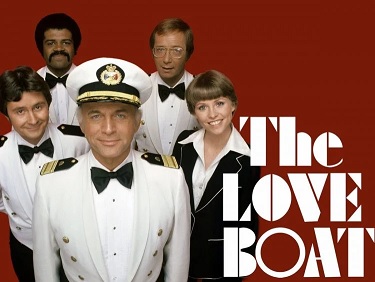
Welcome to Retro Television Reviews, a feature where we review some of our favorite and least favorite shows of the past!  On Wednesdays, I will be reviewing the original Love Boat, which aired on ABC from 1977 to 1986!  The series can be streamed on Paramount Plus!

It’s Love!

Episode 1.13 “Too Hot to Handle / Family Reunion / Cinderella Story”

(Dir by James Sheldon and Richard Kinon, originally aired on January 7th, 1978)

It’s time for another cruise with three separate stories!

Newlyweds George (John Rubinstein) and Sally Allison (a youngish Kathy Bates) board the Pacific Princess, hoping to enjoy the ideal honeymoon.  Instead, it turns out to be one disaster after another.  Sally gets sunburned.  George gets poison ivy.  Having gotten off the boat in Mexico, Sally returns to discover a totally different couple staying in what she thinks is her cabin.  Uh-oh.  It turns out that Sally accidentally got on the Sun Princess and the Pacific Princess has already set sail without her!  This was a pretty simple storyline and, if anything, it mostly seemed to exist so that the show’s writers could see how many bad things that they could do to one perfectly innocent couple.  But John Rubinstein and Katy Bates are so likable as George and Sally that the story works.  You can’t help but hope the cruise gets a little better for them.  Kathy Bates was 29 when she appeared on The Love Boat and there’s nothing about her performance that would necessarily make you say, “Hey, that’s a future Oscar winner!”  But still, both she and John Rubinstein do a good job with the material that they’ve been given.

Meanwhile, Tommy (Bob Crane) is a middle-aged man who has been hired to work as a steward on the ship.  Captain Stubing takes an immediate dislike to the irresponsible, womanizing Tommy.  When he discovers that Tommy has been drinking on the job, Stubing comes close to firing him.  However, Tommy confesses that he’s drinking because he’s just discovered that the daughter who he abandoned years ago is on the cruise.  Wendy (Dori Brenner) has always believed that her father died in a shipwreck and she hopes that Stubing might know something about the wreck.  Seeking to help out Tommy, Stubing tells a lot of lies about Wendy’s “deceased” father but Tommy finally breaks down and confesses the truth.  At first, Wendy rejects Tommy but, with the help of her understanding husband (Robert Hays), she eventually forgives her father.

This storyline hinges on a huge coincidence.  What are the chances that Tommy and Wendy would just happen to end up on the same cruise together and that Tommy would be assigned to serve as Wendy’s steward?  On top of that, what are the chances that Wendy would just happen to have a picture of her mother sitting out where Tommy could see it?  It’s all fairly predictable but, if you’ve seen Auto Focus, it’s interesting to watch Crane’s performance here.  This episode aired just a few months before Crane was murdered in Arizona and it’s easy to see the charismatic but irresponsible and self-destructive Tommy as being a reflection of who Bob Crane himself had reportedly become at the time of his death.  Tommy is a character who lives with a lot of emotional pain and regret and Crane is so surprisingly effective in the role that it’s hard not to wonder if perhaps, on some level, he related to Tommy.

Finally, in the show’s final storyline, Bill Edwards (Bruce Solomon) is a supermarket manager who has booked a cruise with his wife, Doreen (Judy Luciano).  When a wealthy advertising exec cancels his trip, Julie and Gopher decide to let Bill and Doreen stay in the man’s luxury cabin.  This, of course, leads to Stubing mistaking Bill for the ad exec!  Suddenly, Bill and Doreen are sitting at the captain’s table and competing for an advertising contract!  Eventually, the truth comes out but business tycoon Greg Beatty (David White) is so impressed with Bill’s ideas that he arranges for Bill to get a job with an actual advertising company.  Mad Men it’s not!  However, it’s still a charming little story, largely due to the performances of Bruce Solomon and Judy Luciano.

If last week’s episode was a “lesser Love Boat,” this week’s episode show just how much fun The Love Boat could be.  Yes, all of the stories are fairly predictable but the guest stars all perform their roles with a lot of energy.  Bob Crane brings a poignant sense of regret to his performance as Tommy while Bruce Solomon and Judy Luciano are exactly the type of attrative couple that you would want to meet on a cruise.  And, as I said already, it’s impossible not to like John Rubinstein and Kathy Bates as the newlyweds who just can’t catch a break.  The regular cast is used sparingly but effectively in this episode.  Fred Grandy gets a nice scene where he has to explain to John Rubinstein that Kathy Bates got on the wrong boat.  Bernie Kopell plays Doc Bricker as being an agent of chaos.  It’s a fun episode and what more can you ask for?