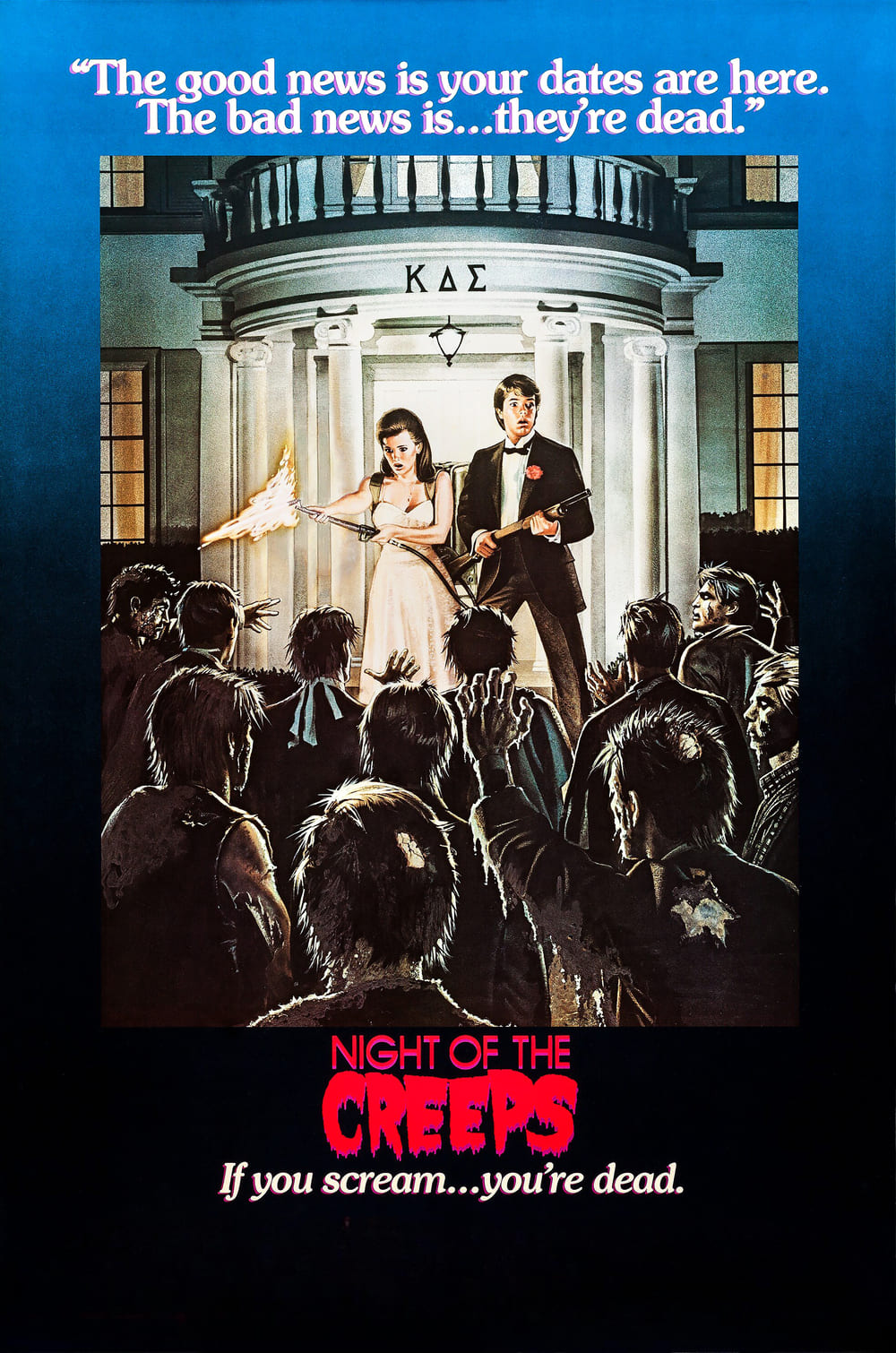
Horror Film Review: Night of the Creeps (dir. by Fred Dekker)


“Zombies, exploding heads, creepy-crawlies… and a date for the formal. This is classic, Spanky.” — Detective Ray Cameron

College is supposed to be a time for making questionable choices, but accidentally helping alien parasites invade campus probably falls outside the usual learning experience. That’s the basic joke behind Night of the Creeps, and Fred Dekker gets an impressive amount of mileage out of it. His 1986 horror comedy mixes the social embarrassment of a campus movie with the bodily violations of a creature feature, then throws in a detective who looks like he hasn’t enjoyed either company or daylight in years. The ingredients are familiar, but the combination has real personality. It’s messy, funny, occasionally touching, and much more interested in entertaining you than looking respectable.

Before the college kids get their chance to make everything worse, Dekker establishes that trouble has been brewing for decades. An opening aboard an alien spacecraft leads into a black-and-white stretch set in 1959, where young love runs into both an escaped axe murderer and an extraterrestrial experiment. It’s a wonderfully excessive introduction, almost daring you to question whether one movie needs all these threats. Somehow, the pieces fit. The opening establishes a history that will eventually catch up with the present, making the later outbreak feel like the continuation of a very bad night rather than a completely random disaster.

In 1986, Chris Romero, played by Jason Lively, has more ordinary concerns. He’s interested in Cynthia Cronenberg, played by Jill Whitlow, and figures pledging a fraternity might improve his romantic prospects. His best friend J.C., played by Steve Marshall, accompanies him on an initiation assignment to steal a corpse. This is, unsurprisingly, not a great plan. Their search brings them to a preserved body, and disturbing it helps unleash the alien slugs that drive the rest of the story. Dekker makes the escalation amusingly direct: Chris wants a more exciting social life, and the universe supplies one with considerably more decomposing flesh than he probably imagined.

The campus setting gives the movie an enjoyable contrast between petty problems and catastrophic ones. Fraternity status and romantic competition seem important until people start becoming breeding grounds for something from outer space. Still, the college-comedy material is also where the film feels most routine. The fraternity antagonists are obnoxious in predictable ways, and Chris spends a fair amount of time being the awkward underdog you’ve seen before. Lively keeps him sympathetic, but the character could use more spark. Cynthia is similarly likable without being especially developed. Whitlow gives her warmth, though the romance never becomes as engaging as the friendships surrounding it.

J.C. is a big reason those friendships work. Marshall brings a loose, teasing energy that makes his exchanges with Chris feel comfortable rather than written purely to deliver information. He can recognize that his friend is being ridiculous without making his affection seem conditional. That gives their relationship some substance beneath the jokes. In a lesser version of this movie, J.C. would exist only to encourage the romance and provide sarcastic commentary. Here, he becomes its emotional anchor. When the danger reaches him, the film briefly stops feeling like a harmless parade of genre references, and that change carries a genuine sting.

Tom Atkins gives the movie a different kind of personality as Detective Ray Cameron. He’s gruff, sarcastic, and seemingly irritated that another day has required his participation. Atkins knows exactly how to sell the dialogue, making “Thrill me” sound like the natural greeting of someone who expects disappointment and would appreciate being surprised. But Cameron isn’t just a collection of quotable lines. His connection to the events of 1959 gives his bitterness a history. Atkins lets that sadness sit beneath the swagger, which makes the character entertaining without reducing him to a tough-guy impersonation. He’s easily the strongest presence whenever he enters a scene.

Dekker deserves credit for allowing those feelings to coexist with the ridiculousness. Night of the Creeps has an obvious sense of humor about itself, but it doesn’t treat caring about its characters as another joke. The actors generally play the danger straight, leaving the comedy to emerge from their reactions and the increasingly unreasonable situation. That approach gives the darker moments room to land. The movie has heart, not because it pauses to insist on its importance, but because friendship and regret remain meaningful even when someone’s head might become a delivery system for space slugs.

The practical effects make that threat suitably unpleasant. There’s something especially nasty about creatures that don’t need to overpower you so much as find an opening, and the slugs turn an exposed mouth into a source of tension. The walking corpses have a grubby physicality that suits the film’s scrappy atmosphere. You can enjoy the craftsmanship while still appreciating how disgusting the result looks. The pacing isn’t quite as dependable: a few stretches of campus business delay the monster action, and the shifts between broad comedy and distress occasionally feel abrupt. Once the outbreak builds toward the formal dance, though, the movie finds the momentum it needs.

What ultimately makes Night of the Creeps work is that its foolish decisions have consequences worth caring about. Chris’s attempt to improve his college experience opens the door to a grotesque disaster, but Dekker doesn’t leave the story at “look what these idiots did.” He gives the characters reasons to stand by one another when their ordinary concerns become irrelevant. That makes the finale more satisfying than a simple procession of creature effects. The movie delivers its share of slime, corpses, and deadpan jokes, then leaves behind a surprisingly warm impression. For a story about things crawling inside people, it’s remarkably good company.
Retro Television Review: St. Elsewhere 1.22 “Addiction”


Welcome to Retro Television Reviews, a feature where we review some of our favorite and least favorite shows of the past! On Fridays, I will be reviewing St. Elsewhere, a medical show which ran on NBC from 1982 to 1988.  The show can be found on Hulu and, for purchase, on Prime!

This week, the first season comes to a close.

Episode 1.22 “Addiction”

(Dir by Mark Tinker, originally aired on May 3rd, 1983)

“To life,” Dr. Auschlander toasts towards the end of the finale of St. Elsewhere’s first season and the sentiment could not be more called for.

While Auschlander has spent the episode hanging out with a friend of his and getting into fights with disrespectful street punks, Dr. Morrison’s wife has been giving birth to their son.  While someone breaks into the supply room and takes off with a huge supply of drugs, Dr. White is sobbing and telling his estranged wife that he knows he has to get help for his addictions.  While one drug addict (Ralph Seymour) commits suicide by injecting an air bubble into his veins, Dr. Craig’s cocky son, Stephen (Scott Paulin), visits from medical school and turns out to be quite a weed-smoking, pill-popping drug user himself.  Ehrlich, assigned to show Stephen around the hospital and teach him what it’s like being a resident, considers telling Dr. Craig that his son has a drug problem but apparently decides not to.  Dr. Craig is very proud that his son is going to follow the family tradition of becoming a surgeon.  Meanwhile, Dr. Fiscus cheats on Shirley Daniels with Kathy Martin.  Fiscus, you idiot.

Life goes on at St. Eligius.  That’s was the theme of the finale and it’s also been the theme of the first season.  For all the bad things that happen, there are also good things.  Some patients die.  Some doctors are incompetent.  But babies are born and doctors like Morrison and Ehrlich and Chandler haven’t given up and are still trying to make the world a better place.  Dr. Auschlander may be terminally ill with cancer but he embraces life and we should all do the same.

It’s a good ending for an overall good first season.  There were a few weak episodes.  Dr. Samuels was a pretty annoying character and I’m a bit relieved to see that David Birney left the show after this season.  Ed Flanders can be a bit overly somber as Dr. Westphall and Howie Mandel is still one of the least convincing doctors that I’ve ever seen.  That said, Morrison, Ehrlich, Chandler, Nurse Daniels, and even Dr. White are interesting characters and I look forward to seeing what happens with them during season 2.  The season’s stand-out was definitely William Daniels as the pompous yet still likable Dr. Craig.  Other than the terrible storyline where he cheated on his wife (and I still claim that was a dream episode, like almost all of the stuff with Dr. Samuels), Dr. Craig was this season’s standout character.

Next week, we start season 2!

Retro Television Review: St. Elsewhere 1.21 “Baron von Munchausen”


Welcome to Retro Television Reviews, a feature where we review some of our favorite and least favorite shows of the past! On Fridays, I will be reviewing St. Elsewhere, a medical show which ran on NBC from 1982 to 1988.  The show can be found on Hulu and, for purchase, on Prime!

This week’s episode is a much better Dr. Craig episode than last week’s.

Episode 1.21 “Baron von Munchausen”

(Dir by Victor Hsu, originally aired on April 19th, 1983)

Anthony Rizzo (Louis Giambalvo) seems like a nice guy.  He’s admitted to the hospital with complaints of stomach pain and a high fever.  Dr. Morrison can’t find anything wrong with him but he does notice that Rizzo has a lot of scars.  Rizzo explains that he’s had a lot of surgeries over the course of his life and he’s got a story to go with each one of them.  Morrison brings in Ehrlich for a consult.  Ehrlich, who loves to perform surgery, suggests opening Rizzo up and doing an exploratory.  Morrison thinks it’s too early for that,  Rizzo, however, loves the idea.  Rizzo then proceeds to die on the operating table.

Ehrlich is shaken.  Morrison is angry.  However, Westphall and Craig take one look at the case and deduce that Rizzo suffered from Munchausen’s Syndrome.  For whatever reason, he was addicted to going to the hospital and having surgery.  He knew all the tricks, from using a light blub to make it look like he had a fever to pricking his finger with a needle to convince the doctors that there was blood in his urine.  It turns out that he died because of the drugs that he had been taking to help him fake his symptoms.  Both Morrison and Ehrlich are relieved to learn that Rizzo’s death was not their fault.

“So, Ehrlich lost his first patient today,” Craig says to Westphall.  “It won’t be his last.”

This was a good episode for Dr. Craig, especially after all that nonsense last week.  When Westphall finds himself in need of a doctor to speak to a group of inner city medical students, he is horrified to discover that Mark Craig is the only one available.  Craig accepts, saying that Westphall should have asked him earlier.

Westphall’s concerns are justified.  Dr. Craig is opinionated, wealthy, and more than a little prejudiced against …. well, everyone.  “My ancestors came here on the Mayflower!” Craig is quick to say.  And yet, the students love him, specifically because he doesn’t pretend to be anything that he isn’t.  Unlike Westphall, who tries give an inspiring pep talk, Craig is open about the reality of practicing medicine in what this episode refers to as being “the ghetto.”  When asked if his medical student son will be working in a ghetto clinic, Craig replies, “Why would he?”  Craig gets a standing ovation from the students, which felt like a bit much but whatever.  It was nice, for once, to see the show admitting that Craig’s blunt honesty can sometimes be more effective than Westphall’s noncommittal style of encouragement.

Afterwards, in a wonderfully acted scene, Craig asked Westphall why people don’t seem to like him,  Westphall shrugs and then says that Craig can be arrogant, rude, prejudiced, intolerant of other worldviews …. “Thank you, Donald,” Craig cuts him off.

Meanwhile, back at the hospital, a crazy woman (Micole Mercurio) is sent to the psych ward after threatening to kill Nurse Daniels.  (No, leave Shirley alone!)  Dr. Wendy Armstrong, who is one of the worst characters on this show, promptly discharges the woman and lets her leave the hospital.  “She threatened to kill me!” Shirley says while Wendy shrugs, unconcerned.  Fiscus also proves to be of no help, as he is once again feeling attracted to Kathy Martin.

Finally, Dr. White goes to a drug addict support group and walks out when things get too emotional.  Booo!  Dr. White is even worse than Dr, Armstrong!

This was a good episode.  Next week, the season finale!

Retro Television Review: St. Elsewhere 1.20 “Craig In Love”


Welcome to Retro Television Reviews, a feature where we review some of our favorite and least favorite shows of the past! On Fridays, I will be reviewing St. Elsewhere, a medical show which ran on NBC from 1982 to 1988.  The show can be found on Hulu and, for purchase, on Prime!

This week, Dr. Craig does the unthinkable …. maybe.

Episode 1.20 “Craig In Love”

(Dir by Victor Lobl, originally aired April 12, 1983)

Dr. Craig is indeed in love in this episode.  He’s totally smitten with the Hungarian Dr. Vera Anya and, when his wife Ellen (played by Bonnie Bartlett, real-life wife of William Daniels) goes out of town to visit her mother, Craig makes plans to show Dr. Anya around the town and maybe more….

Ugh.  Seriously, I don’t like the idea of Dr. Craig cheating on his wife and, though this episode leaves it ambiguous as to what actually happened, it totally appears that’s what Craig did over the weekend.  Dr. Craig is pompous and full-of-himself and rude to almost everyone he talks to but it’s always appeared that he totally loved his wife.  The whole idea of him thinking about cheating — much less actually doing it — just doesn’t seem right for his character.  And, quite frankly, Dr. Anya wasn’t really that intriguing of a character so if Craig did share more than just that passionate goodbye kiss with her …. well, I prefer to pretend this entire storyline didn’t happen.

Far more interesting was the malpractice suit brought against Dr. Chandler and Nurse Daniels.  As the hospital’s lawyer explains it, there really isn’t much of a case to be made for malpractice.  Instead, the dead man’s family is just hoping to get a quick settlement out of it.  Most doctors aren’t willing to pay the legal fees and don’t have the time to go to court.  Chandler, however, is personally offended by the suit and pledges to do whatever he has to do fight it.  Yay, Chandler!  Seriously, I hate people who try to bully people into settlements.  After my Dad died, there was this crazy woman who thought she could bully his estate into giving her half a million dollars.  Instead, she received nothing and that’s exactly what she deserved.  Both Denzel Washington and Ellen Bry gave good performances this week.  Ellen  Bry’s Nurse Daniels is quickly becoming one of my favorite characters.  She doesn’t let anyone push her around.

Speaking of pushing people around, Dr. Morrison finally got sick of Dr. White’s drug addiction and the two of them ended up having a fist fight in the men’s room.  Still, when White later crashed his girlfriend’s car and needed to be bailed out of jail, Morrison was the first person that he called.  Morrison, being a saint, got White out of jail.  White, being a jerk, barely even said thank you.  Morrison went to Westphall with his concerns about Dr. White.  Westphall responded that it wasn’t his place to give a fatherly lecture.  That’s cold, Westphall.  What about when he kills a patient because he’s high?  Will you care then?  No wonder St. Eligius is getting sued for malpractice!

Finally, Dr. Samuels had a cold so he spent the entire episode whining about it.  Seriously, Dr. Samuels is one of my least favorite characters of all time.

This episode was uneven for me.  I’m not happy about Dr. Craig being a cheater but I am happy that Dr. Chandler is standing up for himself.  Dr. White appears to be heading to a very dark place.

There’s only two episodes left in the first season so I’m assuming we’re going to get some sort of closure to at least some of these storylines.  We’ll see what happens next week!