As some of our regular readers undoubtedly know, I am involved in hosting a few weekly live tweets on twitter and occasionally Mastodon. I host #FridayNightFlix every Friday, I co-host #ScarySocial on Saturday, and I am one of the five hosts of Mastodon’s #MondayActionMovie! Every week, we get together. We watch a movie. We snark our way through it.
Tonight, for #MondayActionMovie, the film will be 1996’s D.N.A.!
If you want to join this watch party, just hop onto Mastodon, pull up D.N.A. on YouTube, start the movie at 8 pm et, and use the #MondayActionMovie hashtag!
Jason Shaw (Andrew Cheney) is an aspiring photographer who works as a clerk in a store owned by his sister, Ava (Erin Bethea). One day, Jason meets a woman named Mac (Rachel Hendrix) and it’s attraction-at-first-sight. That night, they go on a date and they have an amazing time. They start bonding instantly. Jason feels as if he’s finally found his soul mate. Unfortunately, the date ends with a car crash that leaves Mac dead.
The next morning, Jason wakes up without a scratch on him. Convinced that he’s just woken up from the most intense dream of his life, Jason goes about his day and he’s immediately hit by a sense of deja vu. He feels like he knows what people are going to say and do before they do it. Everything about the day feels very familiar. And then, once again, he meets Mac….
Yep, Jason is stuck in a Groundhog Day-style time loop. He relives the same day over and over again. Once Jason realizes that this is actually happening to him and that it’s not a dream, he assumes that he’s in the time loop to save Mac. But, no matter he does, the car accident always occurs and Mac always dies at the end of the night. Even when he specifically goes out of his way not to meet her and spends the entire day locked away in his apartment, he still sees a news story about her death in a car accident.
What if Jason hasn’t being sent through the time loop just to save Mac? What if there’s something else that he has to do first?
77 Chances is a sweet film. Yes, it does have a religious angle and that will probably turn off some viewers but who cares? Actually, when you think about it, the idea of God making someone live the same day over and over again makes more sense than the solutions that are typically offered up in time loop films. For my part, I appreciated that Jason wasn’t being forced to live the same day over and over again for the reason that everyone would naturally assume. I love Groundhog Day and Palm Springs but, for the most part, most time loop films suffer because they always tend to hit the same notes. 77 Chances works because it actually tries to do something unexpected with the idea.
77 Chances also works because of the chemistry between Andrew Cheney and Rachel Hendrix. They make for a cute couple and you really do hope that things will work out for them. They just seem to belong together. Rachel Hendrix, in particular, gives a strong and likeable performance as Mac. It’s interesting to see the different ways that she reacts to being approach by Jason over the course of the time loop. While Jason has spent months getting to know her, Mac has no idea who he is. Early on in the time loop, when Jason comes on too strong, Mac blows him off and tells him that his obsessiveness is creepy. Good for her!
77 Chances left me pleasantly surprised. It’s a sweet movie.
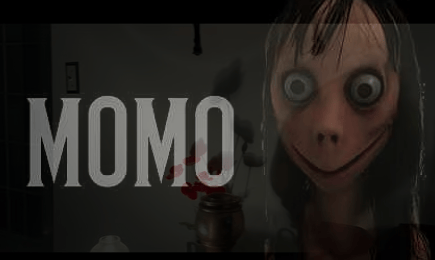
Momo is a home movie short; in fact, I have the same fridge. The short is straight forward- beginning, middle, and an end. A man hears a noise, gets a baseball bat, and jump scare.
I know some of you are gonna be like- Case, this is barely a film. I respond with “Relax”; he’s got some talent and he’s trying to make art. Also, it’s A LOT better than some that have a budget …. of any kind. Think on this, he made this with no budget and it had a clear story and payoff- that’s storytelling. I hope he tries to make something longer with a developed plot.
No, I have not gone soft. If it were bad, I’d say so- it’s fun.
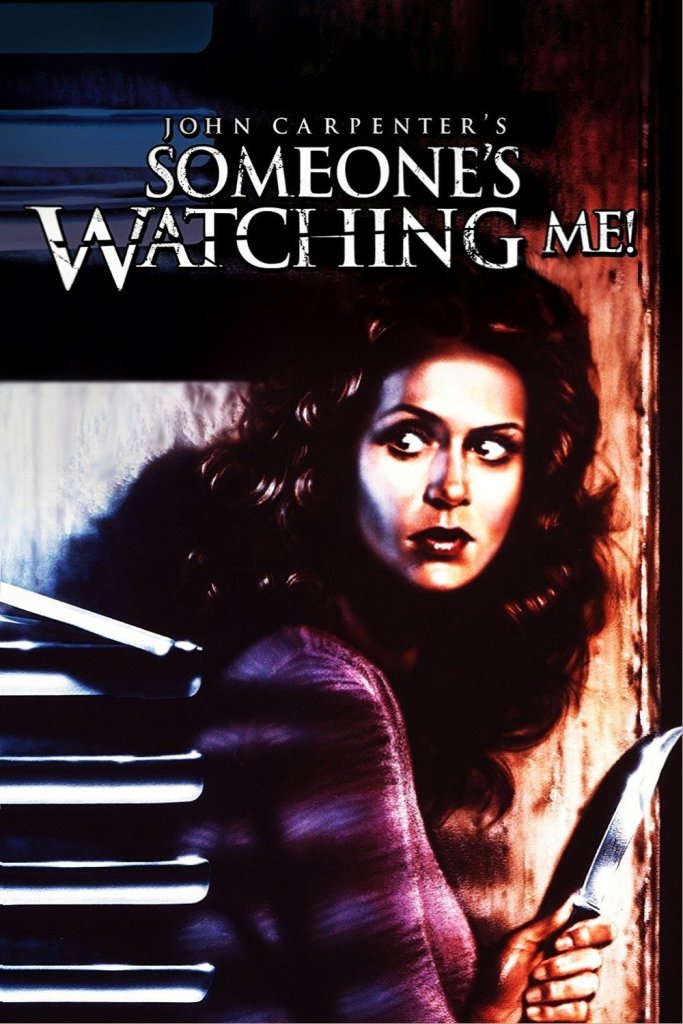
In my latest quest for a scary movie that looks interesting and that I haven’t seen, I came across the title SOMEONE’S WATCHING ME! from 1978. I did what I always do and did a quick search on IMDb to find out a little more about the film. I was definitely surprised when I saw that it was directed by John Carpenter, and that it premiered on television in November of 1978 a couple of weeks after his classic HALLOWEEN hit theaters. The film had been referred to as the “lost Carpenter film,” because for several decades it was not available on home video. For many years in the 80s and early 90s, I’d scour the shelves at my local video stores looking for that special find that I’d call a diamond in the rough. As I got older and married, whenever we’d go to Dallas, I’d head to the Movie Trading Company and scour their shelves searching for the same. Being a big fan of Carpenter, especially ASSAULT ON PRECINCT 13, ESCAPE FROM NEW YORK, and VAMPIRES, it was like I had found that lost jewel, and I couldn’t wait to fire it up.
Lauren Hutton stars as Leigh Michaels, a television director who moves into a high-rise apartment building in Los Angeles. She’s starting a new job and a new life, but things take on a creepy and scary turn when she begins receiving mysterious phone calls and unwanted gifts and letters. Before long, Leigh realizes that someone is watching her every move. Even worse, the police don’t seem very interested in helping her, leaving her to figure out who’s stalking her and what she can do to stop him.
First off, I really enjoyed Lauren Hutton as the lead in the film, which was a bit of a revelation for me. I remember her as the Countess in the 80s vampire comedy ONCE BITTEN, but I mainly remember that one because it was an early leading role for Jim Carrey. I’ve seen her in a lot of movies, but her characters had not stood out much to me. Here, as the focus of the movie, she’s likable, sexy and has this cute running dialogue with herself as she goes about her days. When bad things start happening, she’s not some helpless victim waiting for somebody else to rescue her, either. She’s smart, independent, and even tough enough to take matters into her own hands when she has to.
I also appreciate what John Carpenter is doing here as the writer and the director. A couple of years earlier, he had effectively played off of Howard Hawks with ASSAULT ON PRECINCT 13. This time he’s riffing on Alfred Hitchcock, especially movies like REAR WINDOW and VERTIGO. He accomplishes this through his settings, some of his shots, character traits, and especially, the building of tension. His premise is simple, but the idea that someone could be invading our privacy with bad intentions is a scary thought to all of us, and this movie takes it to the extreme. The screenplay builds on this natural fear with enough info that we realize our likable star is in true danger, and that was enough to draw me in. It also helps that I’m a sucker for these types of stories and characters. The made-for-TV limitations on the project are here, but Carpenter’s talent is also very evident. From the first moment I saw a shadowy character dash behind our heroine while she’s on the phone in her apartment, I knew he was going to have some fun with me. He would make me jump and my heart skip a beat several times over the course of the film’s 97 minutes.
It was also fun seeing some of the important actors and actresses that Carpenter has worked with over the years pop up in the movie. Adrienne Barbeau is especially likable and beautiful as Leigh’s friend and coworker, Sophie. She has this big smile and way about her that I found very appealing. She’s also a lesbian, which was probably a fairly unusual TV movie character trait at the time. Barbeau and Carpenter met on the set of this film and would get married less than a year later, on January 1st, 1979. Charles Cyphers, who’s so good as Sheriff Leigh Brackett in the HALLOWEEN series, shows up in the last half hour as the somewhat sympathetic Detective Gary Hunt. Cyphers also had a small, but pivotal role with Charles Bronson in DEATH WISH II, so I always enjoy seeing him on screen.
I’m not going to sit here and say that SOMEONE’S WATCHING ME! is as good as Carpenter’s classic theatrical features, but for me it was a fun discovery, and I really had a good time with it. The Hitchcock flourishes and Hutton’s excellent performance as our heroine, combined with Carpenter’s obvious talents as a writer and director, provided me with the kind of rare cinematic jewel that I had not found in a long time.
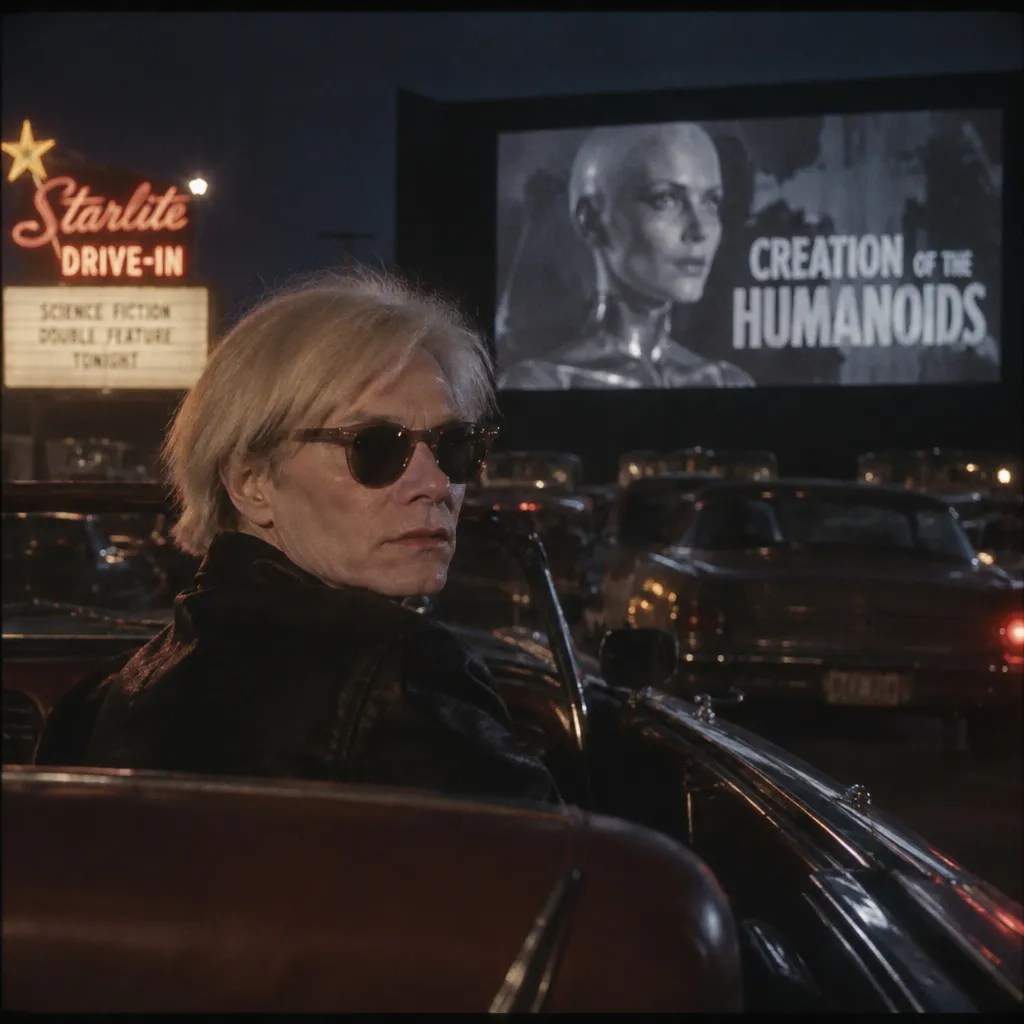
What makes us human? What does it mean to have free will? What is love? What is freedom? The questions and more are asked in the low-budget (and rather odd) science fiction epic The Creation of the Humanoids, which you can view below!
Now, I should warn that Creation of the Humanoids is an extremely talky film. And the plot is occasionally difficult to follow. There’s a lot of ennui to be found in this particular film, both from the humans and those who have been built to serve them However, I find it impossible not to love this one because it’s just such a strange movie. I love it for the colorful set design, the contrast between the resentful robots and the paranoid humans, and the fact that the film — despite being made for next to nothing — actually has more ambition than anything ever made by several of the more successful directors working today. And, while it may not really be a horror film in the way that some of our other October films are, it still feels appropriate for the Halloween season. It just has the perfect holiday atmosphere.
First released in 1962, Creation of the Humanoids was reportedly one of Andy Warhol’s favorite films. Keep an eye out for Plan 9 From Outer Space‘s Dudley Manlove.
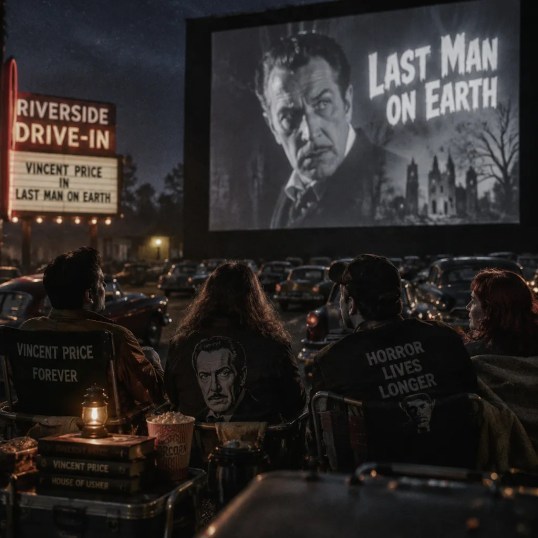
Today, I present to you one of the most important films in horror history. Though it wasn’t appreciated when it was first released back in 1964, The Last Man On Earth was not only the 1st Italian horror film but George Romero has also acknowledged it as an influence on his own Night of the Living Dead.
It’s easy to be a little bit dismissive of The Last Man On Earth. After all, the low-budget is obvious in every scene, the dubbing is off even by the standards of Italian horror, and just the name “Vincent Price” in the credits leads one to suspect that this will be another campy, B-movie. Perhaps that’s why I’m always surprised to rediscover that, taking all things into consideration, this is actually a pretty effective film. Price does have a few over-the-top moments but, for the most part, he gives one of his better performances here and the black-and-white images have an isolated, desolate starkness to them that go a long way towards making this film’s apocalypse a convincing one. The mass cremation scene always leaves me feeling rather uneasy.
The film is based on Richard Matheson’s I Am Legend and no, it’s nowhere as good as the book. However, it’s still a worthy adaptation and one that stays true to the tone of the text, including the fact that Price’s main tormenter was also once his neighbor and best friend. This is one of those films that just hits differently in the wake of 2020’s COVID hysteria.
And now, it’s time for The Last Man On The Earth….
Today’s song comes the hypnotic soundtrack of Paul Schrader’s Cat People. This song was so good that it later showed up and was used to equally strong effect in Quentin Tarantino’s Inglourious Basterds.
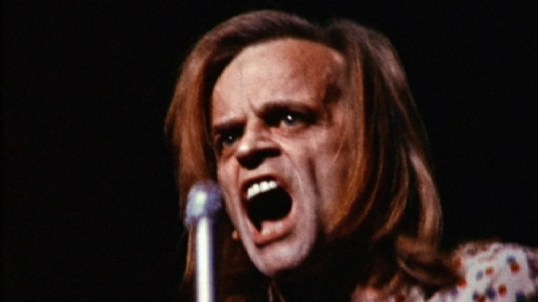
From the 1960s until his death in the early 90s, German actor Klaus Kinski was known for being the enfantterrible of world cinema. Kinski was a volatile talent, an often angry and occasionally violent performer who specialized in playing extreme characters and who reportedly took pride in his ability to drive directors crazy. Kinski appeared in good films and bad films and, in every one of them, he gave the type of unique performance that only he was cable of giving.
Kinski is best-remembered for his work with his frenemy, Werner Herzog. When Herzog and Kinski weren’t making films together, they were often criticizing each other in the press and sending one another death threats. In the documentary My Best Fiend, Herzog documented his partnership with Kinski. Even while Herzog talked about the time that he went to Kinski’s home with the intent of killing him, Herzog’s affection for his frequent star was obvious. Klaus Kinski was one of an unhinged kind.
In Werner Herzog’s 1980 film, Nosferatu, Kinski played the role of Dracula. In this scene, he comes to visit Isabelle Adjani’s Lucy.
In 2017’s Run, Levi (Josiah David Warren) marries Natalie Winters (Taylor Murphy). Natalie is a journalist who has made it a point to report on the growing problem of human trafficking. Her journalism makes her a target for low-life criminals like Jeff Connors (Stephen Baldwin). On their wedding night, Natalie is abducted by two men who are planning on selling her into sex slavery.
The police are useless. So is the FBI. It looks like Levi is going to have to rescue his wife on his own. While Natalie prays in the back of the van in which she’s being held prisoner, Levi hits streets, putting up missing posters and talking to motel maids.
Now, I’m going to post a spoiler here. You can stop reading now, if you want. Otherwise, you have been warned.
Levi does find his wife. He finds her because he just happens to be in the parking lot of a Florida motel when a maid walks by wearing his wife’s scarf. She tells him that she found it in a room. (No judgment from me! For one summer, I lived in a motel with my mom and my sisters and my mom paid for our board by working as a maid. Apparently, people leave stuff behind all the time.) The maid then goes on to say that she saw the van pulling out of the parking lot. She gives a perfect description of the make and the model. She recites the license plate number without hesitation. She then tells Levi exactly which street the van went down and which direction they were heading. Levi then manages to easily track the van down and get the police involved.
WHAT LUCK!
I mean, seriously, for all the time that this movie devoted to Levi trying to find his wife, it all comes down to one maid finding a scarf. I’m sure that some would argue that this is meant to be proof that God arranged for the maid to be in that parking lot at the exact same time as Levi. That’s fine. In the movie, it comes across as being a huge dues ex machina …. which is exactly the same thing, now that I think about it.
Anyway…..
Josiah David Warren has directed a handful of faith-based films and I have to admit that, as a reviewer, I haven’t always been kind to them. Warren’s biggest mistake is that he always casts himself in the lead. He’s not a particularly good actor and, with his perpetually tired expression and unshaven appearance, he tends to come across as being more a stoner than a preacher.
While that continues to be true here, Run is still better than the average Josiah David Warren film. The plot is full of contrivances and the editing is haphazard but Taylor Murphy gives a sympathetic and likable performance as Natalie. For that matter, the often-mocked Stephen Baldwin is convincing as the cocky and dangerous Connors. Baldwin doesn’t get much screentime but he sets a wanted poster on fire with skill and style.
Finally, I appreciated that the film ended on a note of forgiveness and redemption, indicating that there’s hope for everyone. That’s a good message and not one that seems to be particularly popular right now. The film deserves credit for that.
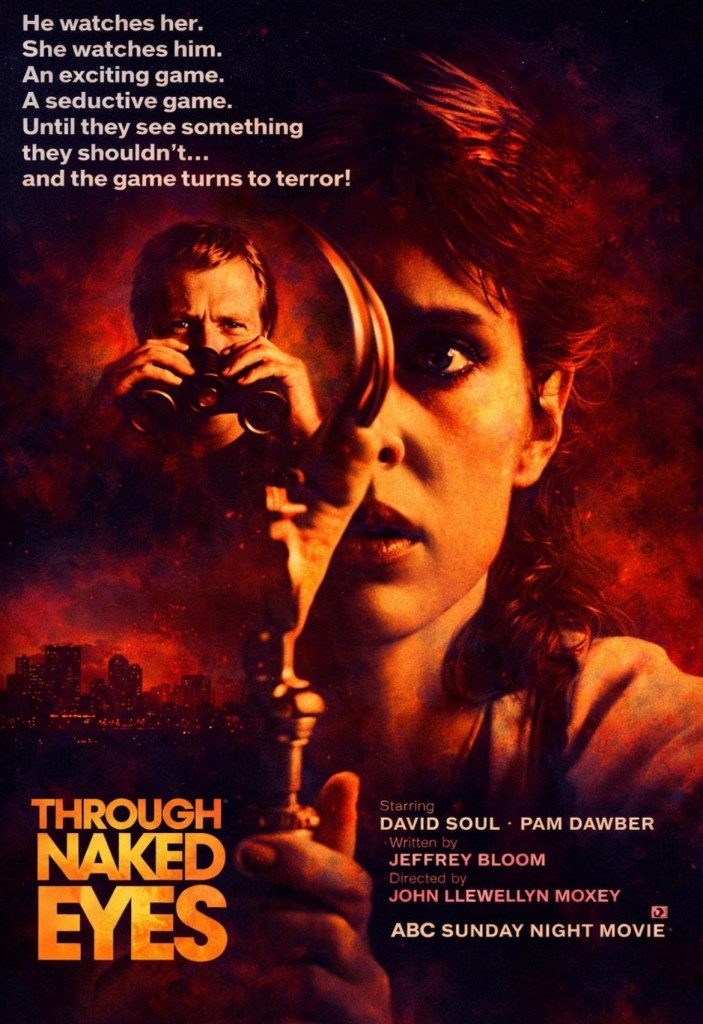
One of the coolest things about being a contributor for The Shattered Lens is the month of October and our Horror-thon. I’m constantly on the lookout for less well-known thrillers that I can watch and write about. I recently came across the 1983 made-for-TV thriller THROUGH NAKED EYES. The premise gives off some definite REAR WINDOW vibes, a favorite of mine, and I’ve always enjoyed the actor David Soul. Having never seen the film, or even heard about it before, I thought I’d give it a shot.
Soul plays William Parrish, a talented flutist who spends most of his time practicing his craft, while still carving out a few moments to pull out his binoculars and check out some of the people who live in the apartment building across the street. One night, he discovers that an attractive woman, Anne Walsh (Pam Dawber), is also watching him through her very nice telescope. Through a variety of circumstances, the two voyeurs meet and begin a relationship. By the way, did I mention that there have been a series of knife murders in the neighborhood, even in William’s own apartment building? And that the detective in charge of the investigation has our musician in his sights as the number one suspect? Of course the fun is watching the suspects and clues pile up as the story plays out!
THROUGH NAKED EYES is one of those movies that snuck up on me. It took a little bit of time for me to get into it as I watched our main character play his flute, practice his flute and sweat profusely. Set in Chicago, they are really trying to make the point that it’s HOT. Everyone is so sweaty. They’ll be having symphony practice and William’s shirt will be so wet that it looks like he just ran a marathon. It was over 100 degrees in Arkansas for 22 days this past summer, and I’ve never been that sweaty inside a building. I guess the AC was spotty in the Windy City back in the early 80s. We also spend time in Anne’s life as we follow her job as guide at the planetarium, as well as her dealings with her sleazy literary agent who’s helping her get some articles published in National Geographic. Seriously dude, that mustache is just creepy. Once we get past all this setup and the two meet, have dinner, and make love, the thriller elements start getting a lot more interesting as the stakes get a lot higher! I won’t say anymore, but I got wrapped up into the story and really enjoyed the last hour.
David Soul gives a strong performance in the film, one that I appreciated more and more as I got to know his character. To be honest, at first he seems pretty darn creepy, but he turns out to have a lot more depth than you might initially think. Pam Dawber, best known to me for MORK & MINDY, is cute, kind, and even sexier than I remembered in her role as the voyeur who had her own little obsession going on. I will admit that it sounded a lot more innocent, and less creepy, when her character explained herself. It convinced me for sure!
The supporting cast in this film is tremendous, and certainly adds to my enjoyment of the film. Fionnula Flanagan has an excellent scene where her shrink character provides a more balanced perspective on our number one suspect. Gerald Castillo is good as the obsessed cop with blinders on for everything except getting his man, who he believes is William. I recognized Castillo from his performances as cops in several Bronson films of the 80s. My favorite scene in the entire film completely surprised me and it involved a scene between William and his estranged dad, played by William Schallert. I love a good, emotional father / son scene. You can even play a game of “spot the future stars” as John Mahoney, Dennis Farina, and Ted Levine play various Chicago police officers throughout the film. It was fun every time one of them would pop up.
If it’s not obvious, I had a good time with THROUGH NAKED EYES. The film does a good job of taking its time and letting us get to know these characters in a way that helps us see them differently as the story plays out. In other words, the film’s drama is effective. It also stretches out the suspense appropriately so that we stay invested in the thriller elements as well. As a viewer, I actually cared about what would happen at the end. Nothing says you enjoy a movie like caring about the outcome, and this one was a very nice discovery for me.