October True Crime: Amish Stud: The Eli Weaver Story (dir by Stacey N. Harding)


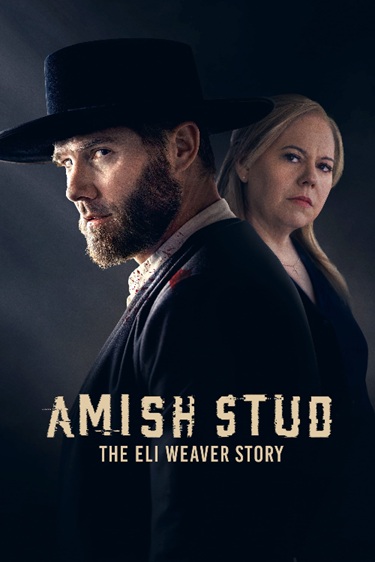
When Barbara Weaver (Miranda MacDougall) is found shot to death in her own home, the police have a difficult task ahead of them. It’s not that there’s any real question as to who probably killed Barbara. Everyone seems to know that Barbara’s husband, Eli (Luke Macfarlane), was a serial philanderer and that Barbara was on the verge of revealing all of his sins to the members of their community. The problem comes from the fact that the community in question is the Amish community and no one is willing to work with a bunch of outsider detectives. Only Barbara’s sister, Abigail (Clare Filipow), seems to be willing to help the detectives prove that Eli and his mistress, Barb (Kirsten Vangsness), were responsible for Barbara’s murder. The investigation reveals that, online, Eli Weaver was known as “Amish Stud” and that he had a long history of cheating.

Amish Stud: The Eli Weaver Story originally aired on Lifetime in 2023. Over the past few years, Lifetime has aired several films about the sordid lives of the Amish. It actually started out on a good note, with a film about the 2006 Amish schoolhouse shooting that emphasized the importance of community and also the power of forgiveness. Since then, the films have grown steadily more melodramatic, with the emphasis usually on Amish women who want to hit the clubs and Amish men who turn out to be full-blown stalkers. One has to feel a bit sorry for the Amish, who for the most part seem like they just want to be left alone and who try not to bother anyone. The truth of the matter is that the outside world will always be fascinated by the Amish. Some of it is because it’s hard to imagine a community living without the technology that the rest of us take for granted. In fact, it’s so hard to imagine that a lot of films about the Amish seem to be determined to prove that the Amish really aren’t so old-fashioned. On Lifetime, Amish communities are regularly portrayed as being a hotbed of sex and betrayal, and one often gets the feeling that a lot of that is because they don’t have to worry about the Amish watching the movie and then hopping on social media to discuss how offended they are.

(For the record, I don’t know any Amish people. I live in Texas. We have quite a few Mennonites, but I haven’t spent much time in any of their communities. I do plan on ordering some of their furniture in the future.)

With all that in mind, I should mention that Amish Stud is based on a true story. Luke Macfarlane plays Eli as being someone who is not particularly religious but who sticks with his Amish community because he knows he would probably end up broke and homeless if he tried to live among the English. The film emphasizes that Eli is not just sleazy but he’s also extremely dorky and needy, and that’s not a good combination by any stretch of the imagination. When Barbara goes to the Bishop about Eli’s cheating, she’s told that it’s her fault for not being a good enough wife. Yikes! It’s a well-made true crime story, featuring good performances from Macfarlane, MacDougall, and Kirsten Vangsness. Watching the film, it occurred to me that Eli really wasn’t that much different from all of the other philandering and untrustworthy husbands and boyfriends that have appeared in countless Lifetime films. He just happened to be Amish. If he hadn’t been Amish, it’s doubtful anyone would have paid that much attention to the story.

As for the real Eli Weaver, he’s currently serving 15 years to life in an Ohio prison. He was denied parole in 2024. His next parole hearing will be in 2032.
Horror Film Review: Daughter of Dracula (dir by Jesus Franco)


In a town off the coast of Spain, women are being murdered and their bloodless bodies left on the beach. A journalist named Charlie (Fernando Bilbao) investigates and discovers that the locals are convinced the killings are the work of a supernatural entity. Meanwhile, the aristocratic Karlstein family gathers at a chapel where the dying Countess Karlstein gives her daughter, Louisa (Britt Nichols), the key to the basement. There, Louisa discovers not only Count Dracula (Howard Vernon) but also her vampirized cousin and lover, Karine (Anne Libert).

The Karlstein family is under a vampire curse. Or maybe they’re not. It’s not always easy to follow this film’s logic. The Countess’s personal secretary (played by the film’s director, Jess Franco) is convinced a curse is at work, but Count Karlstein (Daniel White) appears to be not a vampire but simply a typical self-indulgent aristocrat. (Indeed, it’s sometimes hard to figure out how exactly Dracula ended up in the basement to begin with.) Count Karlstein is also a leading suspect in the murders. He has an alibi for at least one of them, but revealing it would mean admitting he’s been having an affair with Ana (Yelena Samarina), the secretary’s wife…

Yes, this is indeed a Jess Franco film. Even if you didn’t already know, the long, languid (and occasionally out-of-focus) shots of the Spanish beach would give it away. This was one of the eight films Franco shot in 1972, and the storyline has that incomplete feeling that often comes from a rushed production. Franco clearly had a few elements he either wanted or was contractually obligated to include: vampires, lesbians, and decadent aristocrats. A coherent plot doesn’t appear to have been a major concern. Daughter of Dracula has an improvised feel, as if Franco was making the story up as he went along. I suspect that’s exactly what he was doing.

And yet, as was often the case with Franco’s work (especially in the early ’70s), the loose structure and nonsensical plot actually work to the film’s advantage. There’s a dream-like quality to the action, one in which everyone seems to be moving either too slowly or too quickly. The atmosphere of ennui is inescapable. The Karlsteins are an aristocratic family trapped in an inescapable state of decay, and one could argue they’re meant as a stand-in for Old Europe, already being challenged by the ’70s counterculture. That decay is mirrored in Howard Vernon’s world-weary Dracula. Both the Karlsteins and Dracula are creatures from a different age who have found themselves in a rapidly changing Europe. When this film was made, Spain was still ruled by General Francisco Franco, but even he seemed to understand that his time was coming to an end.

Daughter of Dracula is ultimately a lesser Franco film. The version I saw ran a little over 70 minutes and still felt a bit too slow for its own good. It never reaches the decadent heights of Female Vampire or A Virgin Among the Living Dead. That said, Howard Vernon is always entertaining, and the film definitely sprang from the mind of Jess Franco. For better or worse, there was no other filmmaker like him.

Horror Film Review: The Blair Witch Project (dir by Daniel Myrick and Eduardo Sanchez)


Do you remember The Blair Witch Project?

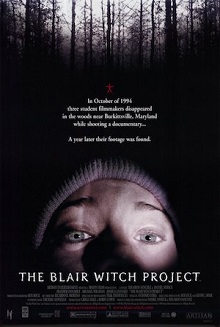
Yeah, I know you remember the movie. I know you remember that it’s a found-footage film about three people who go into the woods to make a documentary about a legendary figure known as the Blair Witch. They end up getting lost in the woods, and then eventually two of them end up running around and finding a house where they presumably fall victim to the witch. Later, their film was found even as they remained listed as “missing.”

But do you really remember what a big deal this movie was back in 1999? In today’s cynical age, it can be easy to forget just how big a deal The Blair Witch Project was when it was first released. It was one of the first films—perhaps the first—to truly take advantage of the Internet as a marketing tool. Whereas other films, up to that point, would just have a simple webpage where you could read bios about the actors and spend ten minutes waiting for a clip from the movie to load, The Blair Witch Project had a web page that didn’t even seem to realize that it was advertising a film. Instead, it was all about the legend of the Blair Witch and how three young people were missing. Today, we’re used to viral hoaxes. In 1999, though, the Internet was still a new enough thing to most people that there was an assumption that anything you saw online had to be real. If you saw a web page saying that Heather Donahue, Joshua Leonard, and Michael Williams had disappeared, then the assumption was that they had really disappeared. It can be hard to remember today, but there were once very serious debates about whether or not The Blair Witch Project was real or if it was just a film.

Today, of course, we all know it was just a film. Joshua Leonard, who was the first of the three to die and whose fingers were apparently chopped off by the witch, has subsequently gone on to be a busy character actor, and he appears to still have all of his fingers. Michael C. Williams is also still acting and apparently also worked as a high school guidance counselor after throwing away the map that would have helped him, Joshua, and Heather find their way out of the forest. Heather Donahue, who famously said, “I’m so scared,” while filming herself at night, has retired from acting but is still occasionally interviewed. They’re all alive! Yay!

Today, it’s hard to watch The Blair Witch Project without thinking about the hundreds of found-footage films that followed in its wake. Like all successful (and/or good) films, The Blair Witch Project made it look easy and, as a result, a lot of people have tried to do the same thing with varied success. (It’s also easy to forget what a big deal the first Paranormal Activity film was.) Seen today, the film’s flaws are easy to spot. The dialogue was largely improvised and, as is so often the case with improv, this leads to a lot of scenes that don’t really seem to go anywhere. And yet, there’s still a certain power to the film. It does capture the frustrating feeling of being lost, and the final run through the house is still effectively creepy. The film’s power has been diluted by 27 years of imitation, but it still works on a very basic level.

That said, the main feeling that one gets from The Blair Witch Project is one of nostalgia. For a film about a witch that kills children and film students, it’s a surprising reminder of a more innocent time. There was a time when people truly believed in the Blair Witch.

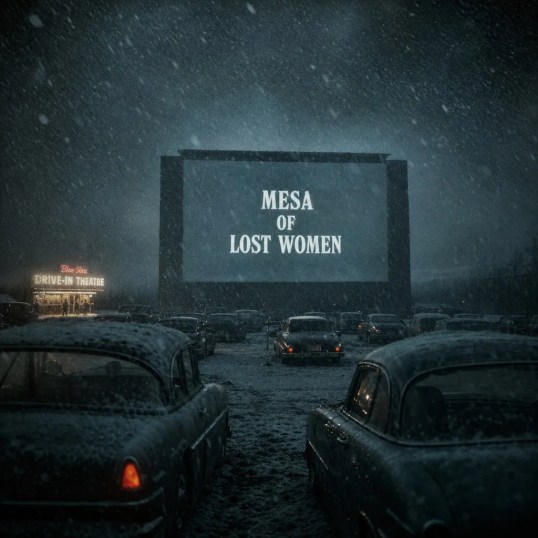
Bonus Horror on the Lens: Mesa of Lost Women (dir by Herbert Tevos and Ron Ormond)


Off in the middle of the desert, Dr. Aranya (Jackie Coogan) is conducting dangerous experiments that are resulting not only in giant spiders but also a master race of superwomen who Aranya is planning to use to conquer the world or something.

1953’s Mesa of Lost Women is a bit of a disjointed film.  It was originally filmed by a German director named Herbert Tevos, who claimed to be an associate of Erich Von Stroheim’s and a former collaborator of Marlene Dietrich’s.  However, despite his claims of being well-connected, no one was particularly impressed with Tevos’s first cut of the film so Ron Ormond was brought in to film additional scenes, the majority of them featuring Jackie Coogan as the insane Dr. Aranya.  Jackie Coogan was, at the time, still best-known for playing The Kid in the Charlie Chaplin film of the same name.  After Mesa, he would go on to play Uncle Fester on the original Addams Family.

Anyway, Mesa of Lost Women is one of those B-movies that simply has to be seen and heard to be believed.  (Lyle Talbot provides the narration, which is judgmental even by the standards of the 1950s.)  Enjoy Mesa of Lost Women!

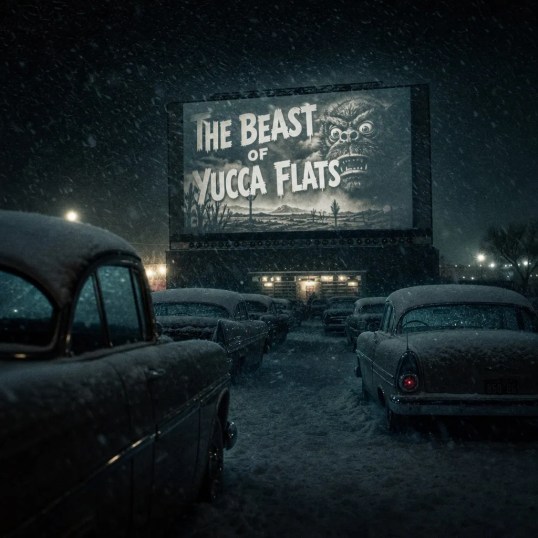
Horror On The Lens: The Beast of Yucca Flats (dir by Coleman Francis)


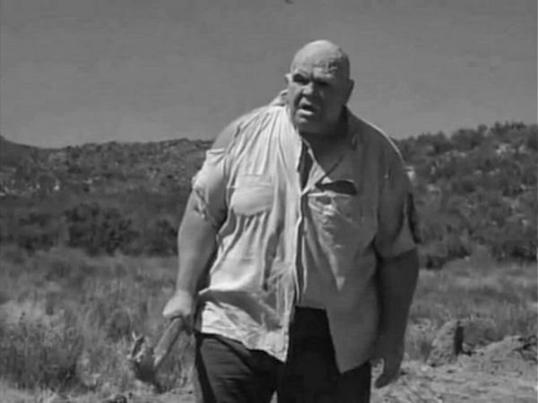
Since today would have Tor Johnson’s birthday, it seems appropriate to sahre the one film in which he starred, 1961’s The Beast Of Yucca Flats.

The Beast of Yucca Flats is a thoroughly inept film that makes next to no sense and has massive continuity errors.  It’s a film that also features Tor Johnson as a Russian scientist who gets mutated by radiation and becomes a monster, but not before taking off almost all of his clothes while walking through the desert.  For that matter, it’s also a film about a family that comes together though adversity — namely, being shot at by the police after the family patriarch is somehow mistaken for Tor Johnson.  And finally, it’s the story of how a dying monster can find comfort from a rabbit and that’s actually kind of a sweet message.

Here’s the thing — yes, The Beast of Yucca Flats is bad but you still owe it to yourself to watch it because you will literally never see anything else like it.  Plus, maybe you’ll be able to figure out what the whole point of the opening scene is.

Because I’ve watched this film a few times and I still have no idea!  But I always tear up when Tor reaches out for that rabbit.

Enjoy!

Join #MondayMania For The Killer Downstairs!


Hi, everyone!  Tonight, on twitter, I will be hosting one of my favorite films for #MondayMania!  Join us for 2019’s The Killer Downstairs!

You can find the movie on Prime and then you can join us on twitter at 9 pm central time!  (That’s 10 pm for you folks on the East Coast.)  See you then!

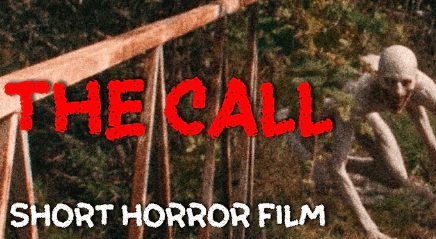
The Call, Short Film Review by Case Wright


If a man wakes up in the woods and no one cares, did a film even happen? Well sadly, this film was made because we don’t have quality control over whom gets to use the iPhone video camera app. We really need some punishment, if you make a film like this. I’m NOT saying beatings…BUT what if we don’t break the skin?

A man wakes up in the woods and monster who mimics human voices chases him. I understand that some of you are thinking Appalachian horror, but you can’t because you will only encourage him and filmmakers like him. We can’t let this become a trend. Just, NO! We already have Alex Magana; he exists- AMONG US! If we get together, we could devise a plan to hide this man’s phone: PROBLEM SOLVED!

Horror Song of the Day: Main Theme From Psycho by Bernard Herrmann


Today’s horror song of the day really needs no introduction.

From 1960, here is the main theme from Alfred Hitchcok’s Psycho, composed by Bernard Herrmann.

Horror Scenes that I Love: Tor Johnson In The Unearthly


We honor the birthday of Tor Johnson with today’s scene of the day.

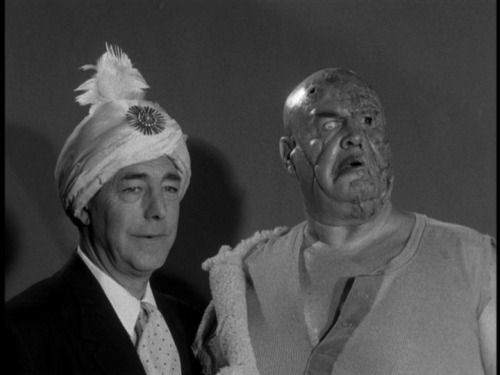
Even though Tor Johnson is playing a character named Lobo, today’s scene that I love isn’t from Ed Wood’s 1955 film, Bride of the Monster. Instead, it’s from 1957’s The Unearthly. In this film, Lobo is now John Carradine’s servant. (Lobo made quite a career out of working for mad scientists.) The Unearthly was directed by Boris Peftroff, a friend of Wood’s, so it’s not improbable that this film’s Lobo was meant to be the same Lobo as the one who appeared in Bride of the Monster and Night of the Ghouls.

Anyway, in this scene, Tor does his usual Lobo stuff while John Carradine plays the piano. “Time for go to bed,” Lobo says at one point, a much-mocked line but one that is delivered with a bit of gentleness by Tor Johnson. My point is that Tor did the best that he could and bless him for it.

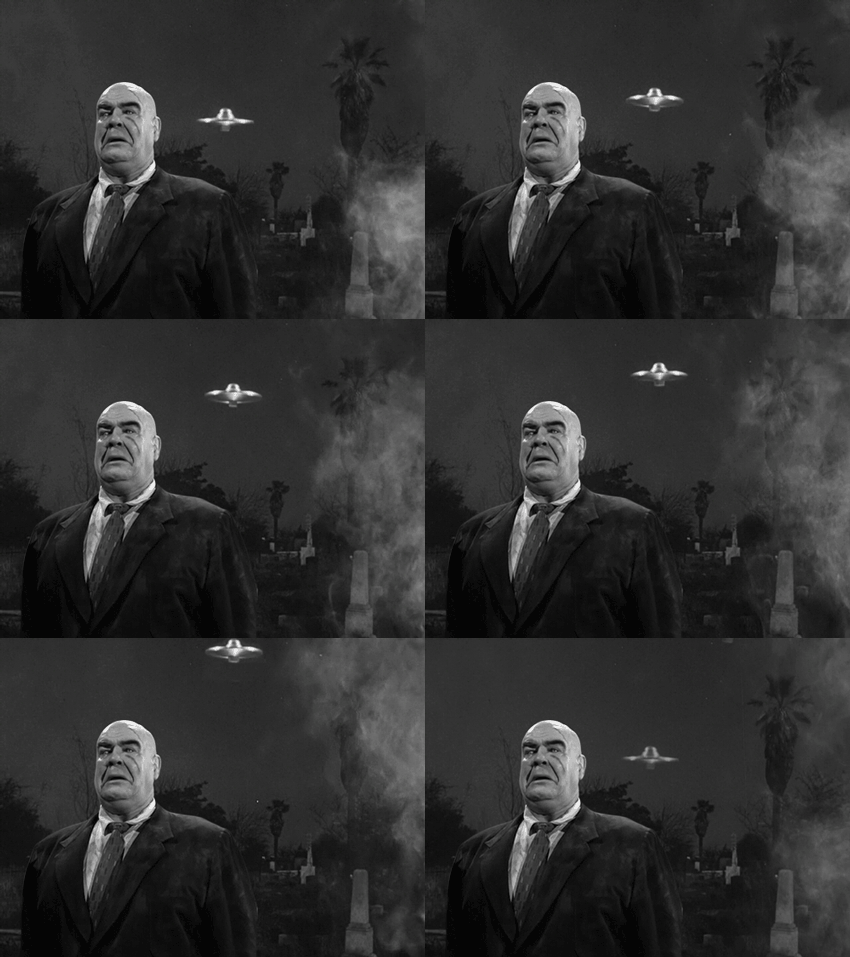
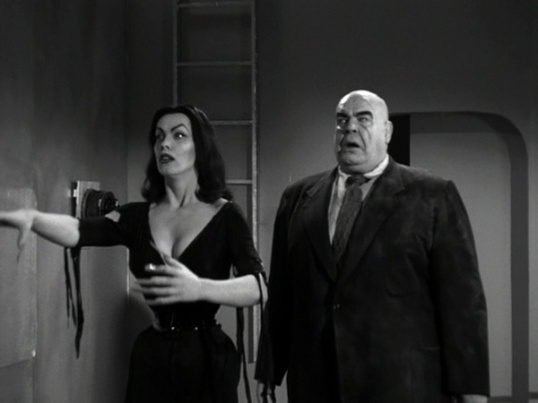
4 Shots From 4 Horror Films: Special Tor Johnson Edition


4 Shots From 4 Films is just what it says it is, 4 shots from 4 of our favorite films. As opposed to the reviews and recaps that we usually post, 4 Shots From 4 Films lets the visuals do the talking.

Today is Tor Johnson’s birthday so it just seems appropriate to present….

4 Shots From 4 Tor Johnson Films

Bride of The Monster (1955, dir by Ed Wood)

Plan 9 from Outer Space (1959, dir by Ed Wood)

Night of the Ghouls (1960, dir by Ed Wood)

The Beast from Yucca Flats (1961, dir by Coleman Francis)