During the height of his popularity in 1976, Charles Bronson tried something quite different with this romantic comedy costarring his wife Jill Ireland. And to be honest, he’s darn funny in the role. This movie has grown on me over the years.
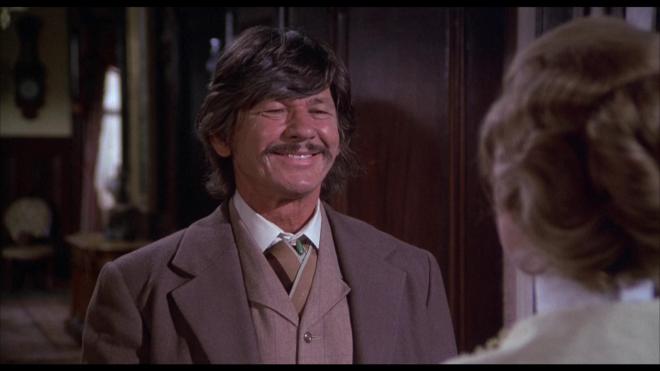
Bronson plays Graham Dorsey, a bank robber who spends an afternoon with the lonely widow Amanda Starbuck (Ireland) while his gang is robbing a bank in town. After his gang is all killed during the robbery, Dorsey must take off and go into hiding, eventually being arrested for impersonating a quack dentist. While he’s in jail, and through a variety of circumstances, a book is written about their afternoon together and it becomes an international sensation. As soon as Dorsey gets out of jail, he goes back to Starbuck’s home to rekindle their affair. Unfortunately for Dorsey, the book has created such a legend of him and their affair that Ms. Starbuck doesn’t even recognize the man he really is. His method of convincing her that he’s the “real” Graham Dorsey is the funniest moment in Bronson’s entire filmography.
Charles Bronson & Jill Ireland are clearly having a wonderful time making this movie together, which is one of the main reasons I enjoy the film. He may not have done it often, but Bronson could play comedy and he’s excellent in this film cast completely against his normal type. Jill Ireland is also very good as the widow Starbuck and her rendition of the song “Hello and Goodbye” was even nominated for a Golden Globe for Best Song. We had the privilege of interviewing Jill Ireland’s niece, Lindsay Ireland, and she told us of singing this song with her aunt Jill and her cousin when she would spend summers with them in Vermont in the 70’s. It’s so fun for me to hear firsthand about those times when the Bronson’s were one of the biggest celebrity couples of the world! The best part, Bronson valued his time with his family over anything else. They were everything to him.
**BONUS CONTENT** – I’ve included a link to the “This Week in Charles Bronson” podcast episode where Lindsay Ireland describes her time with her aunt Jill Ireland, and how they would sing “Hello & Goodbye,” the song that was in FROM NOON TILL THREE, while they were driving down the roads in Vermont. It’s a really nice insight into Jill Ireland.
“The Don is Dead!” shouts the title of this 1973 film and it’s not lying.
After the powerful and respect leader of the Regalbuto crime family dies, the Mafia’s governing body meets in Las Vegas to debate who should be allowed to take over the family’s operations. Frank Regalbuto (a smoldering Robert Forster) wants to take over the family but it’s agreed that he’s still too young and hot-headed. Instead, control of the family is given Don Angelo DiMorra (Anthony Quinn), an old school Mafia chieftain who everyone agrees is a man of respect. Don DiMorra will serve as a mentor to Frank while Frank’s main enforcers, The Fargo Brothers, will be allowed to operate independently with the understanding that they will still respond if the mob needs them to do a job. Tony Fargo (Forrest) wants to get out of the rackets all together while his older brother, Vince (Al Lettieri), remains loyal to the old ways of doing things.
Frank is not happy with the arrangement but he has other things to worry about. He knows that there’s a traitor in his family. While he and the Fargo brothers work to uncover the man’s identity so that they can take their revenge, Don Angelo falls in love with a Vegas showgirl named Ruby Dunne (Angel Tompkins). However, Ruby is engaged to marry Frank and, when Frank returns from taking care of the traitor, he is tipped off as to what has been happening in his absence. Frank goes crazy, nearly beating Ruby to death. Don Angelo declares war on Frank and the Fargo brothers are forced to decide which side they’ll serve.
In the 1970s, almost every crime film was either a rip-off of The French Connection or The Godfather.The Don Is Dead is unique in that it attempts to rip off both of them at the same time. The film opens French Connection-style with a couple of hoods trying to double-cross Frank during a drug deal, leading to shoot-out. (Keep an eye out for Sid Haig as one of Frank’s men.) The film is full of scenes that are meant to duplicate the gritty feel of The French Connection though, needless to say, none of them are directed with the cinema verité intensity that William Friedkin brought to that classic film. Meanwhile, Anthony Quinn plays a character who is very much reminiscent of Don Vito Corleone, even pausing at one point to tell Frank that “drugs are a dirty business.” The Godfather‘s Abe Vigoda and Al Lettieri show up in supporting roles and Robert Forster gives a performance that owes more than a little to James Caan’s Oscar-nominated turn as Sonny Corleone. (Interestingly enough, both Quinn and Forster were among the many actors considered for roles in The Godfather.)
Unfortunately, the film itself is slowly-paced and never really draws us into the plot. Director Richard Fleischer, who directed a lot of films without ever developing a signature style, brings none of the intensity that William Friedkin brough to The French Connection nor can he duplicate Francis Ford Coppola’s operatic grandeur. The Don is Dead plays out like a particularly violent made-for-TV movie. There’s a lot of talented people in the cast but they’re defeated by thinly drawn characters. Robert Evans often said that Coppola was hired to direct The Godfather because, as an Italian-American, he would bring an authenticity to the material that a non-Italian director would not be able to do. The Don Is Dead would seem to indicate that Evans knew what he was talking about.
What’s an Insomnia File? You know how some times you just can’t get any sleep and, at about three in the morning, you’ll find yourself watching whatever you can find on cable or streaming? This feature is all about those insomnia-inspired discoveries!
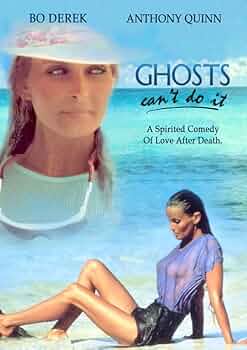
If you find yourself having trouble getting to sleep tonight or tomorrow, you may want to try watching 1989’s Ghosts Can’t Do It. It won’t necessarily put you to sleep but it will give you something to ponder while you lie in bed and stare up at the ceiling. For instance, how exactly did this movie get produced without anyone coming up with a better title than Ghosts Can’t Do It?
Bo Derek plays Kate, the wife of elderly billionaire Scott (played by Anthony Quinn, who appears to be drunk in the majority of his scenes). Despite their age difference, Kate and Scott are deeply in love. When they’re not playing in the snow and riding horses around the ranch, they’re having sex. “Sex, sex, sex, sex!” the movie seems to chant in almost every scene. But then Anthony Quinn has a heart attack, which in this film means that he spends what appears to be hours lying in the snow while trading jokes with Kate. (It’s important to be able to joke with your partner but if my man had a heart attack, my first reaction would be to get a doctor.)
Scott survives his heart attack but he’s told that, in his weakened state, he can no longer have sex. Also, he can’t get a new heart because he’s too old. Facing a future without sex, Scott shoots himself. Fortunately, Scott’s guardian angel (Julie Newmar) takes sympathy on him and sends his spirt back down to Earth. Only Kate can see and hear him and, while she’s happy to be reunited with him, they are both upset to discover that ghosts can’t do it.
Scott comes up with a plan. Kate needs to find a young, virile lover and then murder him so that Scott can possess his body and then he and Kate can have sex whenever they feel like it. Because that plan makes total sense and there’s no way that it could lead to Kate’s soul being damned to an eternity in Hell, Kate agrees. Kate travels the world, having sex and looking for a man who will be able to please her after she has murdered him. Eventually, Kate meets a charming young criminal named Fausto (Leo Damian) and decides that he’ll do. Scott can’t wait to inhabit Fausto’s body but Kate suddenly realizes that she might not have it in her to be a murderer! Well, she’ll never know unless she tries. (I never thought that I would be able to shoot down a drone but then, one night in December….)
While all of this is going on, Kate is handling Scott’s business affairs. This leads to a meeting with a famous and ruthless businessman named Donald Trump. Yes, the 45 and 47th President of the United States plays himself in this film. Kate and Trump meet in a conference room to discuss a deal. Kate mentions that she read Trump’s book. Trump smiles and nods. They have hard-boiled business dialogue. Kate tells Trump that he’s “too pretty” to be as ruthless as he is. ‘You noticed,” Trump says. It’s a pretty dumb scene but, from a historical point-of-view, it’s a reminder of the fact that, long before he was elected President, Trump was already a ubiquitous figure on the American pop cultural scene.
Ghosts Can’t Do It is definitely a misfire, albeit one that is such a huge misfire that it become interesting in the same way that trainwrecks are often interesting. Almost everything about it, from the dialogue to the attempts at humor to the nearly unreadable font that is used for the opening credits, feels wrong. There is one brief moment that works, in which Kate dances with her ghost husband and, for the first and only time in the film, we see a flicker of genuine chemistry between Bo Derek and Anthony Quinn. (Bo Derek, I will mention, is not quite as bad an actress as her reputation suggests. It’s just that she should have been playing campy soap opera villainesses on late night television as opposed to starring in her husband’s crackpot films.) Otherwise, this movie is perhaps the worst movie to ever feature both a two-time Oscar winner and a future President. And, for that reason, it’s a watchable curiosity. It’s just what insomnia demands.
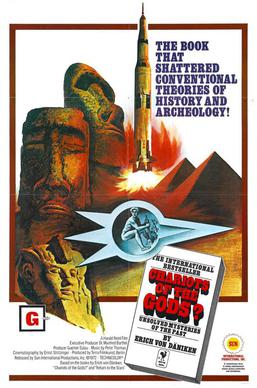
First released in 1970, the German documentary Chariots of the Gods tests the proposition that you can prove anything with stock footage and a narrator.
Chariots of the Gods takes viewers on a tour through some of the most visually impressive locations ever seen by human eyes. Look at the ruins of the Aztec and Inca civilizations! Behold a Mayan observatory! Marvel at Egypt’s pyramids! Trace the amazing Nazca Lines of South America! View the amazing “heads” of Easter Island! Be amazed that an ancient civilization was able to create a primitive battery! Feast your eyes upon colorful cave drawings of mythic beasts and powerful wizards! Examine this skull of a 200,000 year-old bison and think about just how long living things have inhabited this amazing planet!
And then read the ancient texts and consider how every civilization wrote of certain shared events, suggesting that the legendary cataclysms of mythology were based on things that actually happened. Read the words of men and women who lived centuries ago and consider that humans have always been trying to figure out how things work. Humans have always been curious and imaginative creatures and the fact that, from the beginning of time, they were inspired to record their stories indicates that we have an instinctual understanding of the importance of history.
It takes your breath away but, according to this documentary, it shouldn’t.
All of those things that you think humans did? According to Chariots of the Gods, it was the aliens. The aliens built the pyramids. The aliens inspired the cave drawings. All of those ancient texts are actually about spaceships landing on Earth and the aliens saying, “Hi.” The great flood that appears in both the Bible and the epic of Gilgamesh? Aliens! Enoch’s journey into Heaven? Aliens! Elijah’s ascension? Aliens! The Nazca lines? An alien airport! The statues of Easter Island? Alien robots! Chariots of the Gods opens by suggesting that the human race is basically just a big cargo cult, worshipping stuff left behind by the aliens.
Seriously, what a depressing way to look at the world! Instead of marveling at the determination of ancient man, this documentary says that the whole thing was done by aliens and the humans were apparently just standing off to the side. Forget about celebrating ingenuity and imagination. The aliens did it all and all of the ancient stories and all of the cave drawings should be taken very literally because it’s not like the ancient artists could have just been really talented or creative. Instead, when the authors of the Epic of Gilgamesh wrote about Gilgamesh floating over the Earth, it was because it really happened! Imagination had nothing to do with it.
In the tradition of most pseudoscience documents, Chariots of the Gods is one of those documentaries that makes its point by basically refusing to accept that any other viable theories exist. Repeatedly, we’re flatly told that “scientists agree….,” as if every scientist has signed off on the idea of ancient aliens. The documentary’s narrator often informs us that there’s no way ancient people could have constructed and moved giant statues or monuments but he fails to mention that numerous studies that have argued and demonstrated that actually ancient people could very well have done all of that. Essentially, Chariots of the Gods is a travelogue in which we are shown stock footage of some really cool sights while the narrator says, “I bet an alien did that!”
Silly as it was, Chariots of the Gods was still a box office hit and it was nominated for Best Documentary Feature. It’s pseudoscientific legacy lives on today.
Made for television in 1991 and possessing a rather unwieldy title, Shoot First: A Cop’s Vengeance tells the story of two friends in San Antonio in the early 80s.
Farrell Tucker (Dale Midkiff) and Stephen Smith (Alex McArthur) are both cops. They entered the police academy together, they graduated as a part of the same class, and they both hope to be partners while working to keep the streets of San Antonio safe. Tucker is laid back and friendly and not one to worry too much about following all of the regulations. Stephen Smith, on the other hand, is uptight and, at first, by-the-book. He grew up in a poverty-stricken, crime-riddled neighborhood and it left a definite impression on him. He hates crime and criminals but what he really can’t stand is a justice system that seems to be more concerned with the victimizers than with the victims. Tucker and Smith enjoy spending their time together, drinking at the local cop bars and practicing their shooting on the weekends. Tucker’s not much of a shot, whereas Smith is a sharpshooter who rarely misses.
At first, no one notices or even cares that some of San Antonio’s less upstanding citizens are getting gunned down in the streets. But when Smith somehow manages to be first on the scene to a series of shootings, it gets the attention of Internal Affairs. With Sergeant Nicholas (Terry O’Quinn) investigating the possibility of a cop-turned-vigilante and Chief Hogan (G.D. Spradlin) announcing that no one is above the law, Smith starts to get a bit paranoid and Tucker is forced to consider that his friend could very well be a murderer.
And, of course, Tucker’s right! The first scene features Tucker confronting Smith and then the majority of the film is told in flashback. Even if not for that narrative choice, one could guess at Smith’s guilt just from the title of the film. When Shoot First: A Cop’s Vengeance was released on home video, the title was changed to Vigilante Cop, which made Smith’s guilt even more obvious. Finally, some viewers will guess that Smith is guilty because the film is based on a true story. Officer Stephen Smith actually did go on a killing spree, gunning down men who he felt had escaped the law and even sending threatening letters to his chief when the latter announced that vigilante activity would not be tolerated. Officer Stephen Smith went from being a follower of the rules to someone who attempted to write his own rules. It’s an interesting story for anyone who wants to google it.
As for the film, it’s adequate without being particularly memorable. Alex McArthur and Dale Midkiff both give good performance as Tucker and Smith and the cast is full of talented people like Terry O’Quinn, G.D. Spradlin, Bruce McGill, and Lynn Lowry. Observant viewers will even notice a long-haired Jeremy Davies, showing up for a split-second. I liked the performance of Loryn Locklin, as the waitress who marries Smith and then discovers that her charming husband actually has some very serious issues. The main problem with the film is that the story moves a bit too slowly for its own good and some of the Texas accents were more than a little dodgy. If you’re looking for an action film, this won’t be for you, though the shootings are surprisingly graphic for something that was made for television. Shoot First: A Cop’s Vengeance is a rather routine telling of an interesting story.
Though the Academy of Motion Picture Arts and Sciences claim that the Oscars honor the best of the year, we all know that there are always worthy films and performances that end up getting overlooked. Sometimes, it’s because the competition too fierce. Sometimes, it’s because the film itself was too controversial. Often, it’s just a case of a film’s quality not being fully recognized until years after its initial released. This series of reviews takes a look at the films and performances that should have been nominated but were, for whatever reason, overlooked. These are the Unnominated.
“Honorable men go with honorable men.” — Giovanni Cappa
1973’s Mean Streets is a story about Little Italy. The neighborhood may only be a small part of the sprawling metropolis of New York but, as portrayed in this film, it’s a unique society of its very own, with its own laws and traditions. It’s a place where the old ways uneasily mix with the new world. The neighborhood is governed by old-fashioned mafiosos like Giovanni Cappa (Cesare Danova), who provide “protection” in return for payment. The streets are full of men who are all looking to prove themselves, often in the most pointlessly violent way possible. When a drunk (David Carradine) is shot in the back by a teenage assassin (Robert Carradine), no one bothers to call the police or even questions why the shooting happened. Instead, they discuss how impressed they were with the drunk’s refusal to quickly go down. When a soldier (Harry Northup) is given a party to welcome him home from Vietnam, no one is particularly shocked when the solider turns violent. Violence is a part of everyday life.
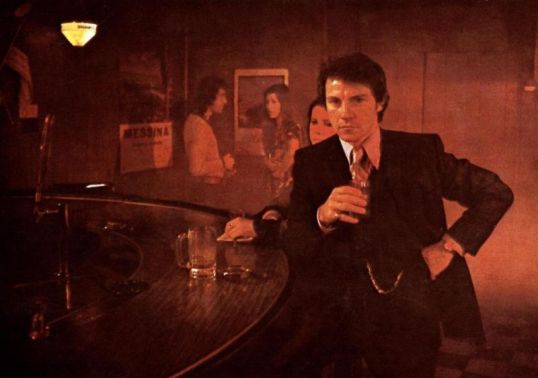
Charlie Cappa (Harvey Keitel) is Giovanni’s nephew, a 27 year-old man who still lives at home with his mother and who still feels guilty for having “impure” thoughts. Charlie prays in church and then goes to work as a collector for Giovanni. Giovanni is grooming Charlie to take over a restaurant, not because Charlie is particularly talented at business but just because Charlie is family. Giovanni warns Charlie not to get involved with Teresa (Amy Robinson) because Teresa has epilepsy and is viewed as being cursed. And Giovanni particularly warns Charlie not to hang out with Teresa’s cousin, Johnny Boy (Robert De Niro). Johnny Boy may be charismatic but everyone in the neighborhood knows that he’s out-of-control. His idea of a good time is to blow up mailboxes and shoot out street lamps. Charlie, who is so obsessed with sin and absolution that he regularly holds his hand over an open flame to experience the Hellfire that awaits the unrepentant sinner, finds himself falling in love with Teresa (though it’s debatable whether Charlie truly understands what love is) and trying to save Johnny Boy.
Charlie has other friends as well. Tony (David Proval) runs the bar where everyone likes to hang out and he seems to be the most stable of the characters in Mean Streets. He’s at peace with both the neighborhood and his place in it. Meanwhile, Michael (Robert Romanus) is a loan shark who no one seems to have much respect for, though they’re still willing to spend the afternoon watching a Kung Fu movie with him. Michael knows that his career is dependent on intimidation. He can’t let anyone get away with not paying back their money, even if they are a friend. Johnny Boy owes Michael a lot of money and he hasn’t paid back a single dollar. Johnny Boy always has an excuse for why he can’t pay back Michael but it’s obvious that he just doesn’t want to. Charlie realizes that it’s not safe for Johnny Boy in Little Italy but where else can he go? Brooklyn?
Mean Streets follows Charlie and his friends as they go about their daily lives, laughing, arguing, and often fighting. All of the characters in Mean Streets enjoy a good brawl, despite the fact that none of them are as tough as their heroes. A chaotic fight in a pool hall starts after someone takes offense to the word “mook,” despite the fact that no one can precisely define what a mook is. The fights goes on for several minutes before the police show up to end it and accept a bribe. After the cops leave, the fight starts up again. What’s interesting is that the people fighting don’t really seem to be that angry with each other. Fighting is simply a part of everyday life. Everyone is aggressive. To not fight is to be seen as being weak and no one is willing to risk that.
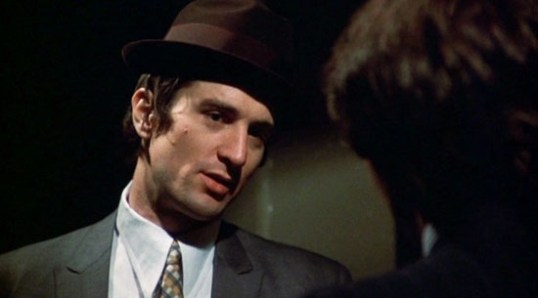
Mean Streets was Martin Scorsese’s third film (fourth, if you count the scenes he shot before being fired from The Honeymoon Killers) but it’s the first of his movies to feel like a real Scorsese film. Scorsese’s first film, Who’s That Knocking On My Door?, has its moments and feels like a dry run for Mean Streets but it’s still obviously an expanded student film. Boxcar Bertha was a film that Scorsese made for Roger Corman and it’s a film that could have just as easily been directed by Jonathan Demme or any of the other young directors who got their start with Corman. But Mean Streets is clearly a Scorsese film, both thematically and cinematically. Scorsese’s camera moves from scene to scene with an urgent confidence and the scene where Charlie first enters Tony’s bar immediately brings to mind the classic tracking shots from Goodfellas, Taxi Driver, and Casino. One gets the feeling that Pete The Killer is lurking somewhere in the background. The scenes between Keitel and De Niro are riveting. Charlie attempts to keep his friend from further antagonizing Michael while Johnny Boy tells stories that are so long and complicated that he himself can’t keep up with all the details. Charlie hold everything back while Johnny Boy always seems to be on the verge of exploding. De Niro’s performance as Johnny Boy is one that has been duplicated but never quite matched by countless actors since then. He’s the original self-destructive fool, funny, charismatic, and ultimately terrifying with his self-destructive energy.
Mean Streets was Scorsese’s first box office success and it was also the film that first brought him widespread critical acclaim. However, in a year when the totally forgotten A Touch of Class was nominated for Best Picture, Mean Streets did not receive a single Oscar nomination, not even for De Niro’s performance. Fortunately, by the time Mean Streets was released, De Niro had already started work on another film about the Mafia and Little Italy, The Godfather Part II.
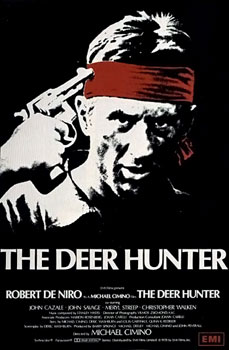
The Deer Hunter, which won the 1978 Oscar for Best Picture Of The Year, opens in a Pennsylvania steel mill.
Mike (Robert De Niro), Steve (John Savage), Nick (Chistopher Walken), Stan (John Cazale), and Axel (Chuck Aspegren, a real-life steel worker who was cast in this film after De Niro met him while doing research for his role) leave work and head straight to the local bar, where they are greeted by the bartender, John (George Dzundza). It’s obvious that these men have been friends for their entire lives. They’re like family. Everyone gives Stan a hard time but deep down, they love him. Axel is the prankster who keeps everyone in a good mood. Nick is the sensitive one who settles disputes. Steve is perhaps the most innocent, henpecked by his mother (Shirley Stoler) and engaged to marry the pregnant Angela (Rutanya Alda), even though Steve knows that he’s not actually the father. And Mike is their leader, a charismatic if sometimes overbearing father figure who lives his life by his own code of honor. The men are held together by their traditions. They hunt nearly every weekend. Mike says that it’s important to only use one shot to kill a deer. Nick, at one point, confesses that he doesn’t really understand why that’s important to Mike.
Steve and Angela get married at a raucous ceremony that is attended by the entire population of their small town. The community is proud that Nick, Steve, and Mike will all soon be shipping out to Vietnam. Nick asks his girlfriend, Linda (Meryl Streep), to marry him when he “gets back.” At the reception, Mike gets into a fight with a recently returned soldier who refuses to speak about his experiences overseas. Mike ends up running naked down a street while Nick chases him.
The Deer Hunter is a three-hour film, with the entirety of the first hour taken up with introducing us to the men and the tight-knit community that produced them. At times, that first hour can seem almost plotless. As much time is spent with those who aren’t going to Vietnam as with those who are. But, as the film progresses, we start to understand why the film’s director, Michael Cimino, spent so much time immersing the viewer in that community of steel workers. To understand who Nick, Mike, and Steve are going to become, it’s important to know where they came from. Only by spending time with that community can we understand what it’s like to lose the security of knowing where you belong.
If the first hour of the film plays out in an almost cinema verité manner, the next two hours feel like an increasingly surreal nightmare. (Indeed, there was a part of me that suspected that everything that happened after the wedding was just Michael’s drunken dream as he lay passed out in the middle of the street.) The film abruptly cuts from the beautiful mountains of Pennsylvania to the violent horror of Vietnam. A Viet Cong soldier blows up a group of hiding women and children. Michael appears out of nowhere to set the man on fire with a flame thrower. An army helicopter lands and, in a coincidence that strains credibility, Nick and Steve just happen to get out. Somehow, the three friends randomly meet each other again in Vietnam. Unfortunately, they are soon captured by the VC.
They are held prisoner in submerged bamboo cages. Occasionally, they are released and forced to play Russian Roulette. Mike once again becomes the leader, telling Steve and Nick to stay strong. Eventually, the three men do manage to escape but Steve loses his leg in the process and a traumatized Nick disappears in Saigon. Only Mike returns home.
The community seems to have changed in Mike’s absence. The once boisterous town is now quiet and cold. The banner reading “Welcome Home, Mike” almost seems to be mocking the fact that Mike no longer feels at home in his old world. Stan, Axel, and John try to pretend like nothing has changed. Mike falls in love with Linda while continuing to feel guilty for having abandoned Nick in Saigon. Steve, meanwhile, struggles to come to terms with being in a wheelchair and Nick is still playing Russian Roulette in seedy nightclubs. Crowds love to watch the blank-faced Nick risk his life.
Eventually, Mike realizes that Nick is still alive. Somehow, Mike ends up back in Saigon, just as the government is falling. Oddly, we don’t learn how Mike was able to return to Saigon. He’s just suddenly there. It’s the type of dream logic that dominates The Deer Hunter but somehow, it works. Mike searches for Nick but will he be able to save his friend?
The Deer Hunter was one of the first major films to take place in Vietnam. Among the pictures that The Deer Hunter defeated for Bet Picture was Coming Home, which was also about Vietnam but which took a far more conventional approach to its story than The Deer Hunter. Indeed, while Coming Home is rather predictable in its anti-war posture, The DeerHunter largely ignores the politics of Vietnam. Mike, Nick, and Steve are all traumatized by what they see in Vietnam. Mike is destroyed emotionally, Steve is destroyed physically, and Nick is destroyed mentally. At the same time, the VC are portrayed as being so cruel and sadistic that it’s hard not to feel that the film is suggesting that, even if we did ultimately lose the war, the Americans were on the correct side and trying to do the right thing. (Many critics of The Deer Hunter have pointed out that there are no records of American POWs being forced to play Russian Roulette. That’s true. There are however records of American POWs being forced to undergo savage torture that was just as potentially life-threatening. Regardless of what one thinks of America’s involvement in Vietnam, there’s no need to idealize the VC.) Released just a few years after the Fall of Saigon, The Deer Hunter was a controversial film and winner. (Of course, in retrospect, the film is actually quite brilliant in the way it appeals to both anti-war and pro-war viewers without actually taking a firm position itself.)
In the end, though, The Deer Hunter isn’t really about the reality of the war or the politics behind it. Instead, it’s a film about discovering that the world is far more complicated that you originally believed it to be. De Niro is a bit too old to be playing such a naive character but still, he does a good job of portraying Mike’s newfound sense of alienation from his former home. In Vietnam, everything he believed in was challenged and he returns home unsure of where he stands. While John, Axel, and Stan can continue to hunt as if nothing happened, Mike finds that he can no longer buy into his own philosophical BS about the importance of only using one shot. Everything that he once believed no longer seems important.
It’s a good film and a worthy winner, even if it does sometimes feel more like a happy accident than an actual cohesive work of art. The plot is often implausible but then again, the film takes place in a world gone mad so even the plot holes feel appropriate to the story being told. Christopher Walken won an Oscar for his haunting performance as Nick and John Savage should have been nominated alongside of him. This was Meryl Streep’s first major role and she gives a surprisingly naturalistic performance. During filming, Streep was living with John Cazale and she largely did the film to be near him. Cazale was dying of lung cancer and he is noticeably frail in this film. (I cringed whenever Mike hit Stan because Cazale was obviously not well in those scenes.) Cazale, one of the great character actors of the 70s, died shortly after filming wrapped. Cazale only appeared in five films and all of them were nominated for Best Picture. Three of them — The first two Godfathers and The Deer Hunter — won.
The Deer Hunter is a long, exhausting, overwhelming, and ultimately very moving film. Whatever flaws it may have, it earns its emotional finale. Though one can argue that some of the best films of 1978 were not even nominated (Days of Heaven comes to mind, as do more populist-minded films like Superman and Animal House), The Deer Hunter deserved its Oscar.
Caligula is a film with a long and storied history. In the mid-1970s, Penthouse publisher Bob Guccione wanted to follow the lead of his rival, Hugh Hefner, and get into the movie business. His plan was to make an explicit adult film with high production values, one that could be sold as a mainstream feature film. He decided that the infamously decadent Roman Emperor Caligula would be the subject of his film. In order to give the project some gravitas, he accepted scripts from both Lina Wertmuller and Gore Vidal. Ultimately, he chose to go with Vidal’s script because Vidal’s name had more cultural cachet than Wertmuller’s. It certainly wasn’t because he liked Vidal’s script, which Vidal later said featured a lot of gay sex but only one scene of heterosexual coupling.
With the promise that Caligula would be a classy production that would push the boundaries of cinematic sex without actually being pornographic, Guccione was able to bring together a truly impressive cast of actors. Malcolm McDowell agreed to play Caligula. Helen Mirren was cast as Caligula’s wife, Caesonia. John Gielgud took on the role of Nerva the philosopher while Peter O’Toole was cast as the diseased Emperor Tiberius. Guccione offered directing duties to John Huston and Lina Wertmuller. In the end, no matter how much money he was willing to spend or how distinguished a cast he had assembled, Guccione could not find a prominent, mainstream director who was willing to work with him. Guccione ended up hiring a director he knew little about, an Italian arthouse filmmaker named Tinto Brass.
Brass proceeded to rewrite Vidal’s script. Brass’s version of the film featured more sex and less politics. Guccione was happy about that until he discovered that Brass’s plan was to direct the sex scenes to be grotesque and disturbing. To his horror, Guccione discovered that Brass was essentially parodying the type of film that Guccione wanted him to direct. Even when Guccione insisted that the latest “Penthouse pets” be cast in the film, Brass tried to keep them in the background. As Guccione’s demands grew, Brass responded by refusing to emphasize the ornate and very expensive sets that Guccione had paid to have created. A working ship was built but Brass reportedly chose to put it in a small warehouse so that there would never be room to get a full shot of it. Guccione responded by taking the film away in post-production and inserting several hardcore sex scenes, which upset the members of the cast who did not sign on to appear in a pornographic film.
As for the film itself, it must be said that Caligula is probably one of the most historically accurate portrayals of ancient Rome. The city was said to be a mix of dirty streets and ornate palaces and Caligula certainly captured the mix of beauty and sordid decadence that was the Roman Empire. The film’s plot actually sticks very closely to what was written about Caligula by Roman historians like Suetonius. Helen Mirren and Malcolm McDowell both give strong performances, even if McDowell later claimed the film ruined his career by typecasting him as a perverse villain. Peter O’Toole is memorably grotesque as Tiberius. Exploitation vets John Steiner and Teresa Ann Savoy also make an impression in their roles and one gets the feeling that they both understood what type of film they were appearing in, even if the bigger names in the cast did not. There are moments of shocking grandeur and visual beauty to be found in Caligula and also moments of such total ugliness that they are difficult to watch. In many ways, Caligula is what Guccione wanted. It’s a big, expensive film that tests boundaries and features explicit sex.
But, Good God, is it ever boring! Seriously, the scene where Caligula visits Tiberius in Capri goes on forever. Despite McDowell’s strong performance, Caligula is not a particularly compelling character. He becomes emperor and then he goes mad. For over two hours, Caligula does one terrible thing after another and there’s only so long that you can watch it before you just want someone to hurry up and kill him. The film suggests that Caligula was rebelling against the Roman establishment but, in the end, who cares? He kills his friends. He has sex with his sister. In the film’s most disturbing scene, he rapes a bride and then fists the groom. It just goes on and on and it gets old pretty quickly.
Still, there’s always been a lot of debate over whether or not it would be possible to make Caligula into a good film. Bob Guccione claimed that he saved the film. Tinto Brass disagreed and his director’s cut, which takes out Guccione’s hardcore inserts, is considerably better-paced than the Guccione version but the nonstop ugliness still gets rather boring.
That brings us to the latest version of Caligula, the Ultimate Cut. Assembled without the input of Tinto Brass or the deceased Bob Guccione, Caligula: The Ultimate Cut played at Cannes in 2023 and was given a limited release by Drafthouse Films in 2024. It was largely assembled out of unused footage and alternate takes. I’ve read that not a single fame from the original version of Caligula is in The Ultimate Cut but I don’t think that’s quite true. (The scene with the giant beheading machine appears to be the same footage that appeared in the original version.) Caligula: The Ultimate Cut removes all of Guccione’s hardcore footage but it also downplays a lot of Brass’s directorial flourishes as well. Instead, The Ultimate Cut is said to much more closely follow Gore Vidal’s vision of the film.
Is the Ultimate Cut any good? It definitely looks better than the previous version of Caligula. The restoration makes Rome into a very colorful city. There’s a bit more humor to McDowell’s performance in the Ultimate Cut. While his version of Caligula still becomes a monster (and the wedding rape is still included in the film), he starts out as a clown whose mission is to humiliate the Roman establishment in much the same way that Tiberius used to humiliate him. In The Ultimate Cut, Caligula is much more of an anarchist. At the same time, the Ultimate Cut features a bit less of John Steiner as the duplicitous Longinus and that’s a shame because Steiner’s performance was one of the best in the original version. As well, Helen Mirren’s performance is stronger in the original version than in The Ultimate Cut. The alternate takes that were used in The Ultimate Cut often seem to favor McDowell over Mirren.
That said, The Ultimate Cut is still a bit of an endurance test. Caligula’s meeting with Tiberius still goes on forever and the nonstop evil of his reign still gets a bit dull after a while. It turns out that Caligula the Anarchist is no more compelling than Caligula the Madman. Brass and even Guccione may have had a point with the original version of Caligula. Caligula is a film that requires a truly sordid and shameless sensibility to be interesting.
In the end, it’s hard not to feel that all of this could have been avoided if Gemellus had been named emperor.
If you study the history of the International Left in the years immediately following the death of Lenin, it quickly becomes apparent that the era was defined by the rivalry between Joseph Stalin and Leon Trotsky.
Trotsky, the self-styled intellectual who was credited with forming the Red Army and who many felt was Lenin’s favorite, believed that he should succeed Lenin as the leader of Communist Russia. Stalin, the ruthless nationalist who made up in brutality what he lacked in intelligence, disagreed. Stalin outmaneuvered Trotsky, succeeding Lenin as the leader of the USSR and eventually kicking Trotsky out of the country. Trotsky would spend the rests of his life in exile, a hero to some and a pariah to others. While Stalin starved his people and signed non-aggression pacts with Hitler, Trotsky called for worldwide revolution. To Stalin, Trotsky was a nuisance whose continued existence ran the risk of making Stalin look weak. When Trotsky was assassinated in Mexico in 1940, there was little doubt who had given the order. After Totsky’s death, the American Communist Party, which had already been weakened by the signing of the non-aggression pact between Hitler and Stalin, was further divided into Stalinist and Trotskyite factions.
Ideologically, was there a huge difference between Stalin and Trotsky? Many historians have suggested that Trotsky probably would have taken many of the same actions that Stalin took had Trotsky succeeded Lenin. Indeed, the idea that Trotsky was somehow a force of benevolence has more to do with the circumstances of his assassination than anything that Trotsky either said or did. In the end, the main difference between Stalin and Trotsky seemed to be Trotsky was a good deal more charismatic than Stalin. Unlike Trotsky, Stalin couldn’t tell a joke. However, Stalin could order his enemies killed whenever he felt like it and some people definitely found that type of power to be appealing. Trotsky could write essays. Stalin could kill Trotsky.
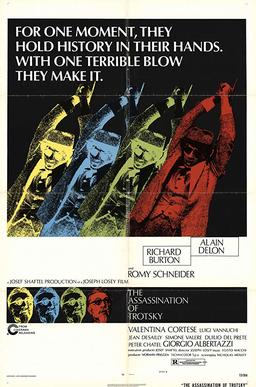
First released in 1972, The Assassination of Trotsky is a cinematic recreation of the events leading to the death of Leon Trotsky in Mexico. French actor Alain Delon plays Frank Jacson, the Spanish communist who was tasked with infiltrating Trotsky’s inner circle and assassinating him with a pickaxe. Welsh actor Richard Burton plays the Russian Trotsky, giving long-winded monologues about world revolution. Italian Valentina Cortese also plays a Russian, in this case Trotsky’s wife, Natalia. And finally, French actress Romy Schneider plays Gita Samuels, who is based on Jacson’s American girlfriend. This international cast was directed by Joseph Losey, an American director who joined the Communist Party in 1946 and who moved to Europe during the McCarthy era.
Losey was an interesting director. Though his first American feature film was the anti-war The Boy With Green Hair, the majority of his American films were on the pulpy side. Not surprisingly, his European films were far more open in their politics. Losey directed his share of undeniable masterpieces, like The Servant, Accident, and The Go-Between. At the same time, he also directed his share of misfires, the majority of which were bad in the way that only a bad film directed by a good director can be. The same director who gave the world The Go-Between was also responsible for Boom!
And then there’s The Assassination of Trotsky. It’s a bit of an odd and rather uneven film. Alain Delon’s performance as the neurotic assassin holds up well and some of his scenes of Romy Schneider have a true erotic charge to them. The scenes of Delon wandering around Mexico with his eyes hidden behind his dark glasses may not add up too much but they do serve as a reminder that Delon was an actor who could make almost any scene feel stylish.
But then we have Richard Burton, looking like Colonel Sanders and not even bothering to disguise his Welsh accent while playing one of the most prominent Russians of the early 20th Century. The film features many lengthy monologues from Trotsky, all of which Burton delivers in a style that is very theatrical but also devoid of any real meaning. As played by Burton, Trotsky comes across as being a pompous phony, a man who loudly calls for world revolution while hiding out in his secure Mexican villa. Now, for all I know, Trotsky could have been a pompous phony. He certainly would not have been the first or last communist to demand the proletariat fight while he remained secure in a gated community. The problem is that the film wants us to admire Trotsky and to feel that the world was robbed of a great man when Jacson drove that pickaxe into his head. That’s not the impression that one gets from watching Burton’s performance. If anything, Burton’s overacting during the assassination scene will likely inspire more laughs than tears.
The Assassination of Trotsky is one of those films that regularly appears on lists of the worst ever made. I feel that’s a bit extreme. The film doesn’t work but Alain Delon was always an intriguing screen presence. (Interestingly enough, Delon himself was very much not a supporter of communism or the Left in general.) The film fails as a tribute to Trotsky but it does make one appreciate Alain Delon.
Rod Steiger won an Oscar for playing Chief Gillipsie in In The Heat of the Night but his co-star, Sidney Poitier, wasn’t even nominated. Despite the fact that Poitier delivered the line that everyone remembers — “They call me Mr. Tibbs!” — the Academy saw fit not nominate him alongside his co-star.
Timothy Hutton won an Oscar for his wonderful performance in Ordinary People but Donald Sutherland, cast against type as his conservative father and giving a heartfelt and heart-breaking performance, was not nominated.
In 1949, Walter Huston won a deserved Oscar for his performance in The Treasure of the Sierra Madre but, somehow, Humphrey Bogart was left out of the nominations.
Martin Landau was honored for playing Bela Lugosi in Ed Wood but Johnny Depp, playing the film’s title character, was ignored.
It’s something that has been happening since the announcement of the very first Academy Award nominations. Someone will win an Oscar and usually, they very much deserve it. Often, they’re a very popular winner because they’ve either overcome adversity or they’ve been nominated several times in the past without winning. But, in all the excitement over their victory, their equally worthy co-stars are overlooked.
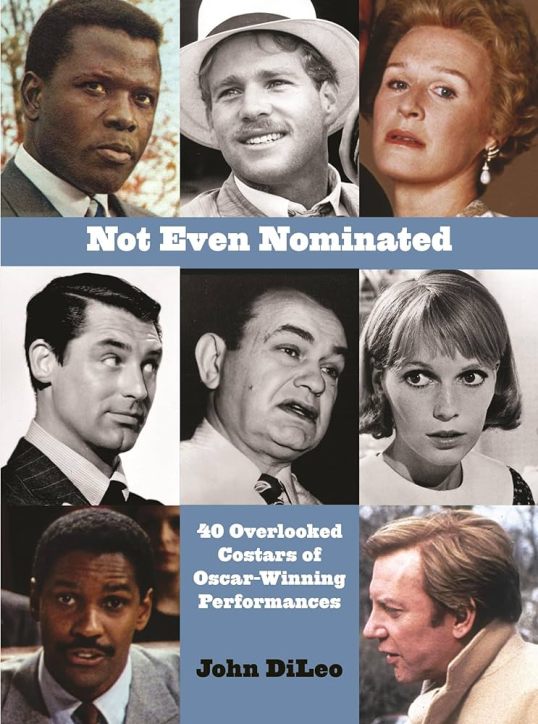
John DiLeo’s Not Even Nominated takes a look at forty overlooked co-stars of Oscar-winning performers. Along with those that I mentioned at the start of this review, DiLeo also writes about performances from everyone from Charles Farrell in Seven Heaven to Cary Grant in The Philadelphia Story to Joseph Fiennes in Shakespeare in Love and Samuel L. Jackson in Django Unchained. Some of DiLeo’s picks are familiar to film lovers. The fact that Poitier wasn’t even nominated in 1968 despite starring in three popular and acclaimed films is something that has been discussed in many books and cultural histories. But DiLeo also gives some time to some equally strong performances that aren’t always cited, like Ryan O’Neal’s performance in Paper Moon and Dirk Bogarde’s turn in Darling and Stephen Boyd’s brilliant (and rather brave) work in Ben-Hur.
It makes for interesting reading. (It helps the DiLeo has an opinionated but enjoyable writing style.) For Oscar obsessives like you and me, it’s a must-have.
 Through the Shattered Lens