I recently went on YouTube and I did a search for “concert films.” The first video that came up was an upload of the 1980 film Rockshow.
Filmed during a 1976 world tour, Rockshow features Paul McCartney and Wings, the band that he formed after the break-up of the Beatles. McCartney and his band play a total of 30 songs in front of an enthusiastic audience. The crowd goes crazy for the Beatles songs, including Lady Madonna, The Long and Winding Road, Blackbird, and Yesterday. That’s to be expected. But they’re also pretty enthusiastic for the songs that McCartney wrote after the Beatles, quite a few of which I recognized. (Silly Love Songs, Band on the Run, the beautiful Maybe I’m Amazed, and that annoying Listen To What The Man Said were all familiar to me.) For all that I’ve read about people being disappointed by Paul McCartney’s post-Beatles career in the 70s, you wouldn’t know it from watching the audience in this film. The highlight, for me, was undoubtedly the energetic performance of Live and Let Die, which featured a very basic but still effective light show.
It’s rare that you ever read anything positive about Paul McCartney’s work with Wings and, watching the film, it was pretty obvious that the band mostly just existed to showcase Paul. The other members of the band seemed to understand that the crowd wasn’t there to see anyone but Paul McCartney and one gets the impression that they were okay with that. That said, I actually liked quite a bit of their music. Even if they weren’t as lyrically complex and creative as Paul’s work with the Beatles, the songs were still enjoyable to listen to and most of them got stuck in my head, for better or worse. There’s a tendency, amongst music snobs, to be dismissive of Paul’s post-Beatles work because he is often viewed as being the most “corporate” of the Beatles. In the popular imagination, John Lennon was the sarcastic peace activist. George Harrison was the spiritual seeker. Ringo Starr was the down-to-Earth comedian. And Paul is often portrayed as being the one who was the most concerned with scoring the most hits, selling the most albums, and making the most money. Well, so be it. That’s usually the point of having a band, after all. Very few people devote their life to the hope of being obscure and poor. Johnny Rotten moved into a mansion the first chance he got.
As for Rockshow, it’s an interesting time capsule. The main thing that stuck out to me was how straight-forward and simple the concert was. There were a few laser effects, a few lighting effects, and a screen that occasionally flashed images of comic book characters but, as far as extra flourishes were concerned, that was pretty much it. There weren’t any dancers doing carefully choreographed routines. There weren’t any explosions or fancy costume changes. Paul and the band played their songs and the audience obviously felt that they got their money’s worth. Paul comes across as being cheerful and enthusiastic about performing and the band seems to have a good time as well. “Hey Paul,” someone in the audience yells and Paul pauses to wave back and it’s a moment of human connection that is missing from so many concert films.
Rockshow runs a little long. 30 songs can be a bit much. But, overall, it’s a good concert film and an enjoyable time capsule. Do you want to experience 1976? Step into the YouTube time machine.
Today’s music video comes from Peter Jackson’s epic adaptation of The Lord of the Rings. May It Be was the theme song for the first installment, 2001’s The Fellowship of the Ring, and the music video features clips from the films, along with Enya singing. The Hobbit trilogy probably would have been better if it had featured more Enya.
It’s hard to know where to really start with Megalopolis.
Directed, written, produced, and financed by Francis Ford Coppola, Megalopolis takes place in an alternate version of the United States of America. In this alternative world, New York is called New Rome and it is dominated by a handful of wealthy families. Former District Attorney Franklyn Cicero (Giancarlo Esposito) has been elected mayor. Everyone seems to hate Cicero and the character tends to come across as being a bit whiny so you really do have to wonder how he got elected in the first place.
Cicero is obsessed with the powerful Crassus-Catallina family, which is headed by banker Hamilton Crassus III (Jon Voight). Hamilton’s nephew is Cesar Catallina (Adam Driver), a brilliant architect who won a Nobel Prize for inventing a type of invisible material. Ever since Cesar’s wife vanished under mysterious circumstances, a cloud of scandal has hung over Cesar’s name and with that scandal has come popularity with both the masses and the tabloid press. When Cesar was tried for murder, the prosecutor was Franklin Cicero. Cesar was acquitted but he now spends his time drinking and mourning his wife. Cesar also has the power to stop time for everyone but him. Why he has this power and how he came to possess it is never made clear, though Cesar compares it to the way that a great painter or writer can capture one moment for eternity.
Cesar is driven through the rainy streets of New York by his chauffeur, Fundi Romaine (Laurence Fishburne). Fundi also serves as the film’s narrator, ruminating about how the Roman Empire eventually became a victim of its own decadence. Just in case the viewer somehow doesn’t pick up on the fact that the movie is comparing modern America to ancient Rome, Fundi informs us of this fact. Thanks, Fundi!
After Cesar publicly denounces Cicero’s plans to turn New Rome into a casino, Cicero’s daughter Julia (Nathalie Emmanuel) decides to take a break from decadent partying to follow Cesar around and try to discover whether or not he actually murdered his wife. Julia discovers that Cesar is not only still mourning his wife but she also witnesses him stopping time. Soon, Julia is working for Cesar’s design firm. At some point, she and Cesar become lovers.
Meanwhile, Cesar’s former lover, Wow Platinum (Aubrey Plaza), has married Crassus and is plotting to take control of his bank. Working with Wow is Cesar’s buffoonish cousin, Clodio Pulcher (Shia LaBeouf), who organizes the angry citizens of New Rome into a mob that threatens the safety and power of both Cicero and Cesar. “Make Rome Great Again,” a sign reads at one of Clodio’s rallies, just in case anyone was missing Coppola’s point.
Clodio is obsessed with destroying Cesar. First, he frames Cesar for deflowering New Rome’s vestal virgin, the singer Vesta Sweetwater (Grace VanderWaal). Then, he sends a 12 year-old assassin after Cesar. Cesar fears that he’s lost his ability to stop time. Julia falls more and more in love with him. Cicero gets booed everywhere he goes and, after his fixer (Dustin Hoffman) is mysteriously killed, he finds himself helpless against Clodio’s mob. Can Cesar be convinced to abandon his self-pity long enough to stand up to Clodio?
And what about the Russian spy satellite that just crashed into New Rome? Who will rebuild the city?
And …. well, let’s just say that there’s a lot going on in New Rome.
Francis Ford Coppola originally came up with the idea for Megalopolis in 1977 and he spent decades trying to bring the film to the big screen. Eventually, Coppola ended up producing and financing the film himself. From 2023 to the the day of the film’s Cannes premiere, the trade papers were full of stories about how difficult the production had been, with the underlying theme being that everything was Francis Ford Coppola’s fault and that the movie would be an unmitigated disaster. (In the coverage found in both Variety and The Hollywood Reporter, there seemed to be a good deal of hostility directed at Coppola’s decision to work outside of the Hollywood system.) Disgruntled members of the crew complained that Coppola was an undisciplined director who spent most of the production high. A half-baked attempt to generate a #MeToo scandal around the film made it obvious that Coppola had burned a lot of bridges with both Hollywood and the media. The film was released to critical derision and poor box office returns. Coppola is 85 years old and it’s entirely possible that Megalopolis will be his final film.
Critics be damned, I liked the majority of Megalopolis. Though the film may be thematically and narratively incoherent, it is a feast for the eyes and it’s hard not to respect the fact that, in this age of overwhelming conformity, Coppola brought his own unique vision to the screen. There are a few moments of genuinely macabre beauty to be found in the film. When the Russian satellite crashes into New York, we don’t see the impact but, on the city walls, we do see the shadows of people screaming in fear. When a drunk Cesar is driven through New Rome, he sees gigantic statues stepping off of their bases and slumping to the ground, exhausted with being on display. Coppola films New Rome like a beautiful, open-air prison. It’s an amazing view but don’t even think about trying to escape. The scenes in New Rome’s Coliseum are filled with an epic yet seedy grandeur. At times, the film’s scenes seem to be almost randomly assembled, leaving us to wonder if we’re seeing the past, the present, or maybe just something that Cesar is imagining in his head.
What is the film actually about? It’s not always easy to say. Even in his best films, Coppola has had a tendency to be self-indulgent. Sometimes, that self-indulgence pays off. Though few would admit it now, The Godfather Part II is one of the most self-indulgent films ever made. But it’s also brilliant so it doesn’t matter. However, with Megalopolis, it’s hard not to feel that this film was such a passion project for Coppola that he didn’t stop to consider whether or not he really had anything new to say. Megalopolis is hardly the first film to compare the supposed decline of America to the fall of the Roman Empire. As much as I enjoyed the film’s visuals, I cringed at the film’s ending. One can only imagine how a past Coppola collaborator like John Milius would have reacted to a bunch of children reciting a pledge to take care of the “one Earth.”
It’s a random film, one in which plot points are raised and often quickly abandoned. At one point, Cesar starts to recite Hamlet’s famous “to be or not to be” soliloquy. The cast is huge and everyone seems to be acting in a different movie. Surprisingly enough, neither Esposito nor Adam Driver are particularly believable in their roles, though I think that has more to do with the film’s loose narrative structure than anything else. Shia LaBeouf is convincingly feral as Clodio while Jon Voight seems to be having fun as the wealthy and crude Crassus. The best performance in the film comes from Aubrey Plaza, who plays her role like a vampish femme fatale who has somehow found herself in a science fiction story. Plaza holds nothing back with her performance and she actually manages to bring some genuine human emotion to Coppola’s surreal epic.
Megalopolis is a monument to self-indulgence but it’s always watchable. Coppola may not know what he’s trying to say but he captures the surreal beauty that comes from getting trapped in one’s own imagination. Megalopolis is not a film for everyone but I’m glad it exists. At a time when artistic freedom seems to be under constant attack, it’s hard not to be happy that Coppola did things his way.
One of the ten films to be nominated for Best Picture of 1937, In Old Chicago tells the story of the O’Leary family.
When we first meet the O’Learys, they’re riding across the Illinois frontier in a covered wagon. After patriarch Patrick O’Leary (J. Anthony Hughes) is killed in a freak accident, Hazel O’Leary (Alice Brady) decides to settle in the bustling town of Chicago. Hazel and her three sons build a life for themselves in a poor, largely Irish neighborhood known as the Patch. Hazel makes a living as a laundress and soon, her home is big enough for her to take in a cow named Daisy. Better not put that lantern too close to Daisy, Mrs. O’Leary….
As for the O’Leary boys, they all build a life of their own in 19th century Chicago.
Free-spirited Dion (Tyrone Power) hangs out in the saloon owned by sinister Gil Warren (Brian Donlevy) and, to his mother’s consternation, he falls for a singer named Belle (Alice Faye). Eventually, Dion and Belle open up their own saloon and go into competition with Warren. Dion soon emerges as one of the leaders of the Patch, a rogue with a charming smile and zero ethics but a total love for his family.
The youngest, Bob (Tom Brown), falls in love with a German immigrant named Gretchen (June Storey). Bob asks Gretchen to marry him while Mrs. O’Leary’s cow stares straight at camera.
Finally, the oldest of the O’Leary boys is Jack (Don Ameche). Jack become a crusading lawyer and eventually, he runs for mayor on a reform ticket. With Dion’s help, Jack is able to defeat Gil Warren. But now that Jack is mayor, he immediately sets his sights on tearing down the Patch and, in his words, “starting over.”
In Old Chicago has a two-hour running time and a lot happens in those two hours. Not only is there all the drama between the brothers but also there’s a handful of production numbers featuring Alice Faye. (Considering that she’s performing at a saloon in the slums of Chicago, it’s impressive that Belle can put on such an elaborate show.) Of course, anyone with a knowledge of history knows that every minute of In Old Chicago is building up to the moment when Mrs. O’Leary’s cow kicks over that lantern and all the wooden buildings in Chicago go up in flames. In Old Chicago is an early disaster movie and, talented cast aside, the main reason that anyone will be watching will be for the recreation of the Great Chicago Fire. As flames roar around them and cattle stampede through the streets, hundreds of extras run for their lives. As Alice Brady, Tom Brown, and Alice Faye stare off to the horizon, the city of Chicago explodes in front of them. Even today, the scenes of the city on fire are impressive.
As for the rest of the film, I enjoyed the melodramatic excess of it all. The stars weren’t exactly the most dynamic actors of the 1930s but Tyrone Power and Don Ameche were both handsome and likable enough to carry the film and it’s easy to see why In Old Chicago was, at the time of its production, the most expensive film ever made. It’s a big film, with ornate sets, hundreds of extras, and elaborate production numbers. It’s entertaining, even though I did occasionally find myself growing impatient as I waited for the fire to finally start burning.
One thing this film is not is historically accurate. Not only is it now generally agreed that Mrs. O’Leary’s cow was innocent of starting the fire but Mrs. O’Leary’s son was never mayor of Chicago. It is true that Chicago caught fire in 1871 and that the mayor turned to General Philip Sheridan (played here by Sidney Blackmer) for help in both putting out the fire and keeping order in the streets. For the most part, though, In Old Chicago is total fiction. That didn’t bother me but then again, I don’t live in Chicago.
In Old Chicago was nominated for Best Picture of the Year but lost to The Life of Emile Zola. However, Alice Brady won the Oscar for Best Supporting Actress.
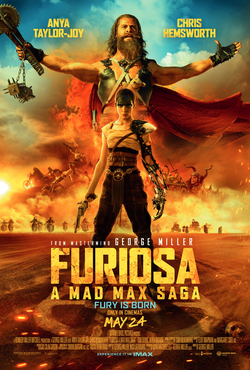
Furiosa: A Mad Max Saga opens with the sound of nervous Australian citizens and commentators, narrating us through the collapse of civilization. We hear about riots. We hear about the breakdown of civilization. We hear that people are literally running out of water.
It’s an effective opening but, for those of us who have seen the other movies set in the Mad Max universe, it also feels a bit redundant. We already know the story of how our world came to an end. Mad Max opened with society in its death throes. The Road Warrior and Mad Max: Beyond Thunderdome both took place a few years after the apocalypse, with the majority of humanity reduced back to a feral existence of scrounging and fighting to survive. Finally, Mad Max: Fury Road took place so far in the future that the only thing that really remained of the old ways were the cars and the guns that were obsessively cared for by the inhabitants of what was once Australia. (Not even the collapse of civilization could halt car culture.)
Furiosa opens 45 years after the apocalypse, with young Furiosa (Alyla Brown) living in the Green Place, one of the few areas of Australia not to be reduced to a waterless desert. When she’s kidnapped by Dementus (Chris Hemsworth) and the Biker Horde, she can only watch in horror as her mother (Charlee Fraser) is crucified by the Horde. Dementus, who was driven mad by the death of his own family, adopts Furiosa as his own and spends years hoping that she will lead him to the Green Place. Instead, Furiosa is eventually “traded” to Dementus’s rival, Immortan Joe (Lachy Hulme), and, under the tutelage of Praetorian Jack (Tom Burke), she eventually grows up to become both Anya Taylor-Joy and the fierce warrior who was at the center of Mad Max: Fury Road.
Like that opening montage of panicky voices describing the apocalypse, Furiosa is well-made but, narratively, it can feel a bit redundant. There’s really nothing major about Furiosa’s backstory that wasn’t previously revealed in Mad Max: Fury Road. Yes, we learn the exact circumstances of how she lost her arm and it’s a scene that definitely establishes Furiosa as a badass but it’s also reveals that she lost her arm in the way that I imagine 99% of Fury Road‘s audience assumed it happened the first place. That’s the problem with both prequels and sequels. If the first movie is effective, that usually means that the audience has been given all of the information that they needed to understand a character’s past and motivation. As a result, prequels often feel narratively unnecessary. Furiosa spends the majority of this movie plotting her escape from Immortan Joe but we already know that it’s not going to happen because Furiosa still has to be at the Citadel for Fury Road.
Compared to Fury Road (in which the action took place over a handful of days as opposed to the decade that is covered in the prequel), Furiosa can feel a little slow. At times, it can even seem a bit draggy. Furiosa devotes as much time to exploring post-apocalyptic society as it does to action sequences. (It has more in common with Mad Max: Beyond Thunderdome than The Road Warrior.) That said, there’s a lot about Furiosa that works wonderfully. No one directs a chase or a battle as well as George Miller. Chris Hemsworth gives a good performance as Dementus, playing him as a tyrant who learned how to lead from watching the Marvel movies that made Hemsworth famous. Hemsworth is particularly strong in his final scene with Furiosa. Dementus may be hateful but, in a strange way, he can be understood. Having lost everything he once cherished in life, Dementus’s actions are as much about his own self-destructive impulses as his own thirst for pwoer. Though she doesn’t take over the role until fairly late in the film, Anya Taylor-Joy gives a fierce performance as Furiosa. Furiosa doesn’t speak much in the film but, when she does, both Anya Taylor-Joy and Alyla Brown make those words count.
Furiosa is an uneven film that falls victim to the same trap that has hindered many prequels. But, ultimately, it’s still a watchable and frequently compelling vision of a disturbing future.
In honor of National Science Fiction Day, today’s song of the day comes from the film that sent James Bond into space!
Released in 1979, Moonrakermay not get as much respect as some of the Bond films but I’ve always liked it. The theme song was the third and final Bond song to be performed by Shirley Bassey. The song was originally written for Frank Sinatra but he turned it down. Johnny Mathis then agreed to perform the song but he backed out at the last minute. Shirley Bassey came in to record the song just weeks before the film was due to premiere.
Because this is a 70s film, there were two versions of this song, the original and the disco. Because I’m the one writing this post, we’re going with the disco version.
Where are you, why do you hide Where is that moonlight trail that leads to your side? Just like the moonraker goes in search of his dream of gold I search for love, for someone to have and hold
I’ve seen your smile in a thousand dreams Felt your touch, and it always seems You love me, you love me
Where are you, when will we meet? Take my unfinished life and make it complete Just like the moonraker knows His dream will come true someday I know that you are only a kiss away
I’ve seen your smile in a thousand dreams Felt your touch, and it always seems You love me, you love me
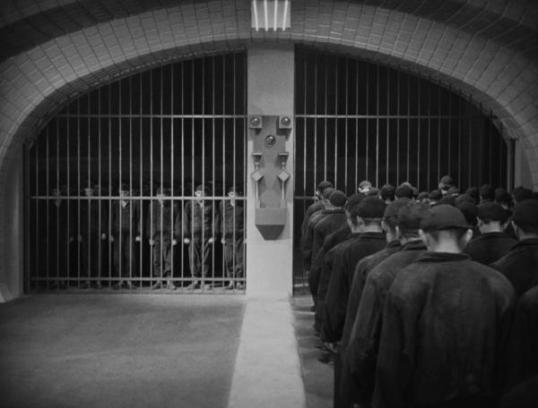
Metropolis (1927, dir by Fritz Lang, DP: Karl Freund and Gunther Rittau)
Since today is National Science Fiction Day, it seems appropriate that today’s scene that I love should come from one of the first great science fiction films! In this scene from Fritz Lang’s Metropolis, we get a look at how the future was imagined in 1927. Lang really was not that far off!
4 Shots From 4 Films is just what it says it is, 4 shots from 4 of our favorite films. As opposed to the reviews and recaps that we usually post, 4 Shots From 4 Films lets the visuals do the talking.
Today, in honor of National Science Fiction Day, it’s time for….
4 Shots From 4 Science Fiction Films
2001: A Space Odyssey (1968, dir by Stanley Kubrick, DP: Geoffrey Unsworth)
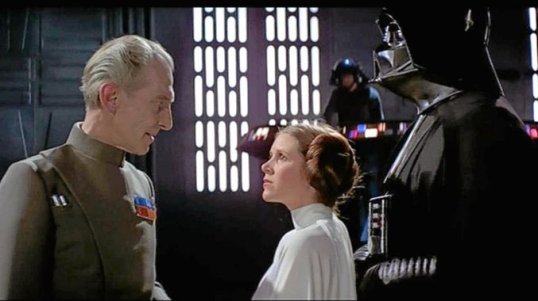
Star Wars Episode IV: A New Hope (1977, dir by George Lucas, DP: Gilbert Talyor)
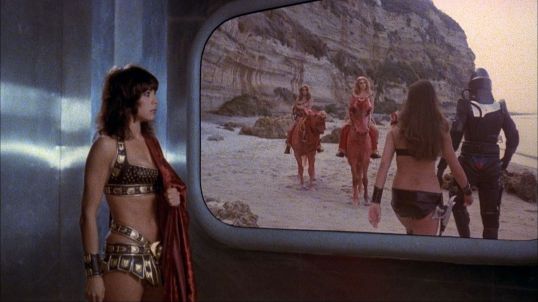
Starcrash (1978, dir by Luigi Cozzi, DP: Paul Beeson and Roberto D’Ettorre Piazzoli)
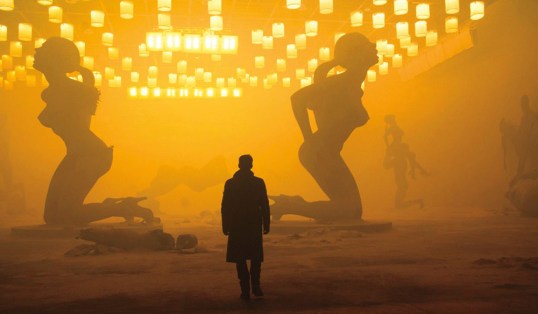
Blade Runner 2049 (2017, dir by Denis Villeneuve, DP: Roger Deakins)
1973’s Save The Tiger tells the story of Harry Stoner (Jack Lemmon).
When Harry was a young man, he loved baseball and he felt like he could conquer the world. He saw combat in World War II and spent the final part of the war on the Island of Capri, recuperating after being wounded in battle. Harry went on to partner up with Phil Greene (Jack Gilford) and they started a clothing company in Los Angeles, Capri Casuals.
Now, Harry is a middle-aged man who is still haunted by nightmares about the war. He’s married. He has a daughter attending school in Switzerland. He’s respected in the industry. He lives in a nice house in Beverly Hills. And he’s totally miserable. He wakes up every day and wonders what is happening to the country. He talks about witnessing a wild pitch at a baseball game, missing the days when something like that could seem like the most important thing in his life. He spends all of his time at work, cheating to balance the books and keeping clients happy by setting them up with a sophisticated prostitute named Margo (played, with a weary cynicism, by Lara Parker).
Save The Tiger covers just a few days in the life of Harry Stoner, as he searches for some sort of meaning in his life. He gives a ride to a free-spirited hippie (Laurie Heineman) who offers to have sex with him. (Harry replies that he’s late for work.) He accepts an award at an industry dinner and, as he tries to give his acceptance speech, he is haunted by the sight of dead soldiers sitting in the audience. With Phil, he debates whether or not to balance the books by setting fire to one of their warehouses in order to collect the insurance. Harry sees a poster imploring him to “Save the Tigers.” Who can save Harry as he finds himself increasingly overwhelmed by the realities of his life?
As I watched Save the Tiger, I found myself thinking about two other films of the era that featured a middle-aged man dealing with a midlife crisis while searching for meaning in the counterculture. In Petulia and Breezy, George C. Scott and William Holden each found meaning in a relationship with a younger woman. And while Petulia and Breezy are both good films, Save The Tiger is far more realistic in its portrayal of Harry’s ennui. There is no easy solution for Harry. Even if he accepted the hippie’s offer to “ball” or if he acted on the obvious attraction between himself and Margo, one gets the feeling that Harry would still feel lost. Harry’s problem isn’t that he’s merely bored with his life. Harry’s problem is that he yearns for a past that can never be recaptured and which may only exist in his imagination. If George C. Scott and William Holden were two actors who excelled at playing characters who refused to yield to the world’s demands, Jack Lemmon was an actor who played characters who often seemed to be desperate in their search for happiness. Save The Tiger features Lemmon at his most desperate, playing a character who has yielded so often and compromised so much that he now has nowhere left to go.
It’s not exactly a cheerful film but it is one that sticks with you. Jack Lemmon won his second Oscar for his performance as Harry and he certainly deserved it. Lemmon does a wonderful job generating some sympathy for a character who is not always particularly likable. Many of Harry’s problems are due to his own bad decisions. No one forced him to use “ballet with the books” to keep his business open and no one is forcing him to hire arsonist Charlie Robbins (Thayer David, giving a performance that is both witty and sinister at the same time) to burn down not only his warehouse but also an adjoining business that belongs to an acquaintance. Harry could admit the truth and shut down his business but then how would he afford the home in Beverly Hills and all the other symbols of his success? Harry yearns for a time when he was young and his decisions didn’t have consequences but that time has passed.
This isn’t exactly the type of film that many would expect from the director of Rocky but director John G. Avildsen does a good job of putting the viewer into Harry’s seedy world. I especially liked Avilden’s handling of the scene where Harry hallucinates a platoon of wounded soldiers listening to his awards speech. Instead of lingering on the soldiers, Avildsen instead uses a series of a quick cuts that initially leave the audience as confused as Harry as to what Harry is seeing. Both Rocky and Save The Tiger are about a man who refuses to give up. The difference is that perhaps Harry Stoner should.
“You can’t play with us, mister!” a kid yells at Harry when he attempts to recreate the wild pitch that so impressed him as a youth. In the end, Harry is a man trapped by his memories of the past and his dissatisfaction with the present. He’s made his decisions and he’ll have to live with the consequences but one is left with the knowledge that, no matter what happens, Harry will be never find the happiness or the satisfaction that he desires. The tigers can be saved but Harry might be a lost cause.


 Through the Shattered Lens