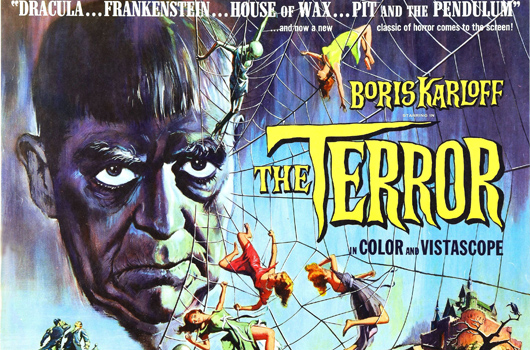
Can you follow the plot of the 1963 horror film, The Terror?
If so, congratulations! You’ve accomplished something that even the people who made the film have admitted to being unable to do.
The film opens in 19th century Europe. Andre Duvalier is an earnest French soldier who has somehow gotten lost in Germany. Andre is played by a youngish, pre-stardom Jack Nicholson. Nicholson, that most contemporary, sarcastic, and American of actors, is thoroughly unconvincing as an idealistic Frenchman from 1806. Obviously unsure of what do with the character, Nicholson delivers his lines stiffly and does what he can to downplay the naturally sardonic sound of his voice. This is probably the only film where Jack Nicholson is a “nice young man.”
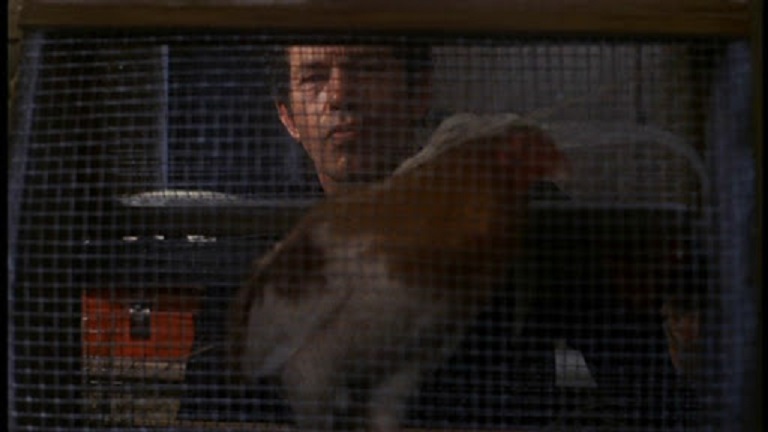
Andre meets a mysterious woman named Helene (played by Sandra Knight, who was Nicholson’s wife at the time). Helene appears to live in a castle with the Baron (Boris Karloff) and his servant, Stefan (Dick Miller, who makes no effort to come across as being, in anyway, European). However, Helene bears a distinct resemblance to the Baron’s long-dead wife, Ilse, who the Baron killed after discovering her with another man. However, a witch in the village claims that Ilse’s lover was her son so she put a curse on the Baron and the presence of Helene is a part of that curse. However, Stefan claims that the Baron isn’t actually the Baron and and that Ilse’s husband isn’t actually dead. However….
Yes, there’s a ton of plot twists in this movie, which is probably the result of the fact that the film was shot without a completed script. In fact, the only reason the movie was made was because Roger Corman had access to Boris Karloff and a castle set that he used for The Raven. When he discovered that he could use the set for two extra days, he shot some random footage with Boris Karloff and then he tried to build a movie around it. As a result, the cast and the directors largely made up the story as the filmed.
Yes, I said directors. While Corman shot the Karloff scenes, he no longer had enough money to use a union crew to shoot the rest of the film. Because Corman was a member of the DGA, he couldn’t direct a nonunion film. So, he assigned the rest of the film to one his assistants, an aspiring filmmaker named Francis Ford Coppola. Coppola shot the beach scenes and, in a sign of things to come, he went overbudget and got behind schedule. Coppola was meant to shoot for three days but instead went for eleven.
Though Coppola shot the majority of the film, he got a better job offer before he could do any reshoots. Coppola suggested that a friend of his from film school, Dennis Jakob, take over. Jakob shot for three days and reportedly used most of the time to shoot footage for his thesis movie.
Still feeling that the movie needed a few extra scenes to try to make sense of the plot, Corman then gave the film to Monte Hellman and, after Hellman got hired for another job, Jack Hill. Hellman would later go on to direct films like The Shooting and Two-Lane Blacktop. Jack Hill would later direct Spider Baby and several other exploitation films in the 70s. Reportedly, on the final day of shooting, even Jack Nicholson took some time behind the camera. It was Nicholson’s first directing job. (Nicholson, for his part, has often said that his original ambition in Hollywood was to become a director and not an actor.)
So, yes, the film’s a bit disjointed. The plot doesn’t make any sense. Nicholson shows little of his trademark charisma. But Dick Miller has a lot of fun as the duplicitous Stefan and Boris Karloff brings his weary dignity to the role of the Baron. Oddly, even though the Baron’s scene were shot before the script had even been written, they’re the ones that make the most sense. It’s a messy film but it plays out with a certain hallucinatory style. It’s a piece of Hollywood history and a testament to Roger Corman’s refusal to waste even two days of shooting. If you’ve got a star and a set for two days, you’ve got enough for a movie!
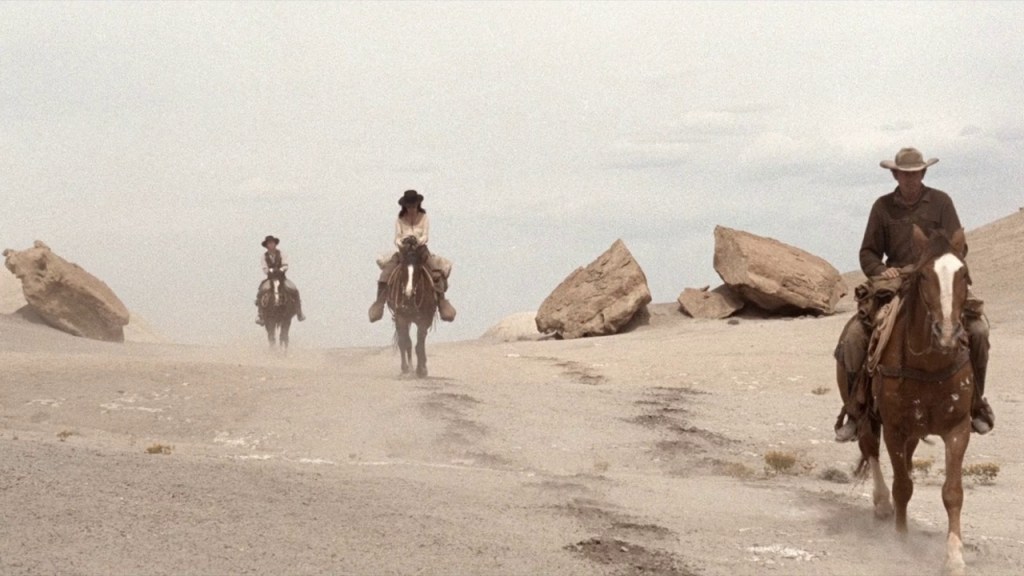


 Three cowboys — Vern (Cameron Mitchell), Wes (Jack Nicholson), and Otis (Tom Filer) — are riding their horses across the old west when they come upon a cabin that is inhabited by one-eyed Blind Dick (Harry Dean Stanton) and his friends. Though they suspect that Dick may be an outlaw, the cowboys accept his offer to stay the night. The next morning, they wake up to discover that they are surrounded by a posse. Mistaken for members of Dick’s gang, Vern and Wes go on the run. Eventually, they find themselves hiding out at the home of Evan (George Mitchell), Catherine (Katherine Squire), and their daughter, Abigail (Millie Perkins). While Wes and Vern wait for their chance to escape, the posse grows closer and closer.
 The time is World War II. The place is the Philippines, shortly before the famous return of Douglas MacArthur. Three U.S. soldiers have been sent on a very important mission to knock out a Japanese communication center before the American invasion. Lt. Craig (Jimmie Rodgers) is their leader and he worries that he might not have what it takes to kill a man. Sgt. Jersey (John Hackett) is cynical and tough. Cpl. Burnett (Jack Nicholson) is the radio man with a sarcastic sense of humor. They have been told to meet up with a rebel leader named Miguel but, shortly after arriving, they discover that Miguel has been killed and the new leader is Paco (Conrad Maga), who distrusts the Americans almost as much as he dislikes the Japanese. Meanwhile, a Japanese captain (Joe Sison) threatens to execute all of the children in a nearby village unless the Americans either surrender or are captured.
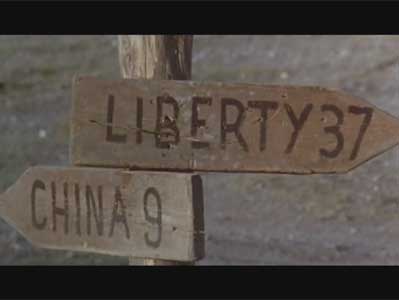
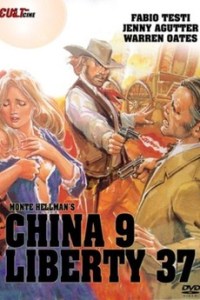 Directed by the legendary Monte Hellman, China 9, Liberty 37 is a revisionist take on the western genre. Fabio Testi plays Clayton Drumm, a legendary gunslinger who is about to be hung for murder. At the last minute, men from the railroad company show up and arrange for Clayton be released. They want him to kill a rancher who is refusing to sell his land. Clayton agrees but, before he leaves for his mission, he gives a brief interview to a writer from “out East.” Cleverly, the writer is played by director Sam Peckinpah, to whose films China 9, Liberty 37 clearly owes a huge debt.
 Catherine loves Matthew but resents his rough ways and feels that he treats her like property. One night, she and Clayton go for a nude swim and then make love. When Matthew finds out, he strikes his wife and, in self-defense, she stabs him in the back. Believing Matthew to be dead, she and Clayton go on the run.
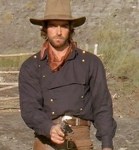 As a western, China 9, Liberty 37 is more interested in its characters than in the usual gunfights. There are no traditional heroes or villains and Monte Hellman emphasizes characterization over action. Even while he is relentlessly pursuing Clayton and Catherine, Matthew admits that he does not blame Catherine for leaving him. As for Clayton and Catherine, they are both consumed by guilt over their affair. This is one of the few westerns where the main character often refuses to fire his gun.
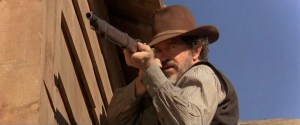 Director Monte Hellman is as well-known for the films he did not get to make as for the ones he actually did make. (Originally, Quentin Tarantino wanted Hellman to director Reservoir Dogs. When Tarantino changed his mind and decided to direct it himself, Hellman was relegated to serving as executive producer. A lot of recent film history would be very different if Tarantino and Hellman had stuck to the original plan.) Like a lot of the films that Hellman actually did get to make, China 9, Liberty 37 was only given a sparse theatrical release and was often shown in a heavily edited version. It has only been recently that the full version of China 9, Liberty 37 has started to show up on TCM. It is an interesting revisionist take on the western genre and must see for fans of Monte Hellman, Jenny Agutter, and Warren Oates.