Film Review: The Greatest (1977, dir by Tom Gries and Monte Hellman)


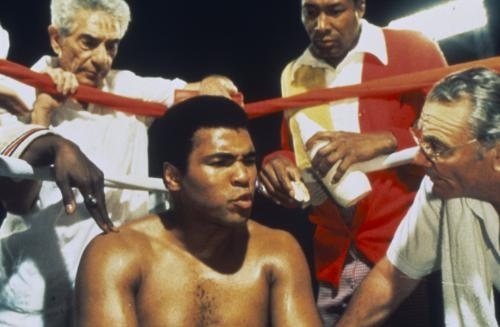
the_greatest_1977_portrait_w858The Greatest opens with 18 year-old Cassius Clay (played by Chip McAllister as a teenager and, as an adult, by Muhammad Ali himself) winning the light heavyweight gold medal at the 1960 Rome Olympics.  Returning home to Kentucky, Clay discovers that not even a gold medal can protect him from racism.  Angered after a restaurant refuses to serve him and his friend, Clay throws his gold medal into the Ohio River.  Under the training of Angelo Dundee (Ernest Borgnine), Clay turns pro and defeats Sonny Liston (Roger E. Mosley) for the heavyweight championship.  Inspired by Malcolm X (James Earl Jones), Clay also joins the Nation of Islam and changes his name to Muhammad Ali.  As heavyweight champion, Ali battles not only his opponents in the ring but racism outside of it.  The Greatest follows Ali as he loses his title for refusing to be drafted and concludes with the famous Rumble in the Jungle, where Ali won the title back from George Foreman.

Sadly, Muhammad Ali has never been the subject of a truly great feature film.  Even Michael Mann’s Ali failed to really capture the mystique that made Ali into such an iconic figure.  The Greatest is interesting because Ali plays himself.  Unfortunately, The Greatest proves that Ali may have been a great showman but he was not a natural actor.  You only have to watch the scene where Ali tries to hold his own with Robert Duvall to see just how stiff an actor Muhammad Ali really was.  Ali’s best scenes are the ones where he is trash talking his opponents or training.  The film opens with Ali jogging while George Benson sings The Greatest Love Of All, a scene that is made all the more poignant when you compare the athletic and confident Muhammad Ali of 1977 with the frail, Parkinson’s stricken Ali of today.
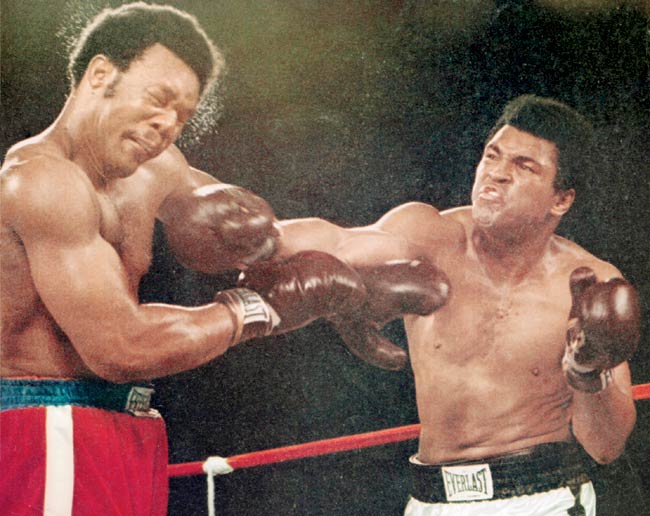
29Muhammad-Ali-1Instead of recreating any of Ali’s legendary fights, The Greatest instead uses actual footage of the matches.  The real life footage is the best part of the film.  After all these years, Ali’s fights against Sonny Liston, Joe Frazier, Ken Norton, and George Foreman remain exciting to watch.  Otherwise, The Greatest is too episodic and low budget to do justice to Muhammad Ali’s story.

If you want to see a truly great film about Ali and his legacy, watch the 1996 documentary When We Were Kings, 2009’s Facing Ali or 2013’s The Trials of Muhammad Ali.  Ali is such an iconic figure that it may be impossible for any feature film to properly do justice to his life and legacy.  These three documentaries come close.

(Director Tom Gries died during the filming of The Greatest.  The movie was completed by Monte Hellman.)
Film Review: The Shooting (dir by Monte Hellman)


I have to admit that I’m not a huge Western fan.  In fact, I can probably count the number of westerns that I’ve actually enjoyed on one hand.  However, at the same time, those westerns that I did enjoy also happen to be some of my favorite films of all time.  When done poorly, a western can be nearly unwatchable.  When done right, however, nothing beats a good western.

Case in point: 1966’s The Shooting.

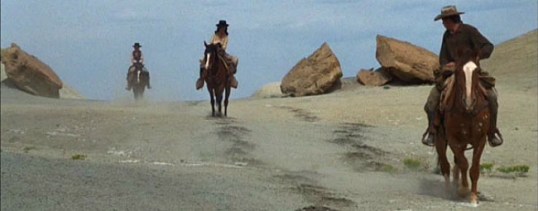
The Shooting tells the story of Willett Gashade (played by Warren Oates), a former bounty hunter who now makes his living a miner.  At the start of the film, he returns to his camp after being gone for several days.  At the camp, he discovers one man dead, one man missing, and one sole survivor, the good-natured by simple-minded Coley (Will Hutchins).  The panicky Coley explains that the camp was attacked by an unseen gunman and says that it was because the missing man had apparently ridden down “a man and a little person” in a nearby town.  How any of this relates to the rest of the film is open to interpretation.

For that matter, the entire film is open to interpretation.  That’s one reason why I love it.

The next day, an unnamed, black-clad woman (Millie Perkins) appears at the camp.  She hires Gashade and Coley to lead her to a town that lies some distance away, on the other side of an inhospitable desert.  Gashade is suspicious of the haughty woman but the far more trusting Coley takes a liking to her immediately.

As Gashade and Coley lead the Woman across the desert, there are hints both obvious and subtle that all is not as it seems.  The Woman, at one point, demands to be led in the wrong direction.  At another point, the woman suddenly shoots and kills her horse.  Eventually, the three of them are joined by Billy Spears (played by a young but already sardonic Jack Nicholson), a well-dressed gunman whose sinister smile does little to hide an obvious sadistic streak and who takes a cruel enjoyment out of taunting and bullying Coley.  It all leads to a shockingly violent and deliberately enigmatic conclusion that raises more questions than it answers.

As directed by Monte Hellman (one of the best directors of the 60s and 70s), the film is less concerned with conforming to the rigid expectations of the western genre and, instead, uses the genre as a way to explore the American culture of violence.  With its cynical dialogue and its stark imagery of a harsh journey through a seemingly endless desert, it’s little surprise that The Shooting is considered to be an existential western.

Fortunately, The Shooting contains a quartet of fine performances that hold the viewer’s interest, even when the story runs the risk of becoming incoherent.  Millie Perkins, who made her film debut playing the title role in 1959’s The Diary of Anne Frank, brings an air of genuine menace to the role of the Woman while Will Hutchins provides the movie with a much-needed heart.  The main appeal of the film, of course, is to see two iconic actors performing opposite each other and neither Warren Oates nor Jack Nicholson disappoints.  Of the two, Nicholson (who co-produced the film with Hellman) has the showier role and he is obviously having a lot of fun playing such an unrepentant villain.  Meanwhile, Warren Oates comes across like a hard-boiled film noir hero who has somehow found himself trapped in a western.

Needless to say, with its deliberately obscure storyline and its refusal to provide a traditional conclusion, The Shooting is not a movie for everyone.  However, for those willing to take a chance, The Shooting can be a very rewarding film.

CA-The-Shooting

And now…6 More Trailers


Hi, everyone!  Sorry for the delay in getting out this latest edition of Lisa Marie’s Favorite Grindhouse and Exploitation Film Trailers.  What can I say?  The holidays are a crazy, crazy time.  If you promise to keep reading and watching then I promise to not be late again in the future.  Deal?  Deal.

And now, without further delay, here’s 6 more trailers!

1) Silent Night, Deadly Night 3: Better Watch Out (1989)

This film was directed by Monte Hellman, who directed some of the best films of the 60s and 70s.  So, in case you were wondering what you get for directing a work of art like Two-Lane Blacktop, well, here you go.

2) Black Christmas (1974)

Continuing the holiday theme, here is the trailer for the original Black Christmas.  This film was directed by the late Bob Clark, who later went on to direct a totally different Christmas movie called A Christmas Story.

3) Madhouse (1974)

I love this trailer for the melodramatic opening.  I love the way the old grindhouse and exploitation movies would literally dare filmgoers to stay away.  That takes confidence!

4) The Freakmaker (1974)

With a title like The Freakmaker, it has to be good.

5) The Creatures The World Forgot (1971)

The World, I am sure, had its reasons for forgetting.

6) Prehistoric Women (1967)

This film is also known as Slave Girls and I’m sure there’s probably prints out there entitled Slave Women and Prehistoric Girls as well. 

Six Trailers of the Supermoon


Picture of supermoon taken by Erin Nicole Bowman

Apparently, as I sit here in my underwear and glasses, the Earth is about as close to the moon as it will ever get.  Because of that, the moon is huge out in the night sky.  Or at least that’s what I’m hearing.  It looks pretty normal to me but anyway, this is being referred to as being “Supermoon.”  I’m not sure why.  If I stood less than an inch from your face, would that suddenly make me Super Lisa? 

But anyway, this weekend’s slightly intoxicated edition of Lisa Marie’s Favorite Grindhouse and Exploitation Trailers is dedicated to Supermoon.

1) Werewolves on Wheels (1971)

Of course, a gigantic full moon would bring a werewolf film with it.  This is one of the thousand or so biker films to come out in the late 60s and early 70s.  These films were interesting mostly from the point of view of how they mixed other genres with the biker conventions.  Werewolves on Wheels did it with lycanthrophy.

2) Werewolf of Washington (1973)

Actually, since it’s a supermoon, we better include two werewolf-themed trailers.  This is for the Werewolf of Washington, starring Dean Stockwell.  For some reason, I’ve actually got several copies of this on DVD (I think this is one of those films that somehow found its way into the public domain) but I’ve yet to actually sit down and watch it.  I think my hesitation has to do with the fact that it appears to be a political satire and it was made in the 70s.  That sounds like a combination for boredom, to be honest.

3) Psych-Out (1968)

Before Dean Stockwell could become a werewolf, he had to serve as Jack Nicholson’s hippie guru in Richard Rush’s Psych-Out.

4) The Shooting (1967)

But before Jack Nicholson could become a hippie, he was a sinister gunman in Monte Hellman’s existential grindhouse western, The Shooting.  The Shooting, which co-stars Warren Oates and Millie Perkins, is an unacknowledged classic and a movie that I’m going to have to review one of these days.  Perkins, by the way, was married to none other than Dean Stockwell.

5) Cockfighter (1974)

And then, 7 years later, Hellman, Oates, and Perkins reunited to make an odd little film called Cockfighter.  This is another film I have to review though I also have to say that, as a former country girl who has actually seen a few cockfights, cockfighting is right up there with dogfighting as far as sickening sadism is concerned.*

6) Macon County Line (1974)

And, of course, while some people in the south were going to cockfights, others were apparently getting killed by redneck lawmen in films like the ’74 classic, Macon County Line.

In honor of Supermoon, I’m going to include two extra trailers.  Seriously, don’t ever doubt that Lisa loves you.

7) The Education of Sonny Carson (1974)

While rural audiences (probably made up of people I’m distantly related to) spent 1974 cheering police brutality and animal cruelty, urban grindhouse audiences were enjoying films like this one.

8 ) Bloody Moon (1981/2)

Finally, since we’re under a supermoon, here’s the trailer for Jesus Franco’s infamous (and frequently banned) slasher Bloody Moon.  I haven’t seen Bloody Moon (copies aren’t that easy to find) but seriously, the involvement of Jesus Franco tells me all I probably need to know.**

—–

*If you’ve got a cock, use it to spread love, not hate.

** Well, we’ll see about that.  I just ordered a copy off of Amazon.