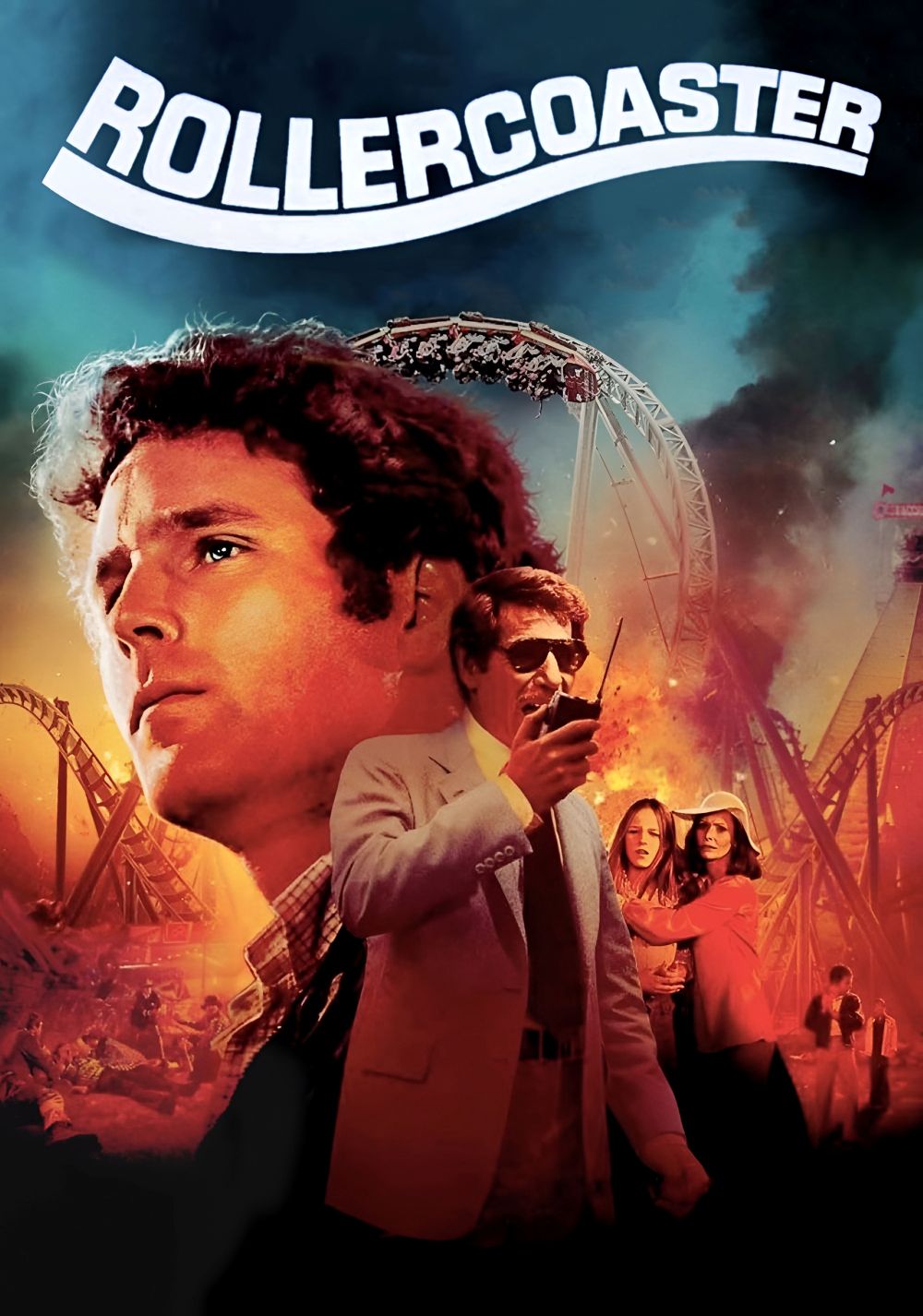
Review: Rollercoaster (dir. by James Goldstone)


“If they pay me and if they do what I say, I’ll never bother them again.” — Young Man

James Goldstone’s 1977 film Rollercoaster exists in a fascinating, albeit deeply flawed, space within the history of seventies disaster cinema. If you are a fan of retro 70s movies, specifically the whole Sensurround era where Hollywood was desperately trying to get people out of their living rooms and into theaters with seat-rumbling audio gimmicks, you have probably heard of this one. It has a genuinely neat, gritty vibe because it was actually shot on location at real amusement parks like Kings Island and Magic Mountain. You get this awesome, vintage, mid-century theme park atmosphere that you just cannot fake on a studio backlot. You can almost smell the cotton candy, the hot asphalt, and the stale beer. But once that initial wave of nostalgia wears off, you are left looking at what is actually on the screen, and honestly, Rollercoaster is not a great film. In fact, one could very easily say it is not even a good film. At its absolute best of times, it is a thoroughly average, middle-of-the-road thriller that feels more like a slightly elevated, padded-out television movie of the week than a major theatrical release.

The plot is about as standard as it gets for this era of disaster-adjacent cinema. A mysterious, young terrorist starts blowing up rollercoasters, not for any grand political manifesto, but simply to extort amusement park owners for millions of dollars. Enter our protagonist, Harry Calder, played by George Segal, who is a cynical safety inspector that just happens to survive the first derailment. Segal is basically just playing George Segal here—exasperated, a bit snarky, wearing a rumpled suit, and teaming up with an FBI agent played by Richard Widmark. The villain is played by a very young Timothy Bottoms, who is effectively creepy but given virtually zero backstory or motivation. He is just a blank-eyed psycho doing psycho things because the script needs an antagonist. The movie essentially just bounces from one park to another, with Segal walking around looking stressed while the FBI tries to figure out where the next bomb is hidden.

The pacing is arguably the film’s biggest sin. For a movie literally named Rollercoaster, it is shockingly lacking in momentum. Goldstone’s direction completely lacks the tight, pulse-pounding beats you would expect from a high-stakes thriller. There is so much filler here, so many scenes of Segal drinking coffee and staring at blueprints, and so much tedious FBI bureaucratic nonsense that it completely kills any tension. The romantic subplot feels entirely tacked on, and the climax fails to deliver the massive, explosive payoff you have been waiting for. If you judge Rollercoaster purely on its cinematic merits—the acting, the script, the direction—it is undeniably average, the kind of movie you leave on in the background while you fold laundry.

However, despite all of these glaring, undeniable flaws, Rollercoaster has a fascinating, almost prophetic legacy when you look back at the history of the thriller genre. It may not be remembered as a great movie, but it essentially built the exact template for an entire subgenre of cat-and-mouse thrillers that dominated the 90s. It practically invented the “specific-professional-against-a-psychopathic-mastermind” formula. Before Rollercoaster, thrillers were usually about spies, cops, or generic everymen. But this film introduced the idea of a highly specific, niche expert being forced into a one-on-one intellectual duel with a terrorist who targets them specifically because of their expertise. Think about how that exact template was endlessly copied and refined in the decades that followed. Look at In the Line of Fire, where Clint Eastwood plays a Secret Service agent hunted by a psycho played by John Malkovich. Or look at Blown Away, where Jeff Bridges is a bomb-defusing expert tormented by an Irish terrorist played by Tommy Lee Jones. Even The Bone Collector fits this mold perfectly, with Denzel Washington’s bedridden forensics expert being targeted by a serial killer who uses specific crime scenes just to test Washington’s intellect. All of these films drew direct DNA from Rollercoaster, using that exact same dynamic of a reluctant protagonist with a very particular set of skills being singled out by a psychopath who treats mass murder like a twisted, personalized game of chess. And if you want the absolute pinnacle of the “expert vs. bomb” trope, you have to look at Speed, which polished the cat-and-mouse dynamic perfected right here in Rollercoaster.

Because the original film was so hampered by 1970s filmmaking technology, it really makes you realize how easily this movie could be remade in this day and age. Back then, the actual destruction of the rides was limited by practical effects, clunky models, and standard camera angles that made the crashes feel somewhat static and safe. Today, technology in filmmaking has advanced to the point that the sheer scale, speed, and physical danger of the rides themselves really does become the focus of real danger. With modern CGI, drone cameras, and advanced practical rigging, you could put the audience right inside the front car of a 300-foot hyper-coaster as the tracks buckle and twist in slow motion. You could make the metal fatigue, the snapping cables, and the horrific physics of a derailment feel genuinely terrifying, turning the amusement park rides into massive, mechanical monsters rather than just static backdrop props for guys in suits to talk around.

Naturally, if Hollywood were to actually remake Rollercoaster today, you know exactly how it would look and who would star in it. It would undoubtedly star someone like Dwayne Johnson or Chris Pratt, a guy who can deliver a quip while looking concerned and holding a blueprint. They would inevitably give the safety inspector a tragic backstory, probably a dead wife or a kid they are estranged from, just to artificially raise the emotional stakes. And because it is a high-concept thriller that does not quite have the cultural weight of a massive comic book franchise, the remake would almost certainly be relegated to a streaming release. It would drop on a Friday on Netflix or Amazon Prime with a generic, algorithmically tested poster and a slick, forgettable title. It would be exactly the kind of mid-budget, mildly entertaining action flick you watch on a rainy Sunday afternoon before completely forgetting about it by Monday morning.

So, ultimately, how do you rate a movie like Rollercoaster? You just have to accept its extreme averageness and respect its ripple effect. It is clunky, the performances are uneven, and it is rarely as thrilling as its title promises. But it absolutely should not be written off entirely. It was the exact moment Hollywood realized that pitting highly specialized professionals against high-concept villains made for compelling, relatable drama. Without George Segal boredly walking around Magic Mountain, we probably do not get the overly dramatic, incredibly ridiculous, yet thoroughly entertaining 90s thriller boom, nor the slick, CGI-heavy streaming thrillers of today. Rollercoaster might just be a mediocre hill, but it is undeniably the hill that started the entire ride.

Film Review: The Concorde …. Airport ’79 (dir by David Lowell Rich)


In 1979’s The Concorde …. Airport ’79, Joe Patroni (George Kennedy) finally gets to fly the plane.

The plane is question is a Concorde, a supersonic airliner that can travel faster than the speed of sound.  When we first see the Concorde, it’s narrowly avoiding a bunch of dumbass hippies in a hot air balloon as it lands in Washington, D.C.  The recently widowed Joe Patroni joins a flight crew that includes neurotic Peter O’Neill (David Warner), who says that he has dreams in which he’s eaten by a banana, and suave co-pilot Paul Metrand (Alain Delon).  Because this is an Airport film, Mertrand is dating the head flight attendant, Isabelle (Syliva Kristel).  “You pilots are such men,” Isabelle says.  “It ain’t called a cockpit for nothing, honey,” Patroni replies.

(One thing that is not explained is just how exactly Joe Patroni has gone from being a chief technician in the first film to an airline executive in the second to a “liaison” in the third and finally to a pilot in the fourth.)

The Concorde is flying to Moscow with a stop-over in Paris.  There’s the usual collection of passengers, all of whom have their own barely-explored dramas.  Cicely Tyson plays a woman who is transporting a heart for a transplant.  She gets maybe four or five lines.  Eddie Albert is the owner of the airline and he’s traveling with his fourth wife.  (Of course, he’s old friends with Patroni.)  John Davidson is an American reporter who is in love with a Russian gymnast (Andrea Marcovicci).  Avery Schrieber is traveling with his deaf daughter.  Monica Lewis plays a former jazz great who will be performing at the Moscow Jazz Festival.  Jimmie Walker is her weed-smoking saxophonist.  Charo shows up as herself and gets kicked off the plane before it takes off.

The most important of the passengers is Maggie Whelan (Susan Blakely), a journalist who has evidence that her boyfriend, Kevin Harrison (Robert Wagner), is an arms trafficker.  Harrison is determined to prevent that evidence from being released so he programs a surface-to-air missile to chase the Concorde.  Patroni is able to do some swift maneuvers in order to avoid the missile, which means that we get multiple shots of passengers being tossed forward, backwards, and occasionally hanging upside down as Patroni flips over the plane.  Oddly no one really gets upset at Patroni about any of this and no one seems to be terribly worried about the fact that someone is obviously trying blow up their plane.  Even after the stop-over in Paris, everyone gets back on the Concorde!  That includes Maggie, who could have saved everyone a lot of trouble by just holding a press conference as soon as the plane landed in Paris.

A year after The Concorde came out, Airplane! pretty much ended the disaster genre.  However, even if Airplane! had never been released, I imagine The Concorde would have still been the final Airport film.  Everything about the film feels like the end of the line, from the terrible special effects to the nonsensical script to the Charo cameo and Martha Raye’s performance as a passenger with a weak bladder.  The first Airport film was an old-fashioned studio film standing defiant against the “New Hollywood.”  The second Airport film was a camp spectacular.  The third Airport film was an example of changing times.  The fourth Airport film is just silly.

And, really, that’s the main pleasure to be found in The Concorde.  It’s such an overwhelmingly silly film that it’s hard to look away from it.  For all of its weaknesses, The Concorde will always be remembered as the film that featured George Kennedy opening the cockpit window — while in flight — and shooting a flare gun at another plane.  As crazy as that scene is, just wait for the follow-up where Kennedy accidentally fires a second flare in the cockpit.  “Put that out,” Alain Delon says while David Warner grabs a fire extinguisher.  It’s a silly moment that it also, in its way, a great moment.

The Concorde brings the Airport franchise to a close.  At least George Kennedy finally got to fly a plane.

Film Review: Airport ’77 (dir by Jerry Jameson)


Airport ’77 is the one where the plane ends up underwater.

If the first two Airport movies emphasized the competence of the the crew in both the airplane and the airport, Airport ’77 takes the opposite approach.  The first of the Airport films to be released after Watergate, Airport ’77 is a cynical film where no one seems to be particularly good at his or her job.  Viewers should be concerned the minute they see that Jack Lemmon is playing Captain Don Gallagher, the pilot of the soon-to-be-submerged airplane.  As opposed to Charlton Heston or even the first film’s Dean Martin, Jack Lemmon was always a very emotional actor.  He excelled at playing characters who were frustrated with modern life.  Just as with Heston and Martin, Lennon plays a pilot who is having an affair with a flight attendant.  The big difference is that, this time, the pilot is the one who desperately wants to get married while the flight attendant (played by Brenda Vacarro) is the one who doesn’t want to get tied down.  As an actor, Lemmon didn’t have the arrogance of a Heston or the unflappability of Dean Martin.  Instead, Jack Lemmon was the epitome of midlife ennui.  He’s disillusioned and he’s beaten down.  He’s America at the tail end of the 70s.

Another sign that Airport ’77 is a product of the post-Watergate era is the character of co-pilot Bob Chambers (Robert Foxworth).  Chambers might seem like a nice and friendly professional but actually, he’s the one who comes up with the plan to knock out all of the passengers with sleeping gas and fly the plane into the Bermuda Triangle so that his partners-in-crime can steal the valuable art works in the cargo hold.  Chambers plans is to land the plane on an unchartered isle so that he and Banker (Monte Markham) can make their escape before the rest of the people on the plane even wake up.  Instead, Chambers turns out to be as incompetent a pilot as he is a criminal.  He crashes the plane into the ocean, where it promptly sinks to the bottom.  The impact wakes up the passengers, all of whom can only watch in horror as the ocean envelopes their plane.  With the water pressure threatening to crush the plane, Captain Gallagher and engineer Stan Buchek (Darren McGavin) try to figure out how to get everyone to the surface.

As usual, the passengers are played by a collection of familiar faces.  Olivia de Havilland and Joseph Cotten play former lovers who are reunited on the flight.  Christopher Lee is a businessman who is unhappily married to alcoholic Lee Grant.  Grant is having an affair with Lee’s business partner, Gil Gerard.  A young Kathleen Quinlan plays the girlfriend of blind pianist Tom Sullivan.  Robert Hooks is the bartender who ends up with a severely broken leg.  As the veterinarian who is called to doctor’s duty, M. Emmet Walsh gives the best performance in the film, if just because he’s one of the few characters who really gets to surprise us.  Actors like George Furth, Michael Pataki, and Tom Rosqui all wander around in the background, though I dare anyone watching to actually remember the names of the characters that they’re playing.  Airport ’77 has the largest number of fatalities of any of the Airport films, largely because even the good guys aren’t really sure about how to reach the surface.

George Kennedy returns as Joe Patroni, though his role is considerably smaller in this film than it was in the first two.   He shares most of his scenes with James Stewart, who plays the owner of the plane.  Fortunately, neither Stewart nor Kennedy were on the plane when it crashed.  Instead, they spend most of the movie in a control room, getting updates about the search.  They don’t get to do much in the film but it’s impossible not to smile whenever Jimmy Stewart is onscreen, even if he is noticeably frail.

Airport ’77 is the best-made of all of the Airport films.  The crash is well-directed and the scenes of water dripping into the plane are properly ominous.  There’s not much depth to the characters but Jack Lemmon and Darren McGavin are likable as the two main heroes and Christopher Lee seems to be enjoying himself in a change-of-pace role.  Olivia de Havilland and Joseph Cotten, two old pros, are wonderful together.  That said, Airport ’77 is never as much fun as the first two films.  Even with the plane underwater, it can’t match the spectacle of Karen Black having to fly a plane until Charlton Heston can be lowered into the cockpit.