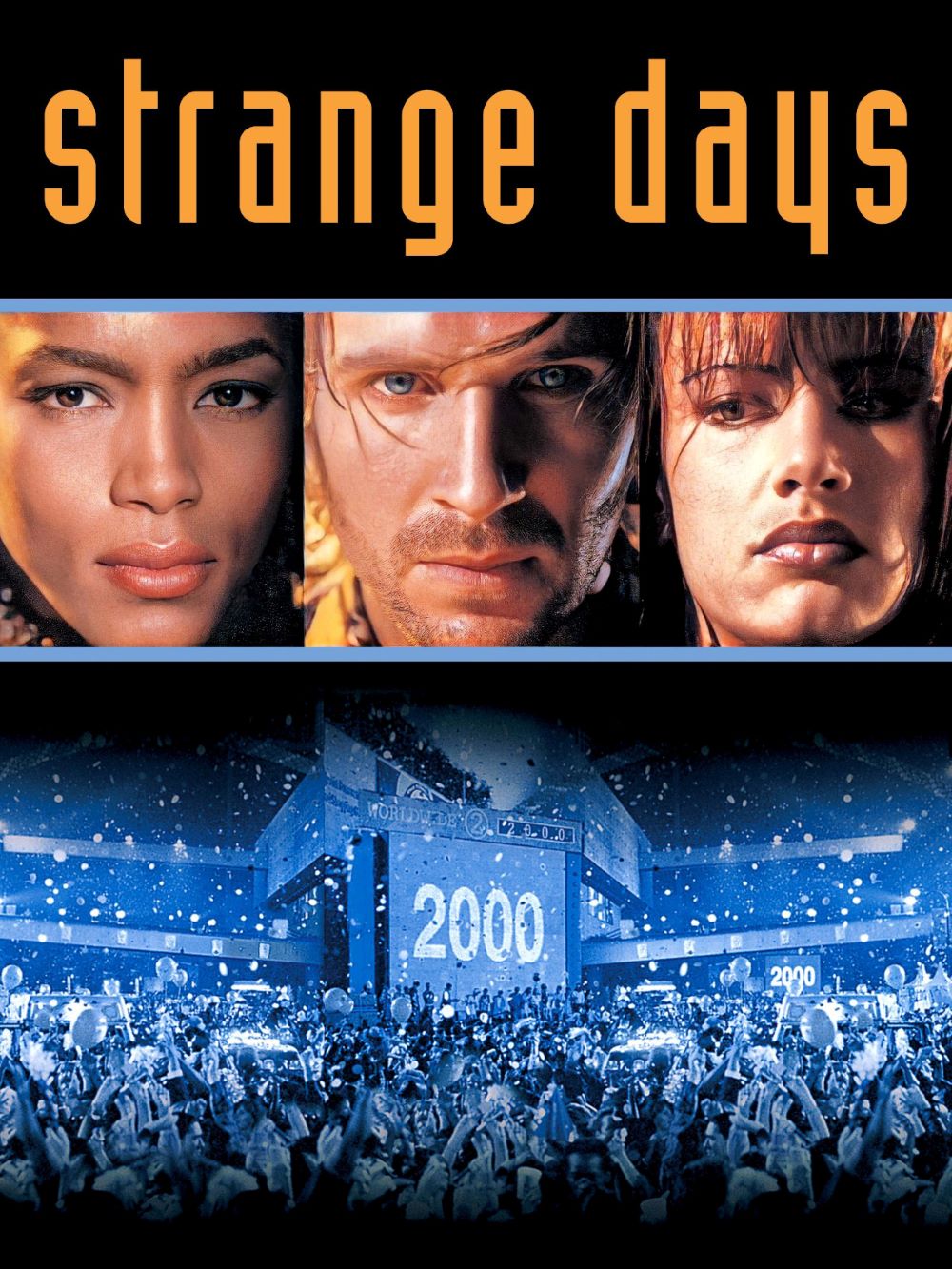
Welcome to Retro Television Reviews, a feature where we review some of our favorite and least favorite shows of the past! On Mondays, I will be reviewing Miami Vice, which ran on NBC from 1984 to 1989. The entire show can be purchased on Prime!
This week, Gina’s in trouble again!
Episode 4.19 “Blood & Roses”
(Dir by George Mendeluk, originally aired on April 1st, 1988)
Frank Mosca (Stanley Tucci) is back!
In case you’ve forgotten, Mosca was the villain from the fourth season premiere, Contempt of Court. That episode ended with Mosca getting away with everything. This episode finds him killing a rival drug lord (Michael Wincott) and trying to kill Crockett. Because Mosca knows who Crockett and Tubbs are, it falls on Gina to go undercover. This becomes yet another episode where Gina starts to fall for the bad guy and ends up having sex with the target of a Vice investigation. As often happens with these type of episodes, Gina ends up shooting Mosca to keep him from shooting Sonny. Mosca’s body plummets down an air shaft and it’s hard not to notice that Stanley Tucci has suddenly become a mannequin with painted hair.
Stanley Tucci gave a magnetic performance as the charismatic but evil Frank Mosca. Watching Tucci, it’s easy to see why the show brought him but Mosca was such a memorable character that it’s shame that he was given a standard Miami Vice death scene. Mosca deserved to go out with a bit more style. Saundra Santiago gave a good performance as Gina but it’s hard not to notice that every time she’s at the center of an episode, it’s pretty much the same basic plot. As a character, Gina deserved better than to constantly be used as a sex toy by every bad guy she went undercover to investigate.
Watching this episode, I found myself wondering if the show’s writers remembered that Crockett was supposed to be married. Between his jealousy over Gina getting close to Mosco and a scene where he and Gina shared a brief but intense kiss, it was hard not to notice that Crockett didn’t seem to be thinking about his wife. Perhaps this episode was originally meant to air earlier in the season, before Crockett’s somewhat improbable wedding. Who knows? It’s been a while since anyone asked Crockett about Caitlin. Maybe they got a quickie divorce offscreen.
This episode was typical of season 4. It was well-made but everything just felt a bit too familiar. to be effective.
That can be a dangerous thing to admit, about both the band and Oliver Stone’s 1991 film. Yes, both the band and the film could be a bit pretentious. They both tended to go on for a bit longer than necessary. They were both centered around a guy who wrote the type of poetry that I used to love back in my emo days. It’s all true.
But, with The Doors as a band, I find that I can’t stop listening to them once I start. Even if I might roll my eyes at some of the lyrics or if I might privately question whether any blues song really needs an organ solo, I can’t help but love the band. They had a sound that was uniquely their own, a psychedelic carnival that brought to mind images of people dancing joyfully while the world burned around them. And say what you will about Jim Morrison as a poet or even a thinker, he had a good voice. He had the perfect voice for The Doors and their rather portentous style. From the clips that I’ve seen of him performing, Morrison definitely had a stage presence. Morrison died young. He was only 27 and, in the popular imagination, he will always look like he’s 27. Unlike his contemporaries who managed to survive the 60s, Morrison will always eternally be long-haired and full of life.
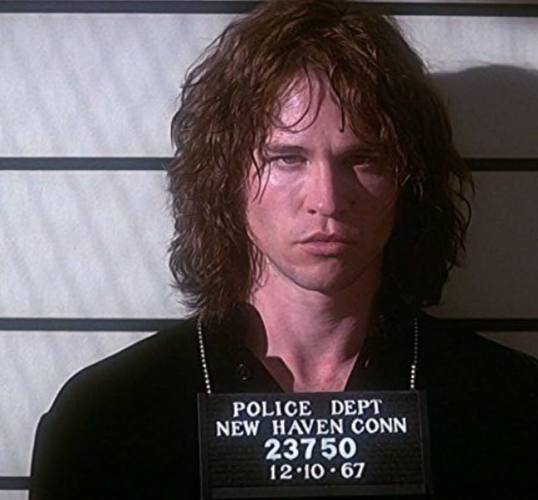
As for The Doors as a movie, it’s definitely an Oliver Stone film. It’s big. It’s colorful. It’s deliberately messy. Moments of genuinely clever filmmaking and breath-taking visuals are mixed with scenes that are so heavy-handed that you’ll be inspired to roll your eyes as dramatically as you’ve ever rolled them. Stone loved the music and that love comes through in every performance scene. Stone also loves using Native Americans as symbols and that can feel a bit cringey at times. Why would Jim Morrison, whose was of Scottish and Irish ancestry, even have a Native American spirit guide? At its best The Doors captures the chaos of a world that it’s the middle of being rebuilt. The 60s were a turbulent time and The Doors is a turbulent movie. I’ve read many reviews that criticized The Doors for the scene in which Morrison gets involved in a black magic ceremony with a journalist played by Kathleen Quinlan. I have no idea whether or not that scene happened in real life but the movie is so full of energy and wild imagery that the scene feels like it belongs, regardless of whether it’s true or not. Stone turns Jim Morrison into the warrior-artist-priest that Morrison apparently believed himself to be and the fact that the film actually succeeds has far more to do with Oliver Stone’s enthusiastic, no-holds-barred direction and Val Kilmer’s charismatic lead performance than it does with Jim Morrison himself.
The Doors spent several years in development and there were several actors who, at one time or another, wanted to play Morrison. Everyone from Tom Cruise to John Travolta to Richard Gere to Bono was considered for the role. (Bono as Jim Morrison, what fresh Hell would that have been?) Ultimately, Oliver Stone went with Val Kilmer for the role and Kilmer gives a larger-than-life performance as Morrison, capturing the charisma of a rock star but also the troubled and self-destructive soul of someone convinced that he was destined to die young. Kilmer has so much charisma that you’re willing to put up with all the talk about opening the doors of perception and achieving a higher consciousness. Kilmer was also smart enough to find the little moments to let the viewer know that Morrison, for all of his flamboyance, was ultimately a human being. When Kilmer-as-Morrison winks while singing one particularly portentous lyric, it’s a moment of self-awareness that the film very much needs.
(When the news of Kilmer’s death was announced last night, many people online immediately started talking about Tombstone, Top Gun, and Top Secret. For his part, Kilmer often said he was proudest of his performance as Jim Morrison.)
In the end, The Doors is less about the reality of the 60s and Jim Morrison and more about the way that we like to imagine the 60s and Jim Morrison as being. It’s a nonstop carnival, full of familiar faces like Kyle MacLachlan, Michael Madsen, Crispin Glover (as Andy Warhol), Frank Whaley, Kevin Dillon, and a seriously miscast Meg Ryan. It’s a big and sprawling film, one that is sometimes a bit too big for its own good but which is held together by both Stone’s shameless visuals and Val Kilmer’s charisma. If you didn’t like the band before you watched this movie, you probably still won’t like them. But, much like the band itself, The Doors is hard to ignore.
In 1989, having already won an Oscar for recreating his Vietnam experiences in Platoon, director Oliver Stone returned to the war with Born On The Fourth Of July.
Based on the memoir of anti-war activist Ron Kovic, Born on the Fourth of July stars Tom Cruise as Kovic. When we first meet Kovic, he’s growing up on Long Island in the 50s and 60s. He’s a clean-cut kid from a nice family. He’s on the school wrestling team and he’s got a lot of friends. When he was just 15, he heard John F. Kennedy telling people to ask what they can do for their country and he was inspired. He decided he wanted to join the Marines, despite the fact that his father (Raymond J. Barry) was still haunted by the combat that he saw in World War II. (In one of the film’s better scenes, a young Kovic notices that the elderly veterans marching in the Independence Day parade still flinch whenever they hear a firecracker.) He enlists in the Marines after listening to a patriotic speech from a recruiter (played by Tom Berenger). Ron runs through the rain to attend his prom and has one dance with Donna (Kyra Sedgwick), on whom he’s always had a crush. There’s nothing subtle about the way that Stone portrays Kovic’s childhood. In fact, one might argue that it’s a bit too idealized. But Stone knows what he’s doing. The wholesomenss of Kovic’s childhood leaves neither him nor the viewer prepared for what’s going to happen in Vietnam.
Vietnam turns out not to be the grand and patriotic adventure that Kovic thought it would be. After Sgt. Kovic accidentally shoots one of his own men in a firefight, he is ordered to keep quiet about the incident. After he is wounded and paralyzed in another firefight, Kovic ends up in a Hellish VA hospital, surrounded by men who will never fully recover from their mental and physical wounds. Kovic is eventually returns home in wheelchair. The film then follows Kovic as he goes from defending the war in Vietnam to eventually turning against both the war and the government. At one point, he ends up with a group of disabled vets in Mexico and there’s a memorable scene where he and another paraplegic (Willem Dafoe) attempt to fight despite having fallen out of their chairs. Eventually, Kovic returns to America and turns his anger into activism.
There’s nothing subtle about Born On The Fourth Of July. It’s a loud and angry film and Oliver Stone directs with a heavy-hand. Like a lot of Stone’s films, it overwhelms the viewer on a first viewing and it’s only during subsequent viewings that one becomes aware of just how manipulative the film is. Tom Cruise gives a good performance as Ron Kovic but his transformation into a long-haired, profane drunk still feels as if it happens a bit too abruptly. A good deal of the film centers on Kovic’s guilt about accidentally killing one of his men but the scene where he goes to the soldier’s family and asks them for forgiveness didn’t quite work for me. If anything, Kovic came across as being rather self-centered as he robs the man’s mother and father of the belief that their son had at least died heroically in combat as opposed to having been shot by his own sergeant. Did Kovic’s need to absolve himself really give him the right to cause this family more pain? Born on the Fourth Of July is an effective work of agitprop. On the first viewing, you’ll want to join Kovic in denouncing the military and demanding peace. On the second viewing, you’ll still sympathize with Kovic while also realizing that he really owes both his mother and father an apology for taking out his anger on them. By the third viewing, you’ll be kind of like, “Wow, I feel bad for this guy but he’s still kind of a jerk.” That said, when it comes to making an effective political film, Adam McKay could definitely take some lessons from Oliver Stone. Born On The Fourth of July is at its best when it simply captures the feeling of living in turmoil and discovering that the world is not as simple a place as you once believed. As idealized as the film’s presentation of Kovic’s childhood may be, anyone who has ever felt nostalgia for an earlier and simpler world will be able to relate.
Oliver Stone won his second Best Director Oscar for Born On The Fourth Of July. The film itself lost Best Picture to far more genteel version of the past, Driving Miss Daisy.
Burned-out writer Jake Bridges (William L. Petersen, a year or two before CSI) comes home one day to discover his wife in bed with another man. Jake, who is already suffering from an epic case of writer’s block, goes to Atlantic City and tries to drink his troubles away. When the bitter Jake gets into a bar fight, he’s saved by Frankie (Michael Wincott). Frankie takes Jake back to his house, where Jake meets Frankie’s girlfriend, Melissa (Diane Lane). Jake also discovers that Frankie works as a debt collector for a local mob boss, Lange (Michael Byrne).
Frankie and Jake strike up an unexpected friendship. Jake wants to experience what it’s like to be a real tough guy. Frankie wants to improve his vocabulary. Frankie agrees to take Jake with him when he makes his collections on the condition that Jake recommend a book to him. Soon, Jake is pretending to be a gangster and Frankie is reading Moby Dick. Frankie shows Jake how to be intimidating. Jake explains the symbolism of Ahab’s quest to Frankie. They become good friends, with the only possible complication being that Jake is falling in love with Melissa.
For a low-budget neonoir that, as far as I know, never even got a theatrical release before being released to video, Gunshy is surprisingly good. The plot may sometimes be predictable but Petersen and especially Wincott give good performances and they both play off of each other well. Diane Lane is undeniably sexy but also bring a fierce intelligence and a sense of wounded dignity to the role of Melissa. This is a love triangle where you want things to work out for all three of the people involved. The rest of the cast is full of familiar faces. Keep an eye out for everyone from R. Lee Ermey to Meat Loaf. Director Jeff Celantano keeps the story moving and proves himself to be adept at balancing scenes of violence with scenes where Frankie and Jake simply discuss their differing views of the world.
An unjustly obscure film, Gunshy is a 90s film that deserves to be rediscovered.
I Shot Andy Warhol was not the only 1996 film to feature Andy Warhol as a character. He was also a prominent supporting character in Basquiat. In this film, he’s played by David Bowie and Bowie gives a far different performance than Jared Harris did in I Shot Andy Warhol. Whereas Harris played Andy as a detached voyeur, Bowie’s performance is far more sympathetic. (Of course, it should be noted that Harris and Bowie were playing Andy Warhol at very different points in the artist’s life. Harris played the younger, pre-shooting Warhol. Bowie played the older, post-shooting Warhol.)
Then again, it’s not just Andy Warhol who is portrayed more positively in Basquiat than in I Shot Andy Warhol. The entire New York art scene is portrayed far more positively in Basquiat. Whereas I Shot Andy Warhol was a film about an outsider who was destined to forever remain an outsider, Basquiat is a film about an outsider who becomes an insider. On top of that, Basquiat was directed by a fellow insider, painter Julian Schnabel.
The film itself is a biopic of Jean-Michel Basquiat (very well played by Jeffrey Wright), the graffiti artist who, in the 1980s, briefly became one of the superstars of the New York art scene. However, it’s less of a conventional biopic and more of a meditation on what it means to be an artist. Throughout the film, Basquiat looks up to the New York skyline and sees a surfer riding a wave across the sky. The image itself is never explicitly explained. We never learn why, specifically, Basquiat visualizes a surfer. But then again, that’s what makes the surfer a perfect symbol of Basquiat’s artistic sensibility and talent. It’s a reminder that, while we can appreciate an artist’s work, only the artist can truly understand what that work is saying. All attempts to try to explain or categorize art are as pointless as trying to understand why that surfer is in the sky. Ultimately, the why is not as important as the simple fact that the surfer is there.
The film follows Basquiat as he goes from living on the streets to being a protegé of Andy Warhol’s and, until he overdosed on heroin, one of the shining lights of the New York art scene. Along the way, Basquiat struggles to maintain a balance between art and the business. In one of the key scenes of the film, an empty-headed suburbanite (Tatum O’Neal) looks at Basquiat’s work and whines that there’s too much green. She just can’t handle all of that green.
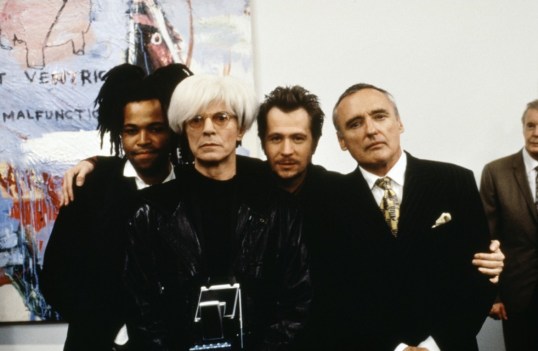
Basquiat’s friendship with Andy Warhol provides this film with a heart. When Bowie first appears — having lunch with a German art dealer played by Dennis Hopper — one’s natural instinct is to assume that Bowie as Warhol is stunt casting. However, Bowie quickly proves that instinct to be wrong. As opposed to many of the actors who have played Andy Warhol over the years, Bowie gives an actual performance. Instead of resorting to caricature, Bowie plays Warhol as being mildly bemused by both his fame and the world in general.
Basquiat also develops a close friendship with another artist. Gary Oldman may be playing a character named Albert Milo but it’s obvious from the moment that he first appears that he’s playing the film’s director, Julian Schnabel. If there was any doubt, Schnabel’s studio stands in for Milo’s studio. When Milo shows off his work, he’s showing off Schnabel’s work. When Albert Milo introduced Basquiat to his parents, the nice old couple is played by Julian Schnabel’s actual parents. It’s perhaps not surprising that Albert Milo is presented as being one of the most important and popular artists in New York City. In a film full of bitchy characters, Albert Milo is unique in that literally everyone likes and respects him. And yet Gary Oldman gives such a good and heartfelt performance that you can’t hold it against the character that he happens to be perfect. There’s a small but touching scene in which Albert Milo and his daughter share a dance in front of one of Schnabel’s gigantic canvases. Of course, Milo’s daughter is played by Julian Schnabel’s daughter.
The entire cast is full of familiar actors. Willem DaFoe appears as a sculptor. Christopher Walken plays a hilariously vapid interviewer. Courtney Love plays a groupie. Benicio Del Toro plays Basquiat’s best friend. Parker Posey shows up as gallery owner Mary Boone. Michael Wincott plays Rene Ricard, the somewhat infamous art critic who was among the first to celebrate the work of both Basquiat and Schnabel. For once, the use of familiar actors does not sabotage the effectiveness of the film. If anything, it helps to explain why Basquiat was so determined to make it. There’s a magical scene where a then-unknown Basquiat peeks through a gallery window and sees Andy Warhol, Albert Milo, and Bruno Bischofberger. However, the film’s audience sees David Bowie, Gary Oldman, and Dennis Hopper. What both Basquiat and the audience have in common is that they’re both seeing bigger-than-life stars.
Basquiat is an often magical and poignant film and I absolutely love it.
Now, before I start in on this review, I should admit that I’m hardly an expert on the manga on which Ghost in the Shell was based. (In fact, as soon as I wrote that previous sentence, I called my boyfriend over and had him read it, just to make sure that I was using the term manga correctly.) A few years ago, I did watch Mamoru Oshii’s 1995 film version. And while I don’t remember a whole lot about the animated Ghost in the Shell, I do remember that I was never bored while watching it. I wish I could say the same about the live action Ghost in the Shell.
Don’t get me wrong. The live action, Westernized Ghost In The Shell is truly a visually impressive film. It takes place in the near future, in the fictional Japanese city of New Port City. New Port City basically looks like the city from Blade Runner, just with a somewhat more colorful visual scheme. Everywhere you look, there are gigantic holographic advertisements and sleek, neon buildings. But, as advanced as New Port City may look at first sight, it’s also full of dark allies, cramped apartments, and gray cemeteries. Visually, it’s a perfect mix of outlandish science fiction and brooding film noir.
Or, at least, it is the first time that you see it. Unfortunately, director Rupert Sanders has a habit of using the visuals as a crutch. It seemed as if, every time a new plot point was clumsily introduced, we would suddenly cut to another shot of New Port City at night, as if the film was saying, “Don’t worry about narrative coherence! Look at the city!”
After about 15 minutes, I decided to take the film up on its suggestion. I stopped paying attention to the slow-moving story and I focused almost exclusively on the visuals. That’s a shame really because, from what I understand, both the manga and the original film are deeply philosophical works that balance style with thematic depth. Unfortunately, since there’s no real depth to the live action Ghost in the Shell, you really have no choice but to focus almost exclusively on the style.
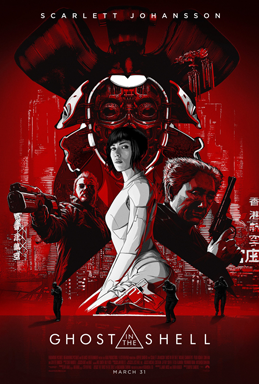
Ghost in the Shell takes place in a world where the line between human and machine has become blurred. Everyone is getting cybernetic upgrades done. One character, Batou (Pilou Asbæk), even gets new eyes halfway through the film. Major (Scarlett Johansson) is unique because, while her brain is human, her body is totally cybernetic. She is a member of Section 9, an anti-terrorism task force. Major has only vague flashes of memory of who she used to be. She’s been told that her parents were killed by terrorists but she doesn’t know if that’s true or if that’s just more manipulation from Cutter (Peter Ferdinando). (It’s no spoiler to say that Cutter turns out to be a not nice guy. He’s the CEO of a Hanka Robotics and when was the last time you saw a movie where a robotics CEO didn’t turn out to be a not nice guy?) After Section 9 thwarts a cyberterrorist attack against Hanka Robotics, Major starts to wonder who she is and who she can trust. Everyone tells her that, because she has a human brain, she’s also a human. But Major still feels lost and without an identity. When she starts to get too close to discovering her past, Cutter sets out to not only destroy her but all of Section 9 as well…
There’s a really good movie in which Scarlett Johansson plays a lost soul looking for her identity in Japan. It’s called Lost in Translation. Or, if you just want to see Scarlett playing someone who is learning more and more about herself and what she’s capable of, you could go watch Lucy. (I don’t care much for that movie but some people seemed to like it.) Or, if you want to see Scarlett play an enigmatic being who explores the world while hiding her true form in a human shell, you can always go watch Under the Skin.
(I highly recommend Under the Skin, which is as thought-provoking as Ghost in the Shell is shallow.)
This is what’s frustrating. Scarlett Johansson gives a really good performance in Ghost in the Shell but she’s continually let down by a script that refuses to take the time to really explore anything. We get a scene or two of Major wondering what it means to be truly human but the movie is always more interested in getting to the next action scene. There’s a lot of talk about what it means to be human but there’s no real exploration. Ghost in the Shell has all the depth of one of those old sci-fi shows where aliens (and, occasionally, androids) approach bemused humans and ask, “What is this thing that you call laughter?”
Ghost in the Shell ends with the hint of more films to come. Personally, I’d rather see Scarlett Johansson in a Black Widow solo film. When is that going to happen, Marvel Studios!? Let’s get to it! As for the live action Ghost in the Shell, it’s just frustrating and forgettable.
The second part of THQ and Vigil Games’ short-film trailer to introduce the character of Death for their sequel to 2010’s Darksidershas now come out and it shows the Pale Horseman of the Apocalypse taking on even more demons and an enormous angelic engine of destruction. We don’t hear Death speak (his voice will be veteran genre actor Michael Wincott), but we do see him in action taking on demons and then finally transforming into his more recognizable Grim Reaper aspect to take on the battle engine.
If there was a game I’m really waiting to get my hands on this summer it will be this game and hopefully the delay of releasing the game on June 26, 2012 to a later date of August 14, 2012 means more polishing and tweaking of the final product before it comes out to the public. Here’s to hoping that when it finally comes out it will not be buggy and be as good or better than the game that preceded it.
One of my favorite video game titles from 2010 was also one of it’s earliest releases with THQ and Vigil Games’ post-apocalyptic action-adventure, hack and slash Darksiders. It was the game which allowed the player to play as War of the Four Horsemen of the Apocalypse. It was a game that was received positively by both critics and the general public though the title was not without it’s flaws.
Darksiderssold quite enough units for both the Xbox 360 and the PS3 that THQ was quick to greenlit a sequel to the title. This was good news since the first game ended in what one could only assume was a cliffhanger. I mean this was a game that was epic in its art design, epic in it’s story (it is set after the world ends in the game’s prologue) and finally it just sounded epic. The ending itself wasn’t just a cliffhanger but gave a clue as to how the game would continue on as a franchise. War a player was already able to play in the first game and the game end’s with three other flaming meteor’s streaking down to Earth. Hmmm, I wonder just who or what exactly are those three mysterious meteors.
[spoilers in video below for those who haven’t played the first game]
With the sequel only months away from release we get the first CG cinematic trailer for it released and show’s the Death as the newest Horseman of the Apocalypse the player gets to play this time around. Yes, you heard that correctly. You as a player gets to play as Death itself. From the look of how Death move and fights in the trailer he’s more lithe and agile than the more brutish and “crush rocks with each step” brother War.
With both Skyrimand Mass Effect 3now out and played this title now goes up my list for 2012 as one of my most-anticipated titles to get a hold of a play. Also, one thing which should make playing Death epic: Michael Wincott will voice the character.
Darksidersis set for a June 26, 2012 release date for the Xbox 360, PS3, Wii U and Windows PC.
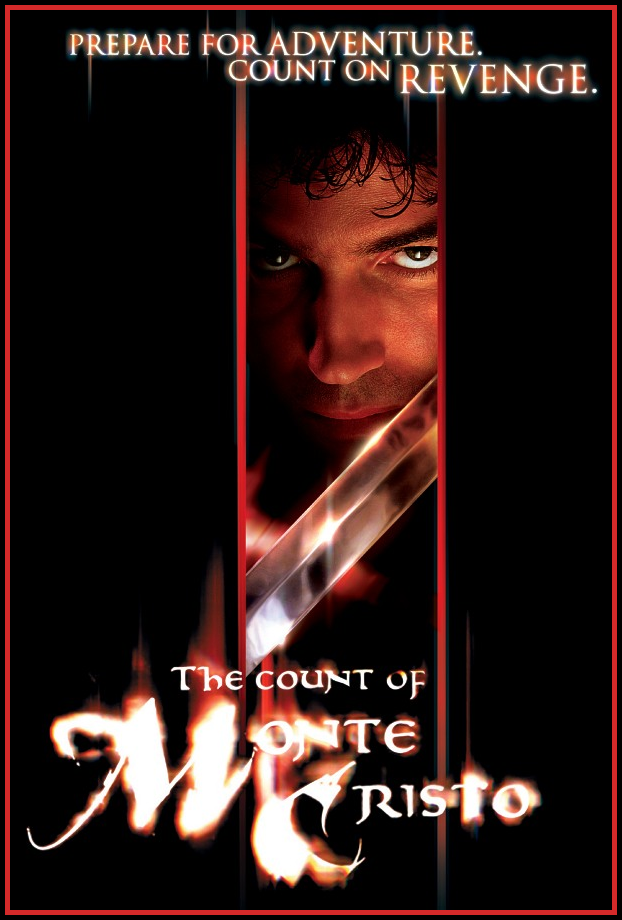
In what has become an unofficial ritual for myself whenever my birthday rolls around I always end up watching a film from 2002 that flew under the radar of most people. While it made modest box-office returns it wasn’t the head-turning blockbuster that some of its producers hoped it would turn out to be. It’s a romantic adventure piece by Kevin Reynolds and for readers of classic literature they’d recognize the title of the film, The Count of Monte Cristo. A film loosely based on the classic novel of adventure, revenge and redemption by French author Alexandre Dumas. The film ends up being a fun, thrilling throwback to films of an era which had marquee stars such as Errol Flynn and Basil Rathbone.
The story is one known well enough. It’s a tale of a man, Edmond Dantès wrongly accussed of a capital crime and imprisoned in the Alcatraz-like prison Chateau d’If through the machinations of three individuals: his best friend Fernand Mondego, first mate Danglars and the ambitious deputy prosecutor Villefort. Dantès spends the next several years in Chateau d’If under the cruel and sadistic eyes of it’s warden, Armand Dorleac (played by Michael Wincott with his usual flair for sadism). It’s while Dantès has started to contemplate suicide after rejecting God for the pain and suffering he has had to endure that he has a fortuitious meeting with another guest of Chateau d’If. It’s this relationship between Dantès and Abbé Faria (Richard Harris in the mentor role he had begun to play in his later years) which take up the bulk of the first third of the film.
Dantès tells him of the circumstances which led to his imprison in Chateau d’If and the thoughts of vengeance on those responsible for his predicament. Faria tries to turn him from his dark path, but seeing how determined his young friend seems on journeying down its twisted path he agrees to teach him how to become adept at being a noble, finances and in swordcraft in exchange for help in digging themselves out of their prison. Taking several more years to complete the education Dantès needs to exact his revenge it ends at the death of Faria and his mentor’s final gift to his student. The location of a treasure so vast that Dantès could retire to a life of peace and contemplation or fund his plans of vengeance.
The middle section of the film shows Dantès finding the treasure and remaking himself through his newfound wealth as the Count of Monte Cristo to better insinuate himself amongst the wealthy and noble-born his targets mingle in. With the help of a bandit whose life spares after a duel in Jacopo (Luis Guzman) the plans Dantès has worked on for years begin to bear fruit as he manipulates and fools Fernand, Villefort and Danglars into his confidence to better see to their downfall. It’s during this time he meets his former fiancee Mercedes (played by the ridiculously beautiful Dagmara Dominczyk), now Countess Mondego after being told of Edmond’s execution earlier in the film, and Fernand’s son Albert. The circumstances of how his former love having had a child and married to one of the men who had conspired against him brings a new complication to Dantès plans.
The last third of the film shows the culmination of Dantès and his elaborate plans to bring about the downfall of all those who had wronged him. While the plans, at times, strain the bonds of disbelief at actually having fooled and worked against his enemies the way the film makes the audience root for Dantès to succeed helps. This is a Dantès who comes off as noble despite being of commoner origins who we stand behind and support in his plans of vengeance. With the amount of wealth at his disposal it’s not too difficult to put oneself in the same shoes and not think of vengeance as well to strike a balance.
It’s a testament to the direction of filmmaker Kevin Reynolds that the film and it’s story never bogs down despite a story with many elaborate plots and secondary characters introduced midway. The fact that the film only borrows some of its complexity from an even more labyrinthine novel shows how the filmmakers actually had to simplify the story as to not make it so complex that it loses the bulk of its audience.
The Count of Monte Cristo also benefit from a strong cast led by Jim Caviezel in the titular role with Guy Pearce playing his former friend and betrayer Fernand Mondego and James Frain as the prosecutor Villefort. Caviezel plays his role as Dantès and as the Count of Monte Cristo as two different people with distinct personalities. There’s Dantès the earnest sailor who just wanted to get back to his love, Mercedes and then there’s the sophisticated and ruthless Count whose machinations would lead to the destruction of lives and reputations. It’s a mystery why Caviezel hasn’t become the star he surely was in the making and this film showed that he had the talent to become one of the industry’s new leading men. I blame Mel Gibson in casting him as Jesus in The Passion of the Christ for having put a curse on Caviezel.
Guy Pierce in the role of Fernand plays the conniving and remoreless villain role to the hilt. With an overbearing and effete noble bearing to his performance it was a character written to inspire hatred not just in its main protagonist but in the audience as well. Pearce knows what his roles represent and has fun playing up the role as main heavy.
Richard Harris as the priest Faria did his usual great work as the elder mentor to a younger man. It was a role he began to be known for starting with Ridley Scott’s Gladiator right up to his final mentor role as the wizard Dumbledore in the Harry Potter film franchise. It’s hard to explain to people that Harris was not always this wise and mentoring father figure, but one who played roles where he’d play womanizers, charming cads and roguish rebel.
The Count of Monte Cristo ended up being more fun than it should be with enough complexities in its storytelling that the film doesn’t dumb down too much the story it was adapted from. To be honest the only way one could truly adapt Dumas’ novel of revenge and redemption is through a long-form tv series. It is just that complex with so many characters that a film adaptation would just be too long or just unnecessarily crowded with characters the audience would care to know. It’s a good thing that the film by Kevin Reynolds was still able to keep to the spirit of the original source while whiling away the story down to its basic core.
It’s a film that plays like a throwback to the swashbuckling films from Hollywood of the 30’s and 40’s and it wouldn’t be too difficult to see Caviezel in the roles Errol Flynn once inhabited. There’s very little special effects in the film which adds more to this sense with swordfight scenes as expertly choreographed as any of the past. The Count of Monte Cristo, for some reason still unknown to me, continues to be the one thing that keeps airing on my birthday and the fact that it’s such a fun and thrilling film that I continue to watch it everytime my day of days roll around. Can’t wait for next year.
At the start of 1980’s Ticket To Heaven, we’re introduced to David (Nick Mancuso), a normal young man from an upper middle class background. David is likable enough but, when we first meet him, is still feeling depressed after breaking up with his longtime girlfriend. He handles his loneliness by meeting up with Karl, a friend from college. Karl, who is accompanied by an almost unbelievably positive young woman (played by a very young Kim Cattrall), invites David to come spend the weekend at a religious “retreat.” For reasons that have more to do with Cattrall than with any interest in religion, David agrees.
The retreat turn out to be a camp where everyone is extremely friendly and extremely positive. From the minute David arrives, everyone is smiling at him and telling him how thrilled they are to meet him. It’s such a positive experience that David doesn’t even complain when he’s given little to eat, allowed very little sleep, and forced to endure hours of talk about the great spiritual leader who set up the camp. When David does eventually decide that he’d like to leave, all of his friendly campmates are so wounded by his rejection that he changes his mind. Who wouldn’t? After all, they’re so nice and idealistic and positive.
Needless to say, David never leaves the camp. When his best friend (played by Saul Rubinek) happens to run into David on the street, he’s shocked to discover that David has become a blank-eyed zombie whose life now revolves around selling flowers in the street and making money for his new friends. However, David’s old friends aren’t quite ready to give him up and the rest of the film details the battle between the two groups for David’s mind and soul.
Ticket to Heaven is a genuinely unsettling film. As directed by Ralph Thomas, the entire film seem to ooze a very real creepiness that stays with you even after the end credits have rolled. The film is at its best when it shows, in painfully believable detail, just how easy it is for someone to become brainwashed and to set aside everything that makes them unique in the name of a “greater good.”
The film’s cast is made up of a talented group of mostly Canadian character actors and, down to the smallest role, they’re all disturbingly believable. Kim Cattrall is probably the most recognizable face in the cast, though Michael Wincott (he of the sexy, gravelly voice) also shows up in a tiny role. Nick Mancuso and Saul Rubinek are believable as best friends and Mancuso is such a likeable presence that it makes his transformation into soulless zombie all the more disturbing. Meg Foster — who looks like a thin, somewhat stable version of Kirstie Alley — gives an excellent and chilling performance as one of the cult’s leaders.
However, for me, the film’s best performance was given by an actor named R.H. Thomson. Playing a cult deprogrammer named Linc Strunc (what a great name), Thomson is only in a handful of scenes but he dominates every one of them. Speaking through clenched teeth and giving off an attitude of weary cynicism, Thomson takes a role that could have been a stereotype and makes it instead very compelling. If I choose to believe Wikipedia, Thomson is still active as an actor and, after seeing his work in Ticket to Heaven, I may have to track down his other films.
Despite having won a Genie (the Canadian version of the Oscar), Ticket to Heaven is something of an obscure film. I have to admit that I bought the DVD on something of a whim and that was mostly because I was intrigued by the words “In 1979, David joined a cult…” on the DVD’s cover. I’ve long been fascinated by cults and just how easily some people can surrender everything the makes them a unique and individual human being.
During my first semester away at college, there used to be a small handful of students who, every night, would gather together outside the student union. Since I’ve always been a night person, I’d often find myself walking by their little group and I always felt a little bit anxious whenever I saw them. They all looked perfectly normal but there was still something off about them. As my roommate Kim put it, they all looked like they had wandered out of a toothpaste commercial. There was also the fact that they obviously considered themselves to be a part of an exclusive club that the rest of us had not been invited to join.
One night, Kim and I went down to the student union to check our mail. As we were heading back to our dorm, we passed this little group and I noticed that one of them appeared to be holding a microphone. I guess he saw me looking because he held the microphone up to his lips and said, his voice booming, “HEY YOU, DO YOU KNOW THE LORD!?” At the time, Kim and I both considered ourselves to be decadent Pagans so we answered by sharing a long kiss in front of them and then laughing at the dead glares that greeted our response before we then ran, hand-in-hand, back to the dorms. In retrospect, I guess that was my invitation to join the club and I’m glad I was too busy trying to be worldly to accept it.
A few nights later, I found myself suffering from the insomnia that’s plagued me for as long as I can remember. Around 3:00 a.m., I was sitting down in the dorm’s lobby, trying to write angsty poetry. On the other side of the lobby was this guy that we’ll call “Rich.” You’ve probably known someone like Rich. He’s one of those guys who was always smiling a little bit too much, who was always almost desperately friendly. Rich was someone who, for whatever reason, was obviously lost and looking at him, you got the sense that he’d never been truly happy a day in his life. I always felt sorry for Rich but I was also a little scared of him.
That night, I was happy that he wasn’t trying to talk to me. Instead, he was just quietly sitting in a corner with a blank stare. Suddenly, he was approached by three men who greeted him by name and, visibly shaking, Rich stood up to greet them. It took me a few minutes but then I recognized that two of the guys were from that same group that always gathered outside the union. Standing in between them was a balding, bearded man who I’d never seen before or since.
The four of them sat down and they were soon leaning forward in huddled conversation. I found myself straining to hear what they were saying but I could only pick up a few words. I could see that Rich was still shaking and that he had started to cry.
Suddenly, the bearded man spoke in a voice that snapped through the entire lobby. “You little shit,” he said, “You pathetic motherfucker!”
As the two others sat there impassively, the bearded man leaned forward until his face was inches in front of Rich’s. From where I was sitting, it looked almost as if Rich’s face was being eclipsed by the back of the man’s head. The man continued to speak but now his voice was low and I couldn’t make out the exact words. But I could tell from his body language and his gestures that he was giving Rich more of the same.
After about an hour of this, Rich started nodding and, tears flowing down his face, he started to say, “Praise God! Praise God! Thank you! Praise God!”
The four of them stood up and, as I watched in disbelief, they stood there hugging each other as Rich continued with his “Praise God!” The three guys then headed out and Rich, smiling even though his face was still slick with tears, skipped out of the lobby.
Rich graduated at the end of that semester. A few years later, when I was about to graduate, I heard someone say that Rich had recently committed suicide. I don’t know if that’s true and it’s almost too obvious an ending to his story.
I thought a good deal about Rich and that night after I finished watching Ticket to Heaven.
Admittedly, Ticket to Heaven is not a “perfect film.” Strong as Mancuso’s performance is, David is still something of a sketchy character. The film does a good job showing the techniques that the cult uses to brainwash David but it’s never quite clear why David was so susceptible to those techniques to begin with. There are hints, of course. David is shown to be upset over breaking up with his girlfriend and there are hints that his safely middle class existence has left with him with little sense of having an individual existence of his own. That doesn’t change the fact that David ultimately comes across as less of a real person and more as a way for the film to preach its anti-cult message.
Indeed, the film’s biggest flaw is that it is essentially a message film. As well-acted and intelligently scripted as it often is, the movie exists to deliver a message. Fortunately, it’s a good message but that doesn’t stop the film from sometimes rather heavy-handed. This is most obvious in the movie’s final scene in which things are tied up just a little bit too neatly.
Still, flaws aside and despite having been made 30 years ago, Ticket to Heaven remains a relevent film. We live in a world that, for the most part, is made up of brainwashed people and, watching the movie, I had to wonder how much difference there really was between the overbearingly positive cultist played by Kim Cattrall and the grim-faced jihadists that currently haunt our nightmares. When you consider just how much evil is justified, on a daily basis, in the name of the greater good, its becomes obvious that the movie’s warning against becoming a living zombie is just as important today as when the film was made.
The film’s cult is based on an actual, real-life group that was apparently very active in the late 70s and who are still around today, the Unification Church. I vaguely remember them being in the news back in 2004 when the head of the church was declared to be “the prince of peace” at a ceremony that was attended by a few congressmen. Type “Unification Church” into google and you’ll end up with links to a lot of stories that would seem to suggest that the real cult is even more creepy than the fictionalized version in Ticket to Heaven.