Catching Up With The Films of 2023: Golda (dir by Guy Nattiv)


In Golda, Helen Mirren stars as Golda Meir, the 4th Prime Minister of Israel and the first woman to lead a government in the Middle East.

The film opens in 1974, with a visibly unwell Golda Meir braving a line of protestors as she testified before a commission that is investigating the events that led to the 19-day Yom Kippur War.  Sitting before the members of the commission, Meir lights a cigarette and, as the smoke forms around her, she speaks with a confidence that belies her physical frailness.  It’s the first of many cigarettes that we will see Golda Meir smoke throughout this film.  While Golda Meir was known for being a chain-smoker in real life, her smoking also plays an important thematic role in the film.  Golda Meir is terminally ill throughout the film, secretly undergoing chemotherapy and continually being told that her high-stress job, her cigarettes, and her coffee are not helping her health.  Golda, however, knows what she has to do to keep herself focuses and to handle the stress of being the leader of a small country that is surrounded by enemies and for her, that means drinking a lot of coffee and smoking a lot of cigarettes.  Much like Israel, she is not going to be told what to do by people who do not understand what she has to deal with on a daily basis.  Throughout the film, Golda willingly sacrifices her physical health for Israel, telling her more trusted aide (Camille Cattin) that the only thing that worries her is developing dementia in her old age.  A leader who cannot think cannot lead.

The majority of the film takes place in 1973, during the 19-day Yom Kippur War.  Israel is caught off-guard by a surprise attack led by Egypt and Syria.  Vastly outnumbered, the IDF struggles to repel the invaders.  While dealing with not only her own bad health but also the personal and ideological conflicts within her government, Meir also reaches out to the U.S. Secretary of State, Henry Kissinger (Liev Schreiber) for help.   Unfortunately, Washington D.C. is more concerned with Watergate than with the latest war in the Middle East and, as Meir quickly deduces, there is also worry that Saudi Arabia will cut off its supply of oil to any country that supports Israel.  Though Meir uses a combination of charm and shrewd political gamesmanship to convince Kissinger to put pressure on the Nixon administration, Meir still finds herself being pressured to accept an internationally-brokered ceasefire rather than pursue a strategy of forcing Egypt into negotiations….

Does this sound familiar?  A vicious surprise attack is launched on Israel during a holy day.  The Israeli Prime Minister, who is loved by some and vilified by others, is accused of not being sufficiently prepared for the attack.  Israel is initially isolated from the world, just to be pressured to accept a ceasefire as soon as it starts to prove its resiliency and humiliate its enemies.  Golda completed production before the October 7th attacks but the film feels like a direct response to them, a reminder that Israel has always had to fight for its existence and that it has always proven itself to be stronger than its enemies realize.

Much like Darkest Hour, another film about a leader who was underestimated, Golda plays out like a dream of history, with the emphasis being on Golda Meir moving from one meeting to another, somehow managing to hold everything together while the world sometimes seem to be falling apart around her.  A good deal of the film’s tension comes from the moments when Golda and her advisors wait to hear whether or not their latest move has been a success.  One of the film’s most harrowing scenes features Golda listening over a radio as a group of Israeli volunteers are wiped out by the invading Egyptians.  It’s a scene that reiterates the human cost of war, regardless of which side wins.  (The film makes good use of historical footage of the war, mixing it with scenes of Golda and her cabinet planning their strategy.  Again, it serves to remind the audience that there are real consequences to every decision.)  Held together by Mirren’s intelligent and authoritative performance, Golda is a film full of details that stick with you.  I’ll always remember the scenes of Golda being led through an underground morgue so that she can secretly be treated for the cancer that is slowly killing her.  With each trip, the morgue become more and more filled with bodies.

Though Mirren’s performance was acclaimed, Golda itself opened to mixed reviews.  I suppose in today’s political atmosphere, that’s to be expected.  After all, Golda is not only a pro-Israel film but it’s also a film that portrays Henry Kissinger as being something other than a one-dimensional Bond villain.  For many of today’s very online film reviewers, all of that is heresy.  At a time when some so-called educated people are driven to a rage at just the sight of posters of abducted Israeli children, Golda‘s reception is not a surprise.  At a time when people are making excuses for terrorists who would attack farmers and concert-goers, a films as otherwise different as You Are So Not Invited To My Bat Mitzvah and Golda can feel like acts of beautiful cultural defiance.

History repeats itself, Golda tells us.  Golda may largely take place in 1973 but, ultimately, it’s a film about 2023 and 2024.

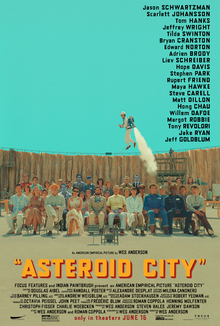
Film Review: Asteroid City (dir by Wes Anderson)


Asteroid City opens with black-and-white footage of Bryan Cranston, wearing a suit and speaking in the authoritative tones of someone who has made his living on television.  Cranston informs us that we are about to see a televised production of a play by the famed but enigmatic playwright named Conrad Earp (Edward Norton).

The play, which is seen in stylized color, opens with Augie Steeback (Jason Schwartzman) driving his family through the desert.  He is taking his son, Woodrow (Jake Ryan), to a Junior Stargazers convention that is being held at Asteroid City, a tiny town that is best-known for being the location of an impact crater.  Along for the ride are Augie’s three daughters, who are all pretending to be witches.  What Augie hasn’t told his children is that their mother has died, her cremated remains are in a Tupperware container, and that they will be moving in with their wealthy grandfather (Tom Hanks).

There’s not much to the town of Asteroid City.  There’s a motel that’s managed by a man (Steve Carell) who sells land deeds out of a refurbished Coke machine.  There’s a diner.  There’s a group of helpful cowboys, led by the polite and helpful Montana (Rupert Friend).  There’s a mechanic (Matt Dillon) who is called into duty when Augie’s car breaks down.  The Junior Stargazer convention is the event of the year for Asteroid City.  Young geniuses from all around the country have descended on the town and have brought their parents.  One of them, Dinah (Grace Edwards), is the daughter of actress, Midge Campbell (Scarlett Johansson).  When an alien (played, at one point in the film, by Jeff Goldblum) shows up and steals the town’s meteorite, General Gibson (Jeffrey Wright) declares a quarantine.  Some people handle the lockdowns better than others.  Augie takes pictures and thinks about his wife.  Midge rehearses for her next role, one that is centered around her character dying.  The genius children play a memory game that they realize will never end because they’re all geniuses.  A teacher (Maya Hawke) tries to teach her students about the Milky Way, just to discover that the kids only want to talk about the alien.  One of the fathers (Liev Schreiber) ends up with a useless plot of desert land and the death ray that his son recently invented.

Throughout it all, Bryan Cranston appears in black-and-white footage that gives us a look into what went on behind the scenes during the production of Asteroid City.  The director (Adrien Brody) was a lech.  The actor playing Augie struggled to understand what the play was about and who his character was meant to be while the actress (Margot Robie) hired to play his wife ended up in another play after her scenes were cut from Asteroid City.  Only once does Bryan Cranston’s host appear in the color sections of Asteroid City, just to sheepishly admit that he’s not supposed to be there before ducking off camera.

Even if his name wasn’t in the opening credits, the viewer could probably easily guess that this is a Wes Anderson film.  It features all of Anderson’s trademarks, all of the things that viewers will automatically love or hate depending on how they feel about Anderson’s quirky aesthetic.  It’s a visually impressive, pop art-flavored, all-star comedy with an undercurrent of profound melancholy, one in which the fanciful strangeness of the alien’s “invasion” is compared and contrasted with the very real-life strangeness of how humans deal with life, loss, death, and uncertainty.  Scenes of clever wordplay are mixed with scenes in which we see Augie still very much struggling to come to terms with the death of his wife and the actor Augie very much struggling to understand what is actually going on in his character’s head.  As far as recent Anderson films go, Asteroid City is not quite as humanistic as Rushmore or Grand Budapest Hotel but, at the same time, it’s still more accessible than The French Dispatch.

If you’re not a fan of Anderson’s style, this film won’t convert you.  That said, I am a fan of Anderson’s style and I absolutely loved Asteroid City.  As with so many of Anderson’s films, the main focus is on how we try to deal with the uncertainties of life by trying to maintain an illusion of control over every aspect of our lives.  Playwright Conrad Earp writes because that way he can have a world that follows his own rules.  The actors follow a script that tells them how to react to everything that happens around them.  In the play, the Junior Stargazers fall back on science while Augie’s father-in-law falls back on religion and Augie’s daughter convince themselves that spells will bring back or, at least, protect their mother.  Even General Gibson falls back on his belief in the government and the military to deal with the sudden appearance by the alien.  The alien is the unknowable and his arrival reminds everyone that life is unpredictable, regardless of how much you try to control your own story.  Indeed, while the film takes place in the 50s and is full of comments about the Red Scare and atomic bomb testing, it’s hard not to see Asteroid City as being a commentary on the recent COVID lockdowns and the debate over whether people could ever go back to living the way that they did before the pandemic.  Much as with the Coen Brothers’s similarly stylized A Serious Man, the ultimate message seems to be that the only way to deal with the unpredictability of life is to embrace it.

It’s also a very funny film, one that is full of small details that reward repeat viewing.  If one focuses on the background characters, it quickly becomes apparent that there are actually several stories unfolding in the film and, much as with life, the viewer just has to be willing to look for them.  (I particularly enjoyed the romance between The Teacher and Montana.)  Jason Schwartzman is compelling as both Augie and the actor playing Augie and Scarlett Johansson plays both Midge and the actress playing Midge with the perfect amount of cool detachment.  To the film’s credit, none of the character’s become caricatures.  They remain individuals, regardless of how bizarre the film’s story may sometimes seem.  Everyone gets a moment to reveal a little depth, from Jeffrey Wright’s sincere (if misplaced) faith in the lockdown policy to the moment when Tom Hanks’s previously unsympathetic father-in-law reveals that he’s as much in mourning as Augie.  The all-star cast also includes Tilda Swinton, Liev Schrieber, Stephen Park, Willem DaFoe, Hong Chau, and Margot Robbie and all of them add to the film’s portrait of quirky but ultimately relatable humanity.

Again, with this film, it undoubtedly helps to already be familiar with and to like Wes Anderson’s way of doing things.  If  you’re not a fan of his film, this one probably won’t change your mind.  That said, for those of us who do enjoy his style, this is Anderson at his best.

Film Review: Hamlet (dir by Michael Almereyda)


What if Hamlet was a hipster douchebag?

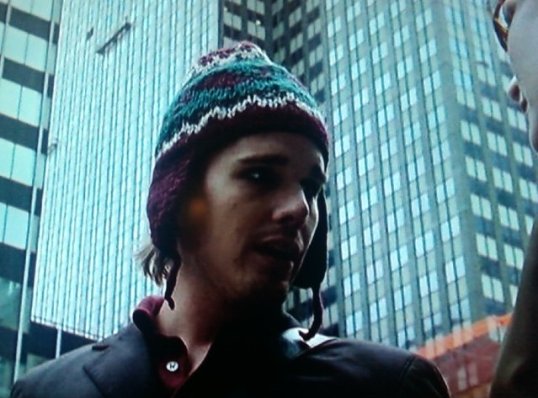
That appears to be the question at the heart of the 2000 film adaptation of William Shakespeare’s most famous play.  In this adaptation, a young Ethan Hawke plays a Hamlet who is no longer a melancholy prince but who is instead a film student with a petulant attitude.

As you probably already guessed, this is one of those modern day adaptations of Shakespeare.  Denmark is now a Manhattan-based corporation.  Elsinore is a hotel.  Hamlet ponders life while wandering around a Blockbuster and, at one point, the ghost of his father stands in front of a Pepsi machine.  While Shakespeare’s dialogue remains unchanged, everyone delivers their lives while wearing modern clothing.  It’s one of those things that would seem rather brave and experimental if not for the fact that modern day versions of Shakespeare have gone from being daring to being a cliché.

At the film’s start, the former CEO of the Denmark Corporation has mysteriously died and his brother, Claudius (Kyle MacLachlan), has not only taken over the company but he’s also married the widow, Gertrude (Diane Venora).  Hamlet comes home from film school, convinced that there has been a murder and his suspicions are eventually confirmed by the ghost of his father (Sam Shepard).  Meanwhile, poor Ophelia (Julia Stiles) takes pictures of flowers while her brother, Laertes (Liev Schreiber), glowers in the background.  Polonius (Bill Murray) offers up pointless advice while Fortinbras (Casey Affleck) is reimagined as a corporate investor and Rosencrantz (Steve Zahn) wears a hockey jersey.  Hamlet spends a lot of time filming himself talking and the Mousetrap is no longer a player but instead an incredibly over-the-top short film that will probably remind you of the killer video from The Ring.

I guess a huge part of this film’s appeal was meant to be that it featured a lot of people who you wouldn’t necessarily think of as being Shakespearean actors. Some of them did a surprisingly good job.  For instance, Kyle MacLachlan was wonderully villainous as Claudius and Steve Zahn was the perfect Rosencrantz.  Others, like Diane Venora and Liev Schreiber, were adequate without being particularly interesting.  But then you get to Bill Murray as Polonius and you start to realize that quirkiness can only take things so far.  Murray does a pretty good job handling Shakespeare’s dialogue but that doesn’t change the fact that he’s totally miscast as the misguided and foolish Polonius.  One could easily imagine Murray in the role of Osiric.  Though it may initially seem a stretch, one could even imagine him playing Claudius.  But he’s simply not right for the role of Polonius.  Murray’s screen presence is just too naturally snarky for him to be convincing as a character who alternates between being a “tedious, old fool” and an obsequious ass kisser.

Considering that he spends a large deal of the movie wearing a snow cap while wandering around downtown Manhattan, Ethan Hawke does a surprisingly good job as Hamlet.  Or, I should say, he does a good job as this film’s version of Hamlet.  Here, Hamlet is neither the indecisive avenger nor the Oedipal madman of previous adaptations.  Instead, he’s portrayed as being rather petulant and self-absorbed, which doesn’t necessarily go against anything that one might find within Shakespeare’s original text.  Hawke’s not necessarily a likable Hamlet but his interpretation is still a credible one.

At one point, while Hamlet thinks about revenge, we see that he’s watching Laurence Olivier’s version of Hamlet on television.  There’s Olivier talking to Yorick’s skull while Hawke watches.  It’s a scene that is somehow both annoying and amusing at the same time.  On the one hand, it feels rather cutesy and more than a little pretentious.  At the same time, it’s so over-the-top in its pretension that you can’t help but kind of smile at the sight of it.  To me, that scene epitomizes the film as a whole.  It’s incredibly silly but it’s so unapologetic that it’s easy to forgive.

Remembering The Real Rocky: Chuck (2017, directed by Philippe Falardeau)


In 1975, an unheralded boxer named Chuck Wepner shocked the world when he managed to go nearly 15 rounds with Muhammad Ali.  (He only fell short by 19 seconds.)  The fight not only made Wepner a temporary celebrity but it also inspired a down-on-his-luck actor to write a script about an aging boxer who just wants to show that he can go the distance.  The name of that script was Rocky and it made Sylvester Stallone a star.

As for Chuck Wepner, he initially enjoyed being known as “the Real Rocky,” but he soon learned that fame is often fleeting.  After Wepner retired from the ring (but not before one exhibition match against Andre the Giant), he attempted to reinvent himself as an actor but a combination of bad friends, bad decisions, and a bad cocaine habit conspired to derail his life and Wepner eventually ended up serving a 10-year prison sentence.  While he was incarcerated, Wepner did get to see a film being shot on location in the prison.  The name of the film was Lock-Up and the star was none other than Sylvester Stallone.

With Chuck, Chuck Wepner finally gets the movie that he deserves.  Wepner’s fight with Ali occurs early on in the film.  The rest of Chuck deals with Wepner’s attempts to deal the aftermath of the biggest night of his life.  Wepner may love his fame but secretly, he knows that it’s not going to last.  While Stallone makes millions playing the role of Rocky Balboa, Chuck struggles to make ends meet.  Even when given a chance to appear in Rocky II, Wepner falls victim to his insecurity and blows the audition.  Seeking escape though drugs, the real Rocky ends up in prison, watching the other Rocky shoot his latest movie.  Though the film suggests that Chuck finally found some peace with his third wife and a career as a liquor distributor, it’s still hard not to feel that Chuck Wepner deserved more.

Featuring a great lead performance from Liev Schreiber and outstanding supporting work from Naomi Watts, Jim Gaffigan, Michael Rapaport, Ron Perlman, and Morgan Spector (who plays Sylvester Stallone as being well-meaning but often insensitive), Chuck is a heartfelt, warts-and-all portrait of Chuck Wepner.  The film sets out to give Wepner the recognition that he deserves and it largely succeeds.  Watch it as a double feature with ESPN’s The Real Rocky.

A Winter Game Film Review: Goon: Last of the Enforcers (dir by Jay Baruchel)


Here at the Shattered Lens, Leonard Wilson is our resident hockey expert.  He can tell you all about the in and outs of the game in general and the New York Rangers in specific.

Myself, I know very little about hockey.  Here’s what I do know:

  1. It’s played on the ice and with a puck.
  2. There are a lot of fights.
  3. All of my Canadian friends love it.
  4. It’s a sport that is mentioned many times on Degrassi.
  5. Two hockey players won the 22nd season of The Amazing Race.
  6. Back in 2011, I followed Arleigh’s suggestion and watched a hockey movie called Goon.  Surprisingly, I really, really liked it.

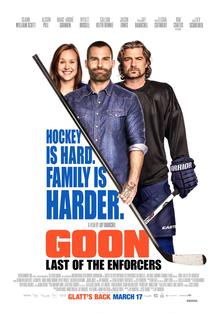
Six years ago, I started my review of Goon by admitting that I didn’t know anything hockey so not much has changed.  However, while I still may not know much about hockey, I am currently obsessed with the Winter Olympics.  And, of course, hockey is a big part of the Winter Games.  Since I’m currently watching movies about winter sports, today seemed like the perfect time to watch 2016’s Goon: The Last of The Enforcers and get caught up on the story of Doug Glatt.

Who is Doug Glatt?  As played by Seann William Scott, Doug Glatt is probably one of the nicest guys that you could ever hope to meet.  He’s not particularly smart.  He’s the type who responds to almost comment with a slightly confused smile.  He tend to take things literally.  But he’s a genuinely sweet guy and it’s impossible not to like him.

Except, of course, when he’s on the ice.  Doug is a semi-pro hockey player, playing for the Halifax Highlanders.  Even his biggest fans will admit that Doug isn’t the best hockey player of all time.  However, no one can throw a punch like he can.  Doug’s an enforcer.  His specialty is beating up the opposing team.  When his coach (Kim Coates) needs to intimidate the other team, he sends Doug out with orders to beat someone up.  Doug has no problem breaking someone’s nose but he usually apologizes afterward.  He’s known as The Thug.

Doug is married to Eva (Allison Pill), who loves hockey but, now that she’s pregnant, she worries about Doug getting seriously injured.  These worries come true when Doug gets into a fight with Anders Cain (Wyatt Russell), a fearsome enforcer on another team.  (Anders just happens to be the son of the owner of the Highlanders.)  Cain not only leaves Doug crumpled up on the ice but he also injures Doug’s right shoulder, making it difficult for Doug to throw a punch with his right hand.  It appears that Doug’s playing days are over.  Doug ends up working in the storage room of an insurance company while the Highlanders continue on without him.  Adding insult to injury, Anders is soon signed by the Highlanders and given Doug’s old position as team captain.

As much as Doug tries to move on, he keeps finding himself drawn back to hockey.  When he runs into a former rival, Ross Rhea (Liev Schreiber), who is now making a living as a glorified gladiator, Doug realizes that he can learn how to fight with his left fist.  But with Eva not wanting him to fight anymore, Doug is forced to decide which team he’s going to play for, the Highlanders or his family?

Especially when compared to the first Goon, Goon: Last of the Enforcers is an extremely busy film.  Beyond Doug trying to adjust to life off the ice, the film also deals with Anders Cain’s relationship with his father, the locker room shenanigans of the Highlanders, Ross Rhea’s attempt to make a comeback, and the antics of obnoxious sports reporter Chad Bailey (T.J. Miller).  That’s a lot for one film to deal with and it’s not surprising that the end result is an uneven mishmash of raunchy comedy and sports-themed melodrama.  Whereas the first Goon worked because it kept things simple and sincere, Goon: Last of the Enforcers is way too complicated for its own good.

That said, as played by Seann William Scott, Doug is just as likable as he was in the first film and Scott and Allison Pill still make for an adorable couple.  In fact, the entire cast does a pretty good job, especially Wyatt Russell and Liev Schreiber.  The film doesn’t really work but, for fans of the first film, it’s still enjoyable enough.  If nothing else, it’s nice to see how things work out for Doug Glatt.

Here’s What Won At The Emmys Last Night!


Last night, Lisa Marie did not watch the Emmys because she says that, “I’m just not feeling TV this year.”  If Twin Peaks had been eligible to be nominated, I bet it would have been a different story!

Instead, she asked me to watch the ceremony and let everyone know what I thought.  It needed less politics and more cats.

Here’s the list of winners:

COMEDY

BEST COMEDY SERIES
“Atlanta”
“Black-ish”
“Masters of None”
“Modern Family”
“Silicon Valley”
“Unbreakable Kimmy Schmidt”
X — “Veep”

BEST COMEDY ACTRESS
Pamela Adlon, “Better Things”
Jane Fonda, “Grace and Frankie”
Allison Janney, “Mom”
Ellie Kemper, “Unbreakable Kimmy Schmidt”
X — Julia Louis-Dreyfus, “Veep”
Tracee Ellis Ross, “Black-ish”
Lily Tomlin, “Grace and Frankie”

BEST COMEDY ACTOR
Anthony Anderson, “Black-ish”
Aziz Ansari, “Master of None”
Zach Galifianaks, “Baskets”
X — Donald Glover, “Atlanta”
William H. Macy, “Shameless”
Jeffrey Tambor, “Transparent”

BEST COMEDY SUPPORTING ACTRESS
Vanessa Bayer, “Saturday Night Live”
Anna Chlumsky, “Veep”
Kathryn Hahn, “Transparent”
Leslie Jones, “Saturday Night Live”
Judith Light, “Transparent”
X — Kate McKinnon, “Saturday Night Live”

BEST COMEDY SUPPORTING ACTOR
Louie Anderson, “Baskets”
X — Alec Baldwin, “Saturday Night Live”
Tituss Burgess, “Unbreakable Kimmy Schmidt”
Ty Burrell, “Modern Family”
Tony Hale, “Veep”
Matt Walsh, “Veep”

BEST COMEDY DIRECTING
X — “Atlanta” (“B.A.N.”)
“Silicon Valley” (“Intellectual Property”)
“Silicon Valley” (“Server Error”)
“Veep” (“Justice”)
“Veep” (“Blurb”)
“Veep” (“Groundbreaking”)

BEST COMEDY WRITING
“Atlanta” (“B.A.N.”)
“Atlanta” (“Streets on Lock”)
X — “Master of None” (“Thanksgiving”)
“Silicon Valley” (“Success Failure”)
“Veep” (“Groundbreaking”)
“Veep” (“Georgia”)

DRAMA

BEST DRAMA SERIES
“Better Call Saul”
“The Crown”
X — “The Handmaid’s Tale”
“House of Cards”
“Stranger Things”
“This is Us”
“Westworld”

BEST DRAMA ACTRESS
Viola Davis, “How to Get Away with Murder”
Claire Foy, “The Crown”
X — Elisabeth Moss, “The Handmaid’s Tale”
Keri Russell, “The Americans”
Evan Rachel Wood, “Westworld”
Robin Wright, “House of Cards”

BEST DRAMA ACTOR
X — Sterling K. Brown, “This is Us”
Anthony Hopkins, “Westworld”
Bob Odenkirk, “Better Call Saul”
Matthew Rhys, “The Americans”
Liev Schreiber, “Ray Donovan”
Kevin Spacey, “House of Cards”
Milo Ventimiglia, “This is Us”

BEST DRAMA SUPPORTING ACTRESS
Uzo Aduba, “Orange is the New Black”
Millie Bobby Brown, “Stranger Things”
X — Ann Dowd, “The Handmaid’s Tale”
Chrissy Metz, “This is Us”
Thandie Newton, “Westworld”
Samira Wiley, “The Handmaid’s Tale”

BEST DRAMA SUPPORTING ACTOR
Jonathan Banks, “Better Call Saul”
David Harbour, “Stranger Things”
Ron Cephas Jones, “This is Us”
Michael Kelly, “House of Cards”
X — John Lithgow, “The Crown”
Mandy Patinkin, “Homeland”
Jeffrey Wright, “Westworld”

BEST DRAMA DIRECTING
“Better Call Saul” (“Witness”)
“The Crown” (“Hyde Park Corner”)
“The Handmaid’s Tale” (“The Bridge”)
X — “The Handmaid’s Tale” (“Offred”)
“Homeland” (“America First”)
“Stranger Things” (“Chapter One: The Vanishing of Will Byers”)
“Westworld” (“The Bicameral Mind”)

BEST DRAMA WRITING
“The Americans” (“The Soviet Division”)
“Better Call Saul” (“Chicanery”)
“The Crown” (“Assassins”)
X — “The Handmaid’s Tale” (“Offred”)
“Stranger Things” (“Chapter One: The Vanishing of Will Byers”)
“Westworld” (“The Bicameral Mind”)

MOVIE/LIMITED SERIES

BEST LIMITED SERIES
X — “Big Little Lies”
“Fargo”
“Feud: Bette and Joan”
“Genius”
“The Night Of”

BEST TV MOVIE
X — “Black Mirror: San Junipero”
“Christmas of Many Colors”
“The Immortal Life of Henrietta Lacks”
“Sherlock: The Lying Detective”
“The Wizard of Lies”

BEST MOVIE/MINI ACTRESS
Carrie Coon, “Fargo”
Felicity Huffman, “American Crime”
X — Nicole Kidman, “Big Little Lies”
Jessica Lange, “Feud: Bette and Joan”
Susan Sarandon, “Feud: Bette and Joan”
Reese Witherspoon, “Big Little Lies”

BEST MOVIE/MINI ACTOR
X — Riz Ahmed, “The Night Of”
Benedict Cumberbatch, “Sherlock: The Lying Detective”
Robert De Niro, “The Wizard of Lies”
Ewan McGregor, “Fargo”
Geoffrey Rush, “Genius”
John Turturro, “The Night Of”

BEST MOVIE/MINI SUPPORTING ACTRESS
Judy Davis, “Feud: Bette and Joan”
X — Laura Dern, “Big Little Lies”
Jackie Hoffman, “Feud: Bette and Joan”
Regina King, “American Crime”
Michelle Pfeiffer, “The Wizard of Lies”
Shailene Woodley, “Big Little Lies”

BEST MOVIE/MINI SUPPORTING ACTOR
Bill Camp, “The Night Of”
Alfred Molina, “Feud: Bette and Joan”
X — Alexander Skarsgard, “Big Little Lies”
David Thewlis, “Fargo”
Stanley Tucci, “Feud: Bette and Joan”
Michael Kenneth Williams, “The Night Of”

BEST MOVIE/MINI DIRECTING
X — “Big Little Lies”
“Fargo” (“The Law of Vacant Places”)
“Feud: Bette and Joan” (“And the Winner Is”)
“Genius” (“Einstein: Chapter One”)
“The Night Of” (“The Art of War”)
“The Night Of” (“The Beach”)

BEST MOVIE/MINI WRITING
“Big Little Lies”
X — “Black Mirror: San Junipero”
“Fargo” (“The Law of Vacant Places”)
“Feud: Bette and Joan” (“And the Winner Is”)
“Feud: Bette and Joan” (“Pilot”)
“The Night Of” (“Call of the Wild”)

VARIETY/REALITY

BEST REALITY COMPETITION PROGRAM
“The Amazing Race”
“Amercan Ninja Warrior”
“Project Runway”
“RuPaul’s Drag Race”
“Top Chef”
X — “The Voice”

BEST VARIETY TALK SERIES
“Full Frontal with Samantha Bee”
“Jimmy Kimmel Live”
X — “Last Week Tonight with John Oliver”
“Late Late Show with James Corden”
“Late Show with Stephen Colbert”
“Real Time with Bill Maher”

BEST VARIETY SKETCH SERIES
“Billy on the Street”
“Documentary Now”
“Drunk History”
“Portlandia”
X — “Saturday Night Live”
“Tracey Ullman’s Show”

BEST VARIETY SERIES DIRECTING
“Drunk History”
“Jimmy Kimmel Live”
“Last Week Tonight with John Oliver”
“Late Show with Stephen Colbert”
X — “Saturday Night Live”

BEST VARIETY SERIES WRITING
“Full Frontal with Samantha Bee”
X — “Last Week Tonight with John Oliver”
“Late Night with Seth Meyers”
“Late Show with Stephen Colbert

Playing Catch-Up With The Films of 2016: The 5th Wave (dir by J Blakeson)


The 5th Wave, which came out in January of this year (and that really should be all you need to hear), is the epitome of a “Who cares?” type of film.

It’s another YA adaptation, taking place in a dystopian future and featuring way too many characters for its own good.  Aliens have invaded the Earth and they’ve attacked in 4 waves.  There was the 1st wave, which destroyed all of the electricity.  There was the 2nd wave which involved a lot of earthquakes and natural disasters.  I imagine California fell off the mainland during the 2nd wave.  The 3rd wave involved bird flu.  The 3rd wave is important because it killed the mother of our protagonist, teenager Cassie Sullivan (Chloe Grace Moretz).  You can’t be a YA protagonist unless you have at least one dead parents.  That’s the rules of the genre.

The 5th Wave deals with the … well, the fifth wave.  As far as I can tell, the 5th Wave involves turning every human left into a stock character from a YA dystopian novel.  Basically, if you’ve sat through Divergent or The Maze Runner or The Giver or countless other YA adaptations, you already know who everyone is in The 5th Wave.  Cassie is our heroine, which means that she spends a lot of time wandering around in the forest, killing potential threats, and thinking about how different things were back in high school.

And that’s really all she does.

See, The 5th Wave last nearly two hours and not a damn thing happens in the entire film.  That’s because the 5th Wave is all about setting up a sequel.  We meet a lot of characters.  We get a lot of backstory.  Imagine if The Walking Dead did a half-season with 6 shows straight of people talking about doing things but never actually doing any of it. (Oh, wait, they did just do that…)  That’s pretty much what sitting through The 5th Wave was like.  We learn that there are aliens disguised as humans.  We learns that what’s left of the government cannot be trusted and I was totally happy with that plot development because seriously, the government sucks.  As we watch Moretz, Ron Livington, Liev Schriber, and Maria Bello struggle to make some of the most cliched dialogue ever sound compelling, we learn that being a talented actor doesn’t mean that you always get to appear in interesting films.

Things drag on and then they end.  Why do they end?  Because that’s the way YA adaptations works.  Nothing can be resolved in just one movie.  Instead, everything’s about setting things up for the next installment.  At the very least, all YA films have to be a part of a trilogy.  And the third part of the trilogy always requires at least two parts to tell the entire story.  That’s just the way things works.

And really, I thought that Divergent was the most soulless YA adaptation that I had ever seen.  But the 5th Wave makes a strong case that perhaps it deserves the title.

I guess we could wait to see what happens when part two comes out but seriously, who cares?

Playing Catch-Up: Spotlight (dir by Tom McCarthy)


Spotlight

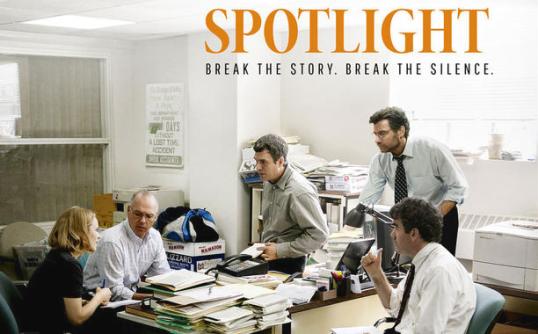
Earlier today, I finally got to see Spotlight, the film that is currently the front-runner to win the Oscar for best picture.  Spotlight tells the story of how the Spotlight team, a group of journalists working for the Boston Globe, investigated the shameful history of sexual abuse of children by Catholic priests in the Archdiocese of Boston.  Starting with charges against one priest, the Spotlight team eventually uncovered sexual abuse by at least 70 priests and also revealed that the revered Cardinal Law was involved in covering up the crimes.

Having now seen Spotlight, I can say it’s a good film.  It’s well-made.  It’s well-acted.  The script contains some memorable lines.  I’ve talked to a few friends of mine who have actually worked as journalists and they have all assured me that Spotlight gets the details of their profession correct and that it’s pretty much an authentic look at what it’s like to be a reporter at a major newspaper.  There’s a lot of good things that can be said about Spotlight.

And yet, I’m not particularly enthusiastic about it.  I think my main issue with the film is that it’s just such an old-fashioned and rather conventional film.  It’s a throw back of sorts, an earnest exploration of a real-life outrage.  (Even the fact that the heroes are journalists makes the film feel as if it was made a decade or two in the past.)  On the one hand, you have to respect that director Tom McCarthy had the guts to tell his story in the least flashy way possible.  But, occasionally, his by-the-book approach is not as compelling as you want or need it to be.  Spotlight is a good film but it’s not a particularly challenging film and it’s the films that challenge us that truly stay with us after the final credits conclude.

Yes, it’s a good film but some are declaring that Spotlight is the best film of the year and I’m afraid that I just don’t see it.  There are a lot of 2015 films that will probably still be fondly remembered 5 years from now: Ex Machina, Mad Max: Fury Road, Inside Out, Sicario, and others.  When compared to those films, Spotlight feels more like an admirable made-for-TV movie.  It feels more like something that should sweep the Emmys than the Oscars.

That said, Spotlight does feature some excellent performances.  In fact, the entire cast does such a good job that it’s difficult to really single anyone out.  They come together as a nearly perfect ensemble.  (That said, I’m a bit torn on whether Mark Ruffalo came across as being passionate or merely mannered.)  Michael Keaton, especially, does a good job, embodying everyone’s ideal image of a journalist with integrity.

Spotlight‘s a good film but my favorite Tom McCarthy movie remains Win Win.

And finally, here’s what won with the Detroit Film Critics!


Spotlight

You can check out the Detroit nominations here.  Remember how stunned everyone was when Liev Schrieber was nominated for best supporting actor?  Well, he went on to win!

You can check out all the winners below!

Best Picture: Spotlight

Best Director: George Miller, Mad Max: Fury Road

Best Actor: Michael Caine, Youth

Best Actress: Saoirse Ronan, Brooklyn

Best Supporting Actor: Liev Schrieber, Spotlight

Best Supporting Actress: Alicia Vikander, The Danish Girl

Best Ensemble: Spotlight

Breakthrough: Alicia Vikander, The Danish Girl and Ex Machina

Best Screenplay: Josh Singer and Tom McCarthy for Spotlight

Best Documentary: Amy

The Detroit Film Critics Announce Their Nominations! Congratulations, Liev Schrieber!


Awards seasons continues as, earlier today, the Detroit Film Critics announced their nominations for the best of 2015!  Like almost all the other film critics groups, Detroit showed a lot of love to Spotlight.  However, unlike previous groups, Detroit did not nominate Michael Keaton, Mark Ruffalo, or Rachel McAdams.  Instead, they nominated Liev Schrieber who, up until this point, had not really figured into the awards race.

If nothing else, the current confusion over who, if anyone, should be nominated for Spotlight might inspire someone to ask why the Academy doesn’t give an award for Best Ensemble.

Another question raised by Detroit: why does the Academy only allow actors to be nominated for one performance per category.  Detroit nominated Alicia Vikander twice for best supporting actress, for both The Danish Girl and Ex Machina.  And why not?  As we saw with Jessica Chastain in 2011, sometimes one performer delivers several great performances in one year.

Here are the Detroit nominations!

BEST FILM

BEST DIRECTOR

BEST ACTOR

  • Christopher Abbott, James White
  • Michael Caine, Youth
  • Leonardo DiCaprio, The Revenant
  • Michael Fassbender, Steve Jobs
  • Tom Hardy, Legend

BEST ACTRESS

  • Cate Blanchett, Carol
  • Brie Larson, Room
  • Jennifer Lawrence, Joy
  • Bel Powley, The Diary of a Teenage Girl
  • Saorise Ronan, Brooklyn

BEST SUPPORTING ACTOR

BEST SUPPORTING ACTRESS

BEST ENSEMBLE

BREAKTHROUGH

  • Sean Baker, Tangerine (director)
  • Emory Cohen, Brooklyn (actor)
  • Bel Powley, The Diary of a Teenage Girl (actress)
  • Jacob Tremblay, Room (actor)
  • Alicia Vikander, Ex Machina, The Danish Girl (actress)

BEST SCREENPLAY

BEST DOCUMENTARY