Film Review: The FBI Story (dir by Mervyn LeRoy)


In 1959’s The FBI Story, veteran FBI agent Chip Hardesty (James Stewart) delivers a lecture to a group of new FBI recruits.  He tells them the story of both the FBI and his time as a member of the agency.  Somewhat implausibly, it turns out that Chip was involved with nearly every major FBI operation, as we discover while watching this flashback-filled, episodic film.

Battling the Ku Klux Klan in the Deep South?  Chip was there.

Investigating the Oklahoma Indian murders?  Chip was not only there but he was also the one who solved them through handwriting analysis!  (Decades later, the crimes and the investigation would serve as the basis of Martin Scorsese’s Killers of the Flower Moon.)

During the public enemy era, Chip was there.  He was there when Baby Face Nelson killed several unarmed FBI agents, including Chip’s best friend (Murray Hamilton).  He was there when John Dillinger was gunned down in Chicago.  He was there when my distant ancestor “Pretty Boy” Floyd was killed in Ohio.  He wasn’t there when J. Edgar Hoover personally arrested Alvin Karpis or when “Machine Gun” Kelly said, “Don’t shoot, G-Man!” but Chip still makes sure to tell the recruits about it.  He also talks about the gunfight that killed Ma Barker, presented her as being a machine gun-toting madwoman.

Chip investigates subversives during World War II and helped to round up Americans of German and Japanese descent during the internment era.  (Chip insists that they weren’t rounded up because of their ancestry but because the FBI had gotten reports that they might be disloyal.)   When the war wraps up, Chip turns his attention to fighting the international communist conspiracy and good for him.  (Communism sucks!)

Strangely enough, it appears that Chip also tells the recruits a good deal about his personal life because we certainly do see a lot of it.  Chip marries a librarian named Lucy (Vera Miles), who struggles with the demands of being an FBI agent’s wife but who ultimately accepts that Chip has to do his duty.  Sometimes, Lucy wants Chip to quit and sometimes, Chip is tempted to get out.  But they always remember that Chip and the FBI have a job to do.  They raise a family.  They lose a son at Iwo Jima.  Their faith in God and country remains undiminished.

The FBI Story was made with the full cooperation of the FBI, with J. Edgar Hoover personally approving the script and making suggestions.  Hoover even appeared as himself in the film, accepting a report about an airplane bombing with a grim look on his face.  At one point, Chip is prepared to quit the FBI until he hears a speech from Hoover and he’s so inspired that he keeps his resignation letter tucked away in his suit pocket.  Since this film came out in 1959, there’s no details of the FBI tapping the phones of Martin Luther King or Hoover collecting dirt on his political opponents.  Instead, The FBI Story is pure propaganda, your reminder that law enforcement never makes mistakes and civil liberties can be always be sacrificed for the greater good.

It’s simplistic propaganda and it’s overlong and it promotes a few falsehoods as facts.  (Despite what the film says, Pretty Boy Floyd had nothing to do with the Kansas City Massacre and most historians agree that Ma Barker was not the criminal mastermind that Hoover made her out to be after she was caught in the crossfire between her sons and law enforcement.)  The film rather casually dismisses the concern over the World War II internments of American citizens.  To me, something like that is a big deal but the film insists to us that it was all blown out of proportion.  That’s the one moment when not even the film itself seems to be totally sold on what it’s selling.

Fortunately, the film stars the ever-reliable James Stewart, who brings his natural mix of charm and gravity to the role of Chip Hardesty.  Stewart was a bit too old to play Chip as a bumbling young man in the early part of the film but, as the character grows up, so does Stewart’s performance.  The scene where he and Vera Miles learn that his son has been killed in combat feels like it’s from a different and far better movie.  I guess my point here is that James Stewart was one of those actors who could make even questionable material watchable and that’s certainly what he does with The FBI Story.  The FBI, at a time when Hoover was aging and the excesses of the McCarthy era had left many Americans uneasy about the government, decides to borrow James Stewart’s credibility to boost their own.  You may not like the FBI but how can you not love Jimmy Stewart?

The FBI Story came out the same year as one of Stewart’s best films, Anatomy of a Murder, a film that was a complicated as The FBI Story was simplistic.  Stewart gives one of his best performances in Anatomy of a Murder, playing the type of character that Chip Hardesty probably wouldn’t want to have much to do with.  With these two films, Stewart showed us both sides of the American justice system, the men who are tasked with enforcing the law and, even more importantly, the men who are tasked with making sure that law was enforced fairly.  Whichever side your on, you have to be happy to have Jimmy Stewart there.

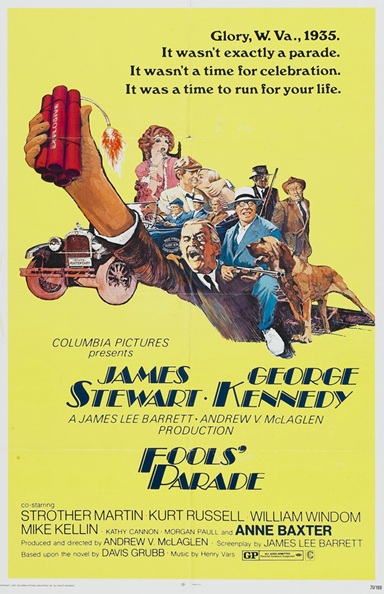
Film Review: Fools’ Parade (dir by Andrew V. McLaglen)


1971’s Fools’ Parade opens in 1935.

Three men are released from the West Virginia state penitentiary and given a train ticket out of town by the prison captain, Council (George Kennedy).  The men are a bank robber named Lee Cottrill (Strother Martin), a young man named Johnny Jesus (a young Kurt Russell), and a courtly older man named Mattie Appleyard (James Stewart).  Despite his polite tone of voice and his folksy manner, Appleyard is actually the most notorious of the three men being released.  Convicted of murdering two men, Appleyard has spent the past 40 years in prison.  Both Appleyard and Cottrill are looking to go straight.  Every day of his sentence, Appleyard worked and earned money.  Along with a glass eye, Appleyard leaves prison with a check for $25,000 dollars.  Appleyard plans to cash the money at the bank and then open a store with Cottrill.

Unfortunately, Appleyard has been released at the height of the Great Depression.  The streets are full men desperately looking for work.  People will do anything to feed their families or to make a little extra money.  Salesman Roy K. Sizemore (William Window) transports guns and dynamite.  Willis Hubbard (Robert Donner) works as a conductor on the train.  Aging prostitute Cleo (Ann Baxter) offers to sell the virginity of her adopted daughter, Chanty (Katherine Cannon).  Junior Killfong (Morgan Paull) sings on the radio and occasionally takes on deadlier work with his friend, Steve Mystic (Mike Kellin).  As for Captain Council, he’s decided that he’s going to make his money by ambushing the train carrying the three men that he has just released from prison.  After killing the men, Council will cash Appleyard’s check himself.

Of course, it doesn’t quite work out as simply as Council was hoping.  Willis Hubbard has a crisis of conscience and lets Appleyard, Cottrill, and Johnny know what Council is planning.  The three men narrowly make their escape but Council frames Appleyard for a murder that he didn’t commit.  Now wanted once again, the three men must not only get the money but also clear their names.  It won’t be easy because, as Hubbard explains, they may be free from the penitentiary but now, they’re trapped in “the prison of 1935.”

Fools’ Parade really took me by surprise.  I watched it because it featured two of my favorite actors, James Stewart and Kurt Russell.  And both Stewart and Russell give very good performances in the film.  Stewart was always at his best when he got a chance to hint at the melancholy behind his folksiness and the young Kurt Russell plays Johnny with a sincerity that makes you automatically root for him.  For that matter, the normally sinister Strother Martin is very likable as Lee Cottrill, a bank robber who is still struggling with the idea of going straight.  But, beyond the actors, Fools’ Parade is a genuinely sad portrait of desperate people trying to survive.  At one point, Sizemore and Cottrill watch as their train passes a camp of people who have been displaced by the Great Depression and it’s even implied that the villainous Council has some regret over what he’s become.  (There’s a small but poignant scene in which Council and Cleo acknowledge the passage of time and, for a minute, the viewer realizes these two people were, at one time, maybe as idealistic and optimistic as Johnny.)  It’s a well-acted film, one in which moments of humor are mixed with moments of true sadness.  I may have picked the film for Jimmy and Kurt but, in the end, the film’s story and performances drew me in.  The 63 year-old Stewart proved that he could still give a memorable performance and the 20 year-old Kurt Russell proved that he was a future star in the making.  If you haven’t seen it, this is definitely a film to check out.

THE FAR COUNTRY (1954) – James Stewart and Walter Brennan head North to make their fortune!


James Stewart is one of the great movie stars of all-time. His work with Frank Capra (MR. SMITH GOES TO WASHINGTON, IT’S A WONDERFUL LIFE) and Alfred Hitchcock (REAR WINDOW, VERTIGO) is legendary. In my household, Stewart’s work with director Anthony Mann is celebrated just as much as those other classics. Mann and Stewart made five classic westerns, beginning with WINCHESTER ‘73 in 1950 and ending in 1955 with THE MAN FROM LARAMIE. I own them all on DVD and watch them quite often. It’s very cold in Arkansas today, so I decided to write about the Yukon-set THE FAR COUNTRY, from 1954. 

Jeff Webster (James Stewart) and his crusty ol’ coot of a partner Ben Tatem (Walter Brennan) head North towards Dawson City, in the Yukon Territory, with a herd of cattle. The two men encounter a variety of problems along the way, with the biggest being the corrupt Judge Gannon (John McIntire) of Skagway, Alaska. When Jeff finds himself in front of the judge for killing two cowhands who tried to steal his herd, Gannon acquits him on the charges but decides to keep his herd as payment for the court fees. With their cattle taken away from them, Jeff and Ben sign up to help business lady Ronda Castle (Ruth Roman) take supplies to Dawson City, where she plans to set up shop. After their first day on the trip, Jeff and Ben double back to Skagway and re-take their herd and take off towards Dawson as fast as they can go, with Gannon and his men in hot pursuit. They’re able to make it into Canada, so Gannon and his goons turn back, determined to hang the men if they ever come back through Skagway.

So Jeff and Ben make it to Dawson City with their cattle where they sell them off for $2 per pound to Ronda. Suddenly flush with cash, the two partners buy a gold claim and proceed to find some nice golden nuggets! When they head back into town, they find that Judge Gannon has now come to Dawson City and is in partnership with Ronda. Of course, that bastard immediately starts cheating the miners out of their claims, this time with gunman Madden (Robert J. Wilke) by his side, enforcing his corrupt actions with lead. Jeff and Ben decide they’re going to sneak out of town with their loot, but Gannon finds out about it and sends his men to stop them. Ben is killed in the process and Jeff is seriously injured. Jeff has tried his best up to this point to not get involved with the mess in Dawson City, but with his best friend now dead, he decides it’s time for Judge Gannon and his thugs to be stopped. 

James Stewart is just so good as Jeff Webster. The best thing about his work with Mann is how each of the movies would give him a meaty role that capitalized on his basic decency, while simultaneously making him a more complex, layered man, miles away from the likes of Mr. Smith or George Bailey. In THE FAR COUNTRY, he’s as tough as nails, but he really doesn’t want to get involved with the people around him. It takes the death of his best friend for him to finally commit to helping them stand up against the bad guys. Stewart’s work here, and in the other Mann westerns, ranks with his very best. 

The remainder of the cast is uniformly excellent. Three time Oscar winner Walter Brennan is always a welcome presence in a movie I’m watching. While he’d pretty much settled into the “old coot” role that would come to personify the later part of his career, his character is a valuable conscience for Stewart a couple of times in the story. I thought that John McIntire and Ruth Roman really stood out in their respective roles as the corrupt Judge Gannon and the stubbornly, independent businesswoman Ronda Castle. Both give excellent performances. The cast is rounded out with a who’s who of character actors like Jay C. Flippen, Harry Morgan, Robert J. Wilke, Royal Dano, and Jack Elam. It’s always nice seeing these familiar faces pop up in these old westerns.

I love it when movies are filmed on location in beautiful places. THE FAR COUNTRY was filmed at the Jasper National Park in Alberta, Canada, which added another interesting element to the film. The final thing I want to say about the film is that the screenplay for THE FAR COUNTRY was written by Borden Chase, who had penned RED RIVER a few years earlier. Not only would Chase write this movie, he would also write the screenplays for WINCHESTER ‘73 and BEND OF THE RIVER, both westerns that paired Anthony Mann and Jimmy Stewart. Chase was an excellent writer of western material, and his strong work in this group of films is crucial to their enduring success. 

Overall, I confidently recommend THE FAR COUNTRY to any person who enjoys westerns or Jimmy Stewart. I might rank THE NAKED SPUR and THE MAN FROM LARAMIE slightly above this one in the Mann / Stewart westerns, but the truth is that you can’t go wrong with any of them. 

I’m sharing the trailer for THE FAR COUNTRY below:

4 Shots From 4 Films – some of Brad’s “favorite westerns” edition!


4 Shots From 4 Films is just what it says it is, 4 shots from 4 of our favorite films. As opposed to the reviews and recaps that we usually post, 4 Shots From 4 Films lets the visuals do the talking!

I thought I’d try one of these “4 shots” posts. It’s really hard for me not to say anything, because each of these movies mean a lot to me, and the western remains my favorite genre even if I am a little stuck in the past. I’ll probably take a stab at a review of each of these films at some point. I hope you enjoy!

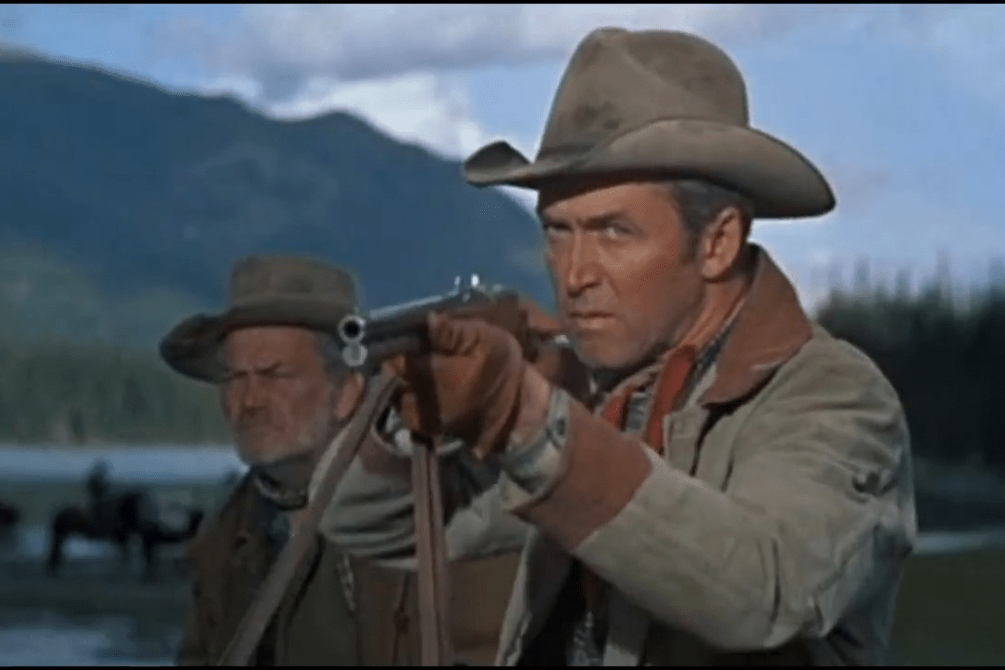
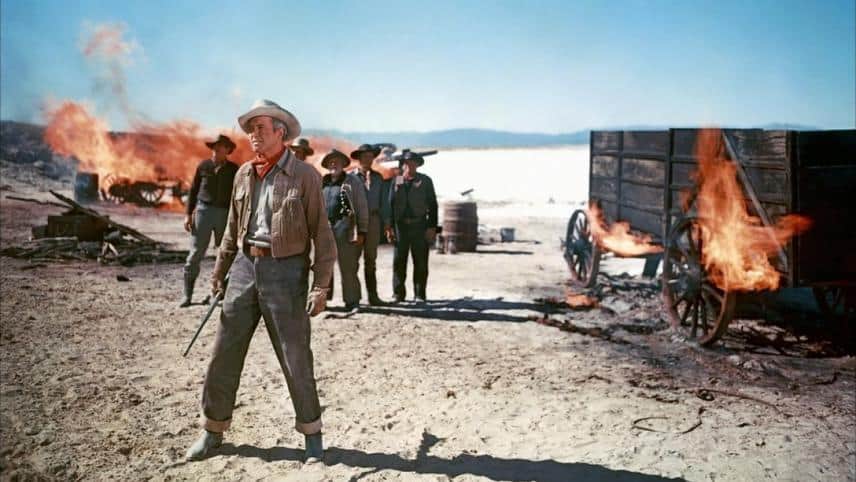
THE MAN FROM LARAMIE (1955)

RIDE LONESOME (1959)

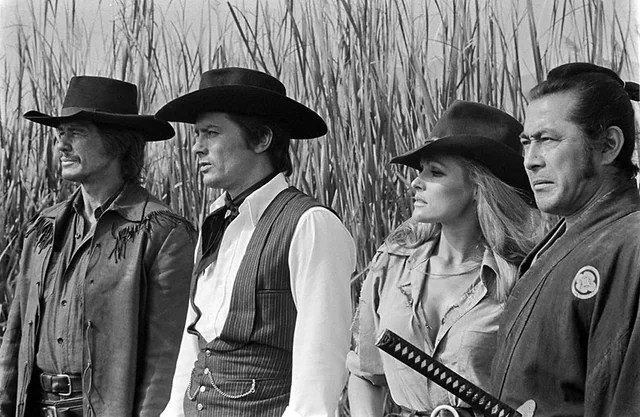
RED SUN (1971)

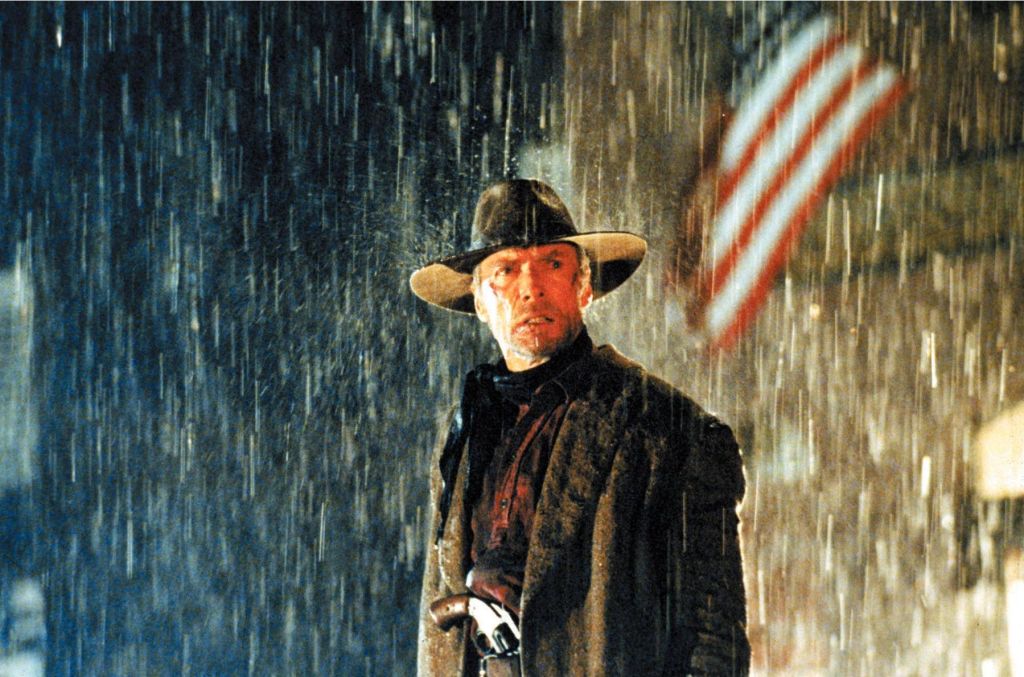
UNFORGIVEN (1992)

Song of the Day: The Man Who Shot Liberty Valance, performed by Gene Pitney


Since I already shared a scene from my favorite John Ford film, it seems only right that today’s song of the day should pay some respect to Mr. Ford as well.  Here is the theme song from 1962’s The Man Who Shot Liberty Valance, performed by Gene Pitney.

When Liberty Valance rode to town
The womenfolk would hide, they’d hide
When Liberty Valance walked around
The men would step aside

‘Cause the point of a gun was the only law
That Liberty understood
When it came to shooting straight and fast
He was mighty good

From out of the East a stranger came
A law book in his hand, a man
The kind of a man the West would need
To tame a troubled land

‘Cause the point of a gun was the only law
That Liberty understood
When it came to shooting straight and fast
He was mighty good

Many a man would face his gun
And many a man would fall
The man who shot Liberty Valance
He shot Liberty Valance
He was the bravest of them all

The love of a girl can make a man stay on
When he should go, stay on
Just trying to build a peaceful life
Where love is free to grow

But the point of a gun was the only law
That Liberty understood
When the final showdown came at last
A law book was no good

Alone and afraid, she prayed that he’d
Return that fateful night, oh that night
When nothing she said could keep her man
From going out to fight

From the moment a girl gets to be full grown
The very first thing she learns
When two men go out to face each other
Only one returns

Everyone heard two shots ring out
One shot made Liberty fall
The man who shot Liberty Valence
He shot Liberty Valance
He was the bravest of them all

The man who shot Liberty Valance
He shot Liberty Valance
He was the bravest of them all

Songwriters: Burt F. Bacharach / Hal David

Scenes That I Love: Who Was Really “The Man Who Shot Liberty Valance?”


John Ford was born 131 years ago today and it seems appropriate that today’s scene of the day should come from his final great film (even if it wasn’t the last film that Ford directed).

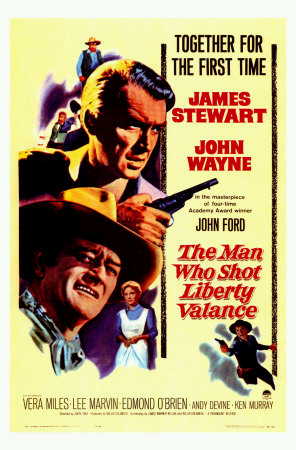
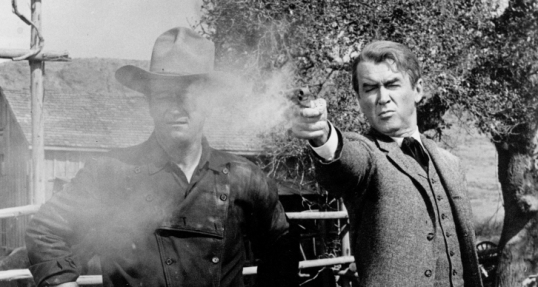
In 1962’s The Man Who Shot Liberty Valance, frontier lawyer Ransom Stoddard (James Stewart) comes to political prominence due to his notoriety for being the man who, in self-defense, gunned down notorious outlaw Liberty Valance (Lee Marvin).  Stoddard, an intellectual who opposes violence, is not happy about this.  When Stoddard considers refusing to be a delegate to the upcoming statehood convention, he is reprimanded by Tom Doniphon (John Wayne).  Stoddard and Doniphon are friends but they’re also romantic rivals, both being in love with Hallie (Vera Miles).  In this scene, Doniphon reveals the truth about who shot Liberty Valance.

Scenes I Love: Jimmy Stewart Sings Somewhere Over The Rainbow in The Philadelphia Story


Today’s scene that I love comes from the 1940 film, The Philadelphia Story, and it features my favorite Golden Age actor, James Stewart, carrying Katharine Hepburn and singing a song that might sound a bit familiar to our readers.

This is the performance, by the way, that won Stewart an Oscar.  Stewart himself often said that he felt the Academy rewarded him to make up for not giving him the Oscar for Mr. Smith Goes To Washington.  That’s probably true but still, this film features Jimmy Stewart at his most charming.  Teaming Stewart up with not just Katharine Hepburn but also Cary Grant makes The Philadelphia Story one of the best romantic comedies to come out of Hollywood’s pre-war era.

(Before the war, Stewart was Jimmy.  After he served bravely in World War II and returned to America, he was definitely James.)

4 Shots From 4 Films: Special James Stewart Edition


4 Shots From 4 Films is just what it says it is, 4 shots from 4 of our favorite films. As opposed to the reviews and recaps that we usually post, 4 Shots From 4 Films lets the visuals do the talking!

Today, we celebrate the birthday of one of the greatest American actors of all time, the wonderful James Stewart!  It’s time for….

4 Shots From 4 James Stewart Films

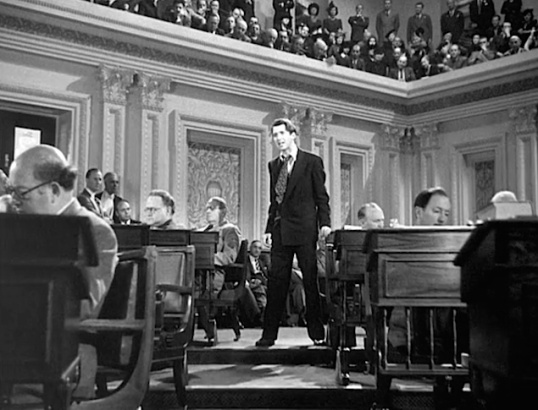
Mr. Smith Goes To Washington (1939, dir by Frank Capra, DP: Joseph Walker)

It’s A Wonderful Life (1946, dir by Frank Capra, DP: Joseph Walker and Joseph Biroc)

Rear Window (1954, dir by Alfred Hitchcock, DP: Robert Burks)

The Man Who Shot Liberty Valance (1962, dir by John Ford. DP: William H. Clothier)

Scenes That I Love: Katharine Hepburn and James Stewart in The Philadelphia Story


On this date, 117 years ago, Katharine Hepburn was born in Hartford, Connecticut.  She would go one to become a cultural icon, a performer who survived being labeled box office to poison to eventually become one of our most acclaimed actresses.  Hepburn was a total of four acting Oscars over the course of her career, a record that has yet to be topped.

Today’s scene that I love comes from 1940’s The Philadelphia Story and it features Katharine Hepburn acting opposite another one of my favorite performers, the great James Stewart.

Scenes I Love: James Stewart Explains The Four Ways To Defend Murder In Anatomy of a Murder


On this date, in 1908, James Stewart was born in Pennsylvania.  Over the course of a long career that saw him become a favorite of every director from Frank Capra to John Ford to Alfred Hitchcock to Anthony Mann, Jimmy Stewart gave a series of amazing performances.  My favorite Stewart film is, of course, It’s A Wonderful Life.  But I also love Stewart’s performance in 1959’s Anatomy of a Murder.  Playing a somewhat cynical attorney, Stewart received his final Oscar nomination for Best Actor for his work in this classic and influential film.

In today’s scene that I love, James Stewart explains to his client (played by Ben Gazzara) that there are four ways that he can defend a murder charge.  The contrast between Stewart’s classic style and Gazzara’s intense method style makes for an intense scene between two very talented and unique actors.