Goin’ South (1978, directed by Jack Nicholson)


Jack Nicholson was not an overnight success.

Nicholson was 17 years old when he first came to Hollywood in 1954.  Looking to become an actor, Nicholson toiled as an office worker at the MGM cartoon studio, took acting classes, and went to auditions.  It would be four years before he even landed his first role, the lead in the Roger Corman-produced The Cry Baby Killer.  When that film failed to become a hit, Nicholson spent the next ten years doing minor roles and occasionally starring in a B-picture.  He auditioned for some big parts, like Benjamin Braddock in The Graduate, Buck Barrow in Bonnie and Clyde, and Guy Woodhouse in Rosemary’s Baby, but his big break continued to allude him.  By 1969, Nicholson was so disillusioned with acting that he was planning to instead pursue a career as a director.  However, before Nicholson officially retired from the acting game, he received a call from the set of Easy Rider.  Depending on who you ask, Rip Torn, who had previously been cast in the role of alcoholic George Hanson, had either quit or been fired.  Bruce Dern, the first choice to replace Torn, was busy filming They Shoot Horses, Don’t They?  Nicholson agreed to step into the role and the rest is history.

Easy Rider may have made Jack Nicholson one of the world’s biggest film stars but he never lost his ambition to direct.  In 1971, he made his directorial debut with Drive, He Said, a film about campus unrest.  At the time, the film flopped at both the box office and with critics and quickly sunk into obscurity.  (It has subsequently been rediscovered and, in some cases, positively reevaluated.)  After the failure of Drive, He Said, it would be another seven years before Nicholson again got a chance to direct.

Nicholson’s second film as a director, Goin’ South, is a comedic western.  Nicholson plays Henry Lloyd Moon, an unsuccessful outlaw who used to ride with Quantrill’s Raiders.  When Moon is captured in Longhorn, Texas, he is sentenced to be hanged.  Fortunately, for Moon, Longhorn has a special ordinance.  Any man condemned for any crime other than murder can be saved from the gallows if a local woman agrees to marry him and take responsibility for his good behavior.  As a result of this ordinance, Longhorn is populated almost exclusively by single women and reformed outlaws.

While standing on the gallows, the cocky Moon is stunned to discover that none of the women want to marry him.  Finally, an old woman emerges from the crowd and announces that she’ll become Moon’s wife.  When Moon hops off the gallows and thanks her, the woman drops dead.  Fortunately, another, younger woman, Julia Tate (Mary Steenburgen, making her film debut), steps forward.

Once they’re married, the lecherous Moon discovers that Julia is a virgin and that the only reason she married him was so she could force him to work in the secret gold mine that’s hidden underneath her property.  The railroad will soon be taking over the land and Julia wants to get all of the gold before she leaves town for Philadelphia.  Though Julia, at first, wants nothing to do with Moon, he eventually wears her down through sheer persistence and the two fall in love.

Complicating matters is Deputy Towfield (Christopher Lloyd), who is upset because he feels that Julia was meant to be his wife.  Also, the members of Moon’s former gang (including Danny DeVito and Veronica Cartwright) show up at Julia’s house and discover the truth about the mine.

Goin’ South gets off to a good start.  The scene on the gallows, where Moon waits for someone to marry him and save his life, is genuinely funny and Nicholson and Steenburgen have a playful chemistry for the first hour of the movie.  Nicholson leers even more than usual in this film but the script is written so that the joke is always on Moon.  Much of the film’s humor comes from Moon always overestimating both his charm and his cleverness.  However, once Moon and Julia finally consummate their marriage, the movie loses whatever narrative momentum it may have had and gets bogged down with the subplots about Towfield and Moon’s gang.  There are funny moments throughout but the story gets away from Nicholson and the film is reduced to a series of set pieces, none of which build up to much.

Not surprisingly, Nicholson gets good performances from his cast, which is largely made up by the members of his 1970s entourage.  Along with Danny DeVito and Christopher Lloyd, longtime Nicholson associates like Tracey Walter, Ed Begley Jr., Richard Bradford, Jeff Morris, and Luana Anders all appear in small roles.  John Belushi plays the tiny role of Deputy Hector.  (Goin’ South was actually the first film in which Belushi was cast, though production didn’t actually begin until after Belushi had finished working on National Lampoon’s Animal House.)  Unfortunately, despite all of the good performances, the script doesn’t do much to develop any of the characters.  Belushi especially feels underused.  (Because Belushi had moved on to Animal House by the time the film went into post-production, Nicholson ended up dubbing several of Belushi’s lines himself.)

Drive, He Said was largely considered to have failed at the box office because Nicholson remained behind the camera so he took the opposite approach with Goin’ South.  Nicholson is in nearly every scene and he gives one of his broadest performances.  It works for the first half of the film, when Moon is constantly trying to get laid and failing every time.  But, during the second half of the movie, Nicholson’s failure to reign in his performance works to the film’s detriment.  When the movie needs Nicholson to be romantic, he’s still behaving like a horny cartoon. Whenever he looks at Mary Steenburgen, it seems as if his eyes should be popping out of his head, Tex Avery-style.  He’s an entertaining cartoon, but a cartoon nonetheless.  As a result, Goin’ South is often funny but it still feels very inconsequential.

Like Drive, He Said, Goin’ South was both a critical and a box office flop and it temporarily turned Nicholson off of directing.  It would be another 12 years before he would once again step behind the camera.  In 1990, Nicholson directed The Two Jakes, the sequel to one of his best films, Chinatown That would be Nicholson’s last film as a director.  Nicholson acted for another 20 years, following the release of The Two Jakes.  To date, he made his final screen appearance in 2010, with a supporting role in James L. Brooks’s How Do You Know.  Nicholson has disputed claims that he’s officially retired, saying that he’s instead just being more selective about his roles.  Even though it’s been ten years since we last saw him on screen, Jack Nicholson remains an American icon and a living legend.

6 Trailers In Memory of Robert Evans


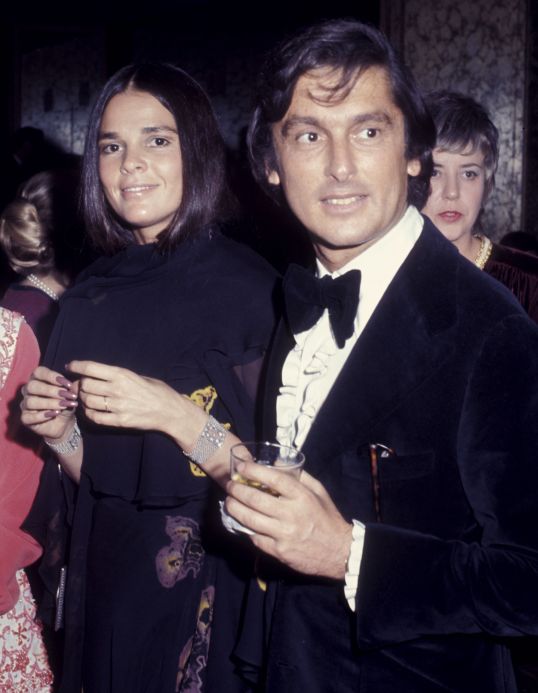
As Jeff reported earlier today, the famed Hollywood producer Robert Evans passed away this weekend.  As a student of both Hollywood and history, I have to say that I always found Evans to be a rather fascinating figure.  It seemed inevitable that his name would pop up whenever I read a book, an article, or even just an interview concerning the films of the 60s, 70s, and 80s.  Robert Evans was nice enough to follow me on twitter and we even exchanged tweets on occasion.

As a producer, Robert Evans is probably more associated with gangster movies like The Godfather and The Cotton Club than horror films.  But Evans was involved in a few “scary” and horror-adjacent films, both as an actor and a producer.  So, tonight’s edition of Lisa Marie’s Favorite Grindhouse Trailers is dedicated to Robert Evans.

  1. Man of a Thousand Face (1957)

As an actor, Evans began his career by playing Irving Thalberg in this biopic of Lon Chaney, Sr.  Evans was specifically chosen for the role by Thalberg’s widow, Norma Shearer.  Not surprisingly, the trailer below concentrates on James Cagney’s performance as legendary horror star, Lon Chaney, Sr.

2. The Fiend Who Walked The West (1958)

One of Evans’s rare starring roles was in this western-horror hybrid.  Yes, that’s Robert Evans as the “kooky killer.”

3. Rosemary’s Baby (1968)

As head of production at Paramount, Evans was responsible for greenlighting this classic horror film, starring Mia Farrow.  Reportedly, Evans arranged for his friend, Jack Nicholson, to screen test for the role of Rosemary’s husband.

4. Marathon Man (1976)

Evans produced this film.  Technically, Marathon Man was a thriller/spy movie.  But the scenes of Dustin Hoffman in the dentist chair definitely qualify as horror.

5. Sliver (1993)

After spending the 80s financially bereft and an almost forgotten figure, Evans made a comeback by producing this incredibly silly “erotic” thriller.

6. Jade (1995)

Sliver did well enough at the box office that Evans followed it up with another, similarly silly thriller.

Of course, while it’s tempting to laugh at films like Jade and Sliver, it should be remembered that Evans was also involved with some of the best and most important films of all time.  Next time you watch The Godfather, be sure to say a little thank you to Robert Evans.

R.I.P.

Horror on the Lens: The Terror (dir by Roger Corman)


Have you ever woken up and thought to yourself, “I’d love to see a movie where a youngish Jack Nicholson played a French soldier who, while searching for a mysterious woman, comes across a castle that’s inhabited by both Dick Miller and Boris Karloff?”

Of course you have!  Who hasn’t?

Well, fortunately, it’s YouTube to the rescue.  In Roger Corman’s 1963 film The Terror, Jack Nicholson is the least believable 19th century French soldier ever.  However, it’s still interesting to watch him before he became a cinematic icon.  (Judging from his performance here and in Cry Baby Killer, Jack was not a natural-born actor.)  Boris Karloff is, as usual, great and familiar Corman actor Dick Miller gets a much larger role than usual.  Pay attention to the actress playing the mysterious woman.  That’s Sandra Knight who, at the time of filming, was married to Jack Nicholson.

Reportedly, The Terror was one of those films that Corman made because he still had the sets from his much more acclaimed film version of The Raven.  The script was never finished, the story was made up as filming moved alone, and no less than five directors shot different parts of this 81 minute movie.  Among the directors: Roger Corman, Jack Hill, Monte Hellman, Francis Ford Coppola, and even Jack Nicholson himself!  Perhaps not surprisingly, the final film is a total mess but it does have some historical value.

(In typical Corman fashion, scenes from The Terror were later used in the 1968 film, Targets.)

Check out The Terror below!

Horror Scenes That I Love: Jack Meets Lloyd in The Shining


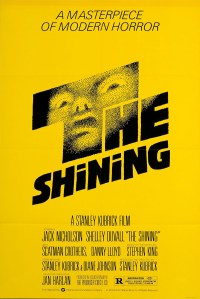
The scene below is, of course, from Stanley Kubrick’s 1980 masterpiece, The Shining.

In this scene, Jack Torrance (Jack Nicholson) stumbles into the Overlook Hotel’s ballroom, still fuming over having been accused of abusing his son.  A recovering alcoholic, Jack sits at the bar and thinks about how he would give up his soul for just one one drink.  And, on cue, Lloyd (Joe Turkel) appears.

As I was watching this scene, it occurred to me that, way back in 1980, there probably was some guy named Lloyd who saw this movie in a theater and was probably totally shocked when Jack suddenly stared straight at him and said, “Hey, Lloyd.”

The brilliance of this scene is that we never actually see Lloyd materialize.  We see him only after Jack has seen him.  So, yes, Lloyd could be a ghost.  But he could also just be a figment of Jack’s imagination.  Jack very well could just be suffering from cabin fever.  Of course, by the end of the movie, we learn the truth.

Everyone always talks about Jack Nicholson’s performance as Jack.  Some people love it and some people hate it.  (I’m in the first camp.)  However, let’s take a minute to appreciate just how totally creepy Joe Turkel is in this scene.  Turkel was a veteran character actor and had appeared in two previous Kubrick films, The Killing and Paths of Glory.  Two years after appearing in The Shining, Turkel played what may be his best-known role, Dr. Eldon Tyrell in Blade Runner.

From Stanley Kubrick’s The Shining, here’s Jack Nicholson and Joe Turkel:

Horror on the Lens: The Little Shop of Horrors (dir by Roger Corman)


(It’s tradition here at the Lens that, every October, we watch the original Little Shop of Horrors.  And always, I start things off by telling this story…)

Enter singing.

Little Shop…Little Shop of Horrors…Little Shop…Little Shop of Terrors…

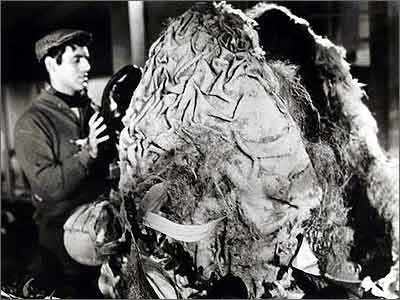
Hi!  Good morning and Happy October the 2nd!  For today’s plunge into the world of public domain horror films, I’d like to present you with a true classic.  From 1960, it’s the original Little Shop of Horrors!

When I was 19 years old, I was in a community theater production of the musical Little Shop of Horrors.  Though I think I would have made the perfect Audrey, everybody always snickered whenever I sang so I ended up as a part of “the ensemble.”  Being in the ensemble basically meant that I spent a lot of time dancing and showing off lots of cleavage.  And you know what?  The girl who did play Audrey was screechy, off-key, and annoying and after every show, all the old people in the audience always came back stage and ignored her and went straight over to me.  So there.

Anyway, during rehearsals, our director thought it would be so funny if we all watched the original film.  Now, I’m sorry to say, much like just about everyone else in the cast, this was my first exposure to the original and I even had to be told that the masochistic dentist patient was being played by Jack Nicholson.  However, I’m also very proud to say that — out of that entire cast — I’m the only one who understood that the zero-budget film I was watching was actually better than the big spectacle we were attempting to perform on stage.  Certainly, I understood the film better than that screechy little thing that was playing Audrey.

The first Little Shop of Horrors certainly isn’t scary and there’s nobody singing about somewhere that’s green (I always tear up when I hear that song, by the way).  However, it is a very, very funny film with the just the right amount of a dark streak to make it perfect Halloween viewing.

So, if you have 72 minutes to kill, check out the original and the best Little Shop of Horrors

Horror on the Lens: The Little Shop of Horrors (dir by Roger Corman)


(It’s tradition here at the Lens that, every October, we watch the original Little Shop of Horrors.  And always, I start things off by telling this story…)

Enter singing.

Little Shop…Little Shop of Horrors…Little Shop…Little Shop of Terrors…

Hi!  Good morning and Happy October the 30th!  For today’s plunge into the world of public domain horror films, I’d like to present you with a true classic.  From 1960, it’s the original Little Shop of Horrors!

When I was 19 years old, I was in a community theater production of the musical Little Shop of Horrors.  Though I think I would have made the perfect Audrey, everybody always snickered whenever I sang so I ended up as a part of “the ensemble.”  Being in the ensemble basically meant that I spent a lot of time dancing and showing off lots of cleavage.  And you know what?  The girl who did play Audrey was screechy, off-key, and annoying and after every show, all the old people in the audience always came back stage and ignored her and went straight over to me.  So there.

Anyway, during rehearsals, our director thought it would be so funny if we all watched the original film.  Now, I’m sorry to say, much like just about everyone else in the cast, this was my first exposure to the original and I even had to be told that the masochistic dentist patient was being played by Jack Nicholson.  However, I’m also very proud to say that — out of that entire cast — I’m the only one who understood that the zero-budget film I was watching was actually better than the big spectacle we were attempting to perform on stage.  Certainly, I understood the film better than that screechy little thing that was playing Audrey.

The first Little Shop of Horrors certainly isn’t scary and there’s nobody singing about somewhere that’s green (I always tear up when I hear that song, by the way).  However, it is a very, very funny film with the just the right amount of a dark streak to make it perfect Halloween viewing.

So, if you have 72 minutes to kill, check out the original and the best Little Shop of Horrors

Horror Scenes That I Love: Jack Torrance Explains The Donner Party


This scene, of course, is from 1980’s The Shining.

Technically, this is  before Jack Torrance met the ghosts and started to lose his mind but, in this scene, you can tell that Jack’s already getting a little bit tired of his family.  Jack Nicholson’s delivery of, “See?  It’s okay.  He heard it on the television,” gets me every time.

Celebrate Roger Corman’s Birthday With These 12 Trailers!


Roger Corman in The Godfather Part II

Today is a very special day!  It’s Roger Corman’s 92nd birthday!

Here at the Shattered Lens, we traditionally celebrate this day with a special edition of Lisa Marie’s Favorite Grindhouse and Exploitation Film Trailers!  Below, you’ll find the trailers for 12 films that were either directed by,  produced by, or distributed by the legendary Roger Corman!

  1. Five Guns West (1955)

This western was the first film that Roger Corman was credited with directing.

2. The Day The World Ended (1955)

Though Corman worked in almost every type of film genre imaginable, he’s probably best remembered for his science fiction and horror films.  This was one of the first of them.

3. Machine Gun Kelly (1958)

Along with westerns and sci-fi films, Corman also directed several gangster classics.  Machine Gun Kelly is remembered as one of his best.

4. The Intruder (1962)

Corman was an exploitation filmmaker with a conscience.  At a time when other films were avoiding social issues, Corman dove right in with challenging films like The Intruder.

5. The Terror (1963)

Corman was famous for his ability to spot new talent.  His 1963 film The Terror starred a then unknown actor named Jack Nicholson.

6. The Masque of the Red Death (1964)

In the 60s, Corman was also well-known for his Edgar Allan Poe adaptations, the majority of which starred Vincent Price.  With these colorful and flamboyant films, Corman showed himself to be a pop artist at heart.

7. Boxcar Bertha (1972)

In the 70s, Corman moved away from directing and focused on producing.  His ability to spot talent undiminished, Corman helped to launch the careers of the some of the important directors of all time.  In 1972, he hired a young director named Martin Scorsese to direct Boxcar Bertha.

8. Cries and Whispers (1973)

While Corman was producing exploitation films, he was also distributing “difficult” foreign-language films that might otherwise have never been seen in an American theater.  In 1973, he distributed this classic Ingmar Bergman film.  Cries and Whispers was nominated for best picture of the year, losing to The Sting.

9. Caged Heat (1974)

Jonathan Demme was another director who got his start directing Corman-produced films like Caged Heat.  Demme would later thank Corman by casting him in several of his films, including the 1991 Best Picture winner, The Silence of the Lambs.

10. Piranha (1978)

Piranha was one of Corman’s biggest hits as a producer.

11. Carnosaur (1993)

With Carnosaur, Corman showed that you didn’t need a lot of money to bring dinosaurs back to life.

12. Dinocroc vs Supergater (2010)

Corman has continued to produce films in the 21st century.  Films like Dinocroc vs Supergator not only won him legions of new fans but they also paved the way for films like Sharkando.

Happy birthday, Roger Corman!

Cleaning Out the DVR #18: Remember Those Fabulous Sixties?


gary loggins's avatarcracked rear viewer

There’s a lot of good stuff being broadcast this month, so it’s time once again to make some room on the ol’ DVR. Here’s a quartet of capsule reviews of films made in that mad, mad decade, the 1960’s:

THE FASTEST GUITAR ALIVE (MGM 1967; D: Michael D. Moore) –  MGM tried to make another Elvis out of rock legend Roy Orbison in this Sam Katzman-produced comedy-western. It didn’t work; though Roy possessed one of the greatest voices in rock’n’roll, he couldn’t act worth a lick. Roy (without his trademark shades!) and partner Sammy Jackson (TV’s NO TIME FOR SERGEANTS) peddle ‘Dr. Ludwig Long’s Magic Elixir’ in a travelling medicine show, but are really Confederate spies out to steal gold from the San Francisco mint to fund “the cause” in the waning days of the Civil War. The film’s full of anachronisms and the ‘comical Indians’ aren’t all that funny…

View original post 728 more words

Lisa Reviews An Oscar Nominee: Five Easy Pieces (dir by Bob Rafelson)


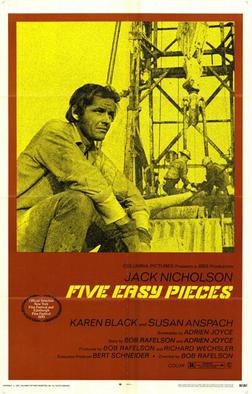
First released in 1970, Five Easy Pieces tells the story of a lost man named Bobby Dupea (Jack Nicholson).

When we first meet Bobby, he’s working at a California oil field.  He likes to go bowling.  He has a girlfriend named Rayette (Karen Black), who is a country music-obsessed waitress.  His best friend is Elton (Billy “Green” Bush), a friendly redneck with a memorable laugh.  Bobby may have a girlfriend and Elton may be married but that doesn’t stop either one of them from going out at night, getting drunk, and trying to pick up women.

Bobby seems to be just another blue-collar guy with a grudge against the bosses but it doesn’t take long to realize that there’s something different about him.  Bobby may be friends with Elton but it’s obvious that the two of them come from very different background.  No matter how much he tries to hide it, Bobby is smarter than everyone else around him.  When he and Elton get stuck in a traffic jam, Bobby spots a piano sitting on the back of a pickup truck.  Getting out of his car, Bobby yells at everyone who is honking and then climbs up to the piano.  He sits down, he puts his fingers to the keys and he starts to play.  Knowing Bobby, you’re expecting him to just bang the keys and make noise.  Instead, he plays beautiful music.

Later, Bobby steps into a recording studio.  Paritia (Lois Smith), a neurotic woman, is playing the piano.  The recording engineers joke about her lack of talent.  Bobby glares at them, annoyed.  It quickly becomes apparent why Bobby is so protective.  Paritia is Bobby’s sister.

Bobby, it turns out, comes from a wealthy family of musicians.  Everyone in the family has dealt with the pressure to succeed differently.  Paritia continues to play, despite not having much talent.  Bobby’s older brother, the buffoonish Carl (Ralph Waite), plays violin and has staid home with their father (William Challee).  Bobby, on the other hand, ran away from home.  He’s spent his entire life trying to escape from both his talent and his family.  However, when Paritia explains that their father has suffered from two strokes and might not live much longer, Bobby reluctantly decides to return home and try to make some sort of peace with his father.

It’s not as easy a journey as Bobby would have liked.  For one thing, Rayette demands to go with him.  On the drive up to Washington, they pick up two hitchhikers (Helena Kallionetes and Toni Basil), one of whom is obsessed with filth.  In the film’s most famous scene, an attempt to get a simple lunch order modified leads to Bobby losing control.

See, that’s the thing with Bobby.  In many ways, he’s a jerk.  He treats Rayette terribly.  While his family is hardly perfect, the film doesn’t hide from the fact that Bobby isn’t always the easiest person to deal with.  And yet, you can’t help but sympathize with Bobby.  If he seems permanently annoyed with the world … well, that’s because the world’s annoying.  And, to Bobby’s credit, he’s a bit more self-aware than the typical rebel without a cause.  When one of the hitchhikers praises his temper tantrum at the diner, Bobby points out that, after all of that, he still didn’t get the order that he wanted.

In Washington, Bobby tells Rayette to stay at a motel and then goes to see his family.  Bobby seems as out-of-place among his wealthy family as he did hanging out in the oil fields with Elton.  He ends up cheating on Rayette with Carl’s fiancee, a pianist named Catherine van Oost (Susan Anspach).

And then Rayette shows up for dinner…

Five Easy Pieces is a sometimes funny and often poignant character study of a man who seems to be destined to always feel lost in the world.  Bobby spends the whole movie trying to find a place where he can find happiness and every time, reality interferes with his plans.  Nicholson gives a brilliant performance, playing Bobby as a talented guy who doesn’t really like himself that much.  Bobby’s search for happiness leads to a rather haunting ending, one that suggests that some people are just meant to spend their entire life wandering.

Five Easy Pieces was nominated for Best Picture but lost to Patton.