The South American drug cartels have been getting too aggressive so the American government decides to take them out with Apache helicopters. Missions leaders Tommy Lee Jones and Dale Dye know that these helicopters are the ultimate weapons of death and that things could go terribly wrong if they recruit the wrong pilots.
So, of course, they get Nicholas Cage and Sean Young to fly them.
FireBirds was an attempt to redo TopGun with helicopters. It does actually improve on Top Gun in that it gives the pilots an actual villain to fight. The drug cartels and the German mercenary (Bert Rhine) that they hire are good B-movie villains and an improvement on the faceless and apparently nationless bad guys who showed up at the end of TopGun. What FireBirds cannot improve on are the flying sequences because fighter planes are just more exciting than to watch than helicopters.
The best thing about the movie is that it brought Nicolas Cage and Tommy Lee Jones together and their acting styles mesh far better than I think anyone would expect. Sean Young is about as believable as a helicopter pilot as you would expect her to be, which is to say not at all. There’s a reason why Young’s best performance was as a robot.
“I. Am. The. Greatest!” Nicolas Cage says in the movie and he sounds convinced. Fire Birds makes the case that Cage is the greatest when it comes to making something bad watchable. This movie would be thoroughly forgettable if not for his presence and the same can be said about a lot of other movies as well. But, Tommy Lee Jones can lay claim to the “Greatest” title as well. Five years after FireBirds, Tommy Lee Jones would tell Jim Carrey, “I cannot sanction your buffoonery,” and the passage of time has shown that Jones knew what he was talking about. Nicolas Cage and Tommy Lee Jones should make more movies together.
1992’s Captain Ron opens with Martin Harvey (Martin Short) suffering through another day as a corporate drone in Chicago. What is Martin’s job like? It’s the type of job where there’s broken glass on the sidewalk because someone jumped out a window. Martin is ready for an escape and he gets it when he’s informed that his deceased uncle has left him a yacht that once belonged to Clark Gable. The only catch is that the yacht is on a Caribbean island and Martin will need to sail it to Miami if he wants to sell it. Martin decides this will be a great opportunity get away from cold Chicago with his wife (Mary Kay Place), daughter (Meadow Sisto), and son (Benjamin Salisbury).
It turns out that the yacht is in terrible shape. And so, for that matter, is the sailor who has been assigned to help the Harveys set sail. Ron “Everyone calls me Captain Ron” Rico (Kurt Russell) is a somewhat slovenly drunk who wears sunglasses over his eyepatch and who is in debt to some dangerous people. It also turns out that, despite talking a big game, Captain Ron is fairly incompetent as a navigator. He knows how the boat works. He knows how to keep the engine from overheating. He knows how to borrow Martin’s video camera so he can film Marin’s wife and daughter while they walk around top deck. What Captain Ron can’t do is actually get the boat to where it needs to go. Instead, Captain Ron takes the family to a number of islands, gets them into trouble with pirates, and also becomes the surrogate father-figure that the family needs.
There’s a lot to criticize about Captain Ron. The script cannot quite decide just who exactly it wants these characters to be. Moments of sentimental family comedy are mixed with scenes of Captain Ron leering at Martin’s wife and daughter. Martin and his wife get stuck in the boat’s shower and I’ll admit that I laughed at the scene because something similar happened to me in college but it still felt as if it was included solely to get the movie up to a PG-13. The film has the making of being a wild comedy but it never quite goes as far as it could. Martin gets upset but he never gets truly frantic, which is a waste of Martin Short’s talents. Ron has the makings to be a true force of chaos but the film instead just makes him incompetent. There’s an odd scene where Martin considers shooting Captain Ron with a flare gun. It comes out of nowhere and it’s not ever mentioned again. It hints at a film that could have been a lot more subversive than it turned out to be.
That said, I did enjoy Captain Ron. The island scenery is lovely. The shots of that dilapidated yacht on the ocean do, almost despite themselves, achieve a sort of grandeur. And then you’ve got Kurt Russell, wearing a red speedo and apparently having the time of his life as the incompetent yet rather cocky Captain Ron. It’s a fun performance, even if the film sometimes doesn’t seem to be sure what to do with it. That the film remains watchable is a testament to the charm of Kurt Russell. Much like the title character, Captain Ron is a film that’s likable even when it shouldn’t be.
1973’s The Spook Who Sat By The Door opens with Senator Hennington (Joseph Mascolo) in a panic.
The Senator is running for reelection and is struggling to appeal to white voters and minority voters at the same time. White voters are happy that the Senator recently gave a speech in favor of “law and order” but now, he’s polling weakly with black voters. His wife (Elaine Aiken) suggests that the Senator win back black voters by demanding that the CIA hire more black agents.
The CIA responds to the political pressure by hiring Dan Freeman (Lawrence Cook) to be their first black agent. Freeman is given the standard CIA training and taught how to start revolutions in other countries. However, after he completes his training, Freeman is assigned no real responsibilities. He is given a desk job and spends most of his day making copies. Whenever a senator or a reporter visits CIA Headquarters, Freeman is trotted out so that the CIA can claim to be diverse. Freeman understands that he’s a token. He knows that his job is to basically sit by the door and be seen. But Freeman actually has bigger plans.
After spending a few years at the CIA, Freeman resigns and heads back to Chicago to work as a social worker. Using what he learned at the agency, he starts to recruit young black men as freedom fighters. He and the Cobras (as they’re called) launch their own guerilla war against the establishment in Chicago. Some of their tactics are violent and some of them are not. Freeman understands the importance of winning both hearts and minds and he recruits Willy (David Lemieux) to serve as his lead propagandist. Because Willy is light-skinned, he is also assigned to rob a bank because Freeman knows that both the witnesses and the police will mistake him for being white and will be less likely to fire on him. (The other members of the Cobras wear whiteface during the robbery.)
Freeman hopes that he will be able to recruit his childhood friend, Dawson (J.A. Preston), to the cause. Dawson, however, now works as a detective for the Chicago PD and has been assigned to beak up the Cobras. Will Freeman be able to bring over Dawson and what will happen if Dawson resists?
Based on a novel by Sam Greenlee (who was one of the first black men to be recruited to work with the United States Information Agency and who based many of Freeman’s CIA experiences on his own), TheSpook Who Sat By The Door has achieved legendary status as a film that the FBI reportedly tried to keep out of theaters. Theater owners were pressured to either not book the film or to only book it for a week before replacing it with a less incendiary film. As a result, The Spook Who Sat By The Door became a difficult film to see. As often happens, the efforts to censor the film only added to its revolutionary mystique.
Of course, in 2024, one can go on YouTube and watch the film for oneself. It’s definitely uneven film, one that has pacing issues (especially at the beginning) and also one that suffers due to its low budget. Depicting the overthrow of the government on a budget will always be a challenge. Some of the acting is a bit amateurish but Lawrence Cook broods convincingly as Freeman and he’s well-matched by J.A. Preston’s portrayal of the more down-to-Earth Dawson. At its best, there’s a raw authenticity and anger to the film that immediately captures the viewer’s attention. It’s the rare political film to actually feature conversations about actual politics and it’s a film that asks how far people would be willing to go to accomplish change. The Spook Who Sat By The Door suggests that the true villains are the members of the establishment who cynically embraced the civil rights struggle in their words but not in their actions. In the end, Dan Freeman becomes a bit of a fanatic but the film suggests that perhaps a fanatic was what the times demanded.
Welcome to Retro Television Reviews, a feature where we review some of our favorite and least favorite shows of the past! On Sundays, I will be reviewing the made-for-television movies that used to be a primetime mainstay. Today’s film is 1986’s The George McKenna Story! It can be viewed on Netflix, under the title Hard Lessons!
George Washington High School is a school that has defeated many well-meaning principals. The hallways are full of drugs and gang members. A good deal of the student body never shows up for class. Fights are frequent. The police are a common sight. The majority of the teachers are men like Ben Proctor (Richard Masur), burned-out and content to hide in the teacher’s lounge.
New Orleans-raised George McKenna (Denzel Washington) is the latest principal and, from the minute that he shows up at the school, he seems a bit more confident than the other principals that the school has had. He barely flinches when a raw egg hits his suit. When he hears a fight occurring, he doesn’t hesitate to head down the hall to investigate. McKenna is determined to make George Washington High into a worthwhile institution and that means inspiring both the students and the teachers.
When it comes to films about dedicated educators trying to reform a troubled school, most films tend to take one of two approaches. One approach, the well-intentioned but not always realistic liberal approach, features the teacher or the principal who demands respect but who also treats the good students and teachers with equal respect and who turns around the school through the power of benevolence. The other approach is the one where the principal or teacher grows frustrated and turns into an armed vigilante who forces the students to shut up and learn. Think of The Principal or The Substitute or Class of 1984. The first approach is the one that most teachers claim that they try to follow but I imagine that, for most of them, there’s an element in wish-fulfillment to be found in watching the second approach. In the real world, of course, neither approach is as automatically successful as it is in the movies.
The George McKenna Story was made for television and it’s based on a true story so, not surprisingly, it follows the first approach. Denzel Washington plays McKenna as someone who could probably handle himself in a fight if he ever got into one but, for the most part, the film portrays McKenna as succeeding by treating his students with more empathy and respect that they’ve gotten from anyone else in their lives. Though cranky old Ben Proctor thinks that McKenna’s methods are foolish and that he’s asking the teachers to do too much, McKenna starts to turn the school around. One student, whose father was threatening to make him drop out, ends up getting nearly straight A’s and reciting Shakespeare. Unfortunately, not everyone can be rescued. One student is arrested for murder and taken away by the cops but McKenna is still willing to be there for that student. McKenna doesn’t give up on his students and, unlike that music teacher in The Class of 1984, he doesn’t allow them to fall through a skylight either.
The George McKenna Story is a predictable film. It’s easy to guess which student will be saved by McKenna’s approach and which student will end up getting stabbed in a gang fight and which student will end up in prison. That said, the film definitely benefits from Denzel Washington in the lead role. Washington exudes confidence from the minute that he appears on screen and you’re left with little doubt that if anyone could reform a school simply through good intentions, it would definitely be Denzel Washington.
For the longest time, I thought that Two-Minute Warning was a movie about a gang of art thieves who attempt to pull off a heist by hiring a sniper to shoot at empty seats at the Super Bowl. As planned by a master criminal known as The Professor (Rossano Brazzi), the sniper will cause a riot and the police will be too busy trying to restore order to notice the robbery being committed at an art gallery that happens to be right next to the stadium.
I believed that because that was the version of Two-Minute Warning that would sometimes show up on television. Whenever I saw the movie, I always through it was a strange plan, one that had too many obvious flaws for any halfway competent criminal mastermind to ignore them. What if the sniper was captured before he got a chance to start shooting? What if a riot didn’t break out? The sniper spent the movie aiming at empty seats but, considering how many people were in the stadium, it was likely that he would accidentally shoot someone. Were the paintings really worth the risk of a murder charge?
Even stranger was that Two-Minute Warning was not only a heist film but it was also a 1970s disaster film. Spread out throughout the stadium were familiar character actors like Jack Klugman, John Cassevetes, David Janssen, Martin Balsam, Gena Rowlands, Walter Pidgeon, and Beau Bridges. It seemed strange that, once the shots were fired and Brazzi’s men broke into the gallery, all of those familiar faces vanished. When it comes to disaster movies, it is an ironclad rule that at least one B-list celebrity has to die. It seemed strange that Two-Minute Warning, with all those characters, would feature a sniper shooting at only empty seats. For that matter, why would there be empty seats at the Super Bowl?
That wasn’t the strangest thing about Two-Minute Warning, though. The strangest thing was that Charlton Heston was in the film, playing a police captain. In most of his scenes, he had dark hair. But, in the scenes in which he talked about the art gallery, Heston’s hair was suddenly light brown.
Recently, I watched Two-Minute Warning on DVD and I was shocked to discover that the movie on the DVD had very little in common with the movie that I had seen on TV. For instance, the television version started with the crooks discussing their plan to rob the gallery. The DVD version opened with the sniper shooting at a couple in the park. In the DVD version, there was no art heist. The sniper had no motive and no personality. He was just a random nut who opened fire on the Super Bowl. And, in the DVD version, he did not shoot at empty seats. Several of the characters who survived in the version that I saw on TV did not survive in the version that I saw on DVD.
What happened?
The theatrical version of Two-Minute Warning was exactly what I saw on the DVD. A nameless sniper opens fire and kills several people at the Super Bowl. In 1978, when NBC purchased the television broadcast rights for Two-Minute Warning, they worried that it was too violent and too disturbing. There was concern that, if the film was broadcast as it originally was, people would actually think there was a risk of some nut with a gun opening fire at a crowded event. (In 1978, that was apparently considered to be implausible.) So, 40 minutes of new footage was shot. Charlton Heston even returned to film three new scenes, which explains his changing hair color. The new version of Two-Minute Warning not only gave the sniper a motive (albeit one that did not make much sense) but it also took out all of the violent death scenes.
Having seen both versions of Two-Minute Warning, neither one is very good, though the theatrical version is at least more suspenseful than the television version. (It turns out that it was better to give the sniper no motive than to saddle him with a completely implausible one.) But, even in the theatrical version, the potential victims are too one-dimensional to really care about. Ultimately, the most interesting thing about Two-Minute Warning is that, at one time, an art heist was considered more plausible than a mass shooting.
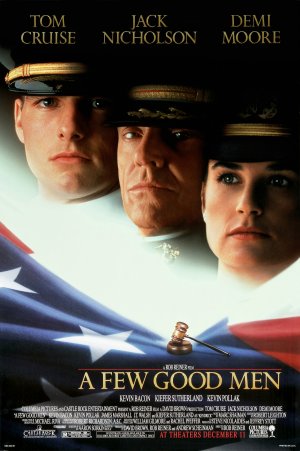
So, late Saturday night, I turned over to TCM’s 31 Days Of Oscar and I was watching the 1992 best picture nominee, A Few Good Men, and I noticed that not only was there only one woman in the entire film but she was also portrayed as being humorless and overwhelmed. While all of the male characters were allowed to speak in quippy one liners and all had at least one memorable personality trait, Lt. Commander Joanne Galloway (Demi Moore) didn’t get to do much beyond frown and struggle to keep up.
“Hmmmm…” I wondered, “why is it that the only woman in the film is portrayed as basically being a humorless scold?” Then I remembered that A Few Good Men was written by Aaron Sorkin and it all made sense. As I’ve discussed on this site before, Aaron Sorkin has no idea how to write woman and that’s certainly evident in A Few Good Men. Joanne (who goes by the masculine Jo) is the one character who doesn’t get to say anything funny or wise. Instead, she mostly serves to repeat platitudes and to be ridiculed (both subtly and not-so subtly) by her male colleagues. You can tell that Sorkin was so busy patting himself on the back for making Jo into a professional that he never actually got around to actually giving her any personality. As a result, there’s really not much for her to do, other than occasionally scowling and giving Tom Cruise a “that’s not funny” look.
(“C’mon,” Tom says at one point, “that one was pretty good.” You tell her, Aaron Tom.)
A Few Good Men, of course, is the film where Tom Cruise yells, “I want the truth!” and then Jack Nicholson yells back, “You can’t handle the truth!” At that point in the film, I was totally on Nicholson’s side and I was kinda hoping that the scene would conclude with Cruise staring down at the floor, struggling to find the perfect come back. However, this is an Aaron Sorkin script which means that the big bad military guy is never going to have a legitimate point and that the film’s hero is always going to have the perfect comeback. Fortunately, the scene took place in a courtroom so there was a wise judge present and he was able to let us know that, even if he seemed to be making the better point, Nicholson was still in the wrong.
As for the rest of the film, it’s a courtroom drama. At Guantanamo Bay, a marine (Michael DeLorenzo) has died as the result of a hazing. Two other marines (Wolfgang Bodison and James Marshall) have been accused of the murder. Daniel Kafee (Tom Cruise), Joanne Galloyway (Demi Moore), and Sam Weinberg (Kevin Pollack) have been assigned to defend them. Jack Ross (Kevin Bacon) is prosecuting them. Kafee thinks that the hazing was ordered by Col. Nathan Jessup (Jack Nicholson) and Lt. Kendrick (Kiefer Sutherland).
We know that Kendrick’s a bad guy because he speaks in a Southern accent and is religious, which is pretty much the mark of the devil in an Aaron Sorkin script. We know that Jessup is evil because he’s played by Jack Nicholson. For that matter, we also know that Kafee is cocky, arrogant, and has father issues. Why? Because he’s played by Tom Cruise, of course. And, while we’re at it, we know that Sam is going to be full of common sense wisdom because he’s played by Kevin Pollack…
What I’m saying here is that there’s absolutely nothing surprising about A Few Good Men. It may pretend to be about big issues of national security but, ultimately, it’s a very slick and somewhat hollow Hollywood production. This, after all, is a Rob Reiner film and that, above all else, means that it’s going to be a very conventional and very calculated crowd pleaser.
Which isn’t to say that A Few Good Men wasn’t enjoyable. I love courtroom dramas and, with the exception of Demi Moore, all of the actors do a good job. (And, in Demi’s defense, it’s not as if she had much to work with. It’s not her fault that Sorkin hates women.) A Few Good Men is entertaining without being particularly memorable.
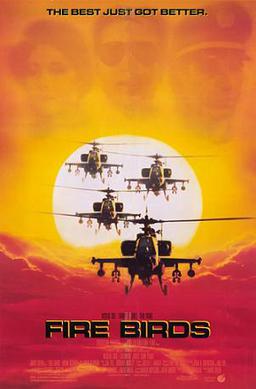 The South American drug cartels have been getting too aggressive so the American government decides to take them out with Apache helicopters. Missions leaders Tommy Lee Jones and Dale Dye know that these helicopters are the ultimate weapons of death and that things could go terribly wrong if they recruit the wrong pilots.


 Through the Shattered Lens