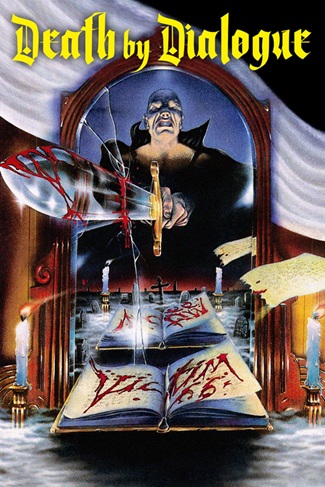
SOV Horror Review: Death by Dialogue (dir by Thomas DeWeir)


In this 1988 film, a group of college friends visit Uncle Ive (Theodore Lehmann), a crippled taxidermist who lives next door to a film set. (We never actually see this film set, but we are assured that it’s there.) Uncle Ive is taken care of by his devoted housekeeper, Ms. Camden (Judy Gordon). And he needs a lot of taking care of because, for some reason, there’s a haunted screenplay on his property. The title of the screenplay is constantly changing, but the one thing that remains consistent is the word “Victim.” The screenplay goes from being “Victim #69” to “Victim #70,” but what never changes is that there has to be a victim. The screenplay predicts how each person in the film is going to die. It’s not so much Death By Dialogue as it is Death By Rewrite.

Speaking of screenplays, this film has a strange one. It’s never really clear why the screenplay is on the property of Uncle Ive, but there are more than a few deaths that manage to be memorable. There’s a standard bursting into flames death. There’s a decapitation by scarf death. There’s a death by impalement on the blade of a bald demon. Strangest of all is the moment when one of the victims stumbles across an ’80s hair band that just happens to be performing behind some bushes. This leads to death by having one’s head smashed with a musical instrument. What’s odd is that we never really know where the band came from. Were they demons? Were they a legitimate band? What happened to them after the head smashing? How come no one heard them playing? Is this the sort of thing that regularly happens near film sets? I mean, I imagine that sort of thing happened at the Spahn Ranch on a daily basis, but I always figured that was the exception to the rule. Eventually, a big scary demon shows up and we’re left to wonder if he wrote the script and if he did so on spec. During WGA strikes, can the cursed screenplay still kill people, or do they have to hire a scab to write the death scenes until the strike is settled? Personally, if anyone wrote my death in a screenplay, I would hope that the studios would, at the very least, bring in an Oscar-winner to do an uncredited rewrite.

(Actually, now that I think about it, my best friend Evelyn and I wrote a pretty good slasher screenplay when we were in college. We gave the best death scenes to ourselves and the people we liked the most. The people we disliked just got dragged offscreen. I really should get it out of storage and do some work on it.)

Anyway, have I rambled enough? If this review seems a bit disjointed and random …. well, so does the film. But that’s not necessarily a bad thing. This is one of those films where the incoherent story actually works to the story’s advantage. It really does create the feeling of being at the mercy of beings that simply cannot be understood or reasoned with. Featuring a game cast and an intriguingly weird premise, Death by Dialogue is enjoyable almost despite itself. No rewrite was necessary!

Retro Television Reviews: The George McKenna Story (dir by Eric Laneuville)


Welcome to Retro Television Reviews, a feature where we review some of our favorite and least favorite shows of the past!  On Sundays, I will be reviewing the made-for-television movies that used to be a primetime mainstay.  Today’s film is 1986’s The George McKenna Story!  It  can be viewed on Netflix, under the title Hard Lessons!

George Washington High School is a school that has defeated many well-meaning principals.  The hallways are full of drugs and gang members.  A good deal of the student body never shows up for class.  Fights are frequent.  The police are a common sight.  The majority of the teachers are men like Ben Proctor (Richard Masur), burned-out and content to hide in the teacher’s lounge.

New Orleans-raised George McKenna (Denzel Washington) is the latest principal and, from the minute that he shows up at the school, he seems a bit more confident than the other principals that the school has had.  He barely flinches when a raw egg hits his suit.  When he hears a fight occurring, he doesn’t hesitate to head down the hall to investigate.  McKenna is determined to make George Washington High into a worthwhile institution and that means inspiring both the students and the teachers.

When it comes to films about dedicated educators trying to reform a troubled school, most films tend to take one of two approaches.  One approach, the well-intentioned but not always realistic liberal approach, features the teacher or the principal who demands respect but who also treats the good students and teachers with equal respect and who turns around the school through the power of benevolence.  The other approach is the one where the principal or teacher grows frustrated and turns into an armed vigilante who forces the students to shut up and learn.  Think of The Principal or The Substitute or Class of 1984.  The first approach is the one that most teachers claim that they try to follow but I imagine that, for most of them, there’s an element in wish-fulfillment to be found in watching the second approach.  In the real world, of course, neither approach is as automatically successful as it is in the movies.

The George McKenna Story was made for television and it’s based on a true story so, not surprisingly, it follows the first approach.  Denzel Washington plays McKenna as someone who could probably handle himself in a fight if he ever got into one but, for the most part, the film portrays McKenna as succeeding by treating his students with more empathy and respect that they’ve gotten from anyone else in their lives.  Though cranky old Ben Proctor thinks that McKenna’s methods are foolish and that he’s asking the teachers to do too much, McKenna starts to turn the school around.  One student, whose father was threatening to make him drop out, ends up getting nearly straight A’s and reciting Shakespeare.  Unfortunately, not everyone can be rescued.  One student is arrested for murder and taken away by the cops but McKenna is still willing to be there for that student.  McKenna doesn’t give up on his students and, unlike that music teacher in The Class of 1984, he doesn’t allow them to fall through a skylight either.

The George McKenna Story is a predictable film.  It’s easy to guess which student will be saved by McKenna’s approach and which student will end up getting stabbed in a gang fight and which student will end up in prison.  That said, the film definitely benefits from Denzel Washington in the lead role.  Washington exudes confidence from the minute that he appears on screen and you’re left with little doubt that if anyone could reform a school simply through good intentions, it would definitely be Denzel Washington.