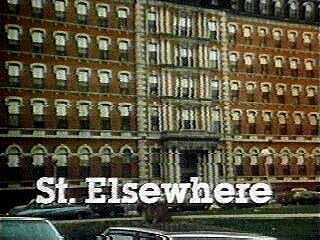
Retro Television Review: St. Elsewhere 1.2 “Bypass”


Welcome to Retro Television Reviews, a new feature where we review some of our favorite and least favorite shows of the past! On Fridays, I will be reviewing St. Elsewhere, a medical show which ran on NBC from 1982 to 1988.  The show can be found on Hulu!

This week, William Daniels claims the show as his own.

Episode 1.2 “Bypass”

(Dir by Thomas Carter, originally aired on November 9th, 1982)

“Hey, it’s Tim Robbins!”

Yes, the future Oscar winner shows up in the second episode of St. Elsewhere, playing a rich kid-turned-terrorist named Andrew Reinhardt.  Reinhardt, who no doubt learned all about Marxism during his first semester away at college, set off a bomb in a bank, killing two people and putting a woman named Kathleen McCallister into a coma.  Both Reihnhardt and McCallister have been brought to St. Eligius.  While Kathleen’s husband, Stephen (Jack Bannon), sobs in the hallway, Reinhardt acts like a petulant brat in his hospital room.

With the nurses refusing to change his sheets or even give him his morphine shots, it falls to Dr. Morrison to take care of him.  Reinhardt is not at all appreciative and Morrison finds himself conflicted.  How is he supposed to give proper medical treatment to someone who he despises?  Morrison is so conflicted that he even goes to Dr. Westphall.  Westphall responds by telling a long story about a time that he fell in love with a patient.  I’m getting the feeling that Morrison feeling conflicted and Westphall telling long stories are both going to be regular features on this show.

(The correct answer to Morrison’s question about how he can take care of a bad person is as follows: It’s your job and you’re getting paid to do it.)

This episode also gave the viewer a chance to get to know Dr. Craig, the very talented but very egotistical head of surgery who is played by the great William Daniels.  Dr. Craig holds a press conference to inform reporters about the conditions of both Reinhardt and Kathleen McCallister and declares that, despite its bad reputation, “St. Eligius is the place to be!”  He then proceeds to get angry when the press is more interested in talking to the surgeon who actually saved Kathleen’s life than to him.

Dr. Craig browbeats a Mr. Broadwater (Robert Costanzo) into getting bypass surgery done.  The surgery appears to have been a success but it’s hard to ignore that Craig essentially bullied the guy into getting a major operation, one that could have killed him if the least little thing had gone wrong.  Resident Victor Ehrlich (Ed Begley, Jr.) assists in the operation and, at one point, Dr. Craig intentionally head butts him when Ehrlich cannot name all of the arteries leading into the heart.  It’s a bit aggressive but, on the plus side, Ehrlich does learn all of the names.  Afterwards, Dr. Craig brags about how his own son is following in his footsteps and tells Mr. Broadwater’s son that some day, a new Dr. Craig will operate on him.  In other words, Dr. Craig is kind of a jerk but he’s good at what he does and he’s played by William Daniels so it’s hard to hold anything against him.

There were other subplots playing out in the background, the majority of which just seemed to be there to remind us that St. Elsewhere is an ensemble show and that, just because someone isn’t a major character in this episode, that doesn’t mean they won’t be important later on.  Psychiatrist Hugh Beale (G.W. Bailey) attempted to learn how to swim and ended up taking a class with a bunch of children.  Dr. Fiscus (Howie Mandel, the least convincing doctor ever) held court in the cafeteria and claimed that the hormones used in processing food were causing children to develop earlier than ever before.  Dr. Peter White (Terrence Knox) wandered around with a bunch of X-rays and begged everyone he met to help him understand what he was (or wasn’t) seeing.  If nothing else, this episode did a good job of capturing the idea of the hospital as being a place that’s always busy.

For the most part, though, it was Dr. Craig who carried this episode.  While Morrison and Westphall ponderously considered the implications of doing their jobs, Craig was an arrogant, angry, and brilliant dynamo and William Daniels’s high-energy performance was a pleasure to watch.  Whenever the episode started to slow down, Dr. Craig would liven things up by yelling at someone.  The hospital was lucky to have Dr. Craig and St. Elsewhere was lucky to have William Daniels.

Retro Television Review: St. Elsewhere 1.1 “Pilot”


Welcome to Retro Television Reviews, a new feature where we review some of our favorite and least favorite shows of the past! On Fridays, I will be reviewing St. Elsewhere, a medical show which ran on NBC from 1982 to 1988.  The show can be found on Hulu!

When I started reviewing Homicide, Jeff suggested that I should also review St. Elsewhere because the two shows shared a similar sensibility and a lot of behind-the-scenes personnel.  (Homicide showrunner Tom Fontana started out as a writer on St. Elsewhere.)  Apparently. a few characters from St. Elsewhere would eventually cross-over to Homicide.  Since I’m planning on soon reviewing two shows that were descended from HomicideOz and The Wire — it only seemed right to also review a show that was Homicide’s ancestor.

Though the show aired largely before my time, St. Elsewhere is definitely a show that I have heard about.  Everyone who follows American pop culture has either read about or seen the show’s infamous final episode and knows about the Tommy Westphall Universe Hypothesis.  Obviously, I can’t get into it now because that would be a spoiler but we’ll discuss it when the time comes!

For now, let’s start at the beginning, with the pilot!

Episode 1.1 “Pilot”

(Dir by Thomas Carter, originally aired on October 26th, 1982)

St. Eligius is a hospital in Boston that has obviously seen better days.  From the outside, it looks old.  On the inside, the hallways have the dim and dull look of a building that hasn’t been renovated in over ten years.  As Dr. Mark Craig (William Daniels, long before he played Mr. Feeney on Boy Meets World) angrily puts it, the hospital gets no respect in Boston.  It’s seen as being a “dumping ground” for patients who can’t afford anything better.  Dr. Craig is world-renowned heart surgeon whose wealthy patients have donated what few improvements the hospital has seen over the past few years.  (“All of our clocks now read the same time!” Dr. Craig brags at one point.)  But not even Dr. Craig can change the hospital’s reputation as being secondary to Boston General.

There are actually a few good things about St. Eligius.  For one thing, a young Denzel Washington is on staff, playing resident Phillip Chandler.  Denzel doesn’t get to do much in the pilot but still, his presence fills the viewer with confidence.  St. Eligius is also home to a world-renowned liver specialist, Dr. Daniel Auschlander (played by Norman Lloyd, who also worked with Hitchcock and Orson Welles).  Auschlander has liver cancer but the hospital chief-of-staff, Dr. Donald Westphall (Ed Flanders), assures everyone that Auschlander will probably “out live us all.”  (And he was right, to an extent.  Norman Lloyd lived to be 106 years old before passing away in 2021.  Ed Flanders died, tragically by suicide, in 1995.)  St. Eligius is a teaching hospital and the residents want to make a good impression by keeping their patients alive.  That’s always a good thing.

At the same time, how secure can you feel when Howie Mandel is one of the residents?  Mandel plays Dr. Wayne Fiscus, who wears a baseball cap and acts …. well, he acts a lot like Howie Mandel.  Like Washington, Mandel doesn’t do a lot in the pilot.  He does get a subplot where he apparently has sex in the morgue with goth pathologist Cathy Martin (Barbara Whinnery) but otherwise, we don’t see him treating a patient or anything like that.  Still, it’s a bit jarring to see Howie Mandel as a doctor.  I would not necessarily want him for my doctor because he’s to be easily distracted.  Maybe he’ll change my mind as the series progresses.

Speaking of sex, Dr. Ben Samuels (David Birney) has gonorrhea and spends most of the pilot approaching doctors and nurses and informing them of his conditions and suggesting that they might want to get tested themselves.  That’s not exactly the best way to be introduced to a character but it also lets us know that this show is not just going to be about dedicated doctors who spend all of their time worrying about their patients and making amazing medical discoveries.  Instead, this show is also about doctors who get venereal diseases.  Has anyone checked on Fiscus in the morgue?

(That said, Dr. Samuels does get a scene where he saves the life of a woman who was injured in a terrorist bombing, as if the show does want to make sure that we know that he can do his job, even if he is spreading VD through the hospital.)

The majority of the episode follows Dr. Jack Morrison (David Morse), a first-year resident who has been working several 24-hour shifts and who complains, at one point, that he hasn’t seen his wife for days.  Dr. Morrison gets upset when a surgeon wants to operate on one of his patients, a 15 year-old girl named Sandy (Heather McAdams).  Morrison believes that surgeons always want to cut into somebody.  Morrison gets even more upset when Sandy’s mother requests that Sandy be transferred to Boston General, which has a reputation for being a better, more modern hospital.  In fact, Morrison is so upset and exhausted that he forgets to file a death certificate for a patient who dies during the night.  As a result, it’s believed that the patient, who has a reputation for being violent, has gone missing and is stalking the hospital.  Dr. Annie Cavanero (Cynthia Sikes) spends the entire episode looking for a dead man, which at least gives her an excuse to visit every ward and introduce the viewers to the members of the show’s ensemble cast.

Having lost my mom to cancer and now my Dad to Parkinson’s, I was hesitant about reviewing St. Elsewhere.  (Actually, I was hesitant about reviewing any medical show.)  When my Dad was in the hospital, I felt like I couldn’t get anyone to give me a straight answer about his condition and I often felt the doctors were talking down to me.  To be honest, my worst conflicts were with the nurses, one of whom told me that I would have to “lose the attitude” before she would explain why my father had been moved to the Delirium Ward.  (It didn’t help that, at the same time my Dad was in the hospital, there was a huge storm that left us without power for a week.)  At the same time, there were other doctors who were helpful.  The staff at the rehab center that my dad was sent to were also wonderful.  I have my regrets about agreeing to hospice care but the nurse who was assigned to my Dad was very empathetic and totally understanding whenever I asked her for a cigarette.  (Under normal circumstances, I don’t smoke because I have asthma but seriously, the stress was killing me.)  I’m bitter and angry about a lot of what happened but I’m also thankful for the small moments of kindness.

Watching a show set in a hospital was not easy for me but the pilot of St. Elsewhere appealed to me with its mix of melodrama and humor.  There was a quirkiness to it that I appreciated.  William Daniels made me laugh with his annoyed rant about how little respect the hospital received.  Most of all, I cared about whether or not Dr. Morrison would still be alive at the end of his shift.  David Morse’s performance won me over.  He’s the type of doctor that I would want to have.  Well, actually, I’d probably want Denzel to my doctor but Dr, Morrison could assist.  Just keep Dr. Howie Mandel away from me.  Nothing against him but he seemed to be having way too much fun at the hospital….

Most importantly, the show ended with a cat.

Next week, the drama continues at St. Elsewhere!

Film Review: Tribulation (dir by Andre Van Heerden)


The Apocalypse saga continues with 2000’s Tribulation!  This is the film that answers the question: How do you get an outspoken atheist and a prominent Jewish entertainer to star in your evangelical Christian propaganda film?  Apparently, you do it by not revealing what type of film that you’re making.

At least, that’s what Margot Kidder said happened.  In an interview with the AV Club, Kidder said that neither she nor Howie Mandel realized that they were appearing in a Christian film until they got on the set, looked at the complete script, and asked why Kidder’s character mysteriously vanished from the film.  According to Kidder, this was a film that she did because she was broke, she couldn’t get a job because she had a reputation for being difficult, and she was offered a lot of money to go up to Toronto for a week and shoot a few scenes.  And so, Kidder, who was not a fan of religion in general, was cast as Eileen Canboro, the outspoken Christian who tries to teach everyone about the rapture.

To quote Kidder: “And I still get stopped by those freaky fundamentalists going “Oh, I’m so glad you did Tribulation.” And I wanna go, “Don’t count me into your group, honeybuns. I’m not one of you.”

As for the film itself, it stars Gary Busey as Tom Canboro, a police detective who is indifferent to religion.  His brother-in-law is Jason Quincy (Howie Mandel), an occultist who, early on in the film, gets possessed by a bunch of Satanists.  The film never really makes it clear why Jason was possessed, beyond I guess to warn against using Ouija boards or reading New Age literature.  After Jason is briefly possessed, the Satanists decide that they have to kill everyone who saw him possessed so that no one learns of their existence.  (But it seems like it would have just been simpler to not possess anyone in the first place.)  All of this leads to Tom eventually slipping into a coma.  Don’t ask how.  It just does.

While Tom’s out of it, the events of the first two movies happen.  Franco Manculousso (Nick Mancuso) magically rids the world of nuclear missiles and declares himself to be the messiah.  Millions of people — including Margot Kidder — mysteriously vanish.  An underground rebellion — labeled “The Haters” by Manculousso — forms against the one world government.  Everyone in the world is given a VR headset that will allow Manculousso to either kill them or steal their soul by giving them the mark of the beast.

(In this film, getting the mark of the beast means that you literally end up with 666 tattooed on your hand.  One thing I always find interesting about films like this is how they take everything in Biblical prophecy so literally.  For instance, 7 is the number of God so therefore it makes sense that the number of the Beast’s number would be 6 because the Beast will always be powerful but ultimately inferior.  He’ll be “one away” from God.  However, films like this always feature people wandering around with 666 prominently displayed on their body and oddly, no one ever says, “Hey, have you ever seen that Omen movie?”)

Anyway, Tom eventually wakes up and finds himself trapped in this brand new world.  It turns out that his sole remaining brother is now prominent follower of Manculousso’s and Jason is now involved in the Hater underground.  A few characters from the previous films pop up, largely so they can be executed by Manculousso.  You know how it goes.

Anyway, if Apocalypse was basically a found footage film and Revelation was an action film, Tribulation is a horror film, complete with demonic possession, exploding heads, and virtual reality snakes.  It’s also a bit slow — it takes forever for Tom to actually enter that coma — but it has a few effective scenes.  Howie Mandel, for instance, really throws himself into being possessed.  As for Gary Busey, Margot Kidder said in that previously cited interview that he was a “pain in the ass” to work with but he actually gives a …. well, I don’t know if it’s really a good performance but it’s definitely interesting.  He’s credible during the first half of the film and then, during the second half of the film, he seems to be genuinely confused.  There’s a few weird moments where he smiles when he definitely shouldn’t be smiling but otherwise, Busey’s okay in this film.

There would be one more film in the Apocalypse saga, Judgment.  I’ll be posting a review of that film in 15 minutes.  Hope to see you there!

Playing Catch Up: First Daughter, Ice Girls, Raising The Bar, Walk Like A Man


So, this year I am making a sincere effort to review every film that I see.  I know I say that every year but this time, I really mean it.  Unfortunately, over the past two weeks, real life has interfered with my movie reviewing, if not my move watching.

So, in an effort to catch up, here are four quick reviews of some of the movies that I watched over the past two weeks!

  • First Daughter
  • Released: 2004
  • Directed by Forest Whitaker
  • Starring Katie Holmes, Marc Blucas, Amerie, Michael Keaton, Margaret Colin, Lela Rochon

Michael Keaton as the President of the United States!?  Now, that’s a great idea.  Michael Keaton plays President Mackenzie.  First Daughter was made long before Birdman so Michael Keaton doesn’t really have a huge part but, whenever he does appear, he is totally believable as a world leader.  You buy the idea that this guy could win an election and that he’d probably be a good (if not necessarily a great) President.  Someone really needs to make another movie where Michael Keaton plays the President.  Maybe President Birdman.  Just don’t give it to Inarritu to direct because he’ll make it too political…

Anyway, the majority of the film is about Katie Holmes as the President’s daughter, Samantha.  Samantha has been accepted to a college in California.  She’s excited because it means that she’ll finally be able to have a life outside of the White House.  The President is concerned because he loves his daughter and he knows that, if she makes any mistakes in California, his political opponents will try to use her against him.  Samantha goes off to college and tries to have a good (but rather chaste) time.  Making that somewhat difficult is her secret service entourage.  Fortunately, Samantha meets a guy (Marc Blucas) who loves her for who she is and not because her father is the President.

It’s all pretty silly and shallow but I have to admit that I get nostalgic whenever I see this movie.  Much like From Justin To Kelly, it’s definitely a film from a more innocent and less angry time.  To date, it’s also the last film to be directed by actor Forest Whitaker.

  • Ice Girls
  • Released in 2016
  • Directed by Damian Lee
  • Starring Michaela du Toit, Lara Daans, Arcadia Kendal, Sheila McCarthy, Taylor Hunsley, Shane Harte, Elvis Stojko

Struggling financially, Kelly (Lara Daans) is forced to move back to her hometown and move in with her sister (Sheila McCarthy).  Until she got married and gave up that part of her life, Kelly was once an up-and-coming figure skater.  Fortunately, her daughter, Mattie (Michaela du Toit), has inherited her mother’s talent.  However, a serious injury shook Mattie’s confidence.  Now, she says she doesn’t want to skate anymore.  Still, she’s willing to accept a job from Mercury (Elvis Stojko) at the local rink and it’s not too long before, under Mercury’s guidance, Mattie is skating once again.  Mattie also befriends another skater, Heather (Taylor Hunsley).  Heather happens to be the daughter of Rose (Natasha Henstridge), who was once in love with Kelly’s father…

It sounds like the set-up of a melodramatic Lifetime movie but actually, Ice Girls is a sweet-natured film about two ice skaters, one who has a mother who is too protective and the other who has a mother who is too driven.  In the end, both of them end up skating for themselves and not their mothers and that’s a good message for the film’s target audience of young skate fans.  The majority of the cast is made up of actual ice skaters, so the skating footage is pretty impressive.  It’s a predictable movie but I enjoyed it when I watched it on Netflix.

  • Raising the Bar
  • Released in 2016
  • Directed by Clay Glen
  • Starring Kelli Berglund, Lili Karamalikis, Tess Fowler, Emily Morris, Peta Shannon

I also watched this one on Netflix, a day after I watched Ice Girls.  (I was in an Olympics sort of mood, even though neither film took place at the Olympics.)  Raising the Bar feels a lot like Ice Girls, except that the ice skaters were now gymnasts and instead of relocating to Toronto, the family in Raising the Bar relocates all the way to Australia.  Once in Australia, Kelly (Kelly Johnson) finds the courage to re-enter gymnastics and ends up competing against her former teammates.

Kelly Johnson gives a good performance in the lead role.  Though it may be predictable, Raising the Bar is an effective and sweet-natured family film.  Perhaps the most interesting thing about watching the film was that I quickly found myself rooting against the American team.  Australia all the way!

  • Walk Like A Man
  • Released 1987
  • Directed by Melvin Frank
  • Starring Howie Mandel, Amy Steel, Cloris Leachman, Christopher Lloyd, Colleen Camp, Stephen Elliott, George DiCenzo, John McLiam, Earl Boen

Oh, what sweet Hell is this?

Okay, I’m going to try to explain what happens in this movie.  You’re not going to believe me.  You’re going to think that I’m just making all of this up.  But I swear to a God … this is an actual movie.

When he was a baby, Boba Shand (Howie Mandel) got separated from his family.  His mother and his father assumed that he was gone forever but what they didn’t know was that Bobo was found and raised by a pack of wild dogs.  For twenty years, Bobo lives as a dog.  Then he’s discovered by Penny (Amy Steel), an animal researcher who tries to teach Bobo how to be a human.  However, as time passes, Penny comes to realize that maybe she’s making a mistake trying to change Bobo.  Bobo is innocent and child-like and obsessed with chasing fire engines.  When he has too much to drink, he runs around on all fours.  And … PENNY’S IN LOVE WITH HIM!

Seriously, she’s in love with a man who thinks he’s a dog.

However, Bobo stands to inherit a fortune and his evil brother (Christopher Lloyd) is planning on having him committed.  Penny has to prove that Bobo is human enough to manage his own affairs while also respecting his desire to continue living like a dog.

I’m serious.  This is a real movie.

Anyway, making things even worse is the performance as Howie Mandel.  Mandel has always been a rather needy performer and the role of a man who thinks he’s a dog only serves to bring out his worst instincts.  Remember when Ben Stiller played Simple Jack in Tropical Thunder?  Well, Mandel’s performance is kinda like that only worse.  At one point, Bobo walks up to a mannequin in a mall and says, “I have to go pee pee.  Come with me,” and I nearly threw a shoe at the TV.  Oh my God, it was so bad.

The main problem with Walk Like A Man is that it wants to have it both ways.  It wants to be a wild comedy about Howie Mandel chasing fire engines but it also makes us want to tear up when Penny explains why Bobo should be allowed to live as a dog.

All in all, it’s a really bad movie.  And yes, it does actually exist.

A Movie A Day #240: The Funny Farm (1983, directed by Ron Clark)


Mark Champlin (Miles Chapin) is a fresh-faced, aspiring comedian from Cleveland who drives across the country, listening to tapes of Steve Martin.  He arrives in Los Angeles, hoping to become a star.  Despite being too naive and trusting, Mark starts to find success in the cut-throat entertainment industry.  Soon, he is performing at the Funny Farm, a comedy club owned by Gail Corbin (Eileen Brennan, giving the exact same performance that Melissa Leo gave in Showtime’s I’m Dying Up Here).  Mark befriends the other comedians, finds love, and hopes for his big break.

There have been several movies and television shows about the drama that goes on behind the scenes in the world of comedy.  It’s rare that they ever turn out well.  For every successful movie about the struggle to make a living by telling jokes, there are a hundred movies like Punchline or this one.  Whereas Punchline tried to pass Sally Field off as an up-and-coming stand-up comic, The Funny Farm was full of actual comedians.  Almost everyone in the film is playing a thinly disguised versions of themselves and snippets of their acts are used throughout the movie.  (Probably the best known member of the cast is Howie Mandel.)  Unfortunately, none of their acts seem to be very funny.  Miles Chapin comes across like every forgettable comic who ever bombed on The Tonight Show.

Eileen Brennan does a good job as the club owner, even if she is underused.  There is also a good scene where the younger comedians meet a legendary, older comic who turns out to be a racist asshole.  During this scene, The Funny Farm actually has something to say about the way comedy progressed and changed over time.  Otherwise, The Funny Farm is forgettable.