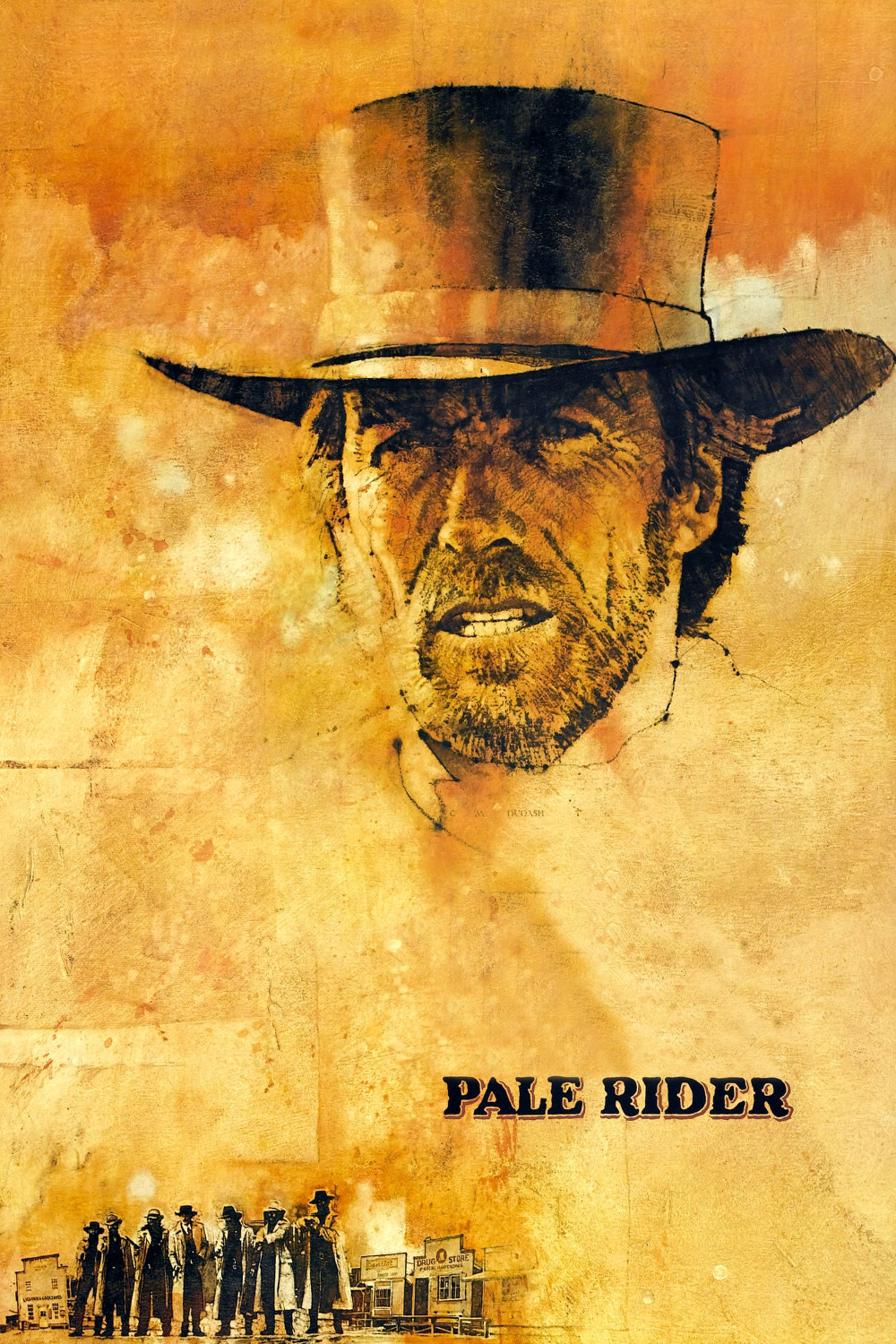
“And I looked, and behold a pale horse. And his name that sat on him was Death. And Hell followed with him.” — Megan Wheeler
Clint Eastwood’s Pale Rider occupies a fascinating space within the Western genre—both a reverent homage to the traditions that shaped classic frontier storytelling and a quiet dismantling of the myths those stories often upheld. Released in 1985, the film arrived during a period when the Western had largely faded from mainstream prominence, regarded by many as a relic of an earlier cinematic era. Yet Eastwood, by then already firmly associated with the genre through his work in Sergio Leone’s Dollar Trilogy and films like High Plains Drifter and The Outlaw Josey Wales, proved that the Western still had room for reinvention. With Pale Rider, he crafted something that feels both deeply familiar and subtly haunting: a film that embraces the iconography of the Old West while draping it in an almost supernatural atmosphere, creating one of the most enigmatic and compelling entries in his directorial career.
In many ways, Pale Rider also feels like a spiritual successor—or even an unofficial companion piece—to High Plains Drifter. Both films center around a mysterious outsider who seemingly emerges from nowhere to confront a corrupt and morally rotten community. In both stories, Eastwood plays a figure who feels less like an ordinary man and more like an embodiment of vengeance itself, a ghostly gunslinger whose true nature is never fully explained. The similarities in narrative structure are impossible to ignore: isolated frontier settlements under siege, powerful men abusing authority, and Eastwood’s near-mythic drifter arriving as a reckoning for buried sins. But where High Plains Drifter leans into bitterness and outright surrealism, portraying the Old West as a place consumed by cruelty and hypocrisy, Pale Rider takes a more restrained and spiritual approach. The Preacher is still intimidating and otherworldly, but he possesses a moral center that the Stranger in High Plains Drifter deliberately lacked. It feels almost as if Eastwood revisited the earlier film’s core ideas over a decade later with greater maturity and reflection, transforming the wrathful ghost story of High Plains Drifter into something more meditative about redemption and justice.
On its surface, Pale Rider follows a relatively straightforward Western premise. A group of struggling gold prospectors in the mountains of California are being terrorized and pressured by a wealthy mining magnate, Coy LaHood, who seeks to drive them off their land so he can exploit the area’s resources for himself. Into this conflict rides a mysterious preacher, played by Eastwood, whose sudden appearance seems almost divinely summoned after a young girl prays for deliverance. This unnamed “Preacher” becomes the reluctant protector of the miners, standing against LaHood and the corrupt marshal Stockburn and his deputies. The bones of the story echo classic Western structures—outsiders defending vulnerable settlers from ruthless power—but Pale Rider imbues this framework with a somber, spiritual weight that elevates it beyond genre familiarity.
One of the film’s most striking strengths is Eastwood’s central performance. By this point in his career, Eastwood had perfected a specific screen persona: laconic, observant, physically economical, and quietly threatening. Yet the Preacher in Pale Rider may be one of his most mysterious variations on that archetype. Unlike the swaggering Man with No Name or even the wounded determination of Josey Wales, the Preacher seems almost detached from ordinary human concerns. His calm demeanor and sparse dialogue give him an ethereal quality, and Eastwood plays him with just enough warmth to avoid complete abstraction. There is kindness in his interactions with the miners, especially the young Megan Wheeler, but it always feels measured, as if the character is passing through rather than fully participating in the world around him. The film deliberately hints at something supernatural—his sudden arrival after prayer, his unexplained scars, his near spectral presence—and Eastwood wisely resists any definitive explanation. The ambiguity is what gives the character his power.
This supernatural undercurrent is central to what makes Pale Rider unique. The title itself references the Four Horsemen of the Apocalypse, specifically Death riding a pale horse, and the biblical symbolism permeates the film without overwhelming it. Eastwood uses religious imagery sparingly but effectively, allowing viewers to wonder whether the Preacher is simply a man with a violent past or something more symbolic: an agent of justice, vengeance, or divine reckoning. The film never commits fully to fantasy, but it constantly suggests that the Preacher exists somewhere between myth and mortal reality. This ambiguity transforms ordinary Western confrontations into something more unsettling and poetic.
Visually, Pale Rider is one of Eastwood’s most beautiful films. Shot by cinematographer Bruce Surtees, whose work with Eastwood had already become legendary, the film makes remarkable use of natural landscapes. The mountainous terrain, dense forests, and rugged mining camps provide a setting that feels less romanticized than the sweeping deserts often associated with traditional Westerns. There is a chill to the environment, both literal and emotional. The forests seem shadowed and secretive, and the mining settlements feel fragile, temporary, vulnerable to destruction. Surtees’ lighting contributes significantly to the film’s tone, bathing many scenes in muted, earthy colors and allowing darkness to linger at the edges of the frame. The result is a Western that often feels ghostly, as though the past itself is haunting every image.
Eastwood’s direction demonstrates his confidence and restraint. He avoids excessive spectacle, choosing instead to let tension build gradually through atmosphere, silence, and careful pacing. Action scenes are brief but impactful, and the violence carries genuine consequence. Unlike many earlier Westerns that glorified gunfights as heroic climaxes, Pale Rider treats violence as something grim and almost inevitable. When the Preacher finally unleashes his skills, it feels less like triumphant empowerment and more like a dark necessity. Eastwood understands that his character’s power is amplified by how sparingly he uses it.
Still, despite how effective the film is overall, Pale Rider is not without flaws. Some viewers may find the pacing overly deliberate, particularly in the middle section where the story spends considerable time with the miners and their daily struggles before major plot developments occur. Eastwood prioritizes mood and atmosphere over narrative momentum, which works artistically but can occasionally make the film feel slower than necessary. The supporting characters, while likable, are also somewhat thinly sketched compared to the larger thematic ideas surrounding them. Hull Barret, Sarah Wheeler, and several of the miners are defined more by their place within the story’s moral framework than by deeply layered characterization. They are ordinary people standing against corruption, but the script does not always give them enough individuality or complexity outside of that central conflict.
What ultimately compensates for this is the strength and sincerity of the performances themselves. Michael Moriarty gives Hull Barret a gentle awkwardness and vulnerability that make him feel genuinely human rather than simply “the good-hearted miner.” There is an understated sadness in the way Moriarty carries himself, as if Hull already expects to lose against forces larger than himself, which makes his gradual courage more affecting. Carrie Snodgress similarly brings warmth and grounded realism to Sarah Wheeler, helping the character feel emotionally authentic even when the screenplay does not explore her inner life in great detail. The miners as a collective also benefit from Eastwood’s direction, which emphasizes camaraderie and shared hardship through small interactions and visual storytelling rather than extensive dialogue or backstory.
In many respects, the relative simplicity of the supporting characters may even be intentional. Pale Rider operates less like a conventional ensemble drama and more like a mythic folk tale or ghost story, where ordinary people encounter a figure who seems larger than life. The miners are not meant to overshadow the Preacher’s mystery; they function as representatives of vulnerable frontier communities trapped between survival and exploitation. Their emotional straightforwardness creates a contrast with Eastwood’s enigmatic presence. Because the supporting cast plays these roles with sincerity and restraint rather than melodrama, the film avoids feeling emotionally hollow even when some characters are not deeply developed on the page. The performances ground the story just enough to keep the supernatural and allegorical elements emotionally believable.
The film’s thematic concerns are nevertheless surprisingly rich. At its heart, Pale Rider is a story about greed and resistance. Coy LaHood represents industrial expansion and unchecked capitalism, using wealth and intimidation to crush smaller, independent prospectors. The miners symbolize ordinary people fighting to preserve their livelihoods and dignity. This conflict gives the film a subtle populist edge, framing the Western frontier not merely as a site of adventure but as a battleground between concentrated power and communal perseverance. Eastwood does not overstate these themes, but they lend the story a resonance that extends beyond genre convention.
There is also an interesting undercurrent of moral ambiguity. The Preacher protects the innocent, but he is hardly a traditional moral hero. His past appears stained by violence, and the scars on his back suggest suffering, punishment, or perhaps sins that remain unresolved. The film implies that redemption may be possible, but only through confrontation with one’s own darkness. This is where Pale Rider aligns with Eastwood’s broader body of work, which often interrogates the mythology of masculine heroism. His protagonists are rarely clean symbols of virtue; they are damaged, haunted men whose capacity for violence complicates their acts of justice.
Richard Dysart makes Coy LaHood more than a simple villain, imbuing him with entitlement and cold pragmatism rather than cartoonish cruelty. But perhaps most memorable among the antagonists is John Russell as Marshal Stockburn, whose quiet menace and personal history with the Preacher add another layer of mystery and inevitability to the film’s final act. Stockburn in particular feels almost like a mirror image of the Preacher himself—another ghost from a violent past returning for unfinished business.
What makes Pale Rider endure is its ability to function on multiple levels simultaneously. It works perfectly well as a classic Western, complete with horseback arrivals, frontier justice, and dramatic showdowns. It also succeeds as a meditation on mortality, redemption, and the fading mythology of the American frontier. Eastwood understands the genre deeply enough to honor its traditions while gently questioning them. The Preacher is both an embodiment of the old Western hero and a ghostly reminder that such heroes may never have truly existed outside of legend.
In many ways, Pale Rider feels like a bridge between Eastwood’s earlier Westerns and the more explicit deconstruction he would later achieve with Unforgiven. Where Unforgiven strips away nearly all romanticism, Pale Rider still allows for mystery and myth, but it tempers them with melancholy and introspection. It recognizes the allure of the gunslinger while quietly suggesting that such figures are often defined by pain and isolation.
Nearly four decades after its release, Pale Rider remains one of Clint Eastwood’s most compelling achievements, both as actor and director. It is a Western that understands the power of silence, shadow, and suggestion. It trusts its audience to sit with uncertainty and to appreciate heroism that comes wrapped in ambiguity. More than just a revival of a fading genre, it is a thoughtful and atmospheric meditation on justice, violence, and the strange figures we summon when ordinary courage is no longer enough. In the vast landscape of Eastwood’s Western legacy, Pale Rider stands as one of his most haunting and quietly profound works.