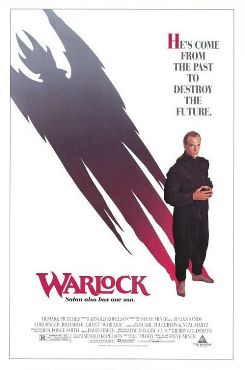
Warlock (1989, directed by Steve Miner)


Before he can be executed in the late 17th century, an unnamed warlock (Julian Sands) is propelled through time by Satan. He ends up in 20th-century Los Angeles, where he seeks the three pieces of the Grand Grimoire, a legendary spellbook that, when reassembled, can undo creation. The Warlock is pursued by Giles Redferne (Richard E. Grant), a witch hunter whose wife was previously killed by the Warlock and who manages to make it through the Warlock’s time portal. Helping Giles navigate the modern world is Kassandra (Lori Singer), a woman who made the mistake of taking the Warlock in and got hit by an aging spell for her trouble. Giles and Kassandra pursue Warlock across the the country as he searches from the three pieces of the book. It’s a quest that takes them from Los Angeles to a Mennonite community and finally to modern-day Massachusetts where the final piece of the Grimoire turns out to be in a very unexpected location.

Warlock definitely benefits from David Twohy’s clever script and Steve Miner’s no-nonsense, energetic direction, but the real secret of its success was the performance of Julian Sands as the Warlock. If you were of a certain age in 1991, Julian Sands will always primarily be the Warlock to you. With his coldly self-amused manner and his unapologetic cruelty, Sands was the epitome of cool evil. The first time I saw Warlock, I was surprised at just how far the film’s villain was willing to go in his quest. Warlock is one of those films where the characters who usually survive do not. No one is safe from the warlock.

The film also benefits from Richard E. Grant taking his role seriously. As for Lori Singer, she’s stuck with a lot of bad old-age makeup and delivers her lines with a lack of enthusiasm. Her performance, though, still doesn’t distract from this surprisingly entertaining film. When I recently rewatched, I recognized Mary Woronov in the role of a psychic. As always when it comes to Mary Woronov, I wished her role had been larger.

Warlock was released in Europe and Australia in 1989 but, because of the financial difficulties of New World Pictures, it didn’t get an American release until 1991. The film did moderately well at the box office and went on to become, for a while, a mainstay on HBO and Cinemax. Julian Sands, who had mostly played young romantic up until that point, was subsequently typecast as a cool, Continental villain. It was followed by two sequels.
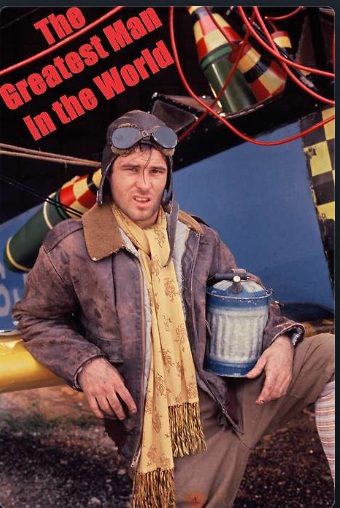
Retro Television Review: The American Short Story #17: The Greatest Man In The World


Welcome to Retro Television Reviews, a feature where we review some of our favorite and least favorite shows of the past!  On Saturdays, I will be reviewing The American Short Story, which ran semi-regularly on PBS in 1974 to 1981.  The entire show can be purchased on Prime and found on YouTube and Tubi.

This week, The American Short Story comes to a close.

Episode #17: The Greatest Man In The World

(Dir by Ralph Rosenbaum, originally aired in 1981)

In this adaptation of a James Thurber short story, a country boy named Jack Smurch (Brad Davis) briefly becomes a celebrity when he breaks Charles Lindbergh’s record for flying nostop around the world.  Two reporters (Reed Birney and John McMartin) are assigned to write a glowing profile of him.  The U.S. Secretary of State (William Prince) wants to make him a symbol of America.  The only problem is that Smurch himself is a violent and dull-minded habitual criminal who can barely fly his plane and who almost crashes when he comes in for a landing at the end of his flight.  Before he took off in his plane, the only person who cared about Smurch was his girlfriend (Carol Kane).  Even Smurch’s own mother says that she hopes that he crashes and drowns.  But once he manages to land, Smurch becomes a hero.  As the saying goes, print the legend.

Smurch, unfortunately, isn’t smart enough to play along with the hero routine.  At a meeting with the Secretary of State and the President (who is implied to be FDR), Smurch proves to be so obnoxious that he’s tossed out of a window.  He plunges to his death but he dies an American hero.

The final episode of The American Short Story was also the best, a wonderfully dark satire on the media and our cultural need for heroes.  Brad Davis’s naturally obnoxious screen presence — the same presence that made audiences enjoy seeing him get tortured in Midnight Express — is put to good use here.  Jack Smurch is such a jerk that you really can’t blame anyone for tossing him out that window.  If nothing else, it got him to stop talking.

The American Short Story was, overall, an uneven series.  Too often, the episodes failed to really capture the tone and style that made the original stories so memorable.  That said, there were a few good episodes, like this one.  If nothing else, perhaps this series inspired people to read the original stories for themselves.  That would have been the best possible outcome.

Next week …. something new will premiere in the time slot!  What will it be?  I’ll give you a clue — it’s set on the beach but it’s not Pacific Blue.  Let’s just say that some people stand in the darkness….

Retro Television Review: St. Elsehwere 1.18 “Dog Day Hospital”


Welcome to Retro Television Reviews, a feature where we review some of our favorite and least favorite shows of the past! On Fridays, I will be reviewing St. Elsewhere, a medical show which ran on NBC from 1982 to 1988.  The show can be found on Hulu and, for purchase, on Prime!

This week, Judith Light has got a gun!

Episode 1.18 “Dog Day Hospital”

(Dir by Victor Lobl, originally aired on March 22nd, 1983)

Finally, Dr. Ehrlich is performing his first solo operation.  Dr. Craig is assisting but Ehrlich is in charge.  He gets to play his music in the OR.  He gets to decide what type of retractor to use.  It’s a simple hernia operation.  The patient (Sam Anderson) is awake and babbling through the whole operation.

Unfortunately, there’s also an angry woman in the OR and she has a gun.  Barbara Lonnicker (Judith Light) is eight months pregnant, despite her husband claiming that he got a vasectomy at St. Eligius.  As she already has several children to deal with, she wants to see the doctor who screwed up the vasectomy but she’s just as willing to shoot any other doctor to get her revenge.  The operation continues while Dr. Craig and Dr. Westphall negotiate with her.

I have to admit that I did find a lot of this episode to be amusing.  Ehrlich’s excitement over getting to do his first operation, Dr. Craig’s stuffy annoyance with being interrupted by a woman with a gun, and the patient’s nonstop rambling all made me smile more than once.  And Judith Light, not surprisingly, was great as the woman with the gun.  I loved the her husband was played by Tom Atkins.  You never know who you might see at St. Eligius!  That said, after the episode ended, I couldn’t help but think about how dumb the whole thing actually was.  How are people always managing to get guns into St. Eligius?  How did Barbara manage to get into an operating room without being stopped beforehand?  (Luther does tell her that she can’t be back there but he’s the only one who seems to notice her before she bursts into the OR.)  How come no one in the hospital seems to be more upset about the fact that there’s a woman waving a gun around an operating room?  At one point, Barbara shoots Ehrlich’s radio and hardly anyone seems to react.  The plot is played for laughs and that’s fine.  But, in this case, the story was a bit too implausible for its own good.

Meanwhile, Nurse Rosenthal returned to work after her mastectomy and struggled to get back into her routine.  Carolyn Pickles did a great job portraying Rosenthal in this episode.  And Fiscus and Shirley Daniels visited an old woman in a nursing home.  The subplots were handled well but, for the most part, this episode still felt as if it was trying a bit too hard.