Ethan, the creator, never makes title cards and I find that… just ughhhhh, but the films are kinda … okay. I am reviewing this short because it was his most watched and he deserves to be judged by his best work; so, here we go!
This is NOT good, but people liked it; in fact, 500,000 people liked it. I want them to know that I am VERY disappointed in them and they will just have to live with that!
The short is voice over with AI Cthulhus that have taken over the Earth because we sent out messages into space to find us. Really, that is the whole film.
On August 17th, 1920, the Cleveland Indians were playing the New York Yankees. Yankee Carl Mays was on the pitcher’s mound. Cleveland shortstop Ray Chapman was at bat. According to contemporary reports, Mays was upset because he felt Chapman had been crowding the plate all day. When Mays threw his next pitch, he aimed at Chapman’s head. Chapman never even saw the ball coming before it smashed into his forehead. The ball hit Chapman’s skull with such force and produced such a loud crack that Mays though Chapman had hit the ball with his bat and, when it bounced back to the pitcher’s mound, Mays threw it to first base. Chapman collapsed and was rushed to the hospital, where he died 12 hours later.
Ray Chapman is the only baseball player to have ever died as a result of an injury that occurred in the game. His death led to the banning of the spitball and a new rule that made it the responsibility of the umpire to replace dirty or worn baseballs that might be difficult for the hitter to see. Chapman’s death also kept Carl Mays out of the Hall of the Fame despite Mays being one of the best pitchers of his generation.
The death of Ray Chapman was a tragedy. Last night, on YouTube, I watched The Beaning, a 9-minute “documentary” that suggested that Chapman’s death was also a blood sacrifice that was arranged by the Yankees ownership as a part of a pact with the Devil. That explains why the Yankees have won 41 pennants and 27 championships. It doesn’t explain how poorly they played last night, though.
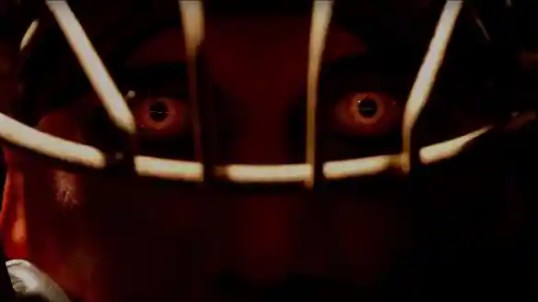
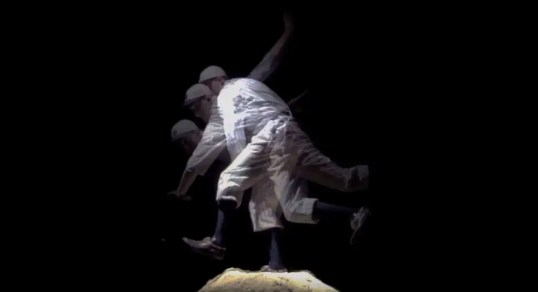
The Beaning argues that baseball was based on Masonic rituals and that the owners of the Yankees made a deal with the dark forces to make their team a success. If you don’t like the Yankees, you’ll enjoy this documentary. The documentary has plenty of archival footage and the recreation of the actual beaning is pretty creepy. The catcher’s eyes even glow red. For the record, I don’t think the Yankees sold their soul to the Devil but you should never underestimate was a team will do to make it to the postseason. Who needs to make a deal with the Devil when you can just join the Astros?
Hi there and welcome to October! This is our favorite time of the year here at the Shattered Lens because October is horror month. For the past three years, we have celebrated every October by reviewing and showing some of our favorite horror movies, shows, books, and music. That’s a tradition that I’m looking forward to helping to continue this year.
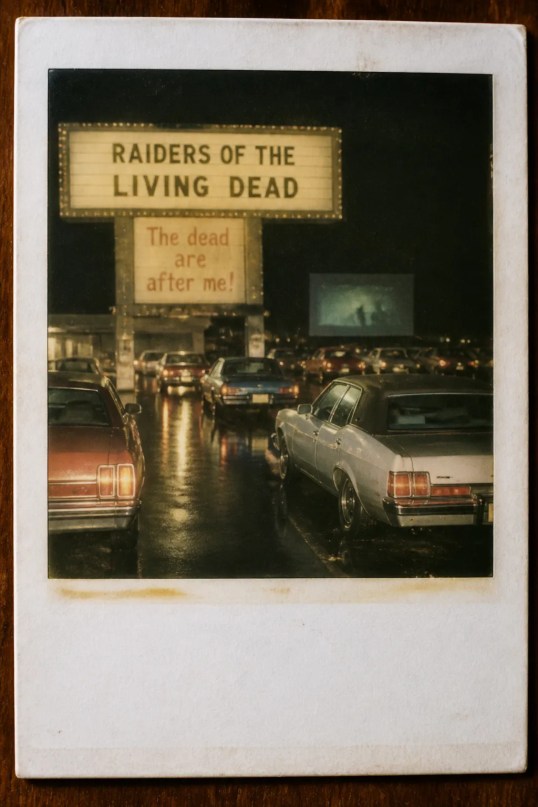
Today, we’ve got the 1986 zombie/sci-fi/action epic, Raiders of the Living Dead!
It’s the story of a creepy boy, a laser gun, a reporter, and a bunch of zombies. There’s a mad scientist involved, too. There always is. The movie opens with a truck being hijacked and then the action shifts to a power plant and, honestly, I have no idea what any of it means. If nothing else, it’s a film that you watch and you can’t help but admire the fact that it somehow got made and went on to find a small but kind of appreciative cult audience. It’s just a very strange film and one that simply most be watched in October.
The 1986 film, Raiders of the Living Dead, features what may be the greatest song ever written about zombies. For your listening pleasure, here is George Edward Lott’s The Dead Are After Me!
Today’s scene that I love comes from the 1981 sequel, Halloween II.
In this creepy scene, Dr. Loomis (Donald Pleasence) and the police take a look at a classroom that Michael Myers has turned into his own personal art studio. On the front board, written in blood, is SAMHAIN. Loomis’s inspection is interrupted by the arrival of Nurse Chambers, who has been sent to get Loomis out of Haddonfield.
(People need to remember what David Gordon Green and his stupid reboot took away from us. Shame on you, David Gordon Green!)
As far as I’m concerned, Laurie and Michael will always be siblings and Dr. Loomis will always be the fractured heart of the series.
4 Or More Shots From 4 Or More Films is just what it says it is, 4 shots from 4 of our favorite films. As opposed to the reviews and recaps that we usually post, 4 Shots From 4 Films lets the visuals do the talking!
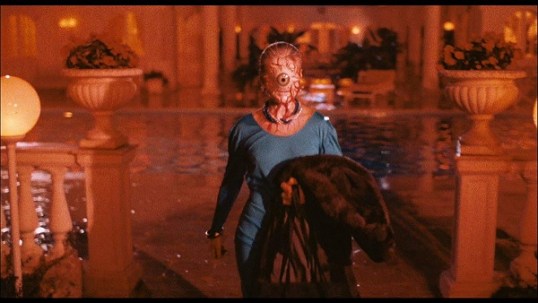
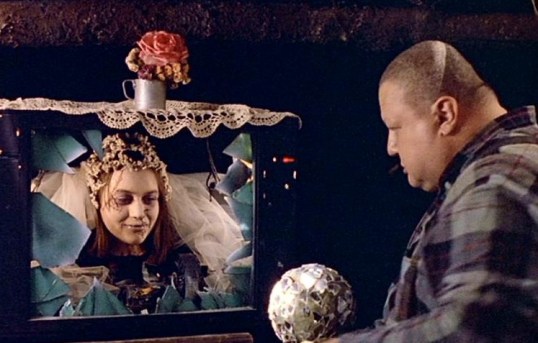
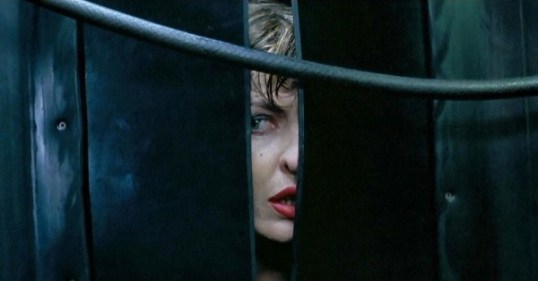
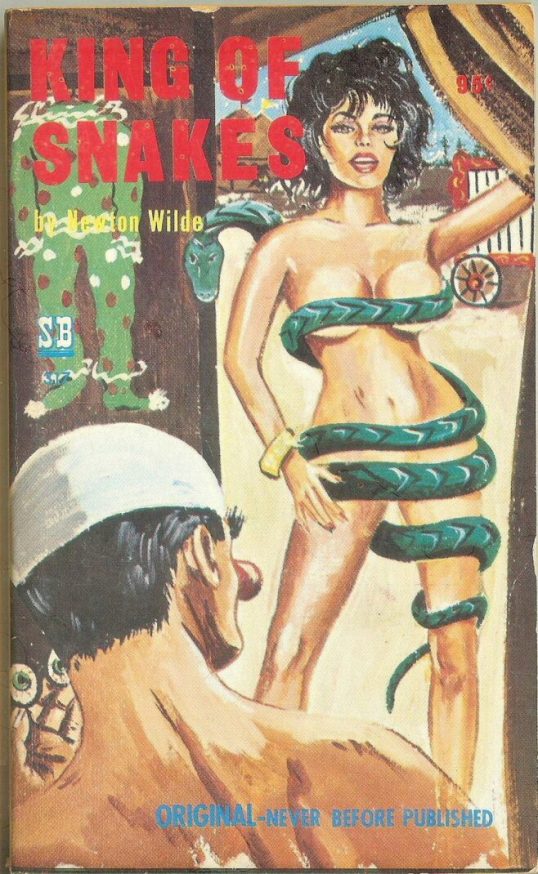
4 Shots From 4 Horror Films
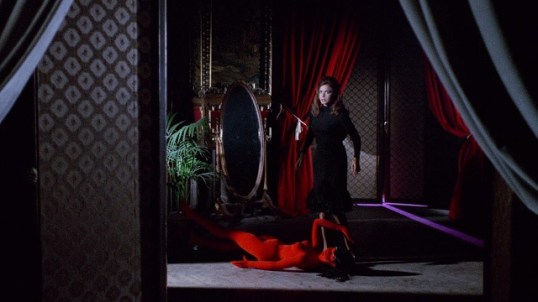
Blood and Black Lace (1964, dir by Mario Bava, DP: Ubaldo Terzano)
Delirium (1987, dir by Lamberto Bava, DP: Gianlorenzo Battaglia)
Dellamorte Dellamore (1994, dir by Michele Soavi, DP: Mauro Marchetti)
Sleepless (2001, dir by Dario Argento, DP: Ronnie Taylor)
Even though this music video only features the band being interviewed and performing on stage, it was initially banned by MTV because it was felt that lyrics were promoting suicide. Actually, Dave Mustaine wrote the song after learning of the death of Metallica bassist Cliff Burton. Mustaine was hurt that no one from the band called him personally to let him know, despite the fact that Mustaine had been one of the original members of Metallica. Mustaine has often spoken very candidly about how getting fired from Metallica inspired him to start Megadeth but it also left him feeling isolated and insecure.
This video was directed by Penelope Spheeris and features footage from her documentary, The Decline of Wester Civilization Part II: The Metal Years.
On tonight’s episode of Fear Itself, a young police officer (Elisabeth Moss) finds herself assigned to be a part of a detail that is guarding a serial killer cannibal named Duane Mellor (Stephen R. Hart). As the night goes on, strange things start to happen and it becomes apparent that Mellor has powers and habits that go beyond just eating people.
You may have noticed that I skipped the fourth episode of Fear Itself. That episode was In Sickness and In Health and it was about a bride-to-be who, on her wedding day, receives a note that reads, “The person you are marrying is a serial killer.” It all leads to a pretty predictable twist. The reason why I decided not to post that episode is because it was written by Victor Salva, a filmmaker who sexually abused the 12 year-old star of his first film and who, after serving 15 months in prison, somehow went on to continue making movies. I’ve made a personal decision not to review anything involving Victor Salva. That said, I do think everyone has to make their own decision as far as problematic filmmakers are concerned so I will say that the episode is on YouTube if you want to watch it.
As for Eater, it’s an intense and atmospheric episode that benefits from Stuart Gordon’s strong direction and which features good performances from both Moss and Hart. You can watch it below!
1990’s Buried Alive may be the worst Edgar Allan Poe adaptation ever filmed.
The film takes place at the Ravenscroft Institute, a former mental asylum founded by the fearsome Jacob Julian (John Carradine). Jacob’s son, Gary (Robert Vaughn), took over the Institute after his father’s death, treated his patients with kindness and compassion, and preached about the need for “freedom.” Now, Gary has transformed Ravenscroft into an all-girls school for juvenile delinquents. The students worship him because he tells them that nothing is their fault and that they deserve to live the life they want. His newest teacher, Janet (Karen Lorre), is a fan as well. In fact, she soon finds herself falling in love with Gary.
However, from the minute Janet shows up at Ravenscroft, she starts having strange visions. She sees thousands of ants crawling over her feet. She hears strange sounds in the walls. At one point, an arm reaches out of a toilet and tries to grab her. She thinks she sees a distinguished Shakespearean character actor sealed behind a wall. Is she losing her mind, or has she stumbled across something more sinister?
Now, when I say that Buried Alive is one of the worst Edgar Allan Poe adaptations I’ve ever seen, understand that it is not the fault of the cast. There are some truly talented people in this film. A young Nia Long plays a student named Fingers. Ginger Lynn Allen has fun playing a bully named Debbie. Robert Vaughn is appropriately intense as Gary, and John Carradine is… well, he’s John Carradine. This was one of Carradine’s final films, and he actually died before it was released. Obviously, Carradine doesn’t do much, but, as was often the case, his intimidating screen presence meant that he didn’t have to do much to make an impression. He just had to exist. Donald Pleasence plays Dr. Schaeffer, a German-accented member of the staff who wears round glasses and an ill-fitting toupee and who pops up occasionally to tell Janet not to wander around at night. Pleasence was obviously not in the best of health when he played Schaeffer, but, much like Carradine, his eccentric presence gives the film some much-needed atmosphere, and there is a fairly effective twist involving his character. Finally, there’s an absolutely adorable black cat that randomly appears throughout the film. It’s the film’s way of acknowledging Edgar Allan Poe, I imagine.
No, the failure of Buried Alive is not due to the cast. It’s really not even due to the script, which borrows the idea of someone being buried alive and not much else from the Poe story. Instead, the fault almost entirely rests with the film’s direction. The story unfolds with little momentum, some scenes meander while others are over far too quickly, and the director seems to think that filming anyone in an extreme close-up will automatically make them creepy. There are a few gross sequences involving a bunch of ants and the film has a few slasher moments, like the silencing of one annoying victim via a garden tool to the forehead , but otherwise there’s little horror and next to no suspense. I actually found myself getting angry over how poorly directed this film was.