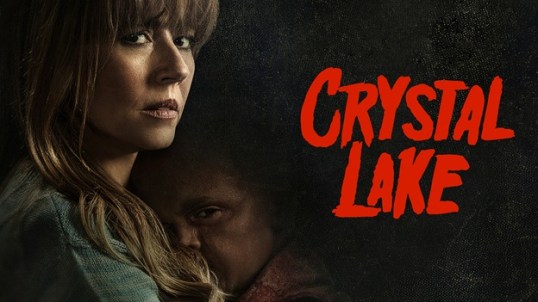
Crystal Lake is a thousand times better than Carrie.
Whoops. Did I say a thousand? I meant to say a million.
I say this despite the fact that Crystal Lake pretty much falls apart during its final two episodes. If the first six episodes constitute an enjoyable and, at times, even loving homage to the Friday the 13th films, the final two episodes go off the rails by giving Jason Voorhees, the epitome of an old-school slasher villain and the symbol of unelevated horror, a very 21st-century, American Horror Story-style origin story. It’s a thoroughly unnecessary addition to the Jason saga, one that exists to plug the plot holes that most Friday the 13th fans have always been happy to ignore. It’s just as bad as Jason Goes to Hell’s insistence that Jason was actually a space slug who could possess people. Personally, I think that we should do what true Friday the 13th fans always do whenever we come across something that doesn’t work and just ignore it.
Even taking that into account, Crystal Lake is still infinitely better than Carrie.
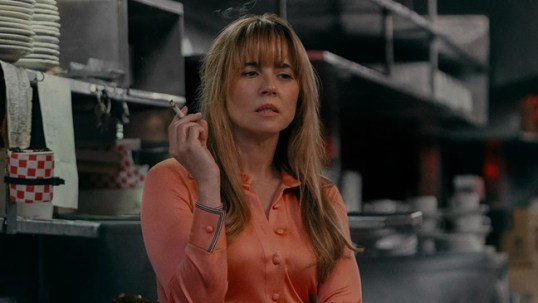
The difference between Crystal Lake and Carrie is that Crystal Lake isn’t trying to be something that it isn’t. Crystal Lake isn’t ashamed of being a pulpy, sordid, and rather bloody horror miniseries. Carrie was made to win Emmys and critical plaudits. Crystal Lake was made to make you put your hands over your eyes whenever Pamela Voorhees (Linda Cardellini) hacks someone’s face off. Crystal Lake fully embraces the horror. Crystal Lake obviously loves the Friday the 13th films, with all of their flaws. Carrie is a series made by and for people who think that they’re better than the horror genre. Crystal Lake is not.
Crystal Lake serves as a prequel to the first Friday the 13th film. Pamela Voorhees is the cook at Camp Crystal Lake and, in the first episode, her son, Jason, disappears while swimming. The camp counselors who were supposed to be watching him were making love. Pamela snaps. She refuses to accept that her son has drowned. She watches angrily as the town moves on. When she hears that the Christys are going to reopen the camp, she is not pleased. That said, she’s snapped long before that. Unlike Carrie, which went out of its way to absolve the character of any sort of responsibility, Crystal Lake does not shy away from presenting Pamela as an unhinged killer. She kills two mysterious men who show up at her house. She kills the abusive mother of Grace (Gwendolyn Sundstrom), who was Jason’s only friend at camp. When a group of Marxist hippies show up and try to convince the now-orphaned Grace to run away with them, Pamela goes after them as well. Pamela kills a lot of people in this miniseries, but she remains a compelling character because of Linda Cardellini’s wonderful performance in the lead role. Her love for Jason is real, and it’s easy to understand why she would feel such rage at a town that is pretending he didn’t exist or why she would have no sympathy for a mother who abuses her child. Cardellini gives such a strong performance that it’s disappointing that the final two episodes let the series down.
As someone who has seen all of the Friday the 13th films, I appreciated how carefully and exactly Crystal Lake recreated the feel and the visuals of the first two entries. Its version of Crystal Lake looks identical to the one that poor Annie discovered during the first film. Even the minor characters are made up to almost exactly resemble the actors who played them in the first film. I immediately knew who was supposed to be Enos. I knew who was supposed to be the waitress with whom Steve Christy would eventually share one of his final conversations. (Steve Christy is seen a few times in Crystal Lake, as a very ’70s teenager.) A wonderful actor named Nick Cordileone played the role of “Crazy” Ralph and, whenever he was on screen, I could immediately see him becoming the character that Walt Gorney played in the first two films. A lot of love and care went into recreating the town of Crystal Lake and the camp. The series does, admittedly, move things up chronologically. In the first film, Jason disappeared in the ’50s. In the series, it happens in the ’70s. That’s no big deal, though. The show has a lot of fun both recreating the ’70s and poking fun at the decade’s unique culture. One need only watch the scene where Pam is dragged to a seminar given by a self-consciously hip self-help guru to understand why the decade gave rise to the unapologetically cynical slasher boom of the ’80s.
Now again, the Jason origin story that is presented in the seventh episode is a problem. And if Crystal Lake returns for a second season, I sincerely hope that it will be ignored in much the same way that the franchise has traditionally ignored its mistakes. If it doesn’t, it’s not going to bode will for the future of this series. Still, flaws and all, Crystal Lake is an enjoyably sordid and bloody show. It makes no apologies for being what it is. Other horror shows could stand to learn from it.