Originally broadcast in the UK on September 27th, 1980, this episode of Hammer House Of Horror deals with a sleazy real estate agent (played by Denholm Elliot) who finds himself besieged by dreams about seducing his assistant Lolly (Lucy Gutteridge) and murdering his wife Emily (Pat Heywood).
Featuring an outstanding lead performance from Elliot and strong direction from Peter Sasdy, this is a good one.
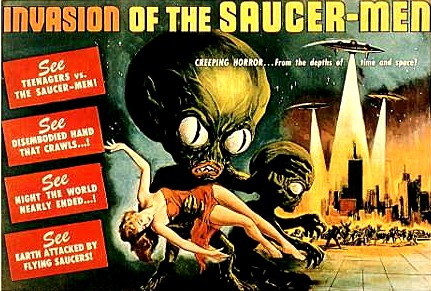
The poster above pretty much epitomizes everything that I love about old B-movies. Between the aliens and the poster’s promise that we’re being given the chance to “SEE (the) night the world nearly ended…!,” it’s hard to resist the temptation to give Invasion of the Saucer Men a chance.
First released in 1957, Invasion of the Saucer Men is, in many ways, a standard alien invasion film. Aliens land in a small town and cause a lot of inconvenience for a bunch of all-American teenagers who are just looking for a place to make out. What sets Invasion of the Saucer Men apart is that it’s meant to intentionally humorous and the aliens totally kick ass.
So, here is today’s edition of Horror On The Lens: Invasion of the Saucer Men!
I suppose if I asked most people what music they identified with horror, John Carpenter’s “Halloween Theme” and Mike Oldfield’s “Tubular Bells” (The Exorcist) would come up first. After that, you’d get a lot of Rob Zombie and Glenn Danzig. So right off the bat, you’re looking at an enormous variety of sounds and styles connected mainly by association. While John Carpenter’s work was intentionally composed for the film in which it appeared, “Tubular Bells” was originally a 50 minute progressive rock opus that was anything but sinister or foreboding in its full form. Misfits was a goth punk band that happened to favor horror themes. White Zombie’s horror imagery was more a matter of crudeness and vulgarity in the spirit of GWAR; their sound was a frontrunner in the emergence of industrial groove metal, and the greatest “horror” associated with Rob was the countless terrible nu metal spinoffs. A couple of “top ten horror songs” lists I stumbled upon even list Bobby Boris Pickett’s “Monster Mash” and Richard O’Brien’s “Time Warp”. I mean, “Monster Mash” is a fun Halloween song, sure, but horror? Really? And the Rocky Horror Picture Show does make me want to vomit, but we have to draw the line somewhere.
Suffice to say, “horror” music is not a genre at all. Simply associating a song with a scene or theme is enough to relate them; Huey Lewis and the News will probably make me smile and think of Christian Bale chopping people to bits in his apartment for the rest of my life. But there are definitely certain musical attributes that conjure in us a less glitzy feeling of dread than Hellbilly Deluxe. That skittering cockroach beat in the background of Halloween is completely unnerving; Carnival music is way creepier than Stephen King’s It; Black Sabbath’s appreciation for diabolus in musica virtually invented heavy metal; and it took a firm dose of the blues in 1988 for Danzig to capture a sense of the sinister that Misfits could never convey.
I don’t believe that any particular musical formula is the coalescence of evil. The music we find most haunting is derived from association too, but it connects in more subtle ways than say, the fact that a particular song appears in a horror film or mentions witches in the chorus. The real deal distorts what comforts us, denies our sense of order, and pries upon our innocence. Through a musical medium as through any other, horror focuses on shattering the lens through which we perceive reality as an ordered, logical construct. It reminds us of the real nightmares in life while nullifying our means to counteract them. It takes us to the world of the child, where emotional extremes enhance our senses of comfort and terror alike.
The carnival tune and music box are prime targets, conjuring in our minds a time when fear was more potent. The brief piano loop, the simple hum, the monotone drone–these bring us to solitude and isolation through minimalism. Effective horror themes offer no comforting symphony or rock ensemble to encase us in a nuanced world. They surround us with something singular and far from warm, or with nothing at all. The wind chimes warn of a storm; when none is coming, the darkness is all the more unnatural. The cathedral bell, a sign of fellowship on a Sunday morning, also tolls for death. A twitch, a buzz, a repeated knocking, a bit of static–things that would otherwise annoy us–exploit the close connection between discomfort and tension.
Or else we can completely overwhelm the senses with noise that strips away the familiarity which typically diminishes extreme music’s effect, leaving us a nervous wreck. When Blut Aus Nord chose to employ programmed, industrial blast beats in their 777 trilogy, they effectively eliminated the one element of the music that would have sounded too familiar to disturb. Instead, the epileptic guitar finds companionship in a persistent, unnatural clatter designed to place us permanently on edge.
Other bands have found other means to the same end. Peste Noire’s unique “black ‘n’ roll” sound enlivens a standard formula for “evil” music with a pep and a grin, giving the brutalizer a human face in the spirit of medieval sadism. Sunn O))) are inclined to drone on for ages, developing a false sense of comfort before infusing their deep buzz with a caterwaul of shrill pitches and clattering chimes. (I actually had a guy start freaking out on me at work one day when “Cry For The Weeper”, which he didn’t even notice playing, hit the 3:55 mark.)
And lastly, we can’t forget the power of lyrics to render a song gruesome. The stereotypical lines of a black metal song–nonsense about necromoonyetis and an appeal to Satanism far less disturbing than the average Christian commentator on Fox News–are pure cheese, and they entertain us in a manner similar to your typical zombie flick. But when you first heard Smashing Pumpkin’s “x.y.u.”, you probably got a feeling more akin to Henry: Portrait of a Serial Killer.
Horror in lyrics is something a bit the opposite of horror in sound; it strikes us most deeply when we can be convinced that there is absolutely nothing supernatural about it. There are certainly a few exceptions–Townes Van Zandt’s tall tale in “Our Mother the Mountain” chills me to the bone–but generally speaking, the real atrocities committed throughout human history far exceed the limits of our imaginations. Vlad Tepes was worse than any vampire, and from Elizabeth Bathory and Ariel Castro to Hernando Cortes and Adolf Hitler, we are flooded by examples of direct personal cruelty and dehumanized mass slaughter. When a song manages to make us think of these individuals and events beyond the safety blanket of historical narrative, an authentic feeling or horror is hard to deny.
Since this October began, we have featured ghosts, vampires, a sadist, and some Cambodian zombies. Therefore, it makes sense that, for our latest horror film on the Lens, we should feature a werewolf.
In The Werewolf of Washington, a manic Dean Stockwell plays an aide to the President of the United States who, during an assignment in Hungary, meets some gypsies, and ends up getting attacked by a werewolf. Soon, Stockwell is back in Washington and turning into a wolf under the glow of the full moon…
The Werewolf of Washington features a memorable performance from Stockwell and the werewolf effects are fairly effective. However, The Werewolf of Washington is mostly memorable as a document of its time. The film was first released in 1973 and it’s meant to be a social and political satire along with being a traditional werewolf movie. Admittedly, this is a low-budget and frequently uneven film but it’s worth seeing just for the scene where Stockwell gets his finger stuck in a bowling ball.
Today’s episode of televised horror comes from the UK.
First broadcast on October 11th, 1980, the fifth episode of Hammer’s House of Horror was entitled The House That Bled To Death. It’s about a family who buys and moves into a house that has a sordid past. The family plans to fix the house up and then sell it for a profit. The house has other plans.
(Incidentally, The House That Bled To Death would have been a great title for one of Lucio Fuci’s later films.)
Today’s horror movie is an early take on one of the most iconic of all monsters. First released in 1936, Revolt of the Zombies tells the story of what happens when the French discover that the secret to creating zombies is located in Cambodia. Naturally, they organize an expedition to track down that secret and destroy it.
Simple, right?
Unfortunately, when it comes to the French and zombies, nothing is ever simple…
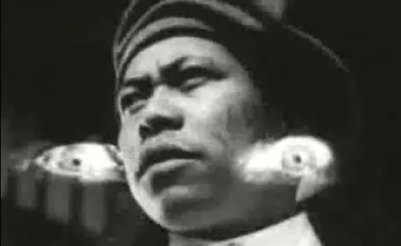
Revolt of the Zombies was directed by Victor Halperin, who had previously directed the atmospheric classic White Zombie. Unfortunately, Revolt of the Zombies is hardly a classic. However, I still find the movie interesting as an example of what a Hollywood zombie film looked like before George Romero revolutionized the genre with Night of the Living Dead. The zombies in Revolt of the Zombies are not the undead cannibals that we’ve all been conditioned to expect. Instead, they’re closer to the original zombies: brainwashed servants without a will of their own.
One final note: the eyes that are frequently superimposed over the action belong to Bela Lugosi.
For the first horror “Song of the Day” I couldn’t decide on which theme from Clive Barker’s Hellraiser I should use.
Fans of the film should know well the original theme composed by Christopher Young for the film. It’s a more orchestral theme that gives the film a sort of grand guignol grandeur. It’s an epic piece that would get used time and time again for each successive sequel. There might be some minute changes to the theme with each new film, but the basic composition remains. It’s a theme that helps one visualize forbidden texts and grimoires laying in wait for the ones brave or foolish enough to turn the page.
Then there’s the unreleased and unused theme that Barker had originally wanted to use from the industrial band Coil. This theme for the film was more about discordant melodies that harkens back to the more disturbing musical composition used for The Exorcist. It’s a theme that brings up images of the sublime and exquisite pain that Pinhead promises to those solve the Lament Configuration.
Some fans prefer the original Christopher Young suite while others have grown to love and prefer the more disturbing piece from Coil. I, for one, think both could’ve been used in the film though if I had to pick one to use as the main theme then I would go with Christopher Young’s composition.
As scary as all the stories of zombies and vampires may be, the most frightening monsters in the world are the ones that walk among us. I may look away when a monster shows up halfway through a movie but what truly scares me is what my fellow human beings have proven themselves capable of doing.
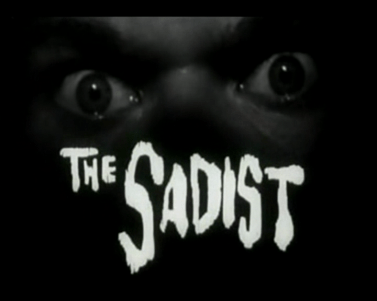
Today’s movie is all about man-made horror. Released in 1963, The Sadist is a dark and rather brutal film about what happens when three teachers have car trouble and find themselves wandering around a seemingly deserted junkyard. They quickly discover that they’re not alone. Watching them and eventually terrorizing them is Charlie (Arch Hall, Jr.), an inartciulate sociopath who quickly proves himself to be a lot more clever than his smugly complacent hostages. This bleak film is memorable for both its starkly effective cinematography and Hall’s disturbingly plausible portrayal of the title character.
For those who have played the Xbox 360 exclusive game Alan Wake should remember this scene I have chosen. It comes right at the end of the game where the title character has finally figured out the secret of what happened to his missing wife and how to save her from the game’s main antagonist.
This antagonist is not some psycho killer or monomaniacal villain. It’s a villain that’s more akin to an evil entity. In fact, we learn throughout the game that the villain, known as the Dark Presence, is like something out of a Lovecraft story. It’s an evil intelligence that has spanned eons and yearns to free itself from it’s watery prison.
Alan Wake realizes that the only way to save his wife was to take her place and fight the Dark Presence from within and this is where the brief scene begins. It’s a scene that starts creepy enough until the very end when the real payoff arrives.
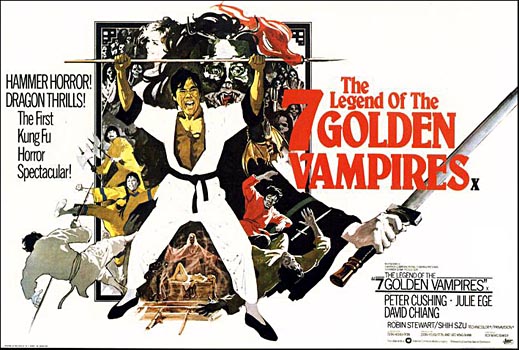
Today’s horror movie is from Hammer films and, needless to say, it’s lot of fun. In The Legend of the 7 Golden Vampires, an ennui-stricken Count Dracula (James Forbes-Robertson) leaves his castle and travels all the way to China. Once in China, he resurrects the legendary 7 golden vampires and uses them to raid a nearby village. One villager (played by David Chiang) goes to the legendary Prof. Van Helsing (Peter Cushing, of course) for help. Van Helsing, along with his son (Robin Stewart) and a wealthy widow (Julie Ege, who decorated several Hammer films), goes to the village to battle the vampires. Providing protecting for Van Helsing’s group is Chiang’s sister (Szu Shih) and six other brothers.
First released in 1974, The Legend of the 7 Vampires was Hammer’s attempt to revive the failing fortunes of their most iconic monster by collaborating with Hong Kong film producer Sir Run Run Shaw. The result is an entertaining hybrid of a traditional Hammer vampire film and a Hong Kong kung fu movie. While James Forbes-Robertson makes for a poor replacement for Christopher Lee, Cushing is perfect as always.



 Through the Shattered Lens