“I don’t want to be a pie. I don’t like gravy.” — Babs
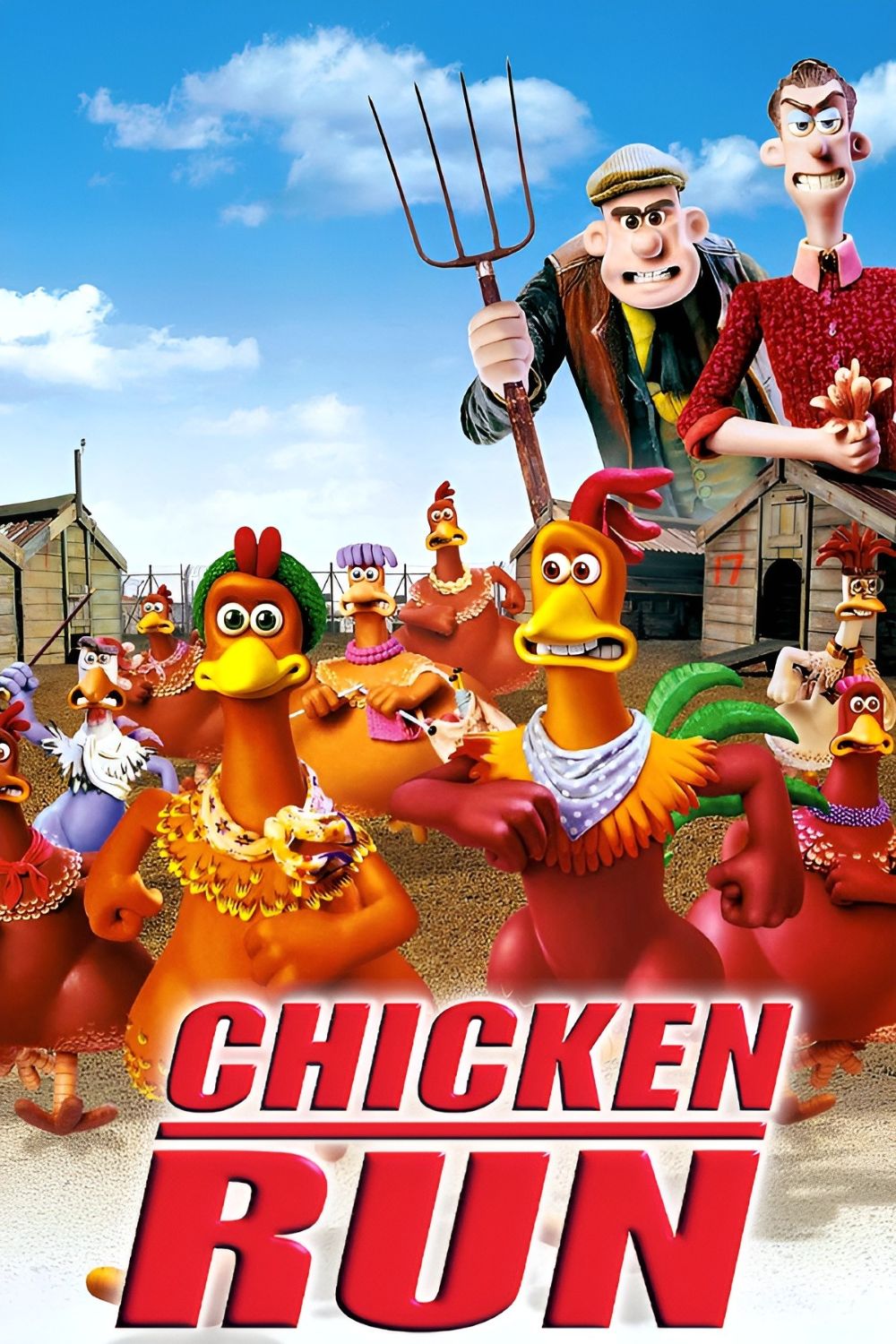
Chicken Run is one of those animated films that seems simple at first glance: a bunch of chickens want to escape a farm before they become pies. That basic premise could have easily turned into a lightweight family comedy full of barnyard jokes and little else. Instead, the 2000 DreamWorks and Aardman production, directed by Peter Lord and Nick Park, plays like a miniature war movie, prison-break thriller, romance, survival adventure, and pitch-black satire all at once. It is consistently funny, but its comedy works because the stakes feel real. These chickens are not merely trying to get away from an annoying farmer; they are trying to survive an industrial system that sees them as disposable raw material.
The first thing that makes Chicken Run so memorable is how completely it commits to its central influence: John Sturges’s The Great Escape. Ginger, voiced with determined energy by Julia Sawalha, is essentially the Steve McQueen-like mastermind of a prisoner-of-war escape film, only without the motorcycle. She has attempted escape after escape from the Tweedys’ chicken farm, and every failure has made her more experienced, more stubborn, and more isolated from the flock. The farm itself is built and filmed like a prison camp: there are fences, watchtowers, guards, roll calls, surveillance, punishments, and a constant feeling that someone is always being watched. The chickens dig tunnels, build plans, assign tasks, debate leadership, and struggle with morale in a way that directly echoes the Allied prisoners in The Great Escape.
That influence is not just a clever parody. It gives the movie a real sense of structure and urgency. Ginger is not a character who simply wishes for freedom; she is obsessed with earning it. Every failed attempt lands her in the punishment shed, a tiny isolated box that is funny in its exaggerated stop-motion form but also genuinely unpleasant. The sight of Ginger sitting alone in darkness, listening to the rain and realizing that another escape has failed, establishes that the movie is willing to make her suffering count. She is not invincible, and the other chickens do not always believe in her. That gives her eventual success much more weight than it would have had in a more conventional cartoon.
The Tweedys are also far more sinister than the average animated villains. Mr. Tweedy, voiced by Tony Haygarth, is the bumbling half of the pair: nervous, confused, increasingly paranoid, and convinced that “the chickens are organizing.” It is one of the best-running jokes in the movie because he is absolutely right, but his wife refuses to take him seriously. Melisha Tweedy, voiced by Miranda Richardson, is the truly frightening one. She is cold, practical, greedy, and almost entirely without sentiment. When egg production drops, she does not consider improving conditions for the chickens. She decides to turn them into chicken pies.
That is where Chicken Run goes into much darker territory than its cheerful clay-animation style initially suggests. The film’s narrative is built around factory farming, confinement, exploitation, and mass slaughter. The chickens know that when one of them stops laying eggs, she is not being taken somewhere safe. She is taken away to die. The scene involving the elderly hen Edwina is particularly unsettling because it is handled with restraint. The audience never sees explicit violence, but the implication is unmistakable. The sound of the axe, the sudden absence, and the reactions of the other chickens tell the whole story. It is dark material for a family film, but it is never treated as a joke. The humor comes from character behavior and British deadpan timing, not from dismissing the fear these animals feel.
That balance is one of the movie’s greatest achievements. Chicken Run is undeniably an animated comedy, filled with visual gags, eccentric voices, and absurdly specific bits of dialogue, yet its themes remain surprisingly grim. The Tweedys’ new pie machine is not just a goofy invention. It is a huge, mechanized symbol of industrialized cruelty, a machine designed to turn living creatures into products at maximum efficiency. Once it appears, the farm stops feeling merely like a prison camp and starts feeling like something even more horrifying: a production line where the inmates are literally the merchandise. The comedy makes the movie accessible, but the darker ideas give it teeth.
Aardman’s stop-motion animation is essential to that effect. The chickens are expressive in a way that never makes them overly cute or polished. Their handmade look gives them texture and personality. You can see the fingerprints of the animators in the characters’ surfaces, the uneven little details of the farm, and the tangible construction of the machinery. Modern computer animation can create smoother movement and more elaborate spectacle, but Chicken Run has a physical presence that is hard to replicate digitally. The fences feel like real fences. The mud feels like real mud. The pie machine feels enormous and dangerous because it is a real object built in miniature and photographed frame by frame.
The design also helps sell the film’s strange mix of bleakness and whimsy. The Tweedys’ farm is gray, muddy, cramped, and oppressive, a place where every chicken coop resembles a barracks. Beyond the fence is a bright green countryside that feels almost mythic to the trapped flock. Freedom is not some vague emotional idea; it is visible right there, just beyond reach. That visual contrast makes Ginger’s desperation easy to understand. She is not asking for luxury. She wants sunlight, open space, and the ability to live without being counted, confined, or killed for failing to produce enough eggs.
Mel Gibson’s Rocky Rhodes enters the story as the possible answer to Ginger’s problem. He is introduced as a flying American rooster who crashes into the farm like a larger-than-life war hero. His nickname, “the Lone Free Ranger,” and his exaggerated confidence make him feel like a parody of classic American movie masculinity. Rocky is all swagger, charm, and improvised survival instinct, which makes him a good contrast to Ginger’s disciplined, strategic personality. He tells the chickens he can teach them to fly, and the entire farm becomes invested in the idea even when the plan seems impossible.
Rocky works because the film does not make him a flawless hero. He is entertaining and ultimately brave, but he is also a fraud. His supposed ability to fly is part of a circus act, and he has escaped captivity before by using a human-operated catapult rather than his own wings. When the truth comes out, it hurts because the chickens have placed their hope in him. Ginger especially feels betrayed, not only because Rocky lied but because she allowed herself to believe that someone else might finally have the answer. Their relationship has a nice edge to it; it is not a sweeping romance so much as a reluctant partnership between two strong-willed survivors who approach freedom in completely different ways.
The sequences built around the escape plan show how much fun Lord and Park have with action-adventure movie language. While The Great Escape is the most obvious inspiration, certain moments have an energy reminiscent of Indiana Jones and the Raiders of the Lost Ark. There are close calls with traps, rapid-fire improvisation, looming mechanical threats, and escapes that depend on inches of timing. The climax inside and around the pie machine especially has that pulpy serial-adventure tension. Characters are dragged toward blades and conveyor belts, machinery rattles and groans, and plans collapse only for someone to invent another solution at the last possible second.
The final act also brings in a strong resemblance to The Flight of the Phoenix, particularly in the way the chickens turn desperation into engineering. The flock has to build a flying machine out of whatever materials they can gather, and the project depends on cooperation between characters with very different skills. Fowler, the elderly rooster voiced by Benjamin Whitrow, becomes crucial here. At first he seems like a pompous relic, forever talking about his days in the Royal Air Force and resisting Ginger’s modern plans. But his knowledge and experience eventually become useful. He gives the group the language, confidence, and organizational spark needed to turn their makeshift aircraft from a dream into something that might actually leave the ground.
Fowler is also one of the funniest parts of the film because he represents a specific kind of old British pride: stubborn, ceremonial, and deeply attached to the past. His stories about serving under “the old RAF” seem ridiculous until the moment the chickens actually need someone who understands the basic principles of flying. The film never makes him into a conventional action hero, but it allows him to reclaim some dignity. Like many of the supporting characters, he gets a small but satisfying arc.
The rest of the flock is memorable because they are not interchangeable background animals. Babs is sweet, distracted, and constantly knitting, but her innocent manner hides an ability to contribute when it matters. Bunty is blunt, cynical, and always ready to question Ginger’s plans. Mac, with her Scottish accent and technical expertise, is the group’s engineer and probably the person most likely to explain why a wild idea will not work. Fetcher, the rat, is opportunistic and cowardly, but he is useful in the way only a black-market scavenger can be. Even the two dimwitted farm dogs have personality, serving as comic obstacles while still making the farm feel guarded and dangerous.
What makes Chicken Run endure is that it never treats its characters’ freedom as a trivial goal. The story has jokes about eggs, knitting, chicken behavior, British class attitudes, and American bravado, but beneath all of that is a serious belief that a community can refuse to accept the role assigned to it. Ginger’s greatest strength is not that she has the perfect plan. It is that she refuses to surrender when every plan fails. Her determination eventually spreads to the other chickens, who stop seeing themselves as helpless inmates and start acting like participants in their own rescue.
The ending is satisfying because it feels earned. The chickens do not escape through luck alone, and they do not wait for a human to save them. They escape because they organize, take risks, use their talents, forgive one another’s failures, and choose action over resignation. That is a surprisingly powerful message for a film about clay chickens escaping a pie factory.
More than two decades later, Chicken Run still stands as one of the strongest animated films of its era. Its stop-motion craft remains beautiful, its jokes still land, and its references to The Great Escape, Indiana Jones and the Raiders of the Lost Ark, and The Flight of the Phoenix add an extra layer of fun for viewers familiar with those films. But it is the movie’s willingness to acknowledge fear, exploitation, and death beneath the comedy that makes it more than a clever genre spoof. Chicken Run is funny because it is inventive, but it is memorable because it understands that freedom means the most when it is hardest to achieve.