1980’s Alligator begins in 1968. While on vacation in Florida, a teenage girl named Marisa Kendall purchases a baby alligator named Ramon. When she returns home to Chicago, her jerk of a father flushes Ramon down the toilet.
12 years pass. Marisa (Robin Riker) becomes a herpetologist. As for Ramon, he actually survives being flushed down the toilet and thrives in the sewer. He eats the carcasses of animals that had been a part of an experiment involving a growth serum. The serum had the desired effect of making the animals bigger but it also increased their metabolism to the extent that they became aggressive and had to eat constantly. Evil industrialist Slade (Dean Jagger) is convinced that, by tossing the carcasses in the sewer, he’s ensured that no one will ever find out about the experiments. Instead, he’s turned Ramon into a giant alligator who is always hungry. Soon, the super-intelligent alligator is ambushing and eating sewer workers.
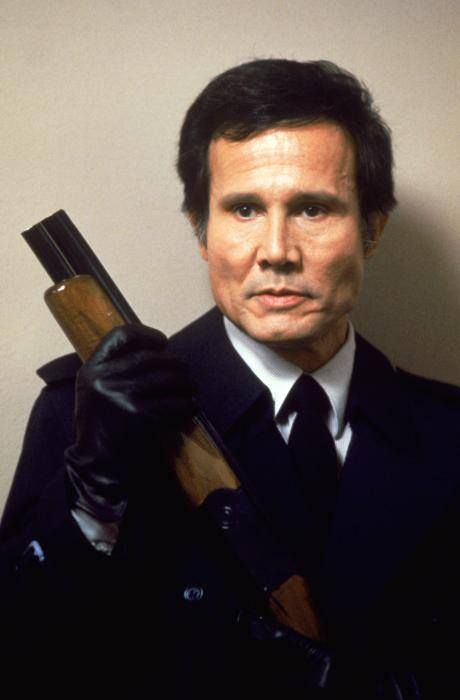
Burned-out Detective Dave Madison (Robert Forster) teams up with Marisa to solve the mystery of why so many body parts are turning up in the sewers. It’s not easy. No one wants to admit that there might be a giant alligator living under the city. Everyone wants to believe that’s just an urban legend. But, after a tabloid reporter (Bart Braverman) manages to snap a few photographs of Ramon before being devoured, the police are forced to deal with the fact that they’ve got an alligator on their hands. As Slade continues to try to cover up his involvement, big game hunter Colonel Brock (Henry Silva) comes to town and announces that he will be capturing the alligator.
Directed by Lewis Teague and written by John Sayles, Alligator is a dark comedy disguised as a horror film. While numerous people get eaten and the film ends on a properly ominous note, Alligator is obviously not meant to be taken seriously. The cast is full of good actors who send up their own images. That’s especially true in the case of Henry Silva, who appears to be having a blast as the hyper macho Colonel Brock. Robert Forster, meanwhile, delivers his lines with a self-aware weariness that seems a bit more appropriate for a noir hero than a film about a detective investigating a giant alligator. One reason why the film works is because Forster, Silva, and the rest of the cast understood exactly what type of film they were appearing in and they delivered their overheated lines with just enough wit to let the viewer know that the film was in on the joke. The big and somewhat stiff-looking alligator may not look entirely real and it may move somewhat awkwardly but ultimately, it’s the most likable character in the movie. It just wants to relax in the sewers but, every few minutes, someone else is bugging him.
When first released, Alligator struggled at the box office but it has since gone on to become a cult favorite. Quentin Tarantino is a self-described fan and he had said he was inspired to cast Robert Forster as Max Cherry in Jackie Brown after seeing him as Dave Madison in this film. That’s not bad for a movie about a giant alligator!
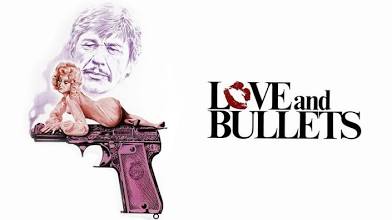
Charles Bronson is an Arizona cop who goes to Switzerland to bring back a gangster’s girlfriend (Jill Ireland). The gangster (Rod Steiger) sends a hitman (Henry Silva) to kill her so she can’t tell his crime secrets to the authorities.
This isn’t one of Bronson’s best films, but it’s still a fun movie to watch on a chilly, rainy day. There are some good action scenes set in various cold & snowy European locations. This is Bronson in “Bond” mode which is kind of fun and different. And what can you say about a stuttering Rod Steiger screaming at his advisors about the meaning of “love.” It’s fun stuff when you like Steiger as much as I do. I do deduct half a star because Steiger gets so mad at one point that he turns over a table with some of the biggest, most scrumptious looking shrimp I’ve ever seen. That was completely uncalled for and wasteful, but not quite as wasteful as Bronson and Henry Silva in the same movie without an epic battle of some sort. The fact that they didn’t fight it out on the Matterhorn itself can only be described as a missed opportunity.
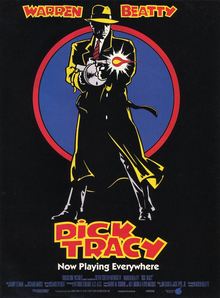
The year is 1937 and “Big Boy” Caprice (Al Pacino) and his gang of flamboyant and often disfigured criminals are trying to take over the rackets. Standing in their way is ace detective Dick Tracy (Warren Beatty), the yellow trench-wearing defender of the law. Tracy is not only looking to take down Caprice but he and Tess Trueheart (Glenne Headly) are currently the guardians of The Kid (Charlie Korsmo), a young street kid who witnessed one of Caprice’s worst crimes. Tracy’s investigation leads him through a rogue’s gallery of criminals and also involves Breathless Mahoney (Madonna), who has witnessed many of Caprice’s crimes but who also wants to steal Tracy’s heart from Tess.
Based on the long-running comic strip, Dick Tracy was a labor of love on the part of Warren Beatty. Not only starring but also directing, Tracy made a film that stayed true to the look and the feel of the original comic strip (the film’s visual palette was limited to just seven colors) while also including an all-star cast the featured Madonna is an attempt to appeal to a younger audience who had probably never even heard of Dick Tracy. When Dick Tracy was released, the majority of the publicity centered around Madonna’s participation in the film and the fact that she was dating Beatty at the time. Madonna is actually probably the weakest element of the film. More of a personality than an actress, Madonna is always Madonna no matter who she is playing and, in a film full of famous actors managing to be convincing as the members of Dick Tracy’s rogue gallery, Madonna feels out of place. Michelle Pfeiffer would have been the ideal Breathless Mahoney.
It doesn’t matter, though, because the rest of the film is great. It’s one of the few comic book films of the 90s to really hold up, mostly due to Beatty’s obvious enthusiasm for the material and the performances of everyone in the supporting cast who was not named Madonna. Al Pacino received an Oscar nomination for playing Big Boy Caprice but equally good are Dustin Hoffman as Mumbles, William Forsythe as Flaptop, R.G. Armstong as Pruneface, and Henry Silva as Influence. These actors all create memorable characters, even while acting under a ton of very convincing makeup. I also liked Dick Van Dyke as the corrupt District Attorney. Beatty knew audience would be shocked to see Van Dyke not playing a hero and both he and Van Dyke play it up for all its worth. Beatty embraces the comic strip’s campiness while still remaining respectful to its style and the combination of Danny Elfman’s music and Stephen Sondheim’s songs provide just the right score for Dick Tracy’s adventures. The film can be surprisingly violent at times but the same was often said about the Dick Tracy comic strip. It wasn’t two-way wrist radios and trips to the Moon. Dick Tracy also dealt with the most ruthless and bloodthirsty gangsters his city had to offer.
Dick Tracy was considered to be a box office disappointment when it was originally released. (Again, you have to wonder if Beatty overestimated how many fans Dick Tracy had in 1990.) But it holds up well and is still more entertaining than several of the more recent comic book movies that have been released.
The 1980’s saw the what film enthusiasts saw as the death of the grindhouse experience. Major cities had begun to clean up their skid rows and the $1 all-day matinee theaters were closing down left and right. By the late 80’s gone were the buckets of stale popcorn, watered down sodas, carpets so sticky that one didn’t even want to think was made them that way and, of course, the sketchy individuals who always seemed to in every showing no matter the time.
Yet, the grindhouse never truly left the cinema, but became a bit more “mainstream” under the many independent studios that came about during the early 80’s. You had Cannon, Carolco, United Film and Orion to name a few. It was with Orion that we get the latest guilty pleasure of mine and that was the one really good film that Chuck Norris ever made: Code of Silence.
Chuck Norris was the Jason Statham and Scott Adkins of the 1980’s action scene. He was cranking out action flicks almost on a yearly basis trying to cash in on not just the Bruce Lee martial arts phase, but also the action hero phase that was beginning to be dominated by Schwarzenneger and Stallone. While Norris never reached the heights of those two action stars, his list of action films from the 80’s and into the early 90’s were decent and, dare I say, very workmanlike.
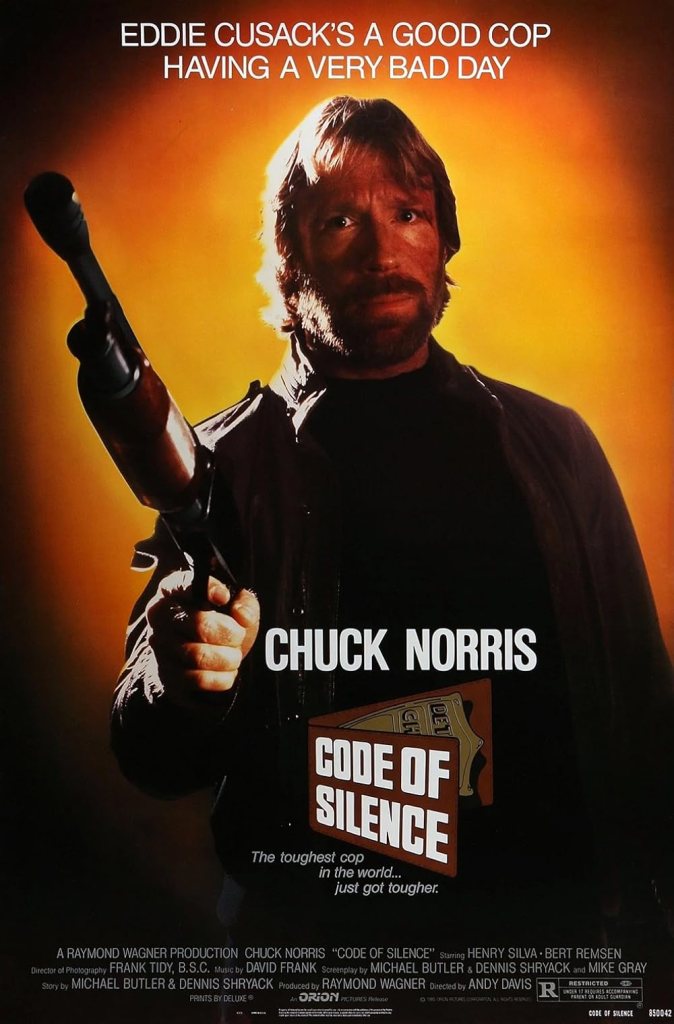
Code of Silence was the one film that had a decent story of the lone good cop that has to fight not just the criminals but also the corrupt cops and system that allows crime to run rampart. Norris as Sgt. Eddie Cusack of the Chicago PD has become the template for the loner hero cop who ends up not just fighting the mob (of differently nationalities) but also a corrupt partner and, they always have one or two, a couple of retired cops who help him but also die in the process.
Norris doesn’t lean heavily on the martials arts of his previous action films. Code of Silence was the film that helped transition him to the gunplay of the action flicks that the public couldn’t get enough of. While the film could and never truly escape it’s grindhouse influence it was very good enough both in characters, plot and direction (director Andrew Davis would later film later classics with The Fugitive and Under Siege).
The film really gets its grindhouse bonafides with the addition of Henry Silva as the main antagonist. Silva would make a career out of being the villain in many 80’s action flicks and in Code of Silence he steals the limelight with his over the top performance as Colombian drug trafficker Luis Camacho. Where Jack Palance got more praise for being the preeminent villain and tough guy of from the 70’s and 80’s, I do believe that Silva was the more sinister of the pair when it came to their performance.
Code of Silence shows that Chuck Norris can carry a film with minimal dialogue and on the power of his silent, seething stares. He was never one for quippy one-liners and Code of Silence is all the better because of it.
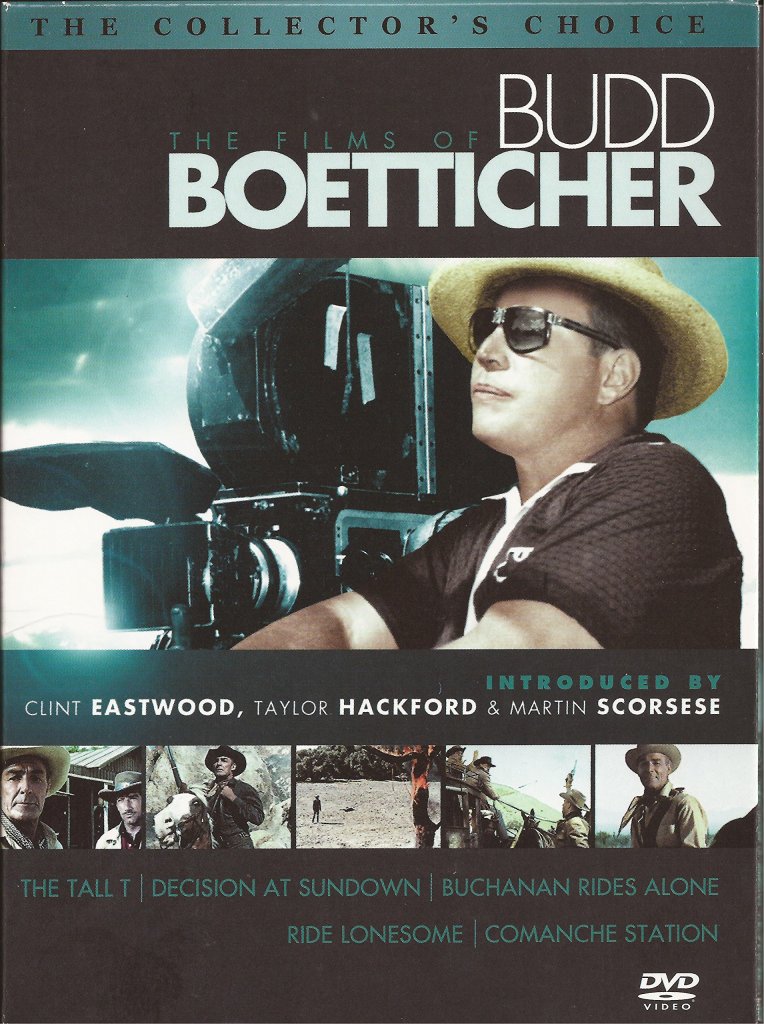
There was a time in my life, before streaming existed, where it seemed like I wanted to buy every movie that interested me in the slightest. The main ways I looked for new movie releases was to go to a store like the Hastings Entertainment Superstore and look at their inventory, or look at the new and recent releases on Amazon’s online store. I could spend hours looking for movies in either location, and I did. Sometime in 2008, I ran across a DVD box set described as “The Films of Budd Boetticher” that contained introductions by the likes of Martin Scorsese, Taylor Hackford, and Clint Eastwood. The films included on the box set were THE TALL T, DECISION AT SUNDOWN, BUCHANAN RIDES ALONE, RIDE LONESOME, and COMANCHE STATION. I remember seeing the names of these movies at various times in my life in my movie books. They had never really caught my attention, although I do remember that they would receive good reviews. This set did catch my attention, however, based on the interesting packaging and the fact that Scorsese and Eastwood were both singing the praises of the films. I did a little bit of quick research and decided to just buy the boxset. I’m glad to report that these films have turned into some of my very favorite movies, and I sing their praises to anyone who will listen.
Version 1.0.0
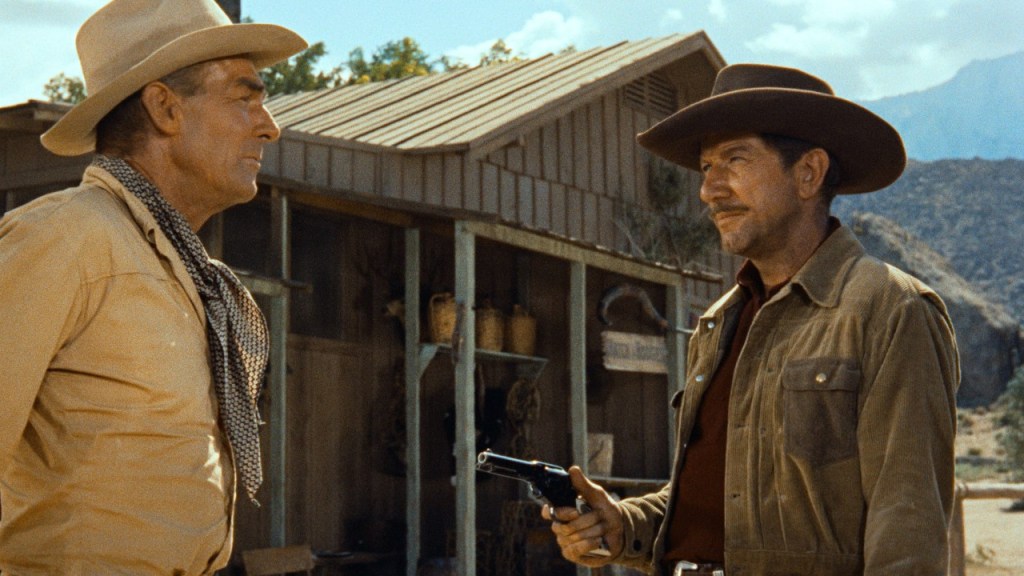
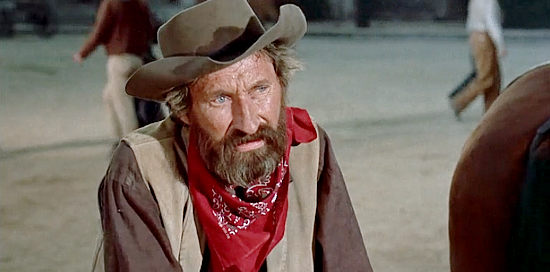
The earliest movie in this set is THE TALL T from 1957, which is based on Elmore Leonard’s short story, “The Captives.” The story opens with our hero Pat Brennan (Randolph Scott) stopping by the Sassabee Stagecoach Station and visiting with the owner Hank (Fred Sherman) and his son, Jeff (Christopher Olsen). Brennan seems like a good-natured guy who has a nice visit with the two and even agrees to purchase young Jeff some striped candy when he stops in the town of Contention later that day. Brennan heads on to Contention where we meet Ed Rintoon (Arthur Hunnicutt), a stagecoach driver who has been hired to take Willard and Doretta Mims (John Hubbard and Maureen O’Sullivan) to Bisbee for their honeymoon. Rintoon and Brennan are clearly old friends. As part of their various conversations, we learn that Doretta Mims is the daughter of Old Man Gateway, the man with the richest copper claim in the territory. After saying goodbye to Rintoon and buying young Jeff his striped candy, Brennan continues on to Tenvoorde’s (Robert Burton) ranch, in hopes of buying a seed bull for his own start-up ranch. For many years, Brennan had been the ramrod on Tenvoorde’s ranch, and the old man clearly wants him to come back. Tenvoorde offers Brennan a chance to get his bull for nothing, but he has to ride the bull to a stand still. If he can’t do it, then Tenvoorde keeps the bull and Brennan’s horse. Brennan takes him up on the offer, falls off the bull, dives into water trough to avoid getting stomped by the bull, and then heads back towards his ranch with nothing but his wet clothes and saddle. As he’s walking down the road, Rintoon comes by on his stagecoach with Mr. and Mrs. Mims. They pick Brennan up and give him a ride. When they stop back at the Sassabee Stagecoach Station, Hank and Jeff are nowhere to be seen. Rather, a voice from inside the station says “Drop your guns and come on down.” Frank Usher (Richard Boone) and young Billy Jack (Skip Homeier) emerge from the station with their guns drawn. When he’s getting down off the stagecoach, Rintoon goes for his shotgun and is shot down by another man, Chink (Henry Silva), whose been waiting in the shadows. These three men are waiting to rob the next stagecoach that comes along. They’ve already killed Hank and Jeff, and are planning to kill every person on this coach, when Willard tells them that his wife Doretta is from the richest family in the territory. Willard tells the three outlaws that Old Man Gateway will pay good money to get his daughter back, if they will just let them live. Usher, the leader of the bunch, likes this idea and sends Billy Jack and Willard back to Contention to request $50,000 from Gateway for the safe return of his daughter. With the endgame changed, Usher takes Brennan and Mrs. Mims to their hideout to wait to get their money from Gateway. Brennan knows that it’s just a matter of time before they are all killed, and he tells Mrs. Mims that they will need to be looking for any possible opportunity to escape.
THE TALL T is just so good. It’s amazing how much drama that director Budd Boetticher could fit into these films that all had running times of less than 80 minutes. The story is simple, but it deals with big themes like honor, cowardice, true love, sociopathic evil, and big dreams. Credit here has to be given to Elmore Leonard, the writer of the short story the film is based on. It must also be given to Burt Kennedy. Kennedy wrote the scripts for THE TALL T, RIDE LONESOME, and COMANCHE STATION. He’s not the credited writer for BUCHANAN RIDES ALONE but he did uncredited work on the script. Kennedy would go on to have a good career writing and directing his own westerns, like SUPPORT YOUR LOCAL SHERIFF, THE TRAIN ROBBERS, and HANNIE CAULDER, but his work with Boetticher is definitely some of his very best.
It’s also amazing how spare and simple everything looks in the THE TALL T. The land is just so dry, with nothing but big rocks and not a tree in sight. Growing up in Arkansas, I’m used to green fields and trees and flowers. It can almost feel like you’re choking on dust just watching this film.
The casting always seems to be perfect in Boetticher’s films. Randolph Scott is simpatico with Boetticher. His character here is a good man who will do what it takes to survive while also keeping his honor intact. Boetticher and Scott are truly a match made in heaven. Richard Boone is great as Frank Usher, the leader of the outlaws. He could have killed Scott’s character Brennan, but he is glad to have an honorable man to talk to after spending all of his time with Billy Jack and Chink. Boone somehow makes his outlaw leader into an honorable man even though he’s done many dishonorable things. It’s an impressive feat. Maureen O’Sullivan has an important role as Doretta Mims, the rich but plain woman, who married Willard because she was afraid she’d end up all alone. Her career goes all the way back to the 1930’s where she played Jane in the original Tarzan movies. She’s a good actress whose character undergoes the widest arc in the entire movie. Henry Silva’s Chink is a sociopath who is keeping score of the number of people he kills. Boone’s Usher would have been much better off if he would have gone with Chink’s advice and put Brennan and the Mims’ in the well back at the Sassabee station! Based on his nonchalant penchant for violence, you can see how Henry Silva would go on to having an amazing career playing bad guys. The last person I want to mention in the cast is Arthur Hunnicutt, who played Ed Rintoon. Hunnicutt is special to me because he comes from the hills of Arkansas, from a little town called Gravelly. He attended the same college I attended, although it was called the Arkansas State Teachers College when he was there. It was the University of Central Arkansas when I came through. Hunnicutt specialized in wise, rural characters. He was even nominated for an Acadamy Award a few years earlier for a movie called THE BIG SKY. He’d go on to be in so many good movies, including playing “Bull” in EL DORADO with John Wayne. I’m just proud of the guy for growing up in extreme rural Arkansas and then becoming a great character actor in Hollywood. I’ll watch anything he’s in.
I recommend all of these Budd Boetticher / Randolph Scott westerns, and THE TALL T is one of the very best!
Did any actor have a better opening act than Steven Seagal? His first five movies are all star turns in high quality, enjoyable action films, beginning with ABOVE THE LAW, and then moving forward to HARD TO KILL, MARKED FOR DEATH, OUT FOR JUSTICE and UNDER SIEGE. While UNDER SIEGE has been described as “Die Hard on a boat” and OUT FOR JUSTICE occupies the top spot as my personal favorite Steven Seagal film, today we will focus on the movie that started it all, ABOVE THE LAW, from 1988.
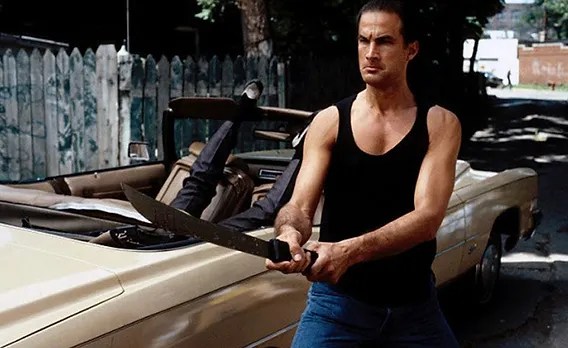
ABOVE THE LAW begins with Nico Toscani (Steven Seagal) providing a voiceover of his early years as a kid in Chicago who became obsessed with the martial arts and who found himself studying with the masters in the orient by the age of 17. He’s clearly a badass. By 22, he’s been recruited by the CIA and is completing missions in Viet Nam. While on a mission, he runs into Zagon (Henry Silva), a CIA torturer, who seems to be able to do whatever he wants with no consequences. After knocking the crap out of Zagon, Toscani quits on the spot and heads back to Chicago to become a tough cop and marry Sara (Sharon Stone). While working a touchy family situation in the Windy City, he stumbles upon a potential drug deal going down soon in the city. He and his partner Delores (Pam Grier) set up the bust, but the product of choice turns out to be C4 explosives, not drugs. Wouldn’t you know that the folks behind these C4 explosives are the CIA and Toscani’s old pal Zagon. Can he stop his old adversary this time and still protect his family?!!
My favorite Chuck Norris film is from 1985 and is called CODE OF SILENCE. I mention that because there are quite a few similarities between ABOVE THE LAW and CODE OF SILENCE. First, Andrew Davis directed both films. He’s a talented filmmaker who would later direct such solid action films as THE PACKAGE (Gene Hackman & Tommy Lee Jones), UNDER SIEGE (Seagal & Tommy Lee Jones), and THE FUGITIVE (Harrison Ford and an Oscar winning Tommy Lee Jones). I wonder now how this film was made without Tommy Lee Jones?!! Second, both films feature a tough cop who practices martial arts and beats the crap out of corruption within law enforcement. In the case of CODE OF SILENCE, it was the police force itself; in ABOVE THE LAW, it’s the Central Intelligence Agency. It’s my personal opinion that CODE OF SILENCE is Chuck Norris’ finest hour. Steven Seagal gets this same kind of bravado and credibility in his very first film role. That’s truly unique. And finally, both movies feature the awesome Henry Silva as the bad guy. Silva has been a bad guy in so many movies, and he’s just damn good at it. I recently watched him in THE TALL T with Randolph Scott from way, way back in 1957. Damn, his Chink’s a psycho. Combine that with his turn as Billy Score in SHARKY’S MACHINE with Burt Reynolds, and you have a guy who deserves to be in the villain hall of fame. These tried and true elements all help produce a fine feature film debut for Seagal!
Just one final comment about the movie’s theme… we all would like to think that no one is above the law in the real world. Unfortunately, all we have to do is watch the news to know that’s simply not the case. Our world is full of people who actually are above the law. One of the best things about a movie like ABOVE THE LAW is that we can watch the movie, munch our popcorn, and just pretend for 100 minutes that justice does exist. It may not be completely realistic, but it’s definitely a satisfying thought!
I just read that actor Henry Silva died on September 14th. He was 95 years old.
Henry Silva appeared in many movies, usually playing gangsters and assassins. He started his film career in the 50s and was still active up until at least 2012. He worked with everyone from Marlon Brando to Frank Sinatra to Charles Bronson and Robert Redford. Speaking for myself, I will always remember him as the heroin-addicted Billy Score, one of the most frightening villains of all time, in Sharky’s Machine.
(If you haven’t seen Sharky’s Machine before, don’t worry. Despite getting shot several times, Bernie Casey does survive and even makes a joke about how he’s going to have to get a new suit.)
All bad action films tend to feature it. (Actually, it shows up in some good action films as well.) Whenever a group of soldiers step on a mine and slowly flip through the air as a result of the subsequent explosion, that’s the Slo Mo of Doom. Whenever an important supporting character is shot and the film suddenly slows down so that each frame of their collapse is their highlighted, that’s the Slo Mo of Doom. Sometimes, it’s a way of saying, “Hey, you should care more about this violent death than you care about all of the other violent deaths in this movie.” Sometimes, it’s a way of showing off the fact that the producers could afford stunt people, even if they couldn’t afford anything else. Other times, it’s just a way to pad out the running time so that a movie can at least reach the 90 minute mark before the end credits roll. Regardless of the reason why it’s deployed, Slo Mo of Doom is usually a good sign that you’re watching a cheesy action film.
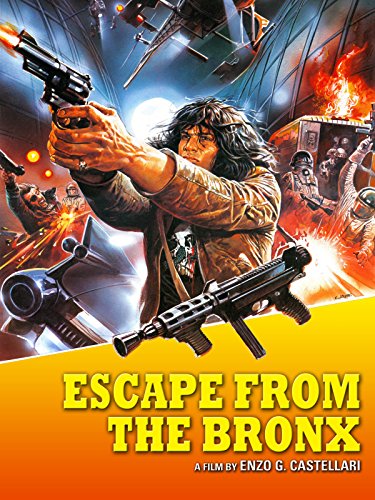
Last night, when I watched the 1983 Italian film, Escape from the Bronx, with a group of friends, we counted at least six instances of the Slo Mo of Doom. There may have been even more, it’s hard to say. Along with frequent slow motion, Escape from the Bronx features a lot of flame throwers, several corporate bad guys, and an abundance of graffiti. It also featured Henry Silva as a villain named Floyd Wangler and Antonio Sabato, Sr. as a flamboyant rebel leader who dressed like he was appearing in an Off Broadway adaptation of The Fantasticks. In short, it was a classic of its kind.
Escape From The Bronx takes place in, what was then, the future. (To be specific, the story is said to take place in the year 2000.) The Bronx has become such an eyesore that an evil corporation wants to blow up all the buildings and rebuild. Unfortunately, the residents of the Bronx know how difficult it is to find an apartment in New York City and they don’t want to move. In order to change their minds, Floyd Wangler and his army of jackbooted, flame thrower-wielding bad guys invade the Bronx. “Leave the Bronx!” they announce. “It is time to leave the Bronx.” And, to be honest, the Bronx looks like a terrible place to live so maybe they have a point.
A motorcycle-riding bad boy named Trash (played by Mark Gregory) doesn’t want to leave the Bronx so he goes underground. While the buildings are being blown up and people are being set on fire, Trash teams up with Doblon (Antonio Sabato, Sr.) and his gang of flashy rebels. Working with a mercenary named Strike (Giancarlo Prete) and journalist named Moon Gray (Valeria D’Obici), Trash plots to kidnap the president of the corporation. Of course, by doing so, Trash might be doing exactly what Floyd wants him to do.
Both John Carpenter’s Escape from New York and George Miller’s Mad Max films were very popular in Europe and Escape From The Bronx was one of the many Italian films to imagine New York (or, in this case, one unfortunate borough of New York) as being some sort of a post-apocalyptic wasteland. (In fact, Escape From The Bronx was a sequel to another film called The Bronx Warriors. The adventures of Trash could not be contained to just one film.) One could argue that Escape From The Bronx was an early warning against the horrors of gentrification, with the poor being set on fire so that the rich can blow up their homes and make even more money. Personally, I thought the film was much more about the struggle of the Italian film industry to come to terms with the legacy of Mussolini. Floyd Wangler may have had a silly name but, as played by Henry Silva, he was the chilling epitome of the authoritarian impulse come to life. With his black uniform and his steely gaze, it was easy to imagine Floyd as one of the fascists who marched on Rome in 1922. There’s a definite political subtext to Escape from the Bronx, one that can easily get overshadowed by the prominent use of the Slo Mo of Doom.
That’s not to say that Escape from the Bronx is a particularly good film, of course. There’s a few decent action scenes but the middle part of the film drags and Mark Gregory doesn’t have much screen presence. Henry Silva is better-cast as the bad guy but it’s hard to take a villain named Floyd seriously. That said, Escape from the Bronx is an entertaining film to watch with a group of friends. This is a film that invites you to talk back to the screen and, with all of its costumed rebels, it’s actually a good film for October. Whatever its flaws, I defy anyone to watch this film without getting “Leave the Bronx” stuck in their head.
And, if nothing else, you can always have fun counting all of the Slo Mo of Doom.
In 1981, director Hal Needham and star Burt Reynolds had a surprise hit with The Cannonball Run. Critics hated the film about a race from one end of America to the other but audiences flocked to watch Burt and a group of familiar faces ham it up while cars crashed all around them. The original Cannonball Run is a goofy and gloriously stupid movie and it can still be fun to watch. The sequel, on the other hand…
When the sequel begins, the Cannonball Run has been discontinued. The film never explains why the race is no longer being run but then again, there’s a lot that the sequel doesn’t explain. King Abdul ben Falafel (Ricardo Montalban, following up The Wrath of Khan with this) wants his son, The Sheik (Jamie Farr, returning from the first film) to win the Cannonball so he puts up a million dollars and announces that the race is back on. Problem solved.
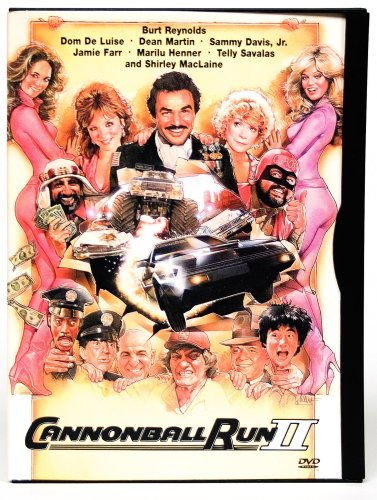
With the notable exceptions of Farrah Fawcett, Roger Moore, and Adrienne Barbeau, almost everyone from the first film returns to take another shot at the race. Burt Reynolds and Dom DeLuise are back. Jack Elam returns as the crazy doctor, though he’s riding with the Sheik this time. Jackie Chan returns, riding with Richard “Jaws” Kiel. Dean Martin and Sammy Davis, Jr. return, playing barely disguised versions of themselves. They’re joined by the surviving members of the Rat Pack. Yes, Frank Sinatra is in this thing. He plays himself and, from the way his scenes are shot, it’s obvious they were all filmed in a day and all the shots of people reacting to his presence were shot on another day. Shirley MacClaine also shows up, fresh from having won an Oscar. She plays a fake nun who rides with Burt and Dom. Burt, of course, had a previous chance to co-star with Shirley but he turned down Terms of Endearment so he could star in Stroker Ace. Cannonball Run II finally gave the two a chance to act opposite each other, though no one would be winning any Oscars for appearing in this film.
Say what you will about Hal Needham as a director, he was obviously someone who cultivated a lot of friendships in Hollywood because this film is jam-packed with people who I guess didn’t have anything better to do that weekend. Telly Savalas, Michael V. Gazzo, Henry Silva, Abe Vigoda, and Henry Silva all play gangsters. Jim Nabors plays Homer Lyle, a country-fried soldier who is still only a private despite being in his 50s. Catherine Bach and Susan Anton replace Adrienne Barbeau and Tara Buckman as the two racers who break traffic laws and hearts with impunity. Tim Conway, Don Knotts, Foster Brooks, Sid Caesar, Arte Johnson, Mel Tillis, Doug McClure, George “Goober” Lindsey, and more; Needham found room for all of them in this movie. He even found roles for Tony Danza and an orangutan. (Marilu Henner is also in the movie so I guess Needham was watching both Taxi and Every Which Way But Loose while casting the film.) Needham also came up with a role for Charles Nelson Reilly, who is cast as a mafia don in Cannonball Run II. His name is also Don so everyone refers to him as being “Don Don.” That’s just a typical example of the humor that runs throughout Cannonball Run II. If you thought the humor of It’s A Mad, Mad, Mad, Mad World was too subtle and cerebral, Cannonball Run II might be right up your alley.
The main problem with Cannonball Run II is that there’s not much time spent on the race, which is strange because that’s the main reason why anyone would want to watch this movie. The race itself doesn’t start until 45 minutes into this 108 minute film and all the racers are quickly distracted by a subplot about the Mafia trying to kidnap the Sheik. Everyone stops racing so that Dean Martin and Sammy Davis, Jr. can disguise themselves as belly dancers to help rescue the Sheik. By the time that’s all been taken care of, there’s only 10 minutes left for everyone to race across the country. After a montage of driving scenes and a cartoon of an arrow stretching across the nation (the cartoon was animated by Ralph Bakshi!), we discover who won the Cannonball and then it’s time for a montage of Burt and Dom blowing their lines and giggling. Needham always ended his films with a montage of everyone screwing up a take and it’s probably one of his most lasting cinematic contributions. Every blooper reel that’s ever been included as a DVD or Blu-ray extra owes a debt of gratitude to Hal Needham. Watching people blow their lines can be fun if you’ve just watched a fun movie but watching Burt and Dom amuse themselves after sitting through Cannonball Run II is just adding insult to injury. It feels less like they’re laughing at themselves and more like they’re laughing at you for being stupid enough to sit through a movie featuring Tony Danza and an orangutan.
The dumb charm of the first Cannonball Run is nowhere to be found in this sequel and, though the film made a profit, the box office numbers were still considered to be a disappointment when compared to the other films that Reynolds and Needham collaborated on. Along with Stroker Ace, this is considered to be one of the films that ended Reynolds’s reign as a top box office attraction. Cannonball Run II was also the final feature film to feature Dean Martin and Frank Sinatra. This could be considered the final Rat Pack film, though I wouldn’t say that too loudly.
Cannonball Run II is a disappointment on so many levels. It’s hard to believe that the same director who did Smokey and the Bandit andHooper could be responsible for the anemic stunts and chases found in this movie. The cast may have had a good time but the audience is left bored. Stick with the first Cannonball Run.
In the year 1987, NASA launches it’s final manned mission. Captain Buck Rogers (Gil Gerard) is sent into space but, while he’s orbiting the Earth, he and his spacecraft fall victim to a strange space anomaly which leaves him in suspended animation. On Earth, Buck Rogers is believed to be lost. 500 years pass. Buck’s ship continues to orbit the Earth while, down below, mankind nearly destroys itself in a nuclear war. Eventually, Earth is reduced to radioactive rubble and what remains of human civilization lives in the city of New Chicago. (Old Chicago, meanwhile, has been taken over by mutants.)
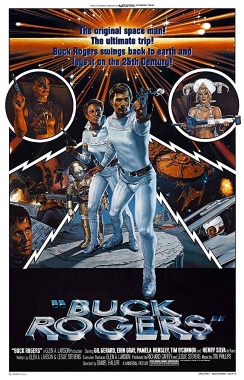
Finally, in the 25th century, Buck and his ship are discovered by Draconia, a spaceship that belongs to the intergalactic Draconian Empire. Buck is brought out of suspended animation and meets the beautiful Draconian Princess Ardala (Pamela Hensely) and her second-in-command, an Earthling named Kane (Henry Silva). Ardala would obviously like to make Buck her prince but, after being in suspended animation for 500 years, Buck just wants to return to Earth. The Draconians allow Buck to return home.
Upon landing in New Chicago, Buck discovers that the world is much different now. Everyone wears skintight uniforms and a little robot named Twiki (voice by Mel Blanc) is the only person willing to be Buck’s friend. Commander Wilma Deering (Erin Gray) is in charge of defending what’s left of human civilization and she’s immediately suspicious of Buck and his story. When it turns out that Ardala and Kane implanted Buck with a tracking device, Deering want to execute him. Can Buck prove his loyalty and also thwart Ardala and Kane’s plot to conquer humanity?
Buck Rogers In The 25th Century was originally a pilot for a Glen Larson-produced televisions series. (Larson was also responsible for the original Battlestar Galactica, another sci-fi show whose pilot was given a theatrical release.) Hoping to appeal to the same audiences who made Star Wars a monster hit, Universal spent a little extra money to upgrade the special effects, added a few suggestive scenes to prevent the pilot from getting the dreaded G-rating, and then released it in theaters a few months before the TV show premiered. That was a good idea because the movie did become a minor hit and the TV series went on to run for two seasons.
As the movie itself, it never feels like anything more than an extended episode of a television series. Gil Gerard is bland in the lead role and most serious sci-fi fans will probably lose interest as soon as the child-friendly robot shows up. Buck Rogers may have been made to capitalize on the success of Star Wars but it doesn’t have any of the attention to detail or the careful world-building that went into George Lucas’s original space opera. On the plus side, though, the Dads who took their kids to matinee showings of this film were probably happy to see Erin Gray and Pamela Hensley prominently featured in the film and Henry Silva is a great villain as always. As with a lot of the sci-fi films that were released in the immediate wake of Star Wars, Buck Rogers In The 25th Century does have a definite camp appeal. It’s bad but some people will enjoy it on a nostalgic level.
Probably the most memorable thing about Buck Rogers In the 25th Century was its James Bond-inspired title sequence. Here it is, in all of its glory:


 Through the Shattered Lens