“What are you doing here?” Chris Hansen (Robert Pattinson) asks a man in a kitchen at the start of Primetime.
What are you doing here? That’s a question that several people struggle to answer over the course of the film. The man in the kitchen really doesn’t have an answer, though we know that he’s there because he thought he would be meeting an underage person for sex. And we know that Hansen is there because he’s the host of To Catch a Predator, a show that a lot of people now pretend they didn’t watch even though we all did.
What are you doing here? That’s a question that Dan Plum (Skyler Gisondo) also struggles to answer throughout the film. When we first see Dan, he’s being filmed as he explains that he doesn’t have an agent and that he’s not in the union but he has done some commercial work. Dan doesn’t know what he’s auditioning for. It’s only after he’s cast that he learns that he’s been cast not for his musical theater background but instead because he can convincingly pass for a 13-year-old. While the members of an organization called Perverted Justice entice pedophiles to come visit them at their “home,” Dan is the one who actually greets them at the door and gets them to come inside so that they can be confronted by Chris Hansen and his camera crew. At first, Dan feels awkward about being a decoy. Then, after one pedophile exposes himself, Dan is frightened by it. Chris’s producer, Andie (Merritt Wever), encourages Chris to take Dan under his wing as a protégé in order to keep Dan with the show. Soon, Dan is approaching his decoy work like an actor preparing for a great stage role.
What are we doing here? That’s the question that Andie wonders when Chris insists on filming an episode in the suburbs of Texas instead of on the then-hot Jersey Shore. Chris has been told by Xavier Von Erck (Matthew Maher), the founder of Perverted Justice, that he’s tracked down a pedophile who has political connections. Chris and Xavier are hoping for a Congressman or maybe someone even bigger. (When Andie expresses some reservations at not knowing for sure who they’re going after, “sensitive” guy Xavier descends very quickly into misogyny.) Instead, they have to settle for an assistant district attorney named Bill Conradt (Alex Winter). When Conradt, after talking to Dan on the phone and promising to come meet him at the house, fails to show up, Chris and Andie decide to confront Conradt at his home.
What am I doing here? Andie asks herself perhaps more than anyone else in the film. Having been with To Catch a Predator since the beginning, she’s been offered a chance to skip over to another network and produce a show called What Would You Do?What Would You Do? copies To Catch a Predator‘s humiliation format but instead of targeting pedophiles, it targets people who fail to return a wallet or who don’t speak up when an actor says something insensitive. If To Catch A Predator can at least claim to be putting bad people in jail, What Would You Do? can’t even pretend that it’s making the world a better place. Primetime suggests that humiliation, and not justice, was the true lifeblood of To Catch a Predator.
What are we doing here? That’s the question that the audience is forced to consider. Did we watch To Catch a Predator because we wanted to see bad people arrested or did we watch it because we enjoyed watching someone realize, on camera, that his life was essentially over? And are we watching Primetime because we’re interested in what it has to say about the show and the man at the center of it or are we watching because we’re nostalgic for the show that abruptly ended after Bill Conradt shot himself in his home? Did we watch originally because we were worried about the dangers of online predators or did we watch so we could laugh?
Primetime raises a lot of questions and, to its credit, it doesn’t offer up any easy answers. Indeed, it’s brave enough to admit that there is no either/or. Yes, To Catch a Predator‘s main appeal might be the spectacle of humiliation but that doesn’t mean that the men who appeared on the show weren’t deserving of it. The film’s ambiguity extends to its portrayal of Bill Conradt, who talks to someone whom he believes to be underage on the phone but who apparently changes his mind about going to the address that he’s given. Conradt suddenly finds himself staring out of his office window at an army of cops and cameramen. Earlier one of those cops is shown getting a Subway sandwich and glancing at a poster celebrating Jared Fogle. As Jeff Zucker (poorly playing himself) puts it to Chris Hansen, To Catch a Predator may be a sleazy show but it’s what America wants.
With the exception of Zucker, the entire cast is impressive. Not surprisingly the film is dominated by Robert Pattinson, who plays Chris Hansen as being neurotic and obsessive. While Hansen grills the men unlucky enough to be caught on camera and asks them how their families would feel, he cheats on his wife with another woman and his idea of a family night is to gather his kids in the living room so they can watch him on TV. Hansen enjoys his fame and he enjoys playing the righteous avenger but he’s full of envy for “serious” journalists like Stone Phillips (played, with the appropriate amount of smug smarminess, by Bill Heck). In one of the film’s strangest moments, he tells Dan about going to India and confronting an “ancient evil” that retreated into a cave only after the villagers that it tormented started to kill each other. Is Hansen telling the truth or is he playing a role? Even he doesn’t seem to know for sure.
The film starts out as a stylized and darkly humorous look at fame and the media in America. However, as it progresses, Primetime takes on the elements of a filmed nightmare, with Hansen moving through the shadows like an almost soulless demon. What is he doing there? By the end of the movie, not even Chris Hansen seems to know for sure.
“Be in my joint in two hours—we’re forming a fuckin’ government.” — Al Swearengen
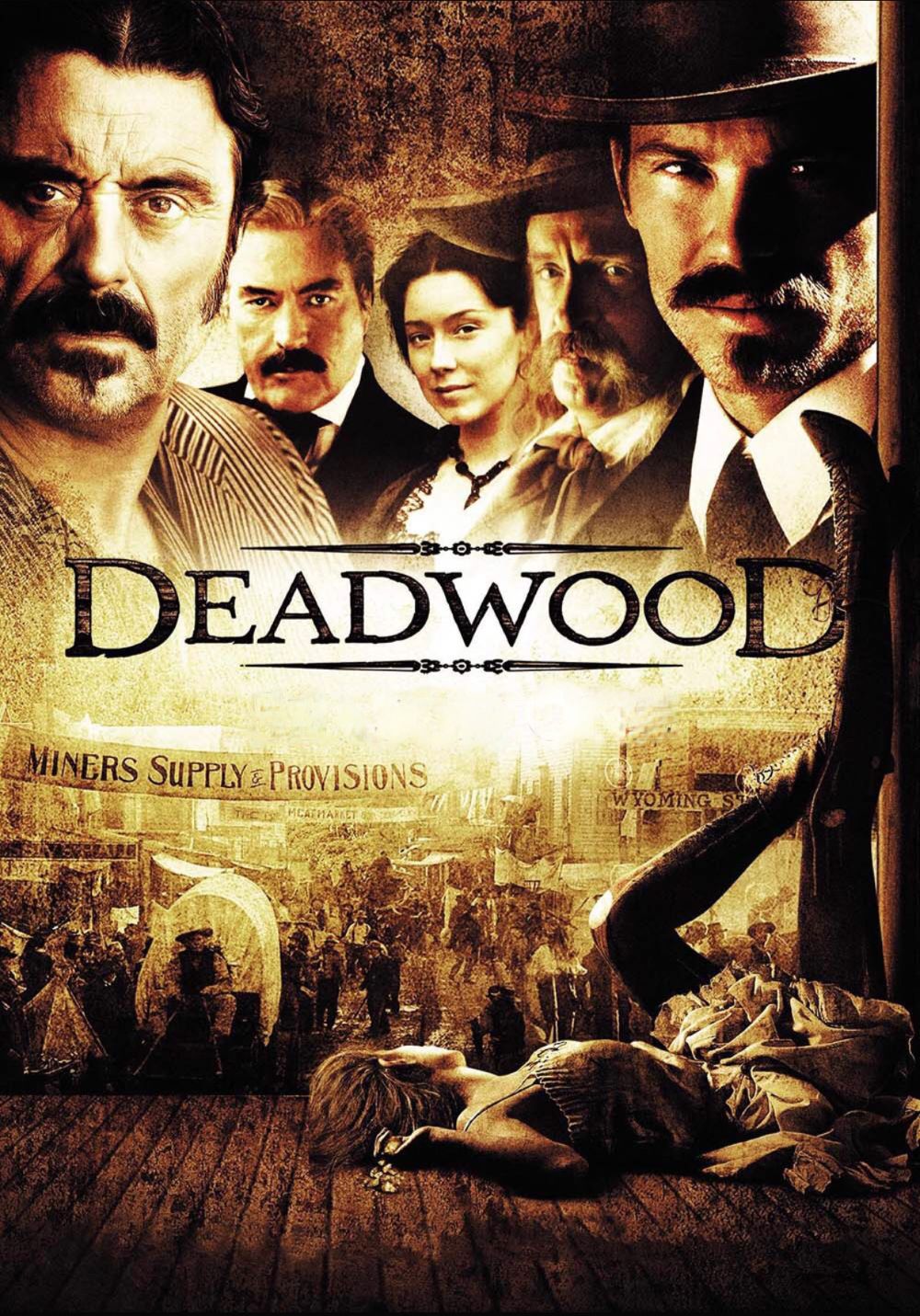
David Milch’s Deadwood is one of those rare television series that feels less like a conventional prestige drama and more like being dropped into a living, breathing, filthy historical world. Set in the rough gold-rush settlement of Deadwood, South Dakota, during the 1870s, the HBO series takes the familiar pieces of the Western—lawmen, gunfighters, prospectors, saloons, prostitutes, corrupt businessmen, and murder—and turns them into something far richer than a genre exercise. It is a Western, but it is also a story about the difficult, often ugly process of creating a society in the middle of chaos. Civilization in Deadwood is not built by noble speeches or clean acts of heroism. It is assembled through greed, fear, business deals, compromise, bloodshed, exploitation, loyalty, and the occasional act of real compassion.
The show’s biggest strength is its ability to make Deadwood itself feel like one of television’s great settings. At the beginning, the camp exists outside the reach of formal American law, which means everyone who arrives sees an opportunity. Some people come looking for gold. Others come looking to escape old lives, make money, gain power, or take advantage of people too desperate to protect themselves. Every character has a different idea of what Deadwood should become, and the series finds drama in the collision between those competing visions. A claim dispute, a murder, a business arrangement, an illness, a newspaper article, or even a random rumor can become part of the larger struggle over who gets to shape the town’s future.
At the center of that struggle is Seth Bullock, played by Timothy Olyphant with an intensity that makes him seem like he is always one bad conversation away from throwing somebody through a window. Bullock arrives in Deadwood with his friend and business partner Sol Star, hoping to start a hardware business and leave behind his past as a lawman. He wants a calmer, more stable existence, but the town almost immediately drags him back toward violence and public responsibility. Bullock has a powerful sense of justice, but he is not a smooth, patient hero. He is rigid, angry, stubborn, and frequently driven by instinct before reflection. Olyphant gives him a clenched physicality—the hard stare, the tense posture, the barely restrained frustration—that makes it clear Bullock is always fighting to keep the more destructive side of himself under control.
That is what makes Bullock such a compelling protagonist. Deadwood never treats him as a simple white-hat sheriff who comes to tame the frontier. He is more decent than many of the people around him, but he is not uncomplicatedly good. His moral certainty can become self-righteousness, and his willingness to defend the vulnerable can slide into an urge to control a situation through force. At times, Bullock’s anger is justified; at other times, it is frightening. Olyphant’s performance works because he does not try to make Bullock effortlessly likable. Instead, he makes him believable as a man who wants order, justice, and dignity in a place that seems designed to expose every violent impulse he is trying to bury.
If Bullock represents Deadwood’s rough version of moral order, Ian McShane’s Al Swearengen represents its ruthless understanding of power. As the owner of the Gem Saloon, Swearengen initially appears to be the obvious villain: a man who profits from vice, manipulation, intimidation, and murder. McShane gives him such enormous control over the role that every scene becomes more charged when Swearengen walks into it. His speech has a strange, unforgettable rhythm, moving between elaborate insults, sly observations, sudden bursts of rage, and dry comedy. He is part Shakespearean king, part criminal entrepreneur, and part exhausted manager trying to hold together a business and a town full of people who are constantly making life harder for him.
What makes Swearengen one of television’s greatest characters is that the series refuses to flatten him into a conventional bad guy. He is undeniably brutal, often monstrous, and capable of treating human beings as disposable pieces in a larger game. The show never asks the audience to forget that. But as Deadwood faces pressure from outside business interests, political maneuvering, and wealthy figures who see the camp as a resource to be absorbed, Swearengen’s investment in the town becomes clearer. He does not become a hero, but he develops into something more complicated: a man whose selfish ambition is inseparable from a practical, almost territorial loyalty to Deadwood. He understands that the camp can only survive if its people occasionally work together, even if he usually has to manipulate them into doing so.
The relationship between Bullock and Swearengen gives the series much of its electricity. They are rivals, reluctant allies, ideological opposites, and men who recognize certain necessary qualities in each other. Bullock sees Swearengen as a moral disease at the center of the camp. Swearengen sees Bullock as an unpredictable nuisance, but also as someone with the strength and authority to be useful. Their confrontations work because neither man can completely dominate the other. Olyphant and McShane create a tension that goes beyond physical threat. Their conflict reflects the show’s larger question: can Deadwood become a place governed by something closer to law and principle, or will it always belong to the people with the most money, violence, and influence?
Still, Deadwood would not be nearly as great if it were only the Bullock and Swearengen show. Its ensemble is one of HBO’s best, filled with actors who make the camp feel populated by people with histories, grudges, private fears, ambitions, and complicated ties to one another. John Hawkes is excellent as Sol Star, Bullock’s business partner and closest friend. Sol is quieter and more patient than Bullock, but Hawkes never lets that quietness fade into the background. He gives Sol an intelligence and decency that make him a crucial moral and emotional counterweight to Bullock’s volatility. His friendship with Bullock is one of the show’s most believable relationships because Sol understands the good in Bullock without ignoring the damage Bullock’s anger can cause.
Molly Parker is equally strong as Alma Garret, a wealthy widow who gradually becomes much more than an outsider caught in Deadwood’s orbit. Alma could have been written as a standard symbol of refinement in a crude frontier town, but Parker gives her tremendous resolve, intelligence, and emotional restraint. Her story is about survival in a different but no less dangerous form. She is forced to navigate grief, addiction, business interests, motherhood, and the expectations placed on a woman in a violently male world. Her relationship with Bullock is complicated in the best way because it is built from longing, frustration, guilt, repression, and circumstance rather than easy romance.
Anna Gunn brings similar depth to Martha Bullock, who becomes increasingly essential as the series develops. Martha could have been pushed aside as merely the protagonist’s wife, but Gunn makes her one of the clearest-eyed people in the camp. She understands the weight of family, grief, responsibility, and compromise, and she gives the character an emotional firmness that Bullock himself often lacks. Martha does not need grand speeches to establish her strength. Her endurance and intelligence gradually make her one of the show’s most quietly powerful figures.
Robin Weigert’s Calamity Jane is another unforgettable character, and one of the series’ most heartbreaking. Jane is loud, drunk, funny, self-destructive, and seemingly incapable of admitting how deeply she cares about people without covering it in profanity or sarcasm. Weigert finds the sadness beneath every messy outburst. Her love for Wild Bill Hickok, her loyalty to those who treat her with kindness, and her profound discomfort with herself make Jane much more than a colorful Western side character. She can be hilarious one minute and devastating the next, which is exactly the emotional balance Deadwood handles so well.
The supporting cast is so strong that the show continually finds new ways to make minor characters feel essential. Gerald McRaney brings a cold, weathered authority to George Hearst, the wealthy mining magnate whose arrival makes Deadwood’s conflicts larger and more dangerous. Hearst is not simply another local schemer. He represents the corporate and political forces that can crush a place like Deadwood from the outside, turning its chaos into something colder and more organized. McRaney plays him with a calm menace that is often more unsettling than open rage. He does not need to shout to make it clear how much power he has.
Brian Cox is terrific as Jack Langrishe, the theatrical and charismatic impresario whose arrival adds another kind of intelligence to the camp. Langrishe can be charming, funny, and seemingly generous, but Cox always lets the audience see the calculation behind the performance. He understands how to survive around men like Swearengen and Bullock because he knows that people are always playing roles, especially when power is on the line. Garrett Dillahunt also does remarkable work in two very different roles. He first appears as Jack McCall, the disturbed and dangerous killer whose actions leave a permanent mark on the camp. Later, he returns as Francis Wolcott, a polished, educated, deeply unsettling man whose manners barely conceal something vicious underneath. Dillahunt’s ability to make those roles feel so distinct is one of the more impressive acting achievements in the series.
Keith Carradine gives Wild Bill Hickok a tired, melancholy gravitas that makes the legendary lawman feel human rather than mythical. He is aware of his reputation, perhaps exhausted by it, and Carradine captures the loneliness beneath the public image. Jeffrey Jones is wonderfully eccentric as A. W. Merrick, Deadwood’s nervous but idealistic newspaper editor. Merrick’s love of language and belief in the importance of a free press make him both funny and unexpectedly vital. In a town shaped by violence and backroom deals, the act of recording events and trying to tell the truth becomes its own form of resistance.
Kim Dickens is excellent as Joanie Stubbs, a woman carrying deep emotional scars while trying to carve out independence in a world that treats vulnerability as an invitation to exploit someone. Her performance brings tenderness and pain to a character who could have easily been reduced to a plot device. Brad Dourif is another major presence as Doc Cochran, the camp’s exhausted, haunted physician. Dourif makes him funny, strange, compassionate, and spiritually worn down by everything he has seen. Jim Beaver is equally memorable as Whitney Ellsworth, the gruff prospector who gradually reveals himself to be one of the show’s warmest and most honorable people. Powers Boothe’s Cy Tolliver, meanwhile, offers a sharp contrast to Swearengen. He is just as ambitious and cruel, but he lacks Swearengen’s strange capacity for loyalty and for understanding that a town, however dirty and violent, is still an ecosystem that must be maintained.
Milch’s writing is famous for its dense, ornate, profanity-heavy dialogue, and it can take a little time to adjust to the show’s rhythm. These characters do not speak in the clean, direct language of a standard television Western. They circle around their meanings, launch into bizarrely poetic insults, turn routine negotiations into verbal duels, and sometimes say more through implication than through plain statements. But once the language clicks, it becomes one of Deadwood’s greatest pleasures. The dialogue gives the show its own identity. It makes the town sound as alive and unpredictable as it looks.
That stylized language also supports what Deadwood is really about. The series is not interested in selling a clean myth of American rugged individualism. It shows the frontier as a collision between people who need one another and often cannot stand one another. Deadwood grows through compromise, manipulation, sacrifice, corruption, and a slow recognition that nobody can survive entirely alone. Even the most vicious people become tied to a larger network of obligations. The show understands that communities are not built by saints. They are built by flawed, wounded, selfish people who occasionally discover that cooperating is better than destroying each other.
The original series ended after three seasons, which leaves it with an undeniably unfinished quality, but that does not lessen its accomplishments. If anything, the lack of a neat conclusion suits the show’s view of history. Deadwood is always changing, always threatened, and never fully settled. The later film provides a welcome return to the characters and offers some emotional closure, but the series remains the core achievement.
Deadwood is demanding television, but it is never hollow television. Its violence has consequences, its humor is vicious and surprisingly warm, and its characters become richer the more time the audience spends with them. Timothy Olyphant gives Seth Bullock the rage of a man trying to force order onto a world that resists it. Ian McShane turns Al Swearengen into a full, contradictory human being rather than a one-note villain. Around them, Milch assembled an extraordinary ensemble that makes every saloon, storefront, street, and muddy patch of ground feel inhabited. People may start the show for the gunfights, the outlaw mythology, and the famously inventive profanity, but the reason Deadwood endures is its people. It understands that civilization is not born cleanly. It is dragged into existence, often unwillingly, by damaged people trying to make a home in a place that barely resembles one.
Welcome to Retro Television Reviews, a feature where we review some of our favorite and least favorite shows of the past! On Sundays, I will be reviewing the made-for-television movies that used to be a primetime mainstay. Today’s film is 1991’s Murder In New Hampshire: The Pamela Smart Story! It can be viewed on YouTube!
When Pamela Wojas (Helen Hunt) first became engaged to Gregg Smart (Hank Stratton), she thought that they would never get older or settle down to a conventional life. She thought that Gregg would always have long hair and that they would spend the rest of their lives following Van Halen around the country. But then Gregg got a job with a New Hampshire insurance company and he cut his hair. And then Pam failed in her attempts to get hired by the local news station and instead, she ended up accepting a job as the part-time media director at a local high school.
Pam spearheaded the school’s anti-drug campaign and ended up working closely with two students in particular, Billy Flynn (Chad Allen) and Cecelia Pierce (Riff Reagan). Billy and Pam bonded over their shared love of Van Halen and soon, they were having an affair. Was Pam just trying to relive her youth or was she already setting up Billy to murder her husband?
Based on the true story that also inspired Gus Van Sant’s To Die For, Murder In New Hampshire jumps back and forth through time. The film opens with Gregg being shot and killed by Billy and one of his friends. It then cuts to a courtroom, where a prosecutor (Howard Hesseman) tells the jury that Gregg was murdered on the orders of his own wife. A very conservatively and modestly-dressed Pam sits in the courtroom and provides quite a contrast to the far more wild and hedonistic Pam who we see in the film’s frequent flashbacks. While Gregg settles comfortably into life as a suburban insurance agent, Pam continually tries to hold onto her past. While Gregg wins awards for selling the most insurance, Pam tells Billy that Gregg beats her and that he’s dangerous.
It’s difficult to watch Murder In New Hampshire without comparing it To Die For. They both tell the same story and they even use the same flashback structure. But if To Die For presented Nicole Kidman as being a soulless killer who was driven by her obsession with being a star, Murder In New Hampshire suggests that Pam’s main motivation was that she just couldn’t handle the idea of settling down and living a conventional, suburban life. As well, To Die For presented Joaquin Phoenix’s gunman as being someone who was essentially incapable of thinking for himself. In Murder In New Hampshire, Billy is far more active character. Though he is undoubtedly manipulated by Pam, Billy is still portrayed as someone who made his own decision to get involved in Pam’s schemes. If To Die For is a stylized satire of the true crime genre, Murder In New Hampshire is the epitome of what was being satirized.
That said, Murder In New Hampshire is a good example of the true crime genre, largely due to Helen Hunt’s wonderful performance as Pam Smart. Hunt plays Pam as someone who has never grown up and who is so scared of being required to that she’ll even resort to murder to pull it off. While Murder In New Hampshire never quite escapes the shadow of To Die For, it’s still an effective film when taken on its own terms.