When I heard that the actress Catherine O’Hara had passed away, I immediately thought of Waiting For Guffman.
I know that a lot of people immediately thought of Schitt’s Creek. And I imagine that a lot of people thought of her as the desperate mother in Home Alone. And definitely, there are a lot of people on twitter who are posting clips of her work on SCTV right now. But I’m a theater nerd and, when you’re a theater nerd, Waiting for Guffman pretty much feels likes watching your life on film.
The entire cast of Waiting for Guffman is brilliant. It’s definitely the most emotionally satisfying of all of Christopher Guest’s mockumentaries. But I’ll have a special place in my heart for Catherine O’Hara and Fred Willard as the community theater superstars. Today’s scene that I love features O’Hara and Willard giving the audition of a lifetime in Waiting For Guffman.
In 2010’s Holyman Undercover, David A.R. White plays Roy. Roy is an 18 year-old Amish dude from Kansas. It’s time for him to experience Rumspringa, a period in which he can live life amongst “the English” and decide whether or not he wants to commit to being Amish. Roy decides to go Los Angeles so he can track down his uncle and work with him as a missionary.
Roy struggles in Los Angeles. Giving money to one homeless man leads to him nearly getting mugged. When he meets his uncle, he discovers that Brian (also played by David A.R. White) is now a struggling actor who has a taste for cocaine. (Brian claims that he’s a holyman working undercover.) Accompanying Brian to an audition leads to Roy getting cast as Satan on a primetime soap opera. His wife is played by vapid supermodel Tiffany Towers (Jennifer Lyons). Meanwhile, the show’s producer is a former country girl named Annie (Andrea Logan White) and soon, Roy is having fantasies about Annie dressing up like an Amish woman and dancing in a field with him. However, the head of the network (Fred Willard) wants Roy to date Tiffany because it’ll be good publicity for the show.
Throughout it all, Roy remains innocent and confused about the modern world. He’s never watched television. He doesn’t know how to use a phone. He doesn’t understand what a credit card is. He’s earnest and honest to a fault and, even after Tiffany makes out with him, he continues to insist that he only has eyes for Annie.
Of course, in reality, I imagine that the typical Amish person knows how to use a phone. I imagine that they probably also know what a television is and they probably even understand that you’re expected to pay your credit card debt. The Amish may choose to reject a good deal of the modern world but that doesn’t mean that they don’t know what the modern world is. But this film isn’t meant to be a realistic portrayal of the Amish or of Hollywood or of really anything.
Indeed, I’m not really sure what to make of this film. It’s faith-based and it ends with Roy delivering a simple message about loving others but the film’s humor is often rather mean-spirited and there’s several jokes that are more than a little racist and homophobic. (Japanese tourists take pictures while shouting, “Godzilla!” When Brian ends up in jail, his cellmate is a hulking black man who says his name is Beef because “it’s what’s for dinner.”) David A.R. White is not bad as Roy but his performance as Brian is incredibly shrill and there’s really no reason, beyond ego, for director White to have cast himself in both roles.
Probably the best thing that one can say about the film is that the name actors — Fred Willard, Clint Howard, Edie McClurg, and Staci Keanan — all manage to survive with their dignity intact. Indeed, the highlight of the film is, believe it or not, John Schneider earnestly playing himself as the actor who replaces Roy as Satan and who then promptly launches a presidential campaign. “The country’s going to Hell anyway!” he says, with just the right amount of self-awareness.
Interestingly enough, the film does end with one particularly prophetic scene, as Roy and Annie leave Hollywood to produce an Amish dating show. Tiffany moves with them to the farm and a group of Amish men compete for her hand in marriage. Farmer Wants A Wife, anyone?
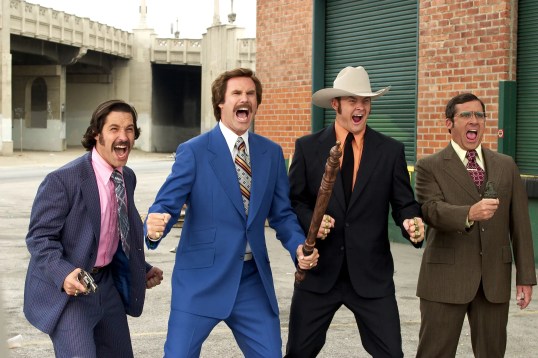
You got that right! That’s one reason why I’ve lost track of the number of times that I’ve watched Anchorman. Whatever’s going on in the world or my life, I know that Anchorman is going to make me laugh and make me feel better about things. The adventures of anchorman Ron Burgundy (Will Ferrell) and his news team (Paul Rudd, David Koechner, Steve Carell) never cease to amuse me, whether they’re capturing the birth of a panda or getting involved in a street fight with their rival newsmen.
“Brick killed a guy.”
He did! Where did Brick get a trident from? When the street fight started, he only had a hand grenade. Ron Burgundy suggests that Brick should find a safehouse and I hope Brick took his advice. There’s a lot of funny people in Anchorman but Steve Carell, playing the weatherman with an IQ under 80, is my favorite. Brick saying that he loves the lamp is so touching.
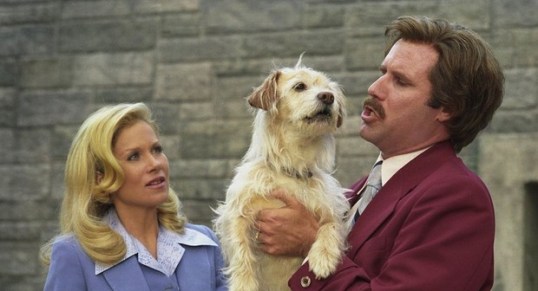
“Fare thee well, Baxter. You shall always be a friend of the bears.”
The first time I saw Anchorman, I couldn’t believe it when Baxter was drop-kicked off that bridge. I swore that I would never watch another movie featuring Jack Black! Baxter was so cute! When Ron broke down over the loss of his dog, I wanted to break down with him. Later, when Baxter emerged from the river and barked, “I’m coming, Ron!,” I was so relieved. Baxter lives! Baxter’s conversation with the bears warmed my heart.
“Stay classy, San Diego.”
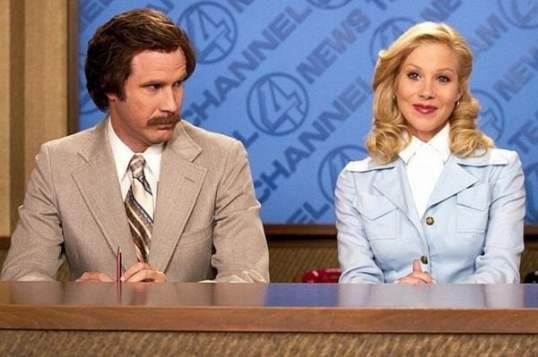
That’s right, San Diego! Stay classy. Anchorman is in a class all of its own. Ron Burgundy makes beautiful music with his jazz flute. Brian Fantana is a walking advertisement for Sex Panther. Veronica Corningstone (Christine Applegate) strikes a blow for women’s liberation and teaches Ron an important lesson about teleprompters. It’s the little moments that make me laugh the most, whether it’s Fred Willard talking to his son’s school about why his son has been expelled or Tim Robbins as the PBS anchor who smokes a pipe and chops off Luke Wilson’s arm or Vince Vaughn shouting about the ratings. Best of all, Will Ferrell has never been better than as the pompous Ron Burgundy, so stupid but so committed to his job that you can’t help but love him.
“Wow, that really escalated.”
You bet it did, Ron! Each moment of Anchorman is funnier than the last. (I wish the same was true of Anchorman 2.) That’s why Anchorman is a film that I watch and rewatch. In fact, I think I’ll go watch it right now!
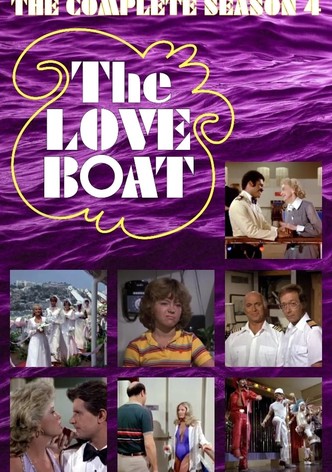
Welcome to Retro Television Reviews, a feature where we review some of our favorite and least favorite shows of the past! On Wednesdays, I will be reviewing the original Love Boat, which aired on ABC from 1977 to 1986! The series can be streamed on Paramount Plus!
This week, a baby is abandoned, an aunt visits, and for some reason, Joe Namath is on the boat.
Episode 4.27 “Maid for Each Other/Lost and Found/Then There Were Two”
(Dir by Howard Morris, originally aired on May 9th, 1981)
Ted Harper (Joe Namath) boards the boat with his best friend, Richard Henderson (Fred Willard). Ted and Richard were fraternity brothers. While in college, the members of the frat decided that, whenever one of them got married, some money would be contributed to a pot. The last single member of the frat would end up getting all of the cash, which is now up to $60,000. Ted and Richard are the last two single members of the frat and they’re competing to see who can hold out the longest.
(Can we just agree that guys are weird?)
Ted has a plan to get the money. He’s gotten his ex-girlfriend, Paula (Karen Grassle), to agree to trick Richard into falling in love with and marrying her, in exchange for some of the money. However, Richard is smarter than Ted realizes and instead offers Paula even more of the money to get Ted to marry her. However, Karen falls for Ted for real. Karen and Ted do get married when the ship docks in Mexico. When Richard announces that he paid Karen to marry Ted, Ted is hurt at first but then he realizes that he was willing to do the same thing to Richard and nothing matters more than love. Awwww!
Now, it may seem strange to cast Joe Namath and Fred Willard as friends. To me, it’s even stranger that this was not the first time that Joe Namath, who was not much of actor, appeared on The Love Boat. Just as he did the last time he was on the boat (and also just as he did when he last visited Fantasy Island), Namath wanders through the story with a goofy grin on his face.
Speaking of goofy, Gopher is super-excited when his wealthy aunt Loretta (Jane Powell) boards the boat. Loretta, however, is scared to tell Gopher that she has lost all of her money and is now working as a maid. Loretta need not have worried. I mean, it’s not as if Gopher has a particularly glamorous job. Plus, Loretta’s not going to be poor for long, not after she meets and falls in love with wealthy Duncan Harlow (Howard Keel).
Finally, Eddie Martin (Gary Burghoff) is a mechanic on the Love Boat who decides to abandon his baby with the captain. The captain, who apparently doesn’t know much about the people who work for him, has no idea who the baby’s father is. But when the baby is taken ill and needs a transfusion of super-rare AB blood, Eddie is forced to stand up and accept the responsibility of being a father. Good for him, I guess. Personally, I like fathers who don’t abandon their babies in the first place.
This was a fairly bland episode. The fourth season is nearly over and, with this cruise, everyone seemed to mostly be going through the motions. This episode seemed like a collection of stories that the show had already handled (and handled better) in the past.
In the fall of 1981, producer Robert Evans and NBC collaborated on Get High On Yourself week. For one week, the network featured its stars encouraging viewers to “Get High On Yourself!:” It all led up to a Get High On Yourself special, which Evans supervised as a part of the community service to which he was sentenced after he was caught getting high on cocaine.
In this clip, the hosts of an early reality show called Real People encourage viewers to “get high on yourself.” Of the hosts, Fred Willard was probably the only one who wasn’t high when this was filmed. Seen today, it’s impossible to watch this without feeling like Willard is doing a bit in an unreleased Christopher Guest movie.
Welcome to Retro Television Reviews, a feature where we review some of our favorite and least favorite shows of the past! On Thursdays, I will be reviewing City Guys, which ran on NBC from 1997 to 2001. The entire show is currently streaming on Tubi!
What’s happening with the neat guys? Let’s find out.
Episode 2.11 “A Nobel Profession”
(Dir by Frank Bonner, originally aired on November 21st, 1998)
Welcome to Manny High! Check out how convoluted this mess is.
Homecoming is approaching and Ms. Nobel tells her students that she will not be happy if she catches any of them playing a prank against Manny’s rival, George Washington High. Chris and Jamal decide that this means that they can pull a prank as long as Ms. Nobel doesn’t notice. So, somehow, they steal a gigantic, heavy, stone statue of George Washington from Washington High and they bring it to Manny High. Now, setting aside the issue of how they managed to steal the statue, why would they bring it back to Manny High? I mean, the whole idea is to keep Ms. Nobel from finding out about the prank.
Anyway, Ms. Nobel sees the statue and cancels the Homecoming dance and announces that no Manny High students, outside of the football team, will be allowed to attend the Homecoming game. On their radio show, Chris and Jamal announce that everyone is going to skip class and go up to the roof and play football. (How do they still have this show? Are school-sponsored radio shows allowed to promote skipping class?) Nobel is so upset to see everyone on the roof that she quits. As she explains it, she has never — in her 15 years of being the sole authority figure at a tough inner city school — been treated disrespectfully before.
Meanwhile, because this is a Thanksgiving episode, Cassidy and Dawn build a big paper-mache turkey for homecoming. But then L-Train and Al accidentally break off the turkey’s head. Rather than admit that it was their fault, they allow Cassidy and Dawn to fight over who was responsible. This is the sort of thing that Ms. Nobel would usually handle but Ms. Nobel is gone now and the new principal, Mr. Brown, doesn’t care.
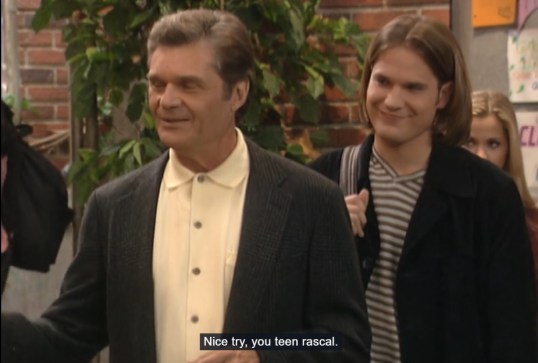
Mr. Brown, by the way, is played by …. FRED WILLARD!
Yes, that Fred Willard. I guess Christopher Guest wasn’t making a movie at the time so Fred was free to hop over to the City Guys set and play Mr. Brown. Mr. Brown is supposed to be a clueless and insensitive buffoon who doesn’t really care about the students but he’s played by Fred Willard so it’s impossible to dislike him. When Ms. Nobel eventually changes her mind and tells Mr. Brown to get off her campus, the audience applauds but the viewers are like, “No! We like Fred Willard!”
That said, I do have to wonder how Ms. Nobel could quit her job and then just change her mind a few days later without it being a big deal. She just walks into the school, announces that she’s back, and she tells Mr. Brown to leave. Does the School Board have any say in this?
On the one hand, this was a dumb episode.
On the other hand …. Fred Willard!
Episode 2.12 “Party of Three”
(Dir by Frank Bonner, originally aired on November 28th, 1998)
Despite using the broadcast to promote civil unrest, Chris and Jamal still have their radio show. When they get a call from a girl who asks whether or not she should dump her boyfriend, Jamal says sure. Uh-oh, the boyfriend was Al! And now, his ex-girlfriend wants to date Jamal! “You broke the code!” Ms. Nobel announces, showing that even she understands dude clichés.
Meanwhile, Dawn wants to throw a comet watching party on the school’s roof. L-Train ruins it by trying to get the attention of the aliens but accidentally getting the attention of the police instead.
This was a dumb episode but I did find it funny that Al, who usually portrayed as being a goofy sidekick, was apparently planning on killing his ex’s new boyfriend at one point and he even had a group of informants who were willing to help him out with his plans. This show could never quite decide just how dangerous Manny High was actually supposed to be.
What’s an Insomnia File? You know how some times you just can’t get any sleep and, at about three in the morning, you’ll find yourself watching whatever you can find on cable or Netflix? This feature is all about those insomnia-inspired discoveries!
Oh Lord.
So, if you were having trouble getting too sleep last night, you could have turned over to one of the many Showtime channels you could have watched the 2006 film, Ira & Abby.
I doubt it would have helped though. Ira & Abby is one of those extremely cutesy little love stories where a neurotic guy meets a quirky woman and they spend the entire film having so many easily solved relationship problems that it’ll drive your anxiety through the roof just watching them.
Ira (Chris Messina) is the son of two psychologists (Judith Light and Robert Klein). Ira is planning on becoming a psychologist himself and, of course, he’s in therapy. At the start of the film, his therapist tells him that he’s beyond help and that he needs to do something spontaneous for once. Ira takes this to mean that he should go the gym.
At the gym, Ira meets Abby (Jennifer Westfeldt), who is quirky and universally beloved by everyone who meets her. (Westfeldt also wrote the script, which …. might explain a little.) Abby has a positive attitude and lives with her musician parents (Fred Willard and Frances Conroy). After Ira sees Abby somehow talk a mugger out of robbing everyone on a subway car, he decides that they have to get married. Free-spirited Abby agrees.
Marriage follows! Complications follow! Annulment and remarriage and more follows! Everyone ends up seeing a different therapist while, at the same time, Ira’s mom has an affair with Abby’s dad. And yes, it eventually does end with every character in the film gathering in one room and taking part in a giant therapy session. It’s exhausting to watch, largely because it just seems like all of the problems could be solved by people not being stupid or foolishly impulsive. Ira is neurotic to the point of no longer being sympathetic. Abby is so perfect and wonderful that you soon get sick of her and her positive attitude. Even Ted Lasso would tell her to turn it down a notch.
The most frustrating thing about the movie is that it features good actors like Chis Messina but it goes out of its way to sabotage them every chance that it gets. Out of the large and impressive cast, only Fred Willard and Judith Light manage to transcend the script. I would have loved to have watched a movie just about their characters.
Rest in Peace, Fred Willard. The veteran comedian died, in his sleep, last night. He was 86 years old.
It’s hard to think of anyone who was as naturally funny as Fred Willard. Here’s one of my favorite Willard performances, from Rob Reiner’s This is Spinal Tap:
Willard appeared in all of Christopher Guest’s improvised mockumentaries. Here he is, with Catherine O’Hara, in Waiting for Guffman:
He was also in Best of Show, where his commentary on the dog show proved to be one of the film’s highlights:
The year is 1998 and America is flat broke. Paper currency is now worthless and, to the joy of Ron Paul supporters everywhere, all transactions are done in gold. After the country ran out of oil, people started using skateboards and bicycles for transportation and many turned their cars into homes. While the citizenry spends their time consuming a steady diet of sitcoms and reality television, the government tries to figure out how to pay back the loan that it took from Sam Birdwater (Chief Dan George), a Native American who made billions after buying Nike. Birdwater wants his money back and he is prepared to foreclose on the entire country.
Newly elected President Chet Roosevelt (John Ritter) is not helping. A combination of Jack Tripper and Jerry Brown (who was gearing up to challenge Jimmy Carter in the Democratic primaries when Americathon was first released), Chet Roosevelt is a spaced-out former governor of California who speaks in 70s self-help slogans and who is more interested in getting laid than leading the country. Roosevelt governs out of The Western White House, a condo in California. When an ad exec named Eric McMerkin (Peter Reigert) suggests a month-long telethon to raise the money to pay off the loan, Roosevelt leaps at the chance.
Hosted by Harvey Korman, the telethon (which is called, naturally, the Americathon) features a wide variety of acts. There’s a ventriloquist. Jay Leno boxes his grandmother. Meat Loaf destroys a car. Even Elvis Costello and Eddie Money make brief appearances. While Chet falls in love with one of the performers, his chief-of-staff (Fred Willard) plots, with the leaders of a new Middle Eastern superstate, to sabotage the telethon.
Based on a play by the Firesign Theater, Americathon has a big, talented cast that is let down by Neal Israel’s uncertain direction and a script that is only rarely funny. The idea of America hosting a tacky telethon to pay its debts sounds like a good SNL skit (especially if Bill Murray played the host) but the premise is too thin for a feature film. Like Airplane! or The Naked Gun films, Americathon is a movie that tosses every joke it can against the wall to see what will stick. If the jokes are good, like in Airplane!, that formula can lead to a comedy classic. If the jokes are bad, not even John Ritter, Harvey Korman, and Fred Willard can make them funny.
Today, if Americathon is remembered, it’s because it supposedly predicted several future events. Americathon does take place in a future where China is an economic superpower, Nike is a huge conglomerate, and reality game shows are very popular. But, even with those correct predictions, Americathon is a such a film of its time that it was probably dated from the minute that it was released. Just the sight of John Ritter in a condo permanently marks Americathon as a film of and about the ’70s.
George Carlin does score a few laughs as the narrator and Elvis Costello performs both Crawlin’ To The USA and (I Don’t Want To Go To) Chelsea. Eagle-eyed viewers might want to keep an eye out for the tragic Playboy playmate, Dorothy Stratten, who has a brief non-speaking role. Otherwise, Americathon is as hopeless as the country it’s trying to save.
That was largely my reaction to watching the 1998 film, Permanent Midnight. In this film, Ben Stiller plays Jerry Stahl, a real-life screenwriter who had a fairly successful career going in the 80s and early 90s. He came out to Los Angeles looking to be a serious writer but, instead, he ended up writing for silly puppet show and getting addicted to heroin. He also married a British television executive named Sandra (Elizabeth Hurley), so that Sandra could get her green card. When the star of a show that he writes for tells him to kick his habit or lose his job, Jerry ends up smoking crack cocaine with a new dealer (Peter Greene). When Sandra tells him that she’s pregnant, Jerry responds by shooting up in the bedroom. When he’s trusted to spend the day taking care of his baby daughter, he drives her around the seediest sections of Los Angeles while he searches for his drug dealer. As the baby cries beside him, Jerry shoots heroin into his jugular. Jerry ends up unemployable and abandoned by every friend that he had. He works at a fast food restaurant, or at least he does until he meets another recovering addict (Maria Bello). She’s the one to whom he tells his story, in between sex and bouts of impotence. In the end, what’s left for Jerry Stahl to do but write a book and then a movie about his life as a junkie?
It’s a harrowing story and I guess Stahl deserves some credit for writing the screenplay for a movie that doesn’t exactly make him look good. However, Permanent Midnight runs into the same problem that afflicts most movies about drug addiction. With very few exceptions, drug addicts are just not that interesting. The only thing more boring than watching someone shoot up is then having to listen to that person explain why he shoots up. (Trainspotting is the obvious exception but Trainspotting benefits from Danny Boyle’s frenetic direction, Ewan McGregor’s explosively charismatic lead performance, a witty script, and a killer soundtrack. These are things that Permanent Midnight lacks.) The film attempts to build up some sympathy for Stahl by telling us about his difficult childhood, his father’s suicide, and his mother’s instability but, in the end, Jerry is a junkie who shoots up in front of his baby. Regardless of how crappy his childhood was, it’s hard to care about whether or not he ever gets his shit together. Mostly, you just want someone to step in and make sure he never gets near that baby again.
Permanent Midnight makes another mistake, one that is all too common when it comes to films about troubled artists. It continually tells us that Jerry is a talented and important writer without ever showing us any evidence of that fact. We’re supposed to feel bad that Jerry is stuck working on a sitcom called Mr. Chompers but, at no point, does the film really convince us that he deserves anything better. Everyone says that Jerry is talented but we don’t really get to see any evidence of that fact. It’s hard not to feel that maybe Jerry should just be happy that, unlike the majority of writers in Los Angeles, he actually has a steady job.
(Jerry does get one good line, when he appears on The Maury Povich Show to promote his book and says, “People always ask, ‘What’s the worst thing heroin drove you to do?’ I always answer, ‘showing up on Maury.'”)
Of course, for most people, the main appeal of seeing Permanent Midnight will be the chance to see Ben Stiller shooting up heroin while soaked in withdrawal sweat. Stiller gives a serious performance, good enough that you regret that his acting career now seems to mostly consist of starring in bad movies and making cameos in even worse ones. There’s actually a lot of familiar faces in Permanent Midnight: Elizabeth Hurley, Maria Bello, Fred Willard, Owen Wilson, Sandra Oh, Janeane Garofalo, Andy Dick, and others. They all give good enough performance but ultimately, this is aimless and ultimately rather frustrating movie.



 The year is 1998 and America is flat broke. Paper currency is now worthless and, to the joy of Ron Paul supporters everywhere, all transactions are done in gold. After the country ran out of oil, people started using skateboards and bicycles for transportation and many turned their cars into homes. While the citizenry spends their time consuming a steady diet of sitcoms and reality television, the government tries to figure out how to pay back the loan that it took from Sam Birdwater (Chief Dan George), a Native American who made billions after buying Nike. Birdwater wants his money back and he is prepared to foreclose on the entire country.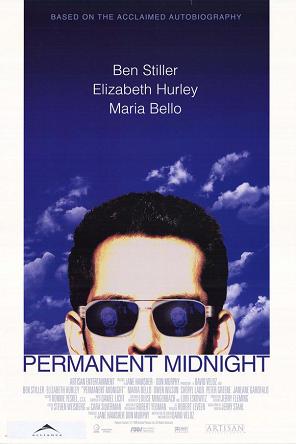
 Through the Shattered Lens