Welcome to Late Night Retro Television Reviews, a feature where we review some of our favorite and least favorite shows of the past! On Mondays, I will be reviewing CHiPs, which ran on NBC from 1977 to 1983. The entire show is currently streaming on Prime!
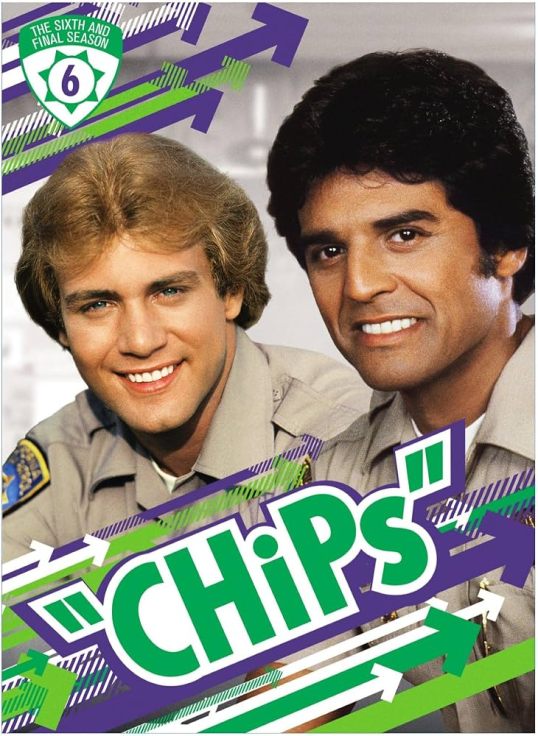
This week, we start the sixth and final season of CHiPs.
Episode 6.1 “Meet the New Guy”
(Dir by John Astin, originally aired on October 10th, 1982)
The sixth season of CHiPs opens up with some changes. Bonnie, Bear, and Turner are all gone. They’ve been replaced by Kathy (Tina Gayle) and Officer Webster (Clarence Gilyard, Jr.) Grossman (Paul Linke) is still providing comedic relief. Harlan (Lou Wagner) is still running the garage. Getraer (Robert Pine) is still the sarge. And Ponch (Erik Estrada) is still riding his motorcycle and flashing his grin.
However, this episode finds Ponch riding solo. Officer Baker is no longer his partner. This was because Larry Wilcox declined to return for another season, specifically because he felt that the producers only cared about keeping Estrada happy. On the show, it’s mentioned that Baker has relocated to Wyoming and he is now working on his father’s ranch. Ponch, however, is not without a partner for long. At the start of the episode, he meets Baker’s replacement. Bobby Nelson (Tom Reilly) is blonde and kind of spacey and he’s nicknamed “hot dog” because he likes to take risks. Ponch has been assigned to work as Nelson’s partner throughout Nelson’s probationary period. Getraer explains that Nelson reminds him of Ponch.
And really, that’s the problem. Ponch is a flamboyant motorcycle cop who smiles a lot and likes to take risks. Bobby is another flamboyant motorcycle cop who smiles a lot and likes to take risks. There’s not much difference between them. Even though Larry Wilcox and Erik Estrada didn’t get along behind the scenes, Baker and Ponch worked as a team because Baker was the opposite of Ponch. Baker was serious and by-the-book and he didn’t take unnecessary risks. Bobby, on the other hand, is pretty much just a blonde version of Ponch.
There is another problem as far as Bobby Nelson is concerned. Judging from this episode, Tom Reilly doesn’t appear to have been much of an actor. Larry Wilcox may not have had the most expansive emotional range but he was totally believable as a cop. Reilly, meanwhile, spends the entire episode looking somewhat spaced out. He delivers his lines in a flat monotone. From the start, there’s very little chemistry between him and Estrada. When Ponch complains about getting a new partner, one gets the feeling that he was expressing Estrada’s own feelings.
That said, this episode isn’t all bad. It opens with one of the most spectacular crashes in the show’s history. The tragic Dominique Dunne gives a strong performance as a teenage mother who sells her baby to a couple but then decides that she wants him back. This episode even manages to work quicksand into its finale. How can you not appreciate a show that makes use of quicksand?
Finally, this episode has one extended sequence that is so ludicrous that you just can’t help but smile while watching it. Two thieves have been robbing health clubs. They just happen to rob the one where Ponch is a member. (Fitness guru Richard Simmons plays Ponch’s teacher.) Ponch, clad only in a pair of black shorts and a motorcycle helmet, jumps on his motorcycle and chases after the robbers. The site of a half-naked Erik Estrada riding his motorcycle down the streets of Los Angeles is the perfect combination of silly and stupid.
This episode had its moments but I’m not really sold on Tom Reilly as a replacement for Larry Wilcox. We’ll see what happens!
 The year is 1998 and America is flat broke. Paper currency is now worthless and, to the joy of Ron Paul supporters everywhere, all transactions are done in gold. After the country ran out of oil, people started using skateboards and bicycles for transportation and many turned their cars into homes. While the citizenry spends their time consuming a steady diet of sitcoms and reality television, the government tries to figure out how to pay back the loan that it took from Sam Birdwater (Chief Dan George), a Native American who made billions after buying Nike. Birdwater wants his money back and he is prepared to foreclose on the entire country.
