Film Review: Cutter’s Way (dir by Ivan Passer)


Yesterday, after it was announced that actor John Heard had been found dead in a Palo Alto hotel room, I lost track of how many people declared that Cutter’s Way, a 1981 film in which Heard co-starred with Jeff Bridges, was one of their favorite movies of all time.  (That includes quite a few people who write for this very site.)  In fact, people were so enthusiastic about Cutter’s Way that I quickly decided that this was a film that I needed to watch for myself.  So, last night, after watching All About Eve on TCM and My Science Project with the Late Night Movie Gang, I curled up on the couch and I watched Cutter’s Way.

Technically, Cutter’s Way is a murder mystery but it’s actually a lot more.  In the grand noir tradition, the mystery is less important than the milieu in which it occurs.  Cutter’s Way takes place in Santa Barbara, California, which the film presents as being a microcosm of America.  It’s place where the rich are extremely rich and the poor are pushed to the side and expected not to complain.  The Santa Barbara of Cutter’s Way is controlled by new money and haunted by old sins.  It’s a world that is perfectly captured, by director Ivan Passer and cinematographer Jordan Cronenweth, in the film’s haunting opening scene:

John Heard plays Alex Cutter.  Years ago, Cutter served in Vietnam and returned with one less eye, one less arm, and one less leg.  An angry alcoholic, the type who always looks like he’s in desperate need of a shower and a shave, Cutter exists on the fringes of society.  Like many alcoholics, Cutter is a master manipulator.  When he has to, he can turn on the charm.  When the police are called after a drunken Cutter purposefully destroys his neighbor’s car, we suddenly see a totally different Alex Cutter.  He’s polite and apologetic, explaining that he was merely swerving to avoid something in the road and, by the way, he served his country in Vietnam.  As soon as the police leave, the real Cutter comes out.  He gets his bottle and starts to rant about how much the world owes him.  Watching the film, you find yourself understanding why some people might want to push this one-legged, one-armed, one-eyed veteran down a flight of stairs, that’s how obnoxious Alex Cutter can be.

And yet, there are people who love Alex Cutter.  There’s his long-suffering wife, Mo (Lisa Eichhorn).  Mo lives in squalor with Cutter, taking care of him and putting up with his bitterness.  There’s the local bar owner, who could probably put his kids through college on Cutter’s bar tab.  (He even drives Cutter home in the morning, after everyone else has deserted him.)  And finally, there’s Richard Bone (Jeff Bridges).

Bone is Cutter’s best friend.  Whereas Cutter is perpetually pissed off, Bone is almost always laid back.  Whereas Cutter feels that everything is his business, Bone prefers to remain detached from the world.  Mention is made of Bone being a graduate of the Ivy League but he spends most of his time giving tennis lessons and sleeping with wealthy women.  Bone takes care of Cutter, though their friendship is occasionally hard to figure out.  Why does Bone stick with Cutter despite all of Cutter’s abuse?  Perhaps Bone feels guilty because he avoided being drafted while Cutter lost half of his limbs in Vietnam.  Or maybe it’s because Bone is in love with Mo.

One night, when Bone is leaving a hotel, he sees a man in an alley.  The man appears to be hiding something in a dumpster.  Later, when the body of a woman is found in that same dumpster, Bone realizes that he probably saw the murderer.  Even more so, Bone thinks that the man resembled J.J. Cord (Stephen Elliott), one of the richest men in Santa Barbara.

Bone, however, isn’t sure that Cord’s the murderer.  Even more so, even if Cord was the murderer, Bone prefers to not get involved.  However, Cutter is sure that Cord’s the killer.  To Cutter, it makes perfect sense.  If men like Cord were willing to send boys to Vietnam and then refuse to take care of them when they returned both physically and mentally maimed by the experience, then why wouldn’t they also think that they could get away with murdering some hitchhiker?

Soon, Cutter has met the dead girl’s sister, Valerie (Ann Dusenberry).  Cutter says that his plan is to blackmail Cord.  He badgers the reluctant Bone into working with him.  It quickly becomes obvious, however, that Cutter is after more than money.  He is obsessed with proving that this rich and powerful man is a murderer.  And he’s not going to let anyone stand in his way.  Not even a stuffed animal:

As I said, Cutter’s Way is about much more than just a murder.  It’s a film about class differences, with even the otherwise slick Bone discovering how difficult it is to infiltrate Cord’s wealthy world.  It’s a film about disillusionment, cynicism, and the fleeting promise of happiness.  As angry as Cutter is, he still ultimately possesses the idealism that both Bone and Mo have lost.  He still believes in right and wrong.  While that angry idealism may make Cutter a pain in the ass, it’s also his redeeming feature.  As the youngest of them, Valerie is still an optimist but she is also the least prepared to deal with the sordid reality of the world around her.  Bone and Mo, meanwhile, both appear to have surrendered their belief that the world can be and should be a better place.  Ultimately, Cutter’s Way is a film that forces you to consider what you would do if you were in the same situation.  Cutter’s Way is not a great title, largely because it makes the film sound like a CW western, but it’s an appropriate one.  The entire film is about Cutter’s way of viewing the world and whether or not Bone will follow Cutter or if he’ll continue to refuse to get involved.

(The novel that the film’s based on was called Cutter and Bone.  According to Wikipedia, the title was changed because audiences thought the movie was a comedy about surgeons.)

I have to agree with those who have called Cutter’s Way a great film.  Not only is it gorgeous to look at but it’s one of the best acted films that I’ve ever seen, from the stars all the way down to the most minor of roles.  John Heard dominates the film, giving a performance of almost demonic energy but he’s perfectly matched by Jeff Bridges.  Bridges, back in his incredibly handsome younger days, gives a subtle and powerful performance as a man struggling with his conscience.  In the role of J.J. Cord, Stephen Elliott doesn’t get much screen time but he makes the most of it.  When he first see him, he’s riding a white horse and rather haughtily looking down on the world around him.  When he last see him, he delivers a line of such incredible arrogance that it literally left me stunned.  Though, when compared to Bridges and Heard, their roles are underwritten, both Lisa Eichhorn and Ann Dusenberry more than hold their own, providing able and poignant support.

Cutter’s Way is a great film and one that everyone should watch if they haven’t.


Lisa’s Early Oscar Nominations for July


With each passing month, the Oscar race becomes just a little bit clearer.  We are still a few months away from the true Oscar season but a few contenders have emerged.

My predictions are below.  Previously, my predictions were all based on wishful thinking and instinct.  Well, there’s still a lot of wishful thinking to be found below but, at the same time, the festival season is providing a guide and there are some early reviews that have started to come in.  I’ve never been a 100% correct in my predictions and I doubt this year is going to be any different.  (For one thing, I always predict 10 best picture nominees, even though that’s close to being a mathematical impossibility under the current Academy rules.)

One final note: Some day, the Academy will get over their resistance to Netflix and streaming.  I don’t think that’s going to happen this year, though.  I kept that in mind while considering the chances of such heavily hyped (and, for that matter, less heavily hyped) contenders as Mudbound and The Meyerowitz Stories.

Anyway, here are my predictions for July!  Be sure to check out my predictions for January, February, March, April, May, and June as well!

Best Picture

Call Me By Your Name

Darkest Hour

Detroit

The Disaster Artist

Dunkirk

The Florida Project

Goodbye Christopher Robin

The Greatest Showman

Logan

Wonderstruck

Best Director

Sean Baker for The Florida Project

Kathryn Bigelow for Detroit

Michael Gracey for The Greatest Showman

Christopher Nolan for Dunkirk

Joe Wright for Darkest Hour

Best Actor

Chadwick Boseman in Marshall

Willem DaFoe in The Florida Project

Hugh Jackman in The Greatest Showman

Gary Oldman in Darkest Hour

Donald Sutherland in The Leisure Seeker

Best Actress

Judi Dench in Victoria and Abdul

Kirsten Dunst in Woodshock

Frances McDormand in Three Billboards Outside of Ebbing Missouri

Emma Stone in Battle of the Sexes

Meryl Streep in The Papers

Best Supporting Actor

Steve Carell in Battle of the Sexes

James Franco in The Disaster Artist

Armie Hammer in Call Me By Your Name

Will Poulter in Detroit

Patrick Stewart in Logan

Best Supporting Actress

Penelope Cruz in Murder on the Orient Express

Holly Hunter in The Big Sick

Melissa Leo in The Novitiate

Julianne Moore in Wonderstuck

Margot Robbie in Goodbye Christopher Robin


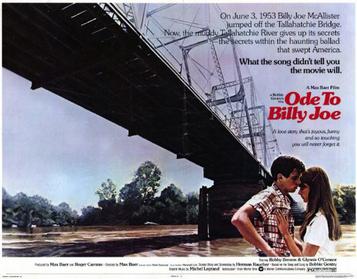
Film Review: Ode to Billy Joe (dir by Max Baer, Jr.)


Why, on June 3rd, did Billie Joe McAllister jump off of the Tallahatchie Bridge in Mississippi?

That was the question that was asked in Ode to Billie Joe, a 1967 country song by Bobbie Gentry.  In the song, the details were deliberately left inconclusive.  Why did Billie Joe commit suicide?  No one knows.  All they know is that he was a good worker at the sawmill and, the weekend before jumping, he was seen standing on the bridge with a teenage girl and apparently, they dropped something down into the river below.  The song suggests that the girl and the narrator are one in the same but even that is left somewhat vague.

Ode to Billie Joe was a hit when it was first released, largely because it’s story could be interpreted in so many different ways.  Why did Billie Joe kill himself?  Maybe it was because he didn’t want to be drafted.  Maybe it was because he and his girlfriend had killed their baby and tossed it off the bridge.  Maybe it was because he was hooked on Dexedrine and his doctor wasn’t available to renew his prescription.  It could be any reason that you wanted it to be.

However, in 1976, when Ode to Billie Joe was turned into a movie, ambiguity would not do.  As opposed to the song, Ode To Billy Joe had to answer the question as to why Billy Joe jumped into that river.  In the movie, 18 year-old Billy Joe (Robby Benson) works at the sawmill and spends his time courting 15 year-old Bobbie Lee Hartley (Glynnis O’Connor).  Bobbie Lee’s father (Sandy McPeak) says that she’s too young to have a “gentleman caller,” even though Bobbie Lee insists that she’s “15 going on 34 … B cup!”  Bobbie Lee warns Billy Joe that her father is liable to shoot his ears off but Billy Joe insists that he doesn’t need ears because he’s in love with her.  That’s kind of a sweet sentiment, even though I don’t think Billy Joe would look that good without ears.

(Whenever I complain about how Southerners in the movies always seem to have two first names, my sister Erin replies, “Yeah, that’s really annoying, Lisa Marie.”  So, I won’t make a big deal about it this time…)

One night, Billy Joe and his friends go out and Billy Joe ends up getting drunk.  He disappears for several days and when he shows up again, something has definitely changed.  After unsuccessfully trying to make love to Bobbie Lee, Billy Joe tells her what happened that night he got drunk.  Billy Joe had sex with a man, something that he has been raised to view as being the ultimate sin.  When Billy Joe is later pulled out of the river, the entire town wonders why he jumped off the bridge and how Bobbie Lee was involved…

Ode to Billy Joe, which aired last Tuesday on TCM, is a better-than-average film, one that I was surprised to have never come across in the past.  That doesn’t mean that it’s a perfect movie. Robby Benson, in the role of Billy Joe, gives an absolutely terrible performance.  You can tell that Benson was trying really hard to do a good job but, often, he goes totally overboard, making scenes that should be poignant feel melodramatic.  Though it probably has more to do with when the film was made than anything else, the film is also vague about Billy Joe’s sexuality.  Is Billy Joe in denial about his identity?  Is he deeply closeted or was he in such a drunken stupor that he was taken advantage of?  Ode to Billy Joe does not seem to be sure.  By committing suicide, Billy Joe joins the ranks of gay movie characters who would rather die than accept their sexuality.  Obviously, he had to jump off that bridge because that’s what the song said he did but there’s a part of me that wishes the movie had featured someone commenting that they never actually found Billy Joe’s body and then the final scene could have taken place 16 years later, with Bobbie Lee living as a hippie in San Francisco and just happening to spot Billy Joe walking down the street, hand-in-hand with his boyfriend.

Here’s what does work about the movie.  Glynnis O’Connor gives a great and empathetic performance as Bobbie Lee.  The scenes with her father and her mother (played by Joan Hotchkis) have a very poignant and wonderful realness to them.  Though I’ll always be a city girl at heart (well, okay — a suburb girl), I spent some time in the country when I was growing up.  And while I was never quite as isolated as Bobbie Lee (who lives in a house with no electricity or plumbing) and the film took place in the past, I could still relate to many of Bobbie Lee’s experiences.  The film may have been made in 1976 and set in 1952 but life in the country hasn’t changed that much.

For instance, there’s this great scene where Bobbie Lee’s father is trying to drive across the bridge.  The only problem is that there’s a bunch of drunk shitkickers on the bridge, sitting in their pickup truck and blocking his way.  It’s a very tense scene, one that I found difficult to watch because, when I was growing up in Arkansas, Oklahoma, Louisiana, and South Texas, I saw the exact same thing happen more times than I care to admit.  In the country, no one backs down.  Scenes like that elevated Ode To Billy Joe to being something more than just another movie based on a song.

Finally, there’s a beautiful scene towards the end of the film, between Bobbie Lee and a character played by an actor named James Best.  I won’t spoil the scene but it’s a master class in great acting.  (Best also played one of the sadistic villains in Rolling Thunder, another good 70s film about life and death in the country.)

Though I wasn’t expecting much from it, Ode to Billy Joe was a pleasant surprise.  It’s not perfect but it’s still worth watching.

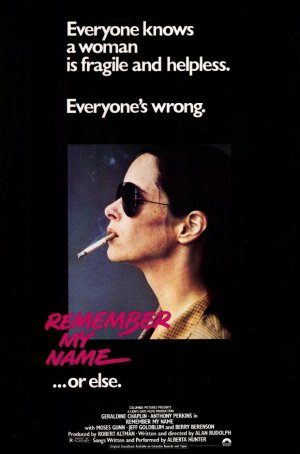
Insomnia File #27: Remember My Name (dir by Alan Rudolph)


What’s an Insomnia File? You know how some times you just can’t get any sleep and, at about three in the morning, you’ll find yourself watching whatever you can find on cable? This feature is all about those insomnia-inspired discoveries!

If you were having trouble sleeping last Tuesday, around one in the morning, you could have turned over to TCM and watched Remember My Name, an odd and sometimes frustrating little thriller from 1978.

Remember My Name opens with Emily (Geraldine Chaplin) showing up in a small town in California.  From the minute we first see and hear Emily, something seems to be off about her.  She views the world through suspicious eyes.  Whenever anyone talks to her, you’re never quite sure whether she’s going be friendly or if she’s going to lash out.  When she speaks, there’s something weird about her vocal inflection, as if she’s always struggling to figure out what she’s supposed to say.  She seems to be separated from the world, almost as if she’s walking through a living dream and only talking to figments of her imagination.  There’s nothing about her that feels at all authentic.

She moves into a small apartment and enters into a relationship with her handyman (Moses Gunn), a relationship that seems to be largely defined by her refusal to open up about herself.  She gets a job at a grocery story that’s managed by a Mr. Nudd (Jeff Goldblum).  Mr. Nudd mentions something about Emily knowing his mother.  Apparently, they met in prison.

Soon, Emily is stalking a construction worker named Neil Curry (Anthony Perkins).  When Neil spots her, he calls out her name and Emily runs away.  And yet, Neil doesn’t bother to tell his wife, Barbara (Berry Berenson), about Emily.  Soon, Emily is even breaking into the Curry home, silently shadowing Barbara as she walks through the house.

I described Remember My Name as being a thriller and I guess that, technically it is.  There are a few moments of tension, especially when Emily is stalking Barbara.  However, the film itself is directed in a detached manner by Alan Rudolph.  Rudolph was a protegé of director Robert Altman (who also produced Remember My Name) and Rudolph’s approach is very Altmanesque, often to the detriment of the film.  (Chaplin and Jeff Goldblum had both appeared in several Altman films, most famously in Nashville.)  Though the film is dominated by Chaplin and Perkins, it’s still very much an ensemble film and the action plays out in a deceptively casual, almost random manner.  It tries so hard to be Altmanesque that Remember My Name gets a bit frustrating, to be honest.  Chaplin gives such a good and memorable performance and she works very hard to make Emily a character who is both frightening and, at times, surprisingly sympathetic but, for the most part, Rudolph’s technique makes it difficult to get emotionally involved in any of the action unfolding on-screen.  Rudolph observes the action but refuses to comment on it.  As a result, Remember My Name is occasionally intriguing but, just as often, it’s rather boring.  Just like real life, I suppose.  And, just like real life, it’s not for everyone.

That said, it was interesting to see Anthony Perkins playing a role other than a knife-wielding inn manager.  Without resorting to any of the familiar tics or the neurotic speech patterns that typecast him forever as Norman Bates, Perkins plays Neil as just being a regular, blue collar guy and he actually does a pretty good job.  Watching the film, I got the feeling that this was perhaps Perkins’s attempt to change his image.  (Whenever Neil appears shirtless, both the film and Perkins seem to be saying, Check out this physique!  Would someone only capable of playing a psycho have abs like this?)  Neil’s wife, Barbara, was played Perkins’s wife, Berry Berenson.  Neither one of them is with us any longer.  Perkins died of AIDS in 1990 while Berry Berenson was on one of the planes that flew into the World Trade Center on 9-11.  They both did good work in this film, as did Chaplin and Goldblum and, really, the entire cast.  It’s just a pity that the film itself isn’t as good as the performances. 

Previous Insomnia Files:

  1. Story of Mankind
  2. Stag
  3. Love Is A Gun
  4. Nina Takes A Lover
  5. Black Ice
  6. Frogs For Snakes
  7. Fair Game
  8. From The Hip
  9. Born Killers
  10. Eye For An Eye
  11. Summer Catch
  12. Beyond the Law
  13. Spring Broke
  14. Promise
  15. George Wallace
  16. Kill The Messenger
  17. The Suburbans
  18. Only The Strong
  19. Great Expectations
  20. Casual Sex?
  21. Truth
  22. Insomina
  23. Death Do Us Part
  24. A Star is Born
  25. The Winning Season
  26. Rabbit Run

Short Film Review: Girl and a Scar (dir by David Cave)


I always enjoy watching and reviewing short films.

The short film format challenges both the filmmaker and the viewer.  For the filmmaker, the challenge is to take the audience on a full cinematic journey in a limited amount of time.  It’s one thing when you have two hours to tell a story, it’s something entirely different when you’ve only got 15 minutes.  As a result, the visuals and the acting become even more important.  You can’t have one wasted shot or one performance that feels out-of-place.  For the viewer (and the reviewer, for that matter), the challenge is to relearn how to watch a movie.  Short films force you to pay attention to every single detail because, often times, it’s only through catching those details that you’ll be able to understand what you’ve just seen.  In short films, there’s no time for the director or screenwriter to come back, take you by the hand, and say, “This is what it all means.”  Instead, it’s up to you to figure it out.  I love a challenge and that’s why I always appreciate and enjoy the chance to watch and review a short film.

For instance, I recently had a chance to watch Girl and a Scar, a 15-minute film from moviemaker David Cave.  It’s a challenging film, one that is full of surreal imagery and haunting atmosphere.  While the ever-present wind howls on the soundtrack, we find ourselves looking at an isolated house, one that would not be out-of-place in a Jean Rollin vampire film.  Inside the house, the Girl (Ileana Cardy) cuts herself with a razor blade.  Throughout the movie, the wound grows, almost as if it has a mind of its own.  We see the Girl outside, standing in front of what appears to be an industrial park and watching as a young man walks away from her and then as a man in a … well, I’m not going to spoil the details.  Let’s just say that she’s approached by a man in a very memorable costume.  In between the scenes of the Girl walking along the beach and stumbling through her isolated home, there are snippets of animation.  We see the girl in the forest, a cartoon that is occasionally eating and occasionally throwing up.  Connecting it all is the sound of that howling wind and that ever-growing wound on the Girl’s stomach.

The imagery is frequently shocking and disturbing and yet, because Cave does such a good job framing his images and maintaining the film’s atmosphere, the film is always watchable.  It helps that Ileana Cardy, though having no dialogue, gives a good and empathetic performance as the Girl.  You may not always understand what is happening to here but you want to understand and that’s the important thing.  From the minute it opens, Girl and a Scar invites you to investigate and try to solve its mysteries.  With the mix of body horror and animation, Girl and a Scar at times feels like a fairy tale told by David Cronenberg.

Short films are not necessarily easy to track down but I do recommend making the effort.  Hopefully, this one will soon start making the festival circuit.


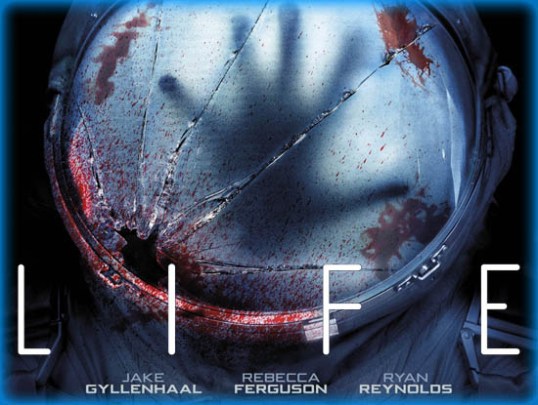
Playing Catch-Up With The Films of 2017: Life (dir by Daniel Espinosa)


I don’t care what Neil deGrasse Tyson says.  Space is dangerous.

Just judging by what I’ve seen in the movies, it might be a good idea for humanity to stay earthbound.  Seriously, it seems like every time a group of astronauts and scientists spend an extended period of time off of our planet, bad shit happens.  They either end up leaving behind someone on Mars or sometimes they crash land on a planet inhabited by vampires.  Occasionally, they end up with evil creatures bursting out of their chest and, if they’re not careful, they might even end up accidentally traveling all the way to Hell and back.

For that matter, it might be a good idea to also stop listening to Bill Nye.  I’ve seen enough movies to know better than to trust science.  Did you know that every time a revived corpse has gone on a killing spree, a scientist has been to blame?  In the movies, science always says it’s going to make the world a better place but ultimately, it just seems to make things worse.

Consider Life, for instance.

This science fiction film, which came out earlier this year and didn’t stick around in theaters for very long, opens with the crew of the International Space Station taking questions from a group of school children on Earth.  Everyone is really excited because a probe has been picked up evidence that there was once extraterrestrial life on Mars.  Starting from one cell, the scientists have managed to clone an alien organism.  (Or something like that.  Wisely, the movie doesn’t waste too much time on how all of this actually works.)  The school kids name the organism Calvin.

Isn’t that cute?

But here’s the thing.  Life is a science fiction/horror movie hybrid and, as a result, we already know that it was a mistake to bring that alien to life.  We know that almost everyone in that space station is going to die a terrible death.  It doesn’t matter that the scientists are played by people like Jake Gyllenhaal, Ryan Reynolds, and Rebecca Ferguson  We know what is going to happen because we’ve all seen at least one movie in the Alien franchise.  We know what’s going to happen and, when things start to fall apart, the entire audience nods and says, “I told you so.”

That’s not to say that Life doesn’t work.   Life may be predictable but that’s actually a part of the film’s charm.  This is the type of film that you need to watch with a group of your loudest and snarkiest friends.  (I watched it with my sisters during the 4th of July weekend.  We all love Jake.  We all love Ryan.  Things got a bit out of hand.)  You don’t watch Life because you’re looking for an upbeat portrait of space exploration.  You watch Life so that you can yell, “No, don’t bring Calvin to life!  No, you idiot!  Don’t go into space!  Don’t lock yourself in the lab!  HAVEN’T ANY OF YOU SCIENTISTS EVER SEEN A HORROR MOVIE BEFORE!?”

(Indeed, one of the unexpected pleasures of Life was seeing that even brilliant people will do stupid things when confronted by the unknown.)

That said, Life occasionally caught me off guard.  It’s not that I was shocked to see the members of the cast being picked off one by one by Calvin.  Instead, I was shocked by the film’s relentlessly dark and bleak vision.  For a film called Life, it’s ultimately all about death.  Just because a character is being played by a big star, that doesn’t mean they won’t end up with Calvin entering their body and graphically devouring them from the inside out.  Calvin was a truly frightening creation and director Daniel Espinosa does a good job of capturing the claustrophobia and clutter of the space station.  Even if they didn’t exactly break any new ground, Espinosa and screenwriters Rhett Reese and Paul Wernick deserve a lot of credit for pursuing the film to its dark conclusion.  In space, they seem to suggest, there is no hope.

In conclusion, the main lesson of Life seems to be this: outer space is a terrible place and the worst thing that humanity can do is leave the planet.  Science is going to be the death of us.  Neil deGrasse Tyson has a lot to answer for.

Gremlin: Movie Preview/Review and trailer


grmlin


Directed by:  Ryan Bellgardt

Cast: Adam Hampton, Kristy K. Boone, Geoff Barron


Preview:

Adam receives a mysterious box from a relative containing a creature that will kill everyone he cares about. The only way to be rid of the curse is to give the box to someone he loves. As the ominous timer on the box counts down to its end, he can only imagine the horrors that await. Does he give the box away to save his family, or unleash a monster upon humanity? He can’t destroy it. He can’t escape it. He can only give it to someone he loves…


Review:

Often I don’t like horror movies (actually rarely) But this time I got pulled in, so to speak. This movie will eventually eat at you. Literally EAT AT YOU!  Also, would be a good idea not to cover your eyes!


Would I recommend this movie? 

With a blind shot!

Gremlin_Stills_4_1.55.1.tif


Now let’s all gather around and watch the trailer:


Yeh, I am freaked out too!


Gremlin will be available on VOD July 11th

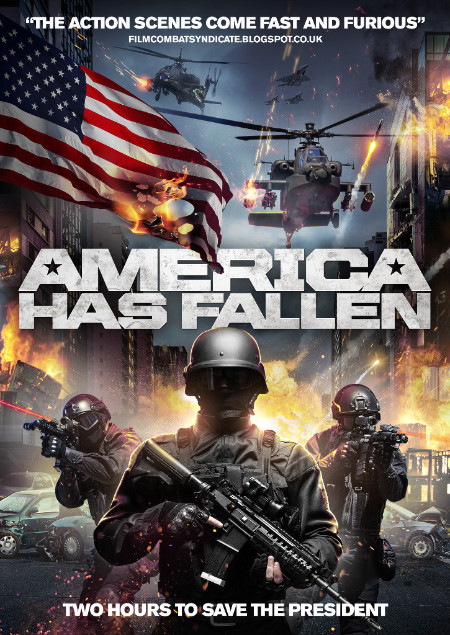
America Has Fallen: Movie Preview/Review and trailer


Amerca fallen


Written, Directed and Star: Tom Getty

Preview:

When a former marine is framed for a deadly terrorist bombing, he must track down the mastermind behind the plot. But soon he discovers an even deadlier conspiracy that threatens the nation. One that will force him to choose between the freedom of millions, and his own survival.

Review:

I am going to make this short and sweet:

I love low budget indie films. They are the bread and butter of what I review.  Getty somehow manages to pull me in by keeping a torrent pace, which is a good thing. You never really get to focus on what is right in front of you.

The CGI is just what you would expect. The acting, well the same.

Would I recommend this movie?

Let’s grab a few beers, sit down and watch the trailer:

And if you want, I’ll watch the movie with you!

America Has Fallen will be available on VOD July 4th 2017

Film Review: Baby Driver (dir by Edgar Wright)


Baby Driver, the new film from director Edgar Wright, is awesome!

That’s the succinct way of putting it and, if you really want to fully enjoy this film, I suggest that you stop reading this review now. There’s no way that a review cannot, to a certain extent, spoil a movie.  Baby Driver is a kinetic blend of action, comedy, romance, and music and it is a movie that you should see without any preconceived notions and expectations.  It’s a movie that earns the right to surprise you with just how good and entertaining it is.  It’s a movie that you should experience fresh.

So, go see the movie.  Seriously, go right now.  GET OUT OF HERE AND SEE THE MOVIE!  This review will still be waiting for you when you get back.  Who knows?  Maybe, while you’re watching the movie, I’ll actually correct some of the typos.  Or maybe not.

Anyway, go away.  I’ll wait for you to return.

la dee da la dee da…

Okay, did you see the movie?  It’s really great, isn’t it?

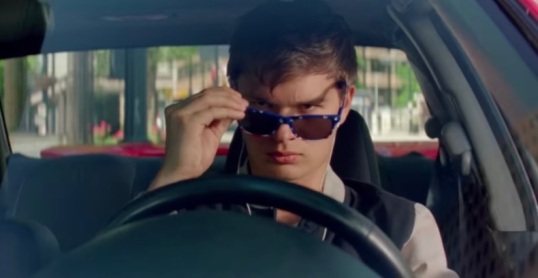
As a result of the childhood car accident that killed his parents, Baby (Ansel Elgort) has been left with a permanent case of tinnitus.  He uses music to drown out the constant ringing in his ears.  There’s almost never a time that Baby isn’t listening to his ipod.  When we first see Baby, he’s sitting behind the wheel of a car, singing along with Jon Spencer and the Blues Explosion.  The second time that we see him, he’s getting coffee while listening to Harlem Shuffle.  In a delirious homage to Singin’ In The Rain (and in a scene that puts the opening traffic jam of La La Land to shame), Baby literally dances across the streets of Los Angeles.  For Baby, every day is a musical.

Of course, Baby doesn’t just use music to block out the ringing.  He also uses the music (and an ever-present pair of sunglasses) to keep the world out.  He rarely speaks or even makes eye contact and, as long as he’s listening to his ipod, he has an excuse not to interact.  He doesn’t have to explain the small scars around his eyes or how he makes his money.  The few times that he does speak to people, it’s to record their voices, which he then turns into music.  Music and the driving are the only two ways this orphan can express his feelings.

When the movie begins, Baby appears to be close to only two men.  One is his deaf foster father, Joseph (CJ Jones).  Baby lives with Joseph, in an apartment where Baby regularly stashes thousands of dollars.  Joseph always watches in disapproval as Baby hides the money under the floorboards.  Joseph signs at Baby that he deserves better than the life he’s leading.  Baby always signs back that he’s only a few jobs away from being done.

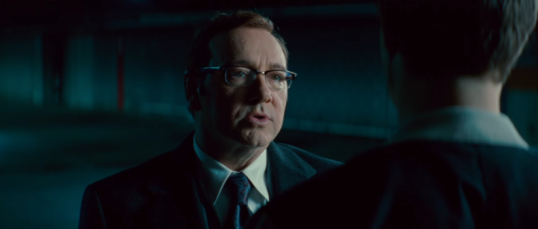
Baby’s other father figure is Doc (Kevin Spacey).  Doc is a rich and connected man.  At times, he seems to sincerely care about Baby but there are other times when Doc is just as quick to threaten to kill him and everyone that he loves.  Doc plans bank robberies for a living.  Doc may change associates from robbery to robbery but one thing always remains consistent.  Baby is always his driver because Baby is the best.  As Doc explains it, the first time he saw Baby, he was stealing Doc’s Mercedes.  Baby drives for Doc as a way of paying off his debt to the older man but you still believe Baby’s sincerity when he tells Doc, “We’re a team.”  (One the film’s best throw-away jokes is the line where Doc reveals that he knows where Baby got the idea to say that.)

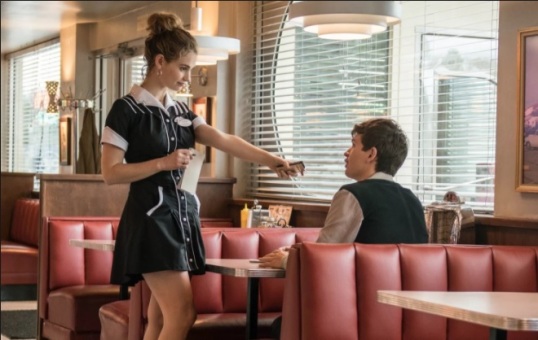
Things start to change for Baby when he meets Debora (Lily James), a waitress who appears to love music just as much he does.  For Baby and Debora, it’s love at first sight but Doc has one more job that he needs Baby for.  It’s their most dangerous job yet and, making thing even more complicated, are the three people who Doc has recruited to work with Baby.  Buddy (Jon Hamm) is a former wall street banker who is eager to prove what a badass he is.  Darling (Eiza Gonzalez) is his wife, who enjoys talking about how many of their former partners have died.  And finally, there’s Bats (Jamie Foxx), a complete and total psycho who brags about never telling a single story that doesn’t end with someone getting killed.

Baby Driver is a propulsive blast of pure adrenaline, perhaps the closest that we will ever get to a genuine pulp musical.  The action scenes left me literally breathless.  I saw the movie at the Alamo Drafthouse and, before the film started, there was a clip of Edgar Wright listing his favorite car chases.  He listed all of the usual suspects, Bullitt, The French Connection, Mad Max: Thunder Road.  The chases scenes in Baby Driver can proudly be listed next to all of those scenes.  This is genuinely exciting crime film, featuring wonderfully over-the-top turns from Foxx, Hamm, and especially Spacey.

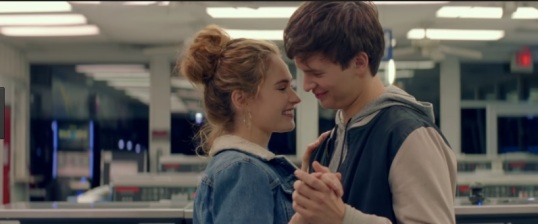
But you know what?  Baby Driver may be a great action film but what makes it special is that it’s also a film with a heart.  Rather bravely, Edgar Wright has not only made an action musical but he’s also mixed in a very sincere and unabashedly sentimental love story.  You never doubt for a second that Baby would give up everything — music, driving, even his life — for Debora.  The scenes between Baby and Debora are almost deliriously romantic.  Ansel Elgort and Lily James both share a very likable and very real chemistry.  You want things to work out for Debora and Baby.  You feel like they belong together and, when it looks like either Baby or Debora might be in danger, you worry for both of them.  As exciting as the film’s action sequences were, it was the ending that brought tears to my eyes and that was almost totally due to the performances of Elgort and James.

Baby Driver is one of the best films that I’ve seen so far this year.  See it this weekend!  If you’ve already seen it, see it again!  This film deserves to be rewarded.