Cannes Film Review: Missing (dir by Costa-Gavras)


The 1982 film Missing takes place in Chile, shortly after the American-backed military coup that took out that country’s democratically elected President, Salvador Allende.

Of course, the film itself never specifically states this.  Instead, it opens with a narrator informing us that the story we’re about to see is true but that some names have been changed “to protect the innocent and the film.”  The film takes place in an unnamed in South America, where the military has just taken over the government.  Curfew is enforced by soldiers and the sound of gunfire is continually heard in the distance.  Throughout the film, dead bodies pile up in the streets.  Prisoners are held in the National Stadium, where they are tortured and eventually executed.  Women wearing pants are pulled out of crowds and told that, from now on, women will wear skirts.  The sky is full of helicopters and, when an earthquake hits, guests in a posh hotel are fired upon when they try to leave.  About the only people who seem to be happy about the coup is the collection of brash CIA agents and military men who randomly pop up throughout the film.

Again, the location is never specifically identified as Chile.  In fact, except for the picture of Richard Nixon hanging in the American embassy, the film never goes out of its way to point out that the film itself is taking place in the early 70s.  If you know history, of course, it’s obviously meant to be Chile after Allende but the film itself is set up to suggest that the story its telling is not limited to one specific place or time.

Charlie Horman (John Shea) is an American who lives in the country with his wife, Beth (Sissy Spacek).  Charlie is a writer who occasionally publishes articles in a local left-wing newspaper.  In the aftermath of the coup, Charlie is one of the many people who go missing.  All that’s known is that he was apparently arrested and then he vanished into the system.  The authorities and the American ambassador insist that Charlie probably just got lost in the confusion of the coup and that he’ll turn up any day.  Even though thousands have been executed, everyone assumes that Charlie’s status as an American would have kept him safe.  As brutal as the new government may be, they surely wouldn’t execute an American….

Or, at least, that’s what Ed Horman (Jack Lemmon) believes.  Ed is Charlie’s father, a businessman from New York who simply cannot understand what’s going on.  He can’t understand why his son and his daughter-in-law went to South America in the first place.  He can’t understand why his government is not doing more to find his son.  And, when he eventually arrives in South America himself, Ed cannot understand the violence that he sees all around him.

Working with Beth, Ed investigates what happened to his son.  At first, Ed blames Beth for Charlie’s disappearance and Beth can barely hide her annoyance with her conservative father-in-law.  But, as their search progresses, Beth and Ed come to understand each other.  Beth starts to see that, in his way, Ed is just as determined an idealist as Charlie.  And Ed learns that Charlie and Beth had good reason to distrust the American government…

Costa-Gavras is not exactly a subtle director and it would be an understatement to say that Missing is a heavy-handed film.  The Embassy staff is so villainous that you’re shocked they don’t all have mustaches to twirl while considering their evil plans.  When, in a flashback, Charlie meets a shady American, it’s not enough for the man to be a CIA agent.  Instead, he has to be a CIA agent from Texas who heartily laughs after everything he says and who brags on himself in the thickest accent imaginable.  When Charlie talks to an American military officer, it’s not enough that the officer is happy about the coup.  Instead, he has to start talking about how JFK sold everyone out during the Bay of Pigs.

As the same time, the film’s lack of subtlety also leads to its best moments.  When Beth finds herself out after curfew, the city turns into a Hellish landscape of burning books and dead bodies.  As Beth huddles in a corner, she watches as a magnificent white horse runs down a dark street, followed by a group of gun-toting soldiers in a jeep.  When Ed and Beth explore a morgue, they walk through several rooms of the “identified” dead before they find themselves in a room containing the thousands of unidentified dead.  It’s overwhelming and heavy-handed but it’s also crudely effective.  While the film itself is a bit too heavy-handed to really be successful, those scenes do capture the horror of living under an authoritarian regime.

(Interestingly, Missing was a part of a mini-genre of films about Americans trapped in right-wing South American dictatorships.  While you can’t deny the good intentions of these films, it’s hard not to notice the lack of films about life in Chavez’s Venezuela or the political dissidents who were lobotomized in Castro’s Cuba.)

Missing won the Palme d’Or at the 1982 Cannes Film Festival (an award that it shared, that year, with the Turkish film Yol) and it also received an Oscar nomination for best picture of the year.  (It lost to Gandhi.)

Cannes Film Review: I, Daniel Blake (dir by Ken Loach)


As I watched the 2016 film, I, Daniel Blake, two thoughts ran through my head.

First: This is one of the saddest, most powerful films that I’ve ever seen.

Second: It’s a pity that, for all of his talent, Ken Loach is such an anti-Semitic twat.

Daniel Blake (Dave Johns) is a carpenter who lives in Newcastle.  He’s a widower who lives alone in a small flat, keeps an eye on his neighbors, and always tries to do the right thing.  As he explains it, he’s never asked for nor accepted charity.  He’s worked hard all of his life and all he’s ever asked is to be treated with respect in return.  After suffering a heart attack, he is told by his doctor that it will be a while before he can safely return to work.  However, when Blake goes to the Department of Work and Pensions, he is told that he had been evaluated and he only “scored 12 points.”  In order to receive an employment and support allowance, he would need to score 14 points.  How does one score 14 points?  No one seems to be quite sure.  Fortunately, there is an appeals process but no one appears to be willing to give Dan a straight answer as to how the process works.  He’s told that it can’t even start until he gets an official call informing him that his application for the allowance has been denied.  Of course, Dan already knows that he’s been denied because, through a bureaucratic snafu, Dan received a letter telling him that he’s been denied.  However, it doesn’t matter that he already knows it.  What matters is that he wait for the official phone call.

In the meantime, it is continually suggested that Dan go online to solve all of his problems, despite the fact that Dan is 59 year-old and has next to no idea how to work a computer.  (When he does go online, he’s forced to ask strangers for help with everything from using the mouse to submitting his forms.)  Broke, Dan applies for a jobseeker’s allowance and is told that he had to spend 35 hours a week looking for employment, despite the fact that his doctor has not cleared him to work.  Whenever someone is willing to hire Dan, Dan is forced to admit that he can’t take the job, adding to the list of his daily humiliations.

Meanwhile, Dan befriends a single mother, Katie (Hayley Squires), who is literally starving herself so that her children will have enough to eat.  (In one of the film’s most powerful scenes, Katie has a breakdown at a food bank.)  When she’s caught shoplifting, a security guard offers to help her out but his help comes with a price of its own.

And through it all, the state continues to grind both Dan and Katie into the ground.  With its harrowing portrayal of two people literally being destroyed by a combination of poverty and authoritarian bureaucracy, I, Daniel Blake is the rare movie that can be enjoyed by both socialists and libertarians.  At no point does I, Daniel Blake romanticize the poverty of its characters.  From the minute we first see Daniel, he is obviously a very ill man and the film does not flinch from showing the personal toll of the daily humiliations of his struggle to just get someone to listen to his voice.  As we watch, we hope things will work out for Dan and Katie, even though we know they won’t.  Katie is fond of saying that she’s going to go back to school and Dan even makes her a bookcase for her future school books but again, we know it’s a dream that will probably never come true.  It’s not a happy film but it is a powerful one.

That said, I nearly didn’t watch I, Daniel Blake because of the fact that it is a Ken Loach film.  Loach is one of the world’s most acclaimed directors, a filmmaker and activist who has been making movies since the late 1960s.  Loach is known for his willingness to make films that both deal with social issues and challenge the British status quo.  Though he may not be well-known in the States, he’s a controversial figure in the UK.  He’s also one of the leading supporters of the despicable BDS movement and, when one looks over his public comments, it’s hard not to get the impression that his criticism of Israel is motivated by more than just disagreement with Israeli government policy.

But I did watch because, ultimately, I feel that art can be separated from the artist.  Ken Loach may be loathsome but this film is not.  I, Daniel Blake won the Palme d’Or at the 2016 Cannes Film Festival, beating out such films as American Honey, Elle, The Neon Demon, and Toni Erdmann.

Cannes Film Review: The Mission (dir by Roland Joffe)


(With this year’s Cannes Film Festival coming to a close, I figured that I would start of today by looking at some previous winners of the Palme d’Or.  We start things off with 1986’s The Mission.)

The Mission opens with a man stoically plunging over a waterfall.  That man is a priest who, in the 1740s, has been sent to convert the natives of the Paraguayan jungle to Christianity.  The natives’ reaction to the priest’s arrival was to tie him to a wooden cross and send him over the falls.  It’s an opening that perfectly captures one of the main themes of The Mission: the contrast between the beauty of nature and the savagery of man.

The majority of the film deals with two men.  Father Gabriel (Jeremy Irons) is the Spanish Jesuit who replaces the martyred priest.  Father Gabriel is a pacifist who manages to win the trust of the natives through a shared love of music.  Gabriel plays the oboe and, when it is snatched away from him, reacts not with anger but with acceptance.  With the help of Father John Fielding (Liam Neeson), Father Gabriel builds a mission and works to educate the natives.  This brings him into conflict with the local plantation owners, the majority of whom just see the natives as being potential slaves.

That’s where Mendoza (Robert De Niro) comes in.  A brutish and violent man, Mendoza makes his living kidnapping natives and selling them into slavery.  When Mendoza discovers that his fiancée, Carlotta (Cherie Lunghi), has fallen in love with his younger brother, Felipe (Aidan Quinn), Mendoza snaps and, in a moment of anger, kills his brother.  Seeking forgiveness for his violent past, Mendoza travels to Father Gabriel’s mission, dragging all of his armor and weaponry in a bundle behind him.  When Mendoza finally reaches the mission, he is not only forgiven by the natives but he also eventually ends up becoming a Jesuit himself.

And, for a while, everything is perfect.  That is until the Spanish turn over their land in South America to the Portuguese and the new colonials decide that having a mission around will make it a little bit too difficult to enslave the natives.  When Father Gabriel is ordered to close the mission, he refuses to do so.  He says that he will stay and that he is willing to be martyred if the Portuguese forces attack.  Gabriel believes that violence is a sin against God.  Mendoza, on the other hand, announces that he will stay and he is prepared to once again pick up weapons to defend the mission…

Dramatically, The Mission is uneven.  While Jeremy Irons and Liam Neeson are both believable and sympathetic as Father Gabriel and Father Fielding and fit right in with the film’s period setting, Robert De Niro seems miscast and out-of-place.  As good an actor as De Niro is, he just doesn’t belong in the jungles of South America.  Whenever he shows up or speaks, your mind immediately goes to New York City.  The film tries to juggle so many theological and political issues that it can get a bit exhausting trying to keep up with it all.  Watching the film, it was hard not to wish for a chance to see what a director like Werner Herzog or Terrence Malick would have done with the same material.

That said, The Mission is a visually impressive film, one that captures the beauty, the innocence, and the danger of the jungle.  The scenes of both Gabriel and Mendoza climbing the waterfall are stunning to watch and, in the end, the film does have a sincere message about the ongoing fight for the rights of indigenous people.  That counts for something.

The Mission received an Oscar nomination for Best Picture, though it lost to Platoon.  It also won the Palme d’Or, beating out such films as After Hours, Down by Law, Mona Lisa, Runaway Train, and The Sacrifice.

4 Shots From 4 Films That Won The Palme d’Or: Wild At Heart, Barton Fink, The Piano, Pulp Fiction


4 Shots from 4 Films is just what it says it is, 4 shots from 4 of our favorite films. As opposed to the reviews and recaps that we usually post, 4 Shots from 4 Films lets the visuals do the talking!

All four of these films have one thing in common: they all won the Palme d’Or at Cannes!

4 Shots From 4 Films

Wild At Heart (1990, dir by David Lynch)

Barton Fink (1991, dir by the Coen Brothers)

The Piano (1993, dir by Jane Campion)

Pulp Fiction (1994, dir by Quentin Tarantino)

Film Review: Anonymous 616 (dir by Mike Boss)


Anonymous 616 opens with the camera panning over a fairly upscale living room.  It’s tastefully decorated, with a nice white couch and a coffee table and even a painting of the house’s owner.  Unfortunately, all of the furniture and decorations are now splattered with blood.

It doesn’t take long to realize that we’re looking at the aftermath of something terrible.  There are four people in the room.  One is lying naked on the couch.  One is slumped in a chair.  Another has literally been nailed to the wall.  One person wanders through the scene, in an apparent daze.  Is that person a survivor or was that person the perpetrator?

The film flashes back to the hours before the massacre happened.  The room is now clean and happy.  Four friends are having a reunion.  The owner of the house is Eric (David Abramsky), who is very proud of his possessions and his money.  (The fact that Eric is so open and honest about his materialism makes him far more likable than you might originally expect.)  Eric’s girlfriend is an artist named Monica (Lena Roma).  She’s the one who painted the picture of Eric that decorates the living room.  And then there’s Jason (Daniel Felix de Weldon) and his girlfriend, Jenna (Jessica Boss).  Jason is in the Army and will soon be going to Iraq for his third tour of duty.  Jason is proud of his service.  He also proudly states that, unlike so many others, he’s never suffered from PTSD.

The reunion starts out friendly enough, though there’s an undercurrent of tension from the beginning.  Whenever a group of characters all claim to be happy with their lives, you know that something bad is going to happen.  While Monica’s 12 year-old daughter (Bella Shepard) relaxes in her room, the four adults talk.  There are hints of dark secrets lurking in the past and flashes of paranoia.  After passing around a joint, Eric explains that there’s a new drug, one that’s described as being like DMT with “an extra kick.”  Everyone gives it a try.

And the reunion continues.  One person steps into an office and finds an anonymous message waiting on a computer.  “i’m the one who knows everything about u,” the message reads before suggesting that it’s time for the person to finally do what they truly want to do.  “B like God!” the message reads.  “Don’t deny your impulses for the next 4 minutes.”

Anoynmous 616 is a low-budget but effective horror film, one that will keep you guessing whether the messages are real or fake, supernatural or just a reflection of a drug-addled psychosis.  The violence is bloody and disturbing but, at the same time, it’s not just violence for the sake of violence.  There’s a lot of going on underneath the surface, much of which I can’t reveal without running the risk of spoiling the film.  In the end, Anonymous 616 is about more than just blood.  It’s about guilt, anger, repression, and betrayal.  It’s a film that invites you to wonder how well you know your best friends.  Well-directed and acted, It’s not always easy to watch (I had to avert my eyes during a scene involving a mallet) but it definitely makes an impression.

Anoynmous 616 is currently available from Amazon.


Here’s The Trailer For Spike Lee’s BlacKkKlansman!


Earlier today, Spike Lee’s BlackkKlansman was screened at the Cannes Film Festival to enthusiastic reviews and a ten minute standing ovation.

Not coincidentally, the first trailer was released today as well.  And here it is:

Amazingly enough, this film is based on a true story.  In Colorado, an African-American cop named Ron Stallworth really did manage to not only infiltrate the local chapter of the Ku Klux Klan but also eventually became the head of the chapter.  In the film, Stallworth is played by John David Washington, son of Denzel.  His partner is played by Adam Driver, who seems to be destined to get an Oscar nomination at some point in the near future.  And David Duke is played by Topher Grace, who has certainly come a long way since That 70s Show.

BlacKkKlansman is due to be released in August of this year.  Both Awards Watch and Awards Circuit currently have it listed as a probable Oscar contender and, going by the initial reaction for Cannes, it very well may be.


Lisa Marie’s Too Early Oscar Predictions for May!


It’s time for me to post my monthly Oscar predictions!

As always, the usual caveats apply.  It’s way too early for me to try to make any predictions.  Most of the films listed below haven’t even been released (or screened) yet and it’s totally possible that a big contender might come out of nowhere in the fall.  That seems to happen almost every year.

So, take these predictions with a grain of salt.  These are my guesses.  Some of them are based on instinct.  Some of them are just there because I think it would be a really, really neat if that movie or performer was nominated.  However, I will say this: I do think that if a comic book movie is ever nominated for best picture, it will be Black Panther.

(I actually preferred Avengers: Infinity War to Black Panther — sorry, Ryan — but, much like Get Out, Black Panther has gone beyond being a movie.  It’s become a cultural signpost, in a way that Infinity War never will.)

The Cannes Film Festival is going on right now and one potential Oscar contender — Spike Lee’s BlackkKlansman — is due to make its debut in the upcoming days.  Right now, I don’t have BlackkKlansman listed in my predictions, mostly because the Academy hasn’t exactly embraced Lee in the past.  But I will be interested to see how Cannes reacts to the film.

(Check out my predictions for January, February, March, and April!)

Best Picture

At Eternity’s Gate

Black Panther

Boy Erased

First Man

If Beale Street Could Talk

Mary, Queen of Scots

The Other Side of the Wind

A Quiet Place

Widows

Wildfire

Best Director

Damien Chazelle for First Man

Ryan Coogler for Black Panther

Barry Jenkins for If Beale Street Could Talk

Steve McQueen for Widows

Josie Rourke for Mary, Queen of Scots

Best Actor

Steve Carell in Beautiful Boy

Willem DaFoe in At Eternity’s Gate

Ryan Gosling in First Man

Lucas Hedges in Boy Erased

Robert Redford in Old Man and the Gun

Best Actress

Viola Davis in Widows

Felicity Jones in On The Basis of Sex

Melissa McCarthy in Can You Ever Forgive Me?

Saoirse Ronan in Mary. Queen of Scots

Kristen Stewart in JT LeRoy

Best Supporting Actor

Russell Crowe in Boy Erased

Sam Elliott in A Star Is Born

Oscar Isaac in At Eternity’s Gate

Michael B. Jordan in Black Panther

Forest Whitaker in Burden

Best Supporting Actress

Claire Foy in First Man

Nicole Kidman in Boy Erased

Regina King in If Beale Street Could Talk

Margot Robie in Mary, Queen of Scots

Sissy Spacek in Old Man And The Gun


4 Shots From 4 Sofia Coppola Films: Lost In Translation, Marie Antoinette, Somewhere, The Beguiled


4 Shots from 4 Films is just what it says it is, 4 shots from 4 of our favorite films. As opposed to the reviews and recaps that we usually post, 4 Shots from 4 Films lets the visuals do the talking!

Today is Sofia Coppola’s birthday!

Sofia Coppola has long been one of my favorite directors.  Unfortunately, she’s also a director who is frequently misunderstood and underestimated.  No one captures romantic ennui with quite the skill of Sofia Coppola.  At the same time, she’s also shown a rare ability to make films that feel at home in both an art house and a commercial theater.  If the MCU ever gets around to doing that Black Widow solo movie, I demand Sofia Coppola be hired to direct it.

This edition of 4 Shots From 4 Films is dedicated to her.

4 Shots From 4 Films

Lost in Translation (2003, dir by Sofia Coppola)

Marie Antoinette (2006, dir by Sofia Coppola)

Somewhere (2010, dir by Sofia Coppola)

The Beguiled (2017, dir by Sofia Coppola)

Cleaning Out The DVR: Party Mom (dir by Michael Feifer)


(I recorded Party Mom off of the Lifetime Movie Network on March 30th.)

Party Mom tells the story of two moms who live in Los Angeles.

Jackie (Krista Allen) is a party mom!  She has a nice house in Beverly Hills, where the party never ends.  She’s always quick to point out that she looks young enough that she could pass for being Ashley’s sister instead of her mother.  For her part, Ashley (Amber Frank) kinda wishes that her mother would be a little more traditional.  Of course, Jackie’s usually too busy trying to get Ashley’s friends drunk to really worry about what her daughter wants.

Caroline (Megan Ward) is definitely not a party mom.  Instead, she’s a hard-working, no-nonsense mom who lives in the Valley with her husband, Gary (Brian Krause), and her two daughters, Brittany (Elise Luthman) and Emma (Savannah Judy).  Caroline just can’t understand today’s teenagers, with their social media and their iPhones and their lack of interest in hanging out with their boring parents.  In Caroline’s day, teens would have loved a chance to spend a night watching TV and eating popcorn with mom and dad!  Now, they just want to sneak out of the house and take selfies.

Brittany thinks that Jackie is the best, though Caroline isn’t quite sure that she wants her daughter hanging out in a mansion where all of the adults are just as stoned and drunk as the kids.  Caroline even attempts to put her foot down and ground her daughter.  Of course, that doesn’t really work.  Instead, Brittany simply sneaks out of her bedroom window and heads for Beverly Hills!

Of course, since this is a Lifetime film, it all leads to the usual combination of underage drinking and tragedy.  When Brittany and a group of drunk friends leave the mansion, a terrible car accident leaves only one survivor.  Jackie finds herself on trial for involuntary manslaughter.  Caroline and Gary are determined to see Jackie pay for being a party mom but Jackie’s rich enough to afford a slick attorney.  In fact, Jackie doesn’t even seem to feel that bad about the car accident or almost anything that happens afterward.  As she explains it, all of the tragedy is due to people from the Valley coming into Beverly Hills, where they don’t belong.  It all leads to murder, arrests, and one final confrontation.

I liked Party Mom, largely because, in high school, my best friend’s mom was a party mom and watching this movie brought back a lot of memories.  At the time, it was always fun going over to my friend’s house and literally getting to do anything that I wanted to do.  Looking back now, of course, it’s easy to say that my friend’s mom was incredibly irresponsible and probably should have been forced to go on Dr. Phil or something.  But, at the time, I was a lot like Brittany.  I just thought it was cool that there was an adult around who refused to care what was being done in her house.

Krista Allen does a really good job in the role of Jackie, tearing through the film like an irresponsible, perpetually drunk tornado.  She especially does well towards the end of the film, when Jackie really goes off the deep end.  Like all good Lifetime film, the melodrama in Party Mom is over-the-top and we’re all the better for it.

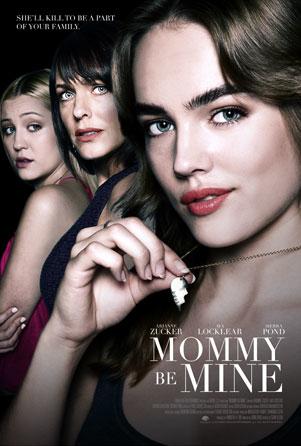
What Lisa Watched Last Night #180: Mommy Be Mine (dir by Sean Olson)


On Friday night, I watched the latest Lifetime premiere, Mommy Be Mine!

Why Was I Watching It?

Finally, I’m healthy again!  After spending two freaking weeks getting my ass kicked by allergy season, I finally feel as if I can start writing about and reviewing movies again.  Obviously, after being knocked out for two weeks, I’ve got a lot to get caught up on so I decided what better way to start than to watch the Friday premiere of the latest Lifetime film, Mommy Be Mine?

What Was It About?

It’s Cara’s (Sierra Pond) first day at school and she already has a friend!  In fact, Cara has decided that Summer (Ava Locklear) is her best friend, despite the fact that 1) Cara has only known her for a day and 2) Summer already has a best friend, the wonderfully sarcastic Tori (Megan McGown).

Still, Cara is determined to not only make Summer like her but to also become a surrogate daughter to Cara’s mother, Lianne (Arianne Zucker).  In fact, Cara even starts to call Lianne “mom.”  Everyone agrees that’s kind of creepy but Cara seems like such a nice girl.  I mean, it’s not like she’s actually a psychotic killer who has killed in the past and who is planning on killing again…

Or is she!?

What Worked?

Sierra Pond did a good job as the scheming psycho.  It was obvious that she was having fun playing the role and, as a result, it was fun to watch her perform.  As well, Arianne Zucker was sympathetic as the overprotective mother.  When she finally snapped and told off Cara, it was a great moment.

What Did Not Work?

Usually, I have little trouble suspending my disbelief when it comes to a Lifetime film.  Lifetime films are specifically designed to be melodramatic and just a little bit silly.  That’s what makes them so much fun.  If the characters didn’t always do the stupidest possible thing, the viewer would miss out on the fun of yelling, “Oh my God, you’re so stupid!”

That said, even by the standards of Lifetime, Cara was a bit too obviously insane.  That’s not to say that Seirra Pond didn’t do a good job playing the role.  She appeared to be having a lot of fun with the role.  But, as a character, Cara was so obviously messed up that it was hard to sympathize with anyone who would actually be stupid enough to allow her into their house.  The minute she started calling Lianne “mom” should have been the minute that both Lianne and Summer announced, “Okay, time for you to go away now!”

As good as the rest of the cast was, Ava Locklear sometimes seemed to be lost in the role of Summer.  This was her first leading role and, in some scenes, her inexperience definitely showed.

“Oh my God!  Just like me!” Moments

As always, I totally related to the sarcastic (if obviously doomed) best friend.  From the minute that she first met Cara, Tori not only knew that she was up to no good but she had no hesitation about sharing that opinion.  Unfortunately, characters in Lifetime films never seem to listen to their sarcastic best friend until it’s too late.  Sarcastic best friends always end up dying a little after the one hour mark and it’s a shame.

Lessons Learned

Seriously, if your oldest friend in the world says your newest friend is a psycho bitch, don’t question the conclusion.  Trust the voice of experience.